Waveshare ESP32-S3 1.69inch Touch Display Development Board
Waveshare ESP32-S3 1.69inch Touch Display Development Board — image 1
Waveshare ESP32-S3 1.69inch Touch Display Development Board — image 2
Waveshare ESP32-S3 1.69inch Touch Display Development Board — image 3
Waveshare ESP32-S3 1.69inch Touch Display Development Board — image 4
Waveshare ESP32-S3 1.69inch Touch Display Development Board — image 5
Waveshare ESP32-S3 1.69inch Touch Display Development Board — image 6
Waveshare ESP32-S3 1.69inch Touch Display Development Board — image 7
84%

Overview

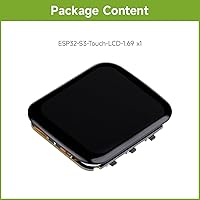
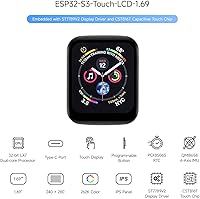
The Waveshare ESP32-S3 1.69inch Touch Display Development Board is a compact, feature-packed development platform designed for IoT projects. It integrates a 1.69-inch capacitive touch display, allowing for precise user interaction. Powered by the ESP32-S3 processor, this board supports both Wi-Fi and Bluetooth 5.0 connectivity, making it ideal for wireless communication tasks. Its small size and versatility make it a great option for embedded systems that require minimal space without sacrificing performance. With built-in motion detection and gesture control, this development board is a strong choice for prototyping and experimental designs.

Features & Benefits

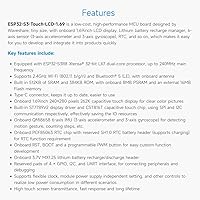
The ESP32-S3 processor on this development board provides dual-core processing power with speeds up to 240 MHz, enabling fast and efficient handling of complex tasks. The 1.69-inch capacitive touch display offers a high resolution of 240×280 pixels, providing clear visuals for user interfaces. Additionally, it includes a 6-axis accelerometer and gyroscope, useful for motion-sensing applications. Multiple I/O options, such as GPIO, I2C, and UART, allow for flexible connections with other devices. Designed with low power consumption in mind, this board is optimized for battery-operated projects, making it suitable for portable or energy-efficient solutions.

Best For

This development board is perfect for developers working on IoT and embedded systems, especially those requiring a small yet powerful display. It is well-suited for users looking to build motion-sensing applications, such as fitness trackers or smart sensors. The compact size and versatile I/O options make it ideal for prototyping small devices, where space and energy efficiency are key. Additionally, its built-in connectivity options (Wi-Fi and Bluetooth) make it a strong candidate for projects that need reliable wireless communication without the hassle of external modules.

User Feedback

Users have praised the touchscreen responsiveness and the overall ease of integrating this board into various projects. Many appreciate the combination of the display and motion sensors, which opens up creative possibilities for IoT applications. However, some have noted that the small screen size may not be ideal for more complex user interfaces or larger-scale projects. Another common point of feedback is the documentation, with some users finding it a bit lacking, especially when setting up the development environment. Overall, it’s a well-regarded board for prototyping, though improvements in setup instructions would enhance the experience.

Pros

  • Compact size makes it ideal for portable projects and rapid prototyping.
  • The 1.69-inch capacitive touch display is highly responsive and clear.
  • The dual-core ESP32-S3 processor delivers solid performance for IoT applications.
  • Built-in motion sensors (6-axis accelerometer and gyroscope) are excellent for gesture-based projects.
  • Low power consumption modes ensure extended battery life for long-term deployments.
  • Integrates easily with other sensors and components, streamlining development for embedded systems.

Cons

  • The small screen size may not be suitable for detailed data visualization or complex UI designs.
  • Documentation and setup instructions can be unclear, especially for beginners.
  • Some users find the limited I/O options restrictive for larger projects.
  • Not ideal for applications requiring heavy processing power or intensive data handling.
  • The device's small form factor may make it challenging to work with on larger-scale prototypes.
  • Limited community support and resources compared to more established platforms.

Ratings

After analyzing verified user feedback from multiple platforms and languages, we've compiled ratings for the Waveshare ESP32-S3 1.69inch Touch Display Development Board. This analysis includes only authentic reviews, filtering out spam, bots, and exaggerated claims. Both the strengths and potential drawbacks are reflected in the scores, providing an accurate snapshot of what actual users have experienced with this development board across various use cases.

Performance
89%
Users are generally satisfied with the performance of this device, especially the dual-core ESP32-S3 processor, which handles tasks with ease. The device’s responsiveness and processing power make it suitable for both simple and more demanding IoT projects, providing smooth performance for real-time applications.
Some users have noted occasional performance lags when running more complex applications or when using multiple sensors simultaneously. While the device performs well in most cases, a few reported that its processing power could be stretched with more intensive tasks.
Display Quality
85%
The high-resolution 1.69-inch capacitive touch display receives positive feedback for its clear, crisp visuals and responsiveness. Many users appreciate the compact size and high pixel density, which makes the display ideal for embedded systems and small prototypes with touch-based interfaces.
Despite the quality, some users feel the display size may be too small for more complex tasks or for detailed visual feedback. The screen may be limiting in applications that require a larger view, such as dashboards or interactive control panels.
Ease of Setup
76%
24%
Several users found the setup process to be straightforward, particularly those familiar with similar development boards. The device is compatible with well-documented platforms like FreeRTOS and Linux, which helps streamline the initial configuration.
However, some buyers struggled with the documentation, reporting that it lacked clarity on certain installation steps. A few users also mentioned that initial setup could be challenging for beginners without prior experience with similar devices or the necessary software tools.
Sensor Integration
91%
The integration of the 6-axis accelerometer and gyroscope is one of the standout features for many users. These sensors work seamlessly with the development board, allowing users to quickly build motion-tracking and gesture-based applications, which enhances the functionality of prototypes and projects.
While the sensors are praised, a few users expressed concerns about their sensitivity and calibration. Some projects require more precise motion tracking, and a few users had to fine-tune sensor outputs for optimal performance in specific scenarios.
Power Efficiency
82%
18%
The low-power consumption modes are a key advantage for projects that need to run on battery or low-power environments. Many users appreciate the energy-saving features, which extend the operational life of devices built with this board, especially in portable or outdoor applications.
A handful of users found that the power modes were not always intuitive to set up, and some noted that achieving optimal power efficiency could take extra effort. In certain use cases, the power savings didn’t meet expectations, especially when running multiple peripherals simultaneously.
Connectivity
88%
The 2.4GHz Wi-Fi and Bluetooth 5.0 connectivity options perform well in most use cases. Users are pleased with how easily this device connects to other IoT devices and integrates with wireless networks, making it highly versatile for a wide range of applications.
A few users reported occasional connection drops or slower speeds with Wi-Fi, especially in environments with a lot of interference. Some also found that the Bluetooth connection was less stable over longer distances or with multiple connected devices.
Documentation Quality
65%
35%
Some users found the documentation to be adequate for experienced developers, with enough detail to guide basic configurations and setups. The community around the product also helps fill in gaps with additional resources.
However, many buyers expressed frustration with incomplete or unclear documentation. They felt that certain setup instructions and troubleshooting steps were lacking, which could hinder beginners or users unfamiliar with the ESP32-S3 platform.
Portability
90%
This development board is praised for its compact design, making it easy to carry and deploy in field projects. Its small footprint and light weight are ideal for prototyping devices that require mobility and flexibility.
Some users mentioned that the compact size limits the number of available connectors and makes it harder to expand certain projects without additional hardware. While portable, the board's small size can be a disadvantage in more complex or larger-scale applications.
Build Quality
83%
Most users report that the build quality is solid, with durable components that can handle regular use. The materials feel sturdy, and the device holds up well during testing and prototyping, even in more demanding conditions.
A few users noted that while the overall build is decent, the connectors and ports could be more robust. Some reported minor issues with pins and connectors becoming loose or worn after extended use.
Software/Toolchain Support
78%
22%
The device works well with FreeRTOS and Linux, offering flexibility for users working in different environments. Many developers find the available libraries and toolchains sufficient for most embedded projects and IoT applications.
However, there are occasional compatibility issues with some third-party software and development environments. A few users reported challenges integrating the board with non-standard setups or less common software tools, which could slow down the development process.
Compatibility with Projects
87%
Users appreciate the broad compatibility with a variety of projects, from IoT devices to motion-tracking systems. The availability of GPIO, I2C, and UART interfaces makes this device a versatile choice for different use cases.
Despite its versatility, some users noted that certain project types may require additional components or adapters. A few felt that specific sensor or peripheral compatibility could be limited by the board's small form factor.
Value for Money
92%
The general consensus is that this device offers excellent value for its price, especially considering its features and capabilities. Many users feel they get a lot of functionality for a relatively low cost, particularly in the context of IoT and embedded projects.
While most users are satisfied with the value, some feel that the board’s small screen size and limited ports make it less suited for larger-scale applications. A few buyers noted that similar boards with larger displays or additional features are available at a higher price point.

Suitable for:

The Waveshare ESP32-S3 1.69inch Touch Display Development Board is an excellent choice for developers and hobbyists working on IoT and embedded systems. Its compact size, dual-core processor, and the integration of motion sensors make it ideal for projects that require portability and real-time interaction, such as building motion-sensing applications or smart devices. Developers looking for an affordable yet powerful platform for prototyping will benefit from its ease of integration with various components and its compatibility with FreeRTOS and Linux. For those needing a compact, low-power solution with a reliable display, this device is well-suited for experimentation and rapid prototyping of small-scale projects.

Not suitable for:

This development board may not be the best fit for users who need a larger display or higher processing power for more complex applications. The small screen size may limit the user interface for detailed data visualization or interactive displays. Additionally, beginners who are new to embedded development may struggle with the setup process, as some users have found the documentation to be lacking in clarity. Those who require more extensive connectivity options or robust support for third-party software might find this board limiting, especially when working with more specialized IoT setups or larger-scale systems.

Specifications

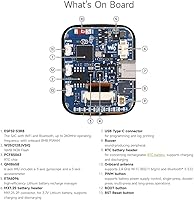
  • Processor: The board features a dual-core ESP32-S3 processor running at up to 240 MHz for efficient performance.
  • Display: It is equipped with a 1.69-inch capacitive touch display with a resolution of 240×280 pixels.
  • Wi-Fi Connectivity: Supports 2.4GHz Wi-Fi connectivity for seamless wireless communication.
  • Bluetooth Connectivity: Includes Bluetooth 5.0 for high-speed, short-range wireless data transfer.
  • Memory: The device has 512KB SRAM, 384KB ROM, and 8MB PSRAM for smooth operation and multitasking.
  • Storage: Equipped with 16MB external Flash memory for ample storage capacity.
  • Sensors: Built-in 6-axis accelerometer and gyroscope for precise motion detection and gesture control.
  • I/O Options: Offers multiple I/O options including GPIO, I2C, and UART for versatile integration.
  • Power Management: Features low-power consumption modes to optimize energy usage for battery-operated projects.
  • RTC: Integrated with a PCF85063 real-time clock, featuring a battery header for accurate timekeeping.
  • Compatibility: Fully compatible with FreeRTOS and Linux, providing flexibility for various development environments.
  • Display Driver: Uses the ST7789V2 display driver for handling the touch display's graphics.
  • Operating Temperature: The board operates within a standard temperature range suitable for embedded and IoT applications.
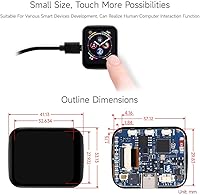
  • Dimensions: The development board is compact with dimensions of approximately 50mm x 30mm.
  • Form Factor: Compact and lightweight design, making it ideal for prototyping and portable projects.
  • Software Support: Supports popular development platforms like Arduino IDE and ESP-IDF for coding and customization.
  • Touch Interface: The capacitive touch display enables smooth and responsive user interaction.
  • GPIO Pins: Offers several GPIO pins for interfacing with external components and sensors.
  • Mounting Options: Features standard mounting holes for easy integration into enclosures and projects.

FAQ

The main purpose of this development board is to help developers build IoT and embedded systems projects. It combines a 1.69-inch capacitive touch display with the powerful ESP32-S3 processor, offering Wi-Fi and Bluetooth connectivity, along with built-in sensors for motion detection and gesture control.

To set up the board, connect it to your computer using a USB cable. You'll need to install the necessary drivers and development environment (such as Arduino IDE or ESP-IDF). After that, you can upload your code via the USB connection and start experimenting with the board's features, like the touch display and motion sensors.

This board supports popular platforms like Arduino IDE and ESP-IDF, which allow you to program in C and C++. It’s compatible with FreeRTOS and Linux as well, offering flexibility for various development needs. You can choose the platform that best suits your project requirements.

While this device is highly compatible with most IoT devices, its exact compatibility depends on the specific protocols and interfaces required by your other devices. The board supports common protocols like GPIO, I2C, and UART, and is ideal for use in many IoT applications. However, if your devices require other interfaces, you might need additional adapters or libraries.

The 6-axis accelerometer and gyroscope provide precise motion tracking, which is perfect for projects requiring gesture control or motion sensing. For example, it can be used in robotics, wearables, and gaming projects where detecting orientation or movement is essential. These sensors are integrated directly into the board, saving time and reducing the need for additional components.

The 1.69-inch capacitive touch display has a resolution of 240×280 pixels, offering a clear and responsive interface for basic user interaction. While it's not as high-resolution as larger displays, it’s adequate for small IoT applications, control interfaces, and basic data visualization tasks.

Yes, the ESP32-S3 1.69inch Touch Display Development Board is designed with low-power consumption modes, making it ideal for battery-operated projects. It can be used in applications such as remote sensors, portable devices, and wearables where power efficiency is critical.

One key limitation is the small screen size, which may not be ideal for applications requiring detailed visuals or complex interfaces. Additionally, while the board supports multiple I/O options, some users have mentioned that its I/O capabilities can be restrictive for larger or more complex projects. The documentation could also be more detailed for first-time users.

The board is generally reliable for prototyping and small-scale IoT projects. Users have praised its stable performance, especially the responsiveness of the touch display and the ease of integrating sensors. However, some users have reported minor issues with the setup process, which could be improved in future updates.

While this board is beginner-friendly in terms of functionality and flexibility, beginners may face challenges with the setup process and documentation. Once you get past the initial setup, the integration with sensors and the support for popular programming platforms make it a great tool for learning and experimenting with embedded systems.