LILYGO T-Beam Meshtastic 915MHz
Overview
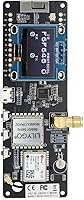
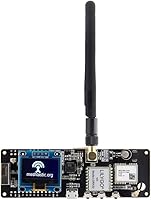
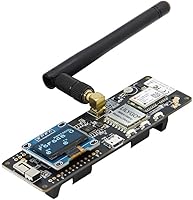
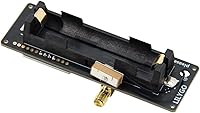
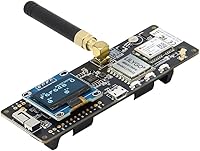
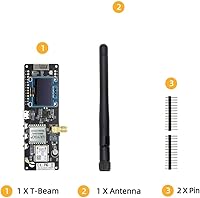
The LILYGO T-Beam Meshtastic 915MHz is one of the most complete ready-to-run nodes you can buy for building an off-grid mesh network. Meshtastic is an open-source protocol that lets devices relay text messages across long distances without cellular or internet infrastructure — think of it as a decentralized radio chat network. The 915MHz frequency band is the right choice for North America and Australia, offering a solid balance of range and signal penetration. What sets this T-Beam board apart from bare-board alternatives is the pre-soldered OLED display, which means you can check node status the moment you power it up, no extra wiring required.
Features & Benefits
At the core of this LoRa development board sits an ESP32 dual-core MCU paired with both WiFi and Bluetooth 4.2, so connecting it to the Meshtastic mobile app is straightforward. The SX1276 LoRa chip handles the long-range radio side, transmitting data at low power — useful when running on a battery pack in the field. A NEO-6M GPS module with an RTC backup battery keeps positioning data alive between power cycles, which matters for tracking applications. The CH9102F serial chip means flashing firmware requires nothing beyond a standard USB cable. Rounding things out, 8MB of PSRAM and 4MB of Flash give the firmware enough breathing room to handle complex mesh routing without hitting memory limits.
Best For
This T-Beam board hits its stride in scenarios where cellular coverage is absent or unreliable. Hikers and backcountry groups are the obvious fit — the combination of LoRa mesh and GPS tracking is hard to beat for group coordination on a trail. Disaster preparedness teams will also appreciate a node that deploys quickly with minimal setup. On the maker side, developers already working in the ESP32 ecosystem will find the hardware familiar, and the extra RAM makes it viable for more ambitious firmware experiments. It also works well as a foundation for remote asset tracking prototypes where both position data and wireless messaging need to travel over the same compact device.
User Feedback
Buyers consistently praise the pre-assembled OLED and the fact that this Meshtastic node arrives ready to flash rather than requiring soldering work. Real-world LoRa range reports vary considerably — open terrain users report impressive distances, while urban testers note the expected signal attenuation from buildings. A recurring friction point is Windows driver installation for the CH9102F chip; first-time users often need to install the driver manually before the board is even recognized. GPS cold-start delays come up regularly too, though LILYGO's GPS Reset firmware helps. One genuine source of confusion is the antenna setup: the onboard WiFi antenna and the IPEX connector cannot run simultaneously, and that constraint is easy to overlook.
Pros
- All major radios — LoRa, GPS, WiFi, and BLE — are integrated on a single board, eliminating multi-module sourcing headaches.
- The pre-soldered OLED display shows node status immediately on power-up, no extra wiring or components required.
- 915MHz frequency is the correct band for North America and Australia, offering strong range and obstacle penetration.
- The NEO-6M GPS retains almanac data via an RTC coin cell, making subsequent location fixes noticeably faster.
- 8MB PSRAM gives the Meshtastic firmware genuine breathing room for complex mesh routing and future feature additions.
- One of the largest community ecosystems in the Meshtastic hardware space means most problems are already documented and solved.
- Pairs cleanly with the Meshtastic mobile app over Bluetooth, enabling phone-based node management without a tethered laptop.
- Open-terrain LoRa range regularly impresses users who deploy this LoRa development board in rural or wilderness settings.
Cons
- CH9102F driver installation on Windows is a recurring stumbling block that the product documentation does not adequately address.
- GPS cold-start delays of several minutes are common, particularly indoors or under heavy cloud cover.
- The onboard and IPEX antennas cannot be used simultaneously, but this critical constraint is easy to overlook without careful reading.
- Urban LoRa range falls well short of open-terrain performance, which catches city-based buyers off guard.
- Firmware flashing and initial configuration require a meaningful time investment that can frustrate less experienced users.
- Unit-to-unit quality consistency is not perfectly reliable; a small but notable percentage of buyers report minor hardware issues out of the box.
- Running GPS, LoRa, WiFi, and BLE concurrently drains battery faster than many field deployment scenarios can comfortably sustain.
- Official documentation bundled with or linked from the product listing is sparse, pushing new users toward scattered community resources.
Ratings
The LILYGO T-Beam Meshtastic 915MHz has been put through its paces by a wide range of buyers — from weekend hikers to embedded systems developers — and our AI-driven scoring model has processed verified global reviews, actively filtering out incentivized and bot-generated submissions to surface what real users actually experience. The scores below reflect both the genuine strengths that make this board a popular choice in the Meshtastic community and the friction points that have frustrated buyers enough to mention them repeatedly. Nothing is glossed over.
Out-of-Box Readiness
LoRa Range Performance
GPS Accuracy & Reliability
Firmware Setup & Flashing
Build Quality & Hardware Integration
Antenna Configuration
ESP32 Ecosystem Compatibility
Meshtastic App Integration
Power Efficiency
Value for Money
Documentation & Support
Physical Size & Portability
Community & Ecosystem Maturity
Suitable for:
The LILYGO T-Beam Meshtastic 915MHz is a strong fit for anyone who needs reliable communication or location tracking in places where cellular networks cannot be counted on. Hikers, trail runners, and backcountry groups will get the most immediate value — the combination of LoRa mesh messaging and onboard GPS means a group can stay coordinated across several miles of open terrain without a cell signal in sight. Disaster preparedness enthusiasts and community emergency response teams will also find this T-Beam board compelling, since a handful of nodes can form a resilient local mesh network that operates entirely off-grid. Amateur radio hobbyists and makers exploring the ESP32 ecosystem will appreciate that the hardware arrives ready to flash rather than requiring a soldering session before anything works. Developers building remote sensor networks or asset-tracking prototypes benefit from having LoRa, GPS, WiFi, and BLE all integrated on one board, eliminating sourcing and compatibility headaches across separate modules.
Not suitable for:
The LILYGO T-Beam Meshtastic 915MHz is not the right choice for buyers who want a truly plug-and-play experience with zero technical overhead. Flashing Meshtastic firmware, installing the CH9102F driver on Windows, and understanding the antenna configuration rules all require a baseline of comfort with embedded development — anyone expecting to simply power it on and start messaging will run into friction quickly. Urban users hoping to replicate the open-terrain range figures they read about in community forums should temper their expectations; buildings and interference cut effective range substantially, and the onboard antenna is not optimized for dense environments. This LoRa development board is also not ideal for ultra-compact or wearable projects, since smaller Meshtastic-capable modules exist for size-constrained deployments. Finally, buyers who only need basic GPS tracking without the mesh networking layer may find the feature set overpowered for their use case, and a simpler, purpose-built tracker would serve them better at lower complexity.
Specifications
- MCU: The board is powered by an ESP32 dual-core processor from Espressif, supporting concurrent task execution across wireless communication and application logic.
- Flash Storage: 4MB of onboard Flash memory stores the firmware and application data for Meshtastic or custom ESP32 sketches.
- RAM: 8MB of PSRAM supplements the ESP32's internal memory, providing headroom for complex firmware builds and larger data buffers.
- WiFi: 802.11 b/g/n WiFi is supported via the ESP32's integrated radio, enabling local network connectivity for configuration or MQTT bridging.
- Bluetooth: Bluetooth 4.2 BLE allows the board to pair with the Meshtastic mobile app on Android or iOS for wireless node management.
- LoRa Chip: The SX1276 LoRa transceiver handles long-range, low-power radio communication at the 915MHz frequency band used in North America and Australia.
- LoRa Frequency: Operating at 915MHz, the board is compliant with ISM band regulations in the US, Canada, and Australia, and is not suitable for use in EU regions without modification.
- GPS Module: A NEO-6M GPS module provides real-time positioning data with support for standard NMEA output and an integrated mini ceramic antenna.
- GPS Backup: An RTC coin cell battery retains almanac and clock data between power cycles, improving the speed of subsequent GPS fixes after the first cold start.
- USB-Serial Chip: The CH9102F USB-to-serial chip handles firmware flashing and serial communication via a standard USB cable, though a separate driver installation is required on Windows.
- Display: A factory-soldered OLED module provides a small visual readout of node status, GPS coordinates, and mesh network activity without requiring additional wiring.
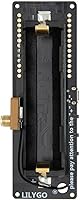
- Antenna Options: The board includes a 3D onboard WiFi antenna and an IPEX connector footprint for an external antenna; these two options are mutually exclusive and cannot be used simultaneously.
- GPS Antenna: A mini ceramic GPS antenna is included in the package and connects to the NEO-6M module to support outdoor positioning in standard clear-sky conditions.
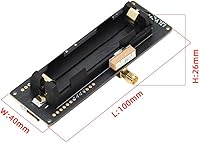
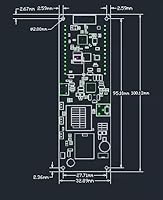
- Weight: The board weighs 2.89 ounces, making it light enough for backpack-based field deployments and portable off-grid communication setups.
- Package Dimensions: The retail package measures 5.91 x 4.76 x 1.42 inches, accommodating the board and included accessories with reasonable protection for shipping.
- Processor Brand: The ESP32 SoC is manufactured by Espressif Systems, a well-established supplier with broad community and toolchain support across Arduino and ESP-IDF environments.
- USB Interface: The board connects to a host computer via USB for firmware flashing and serial monitoring, with the CH9102F chip managing the hardware-level communication bridge.
- Platform Support: The board is officially supported by the Meshtastic open-source firmware project, with pre-built binaries and configuration documentation maintained on the project's GitHub repository.
Related Reviews
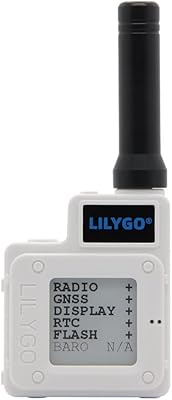
LILYGO T-Echo 915MHz
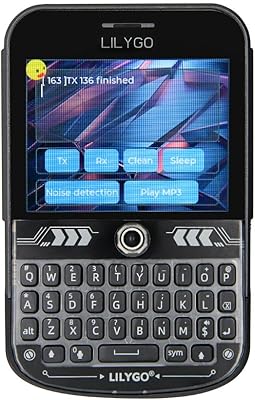
LILYGO T-Deck Plus ESP32-S3 915MHz
LILYGO T-Embed CC1101

Sonos Beam Gen 1 Soundbar
AT&T Turbo Hotspot 3
XREAL Beam Pro 6G+128G AR Companion
UNI-T UT383 Digital Lux Light Meter
Eaglend EH01-T Wired Headset