Overview

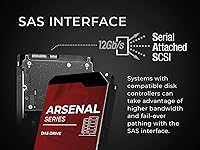
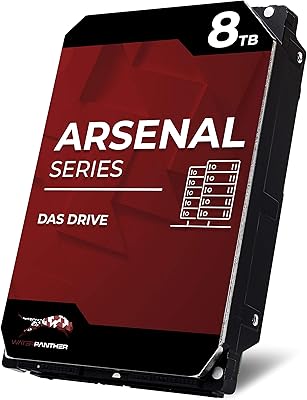
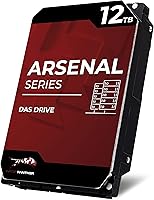
The Water Panther Arsenal 12TB SAS Hard Drive is an enterprise-class direct-attached storage drive built for businesses that need high-capacity, dependable storage without paying tier-1 brand premiums. Quick clarification on the interface: SAS (Serial Attached SCSI) is not interchangeable with the SATA ports found in most desktop systems — you need a SAS-capable disk controller to use this drive, full stop. Water Panther isn't a household name like Seagate or Western Digital, and that will reasonably give some buyers pause. Still, the specs are solid on paper, the 3.5-inch form factor fits standard JBOD enclosures and disk shelves cleanly, and the 4.4-star average across 64 ratings suggests the people actually deploying these in racks are largely satisfied.
Features & Benefits

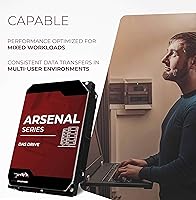
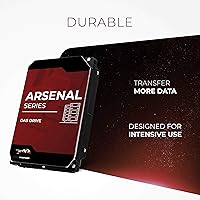
The Arsenal 12TB drive uses CMR recording technology, which matters more than it might seem — unlike SMR drives that can stall during RAID rebuilds, CMR handles sequential writes predictably and consistently. Spinning at 7,200 RPM with a minimum sustained transfer rate of 220 MB/s, this enterprise HDD can move a terabyte of data in roughly 75 minutes, which is meaningful when you're scheduling overnight backups or rebuilding a degraded array. A 256MB cache buffer keeps latency from spiking during sustained I/O bursts. The 500TB/year workload rating — about three times what typical NAS drives are rated for — and a 2 million hour MTBF figure make the durability case clear for always-on server use.

Best For

This SAS hard drive is a natural fit for IT administrators who need to replace failed drives in existing SAS-based RAID arrays or JBOD enclosures without overpaying for a brand-name replacement. Small and mid-sized businesses building out direct-attached storage infrastructure will also find it compelling, especially when managing cost per terabyte matters at scale. Home lab users running Linux with an SAS HBA card are another solid audience. That said, be clear-eyed about the limitations: if your system only has SATA ports, this drive will not work — no adapter will bridge that gap. It's not designed for standalone NAS enclosures or consumer hardware either.

User Feedback

With 64 ratings and a 4.4-star score, the feedback picture is positive but limited — that sample size isn't large enough to draw sweeping conclusions. Among those who have reviewed this enterprise HDD, the drop-in compatibility with existing SAS enclosures and consistent real-world transfer speeds draw the most praise. Buyers replacing drives in production RAID arrays report it spinning up without issue. On the less encouraging side, some reviewers express hesitation about warranty and RMA support from a lesser-known brand — a fair concern if you're relying on these in a critical environment. Noise and heat under sustained load are occasionally mentioned, though no pattern of serious complaints emerges from the available data.

Pros

  • CMR recording technology ensures predictable sequential write performance and stable RAID rebuild behavior.
  • The 500TB/year workload rating is roughly three times what consumer NAS drives are built to handle.
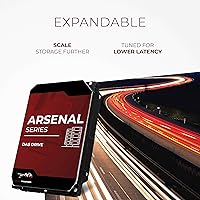
  • A 256MB cache buffer keeps I/O latency manageable during heavy multi-drive workloads.
  • At 220 MB/s minimum transfer speeds, moving large backup sets or rebuilding degraded arrays is reasonably fast.
  • The 2 million hour MTBF rating puts this SAS hard drive in the same durability conversation as established enterprise options.
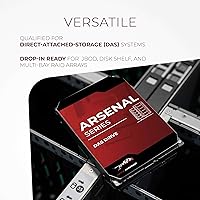
  • Drop-in compatibility with standard JBOD enclosures and disk shelves means minimal setup friction for existing SAS infrastructure.
  • Native Command Queuing helps the drive handle multi-threaded requests efficiently in demanding server environments.
  • 12TB capacity at this price point offers a competitive cost-per-terabyte for organizations expanding bulk storage.
  • The 3.5-inch form factor fits virtually every enterprise server chassis and disk shelf without adapters.
  • Buyers with existing SAS arrays report consistent real-world speeds that align reasonably well with stated specs.

Cons

  • Water Panther is a lesser-known brand, and long-term warranty support and RMA reliability are hard to verify at scale.
  • The review pool of 64 ratings is thin — not enough data to confidently assess failure rates or longevity trends.
  • SAS controller dependency is a strict hard requirement, making this drive useless in most consumer or prosumer setups.
  • No publicly detailed warranty terms are prominently documented, which is a legitimate concern for business-critical deployments.
  • Heat and noise output under sustained load have been noted by some users, which matters in dense multi-drive configurations.
  • Sourcing replacement drives from a niche brand could become difficult if the product line is discontinued.
  • The Arsenal 12TB drive offers no SSD-tier performance — latency-sensitive workloads will expose the mechanical speed ceiling quickly.
  • Limited third-party reviews outside Amazon make independent validation of the brand's reliability claims difficult.
  • Organizations standardized on Seagate or WD may face procurement resistance when introducing an unfamiliar vendor into production arrays.

Ratings

Our scores for the Water Panther Arsenal 12TB SAS Hard Drive were generated by AI after analyzing verified buyer reviews from global sources, with spam, incentivized, and bot-generated feedback actively filtered out before scoring. Each category below reflects both the genuine strengths buyers experience in real deployments and the friction points that surfaced repeatedly across the review pool. Nothing has been softened — the scores reflect what the data actually shows.
Value for Money
83%
Buyers consistently note that the per-terabyte cost sits well below what Seagate and WD charge for equivalent enterprise SAS drives, making it attractive for IT teams building out storage capacity on a constrained budget. For organizations adding multiple drives to an existing array, those savings add up quickly.
The value equation gets murkier when you factor in uncertainty around warranty support and long-term brand viability. If a drive fails and the RMA process proves slow or difficult, the initial cost savings can be quickly erased by downtime costs in a production environment.
Read/Write Performance
86%
The 220 MB/s minimum transfer rate holds up in practice according to buyers who have run sustained backup jobs and sequential data migrations. At 7,200 RPM with Native Command Queuing, multi-threaded workloads like concurrent file access in a shared storage environment are handled without noticeable queuing delays.
Performance is solid for a mechanical drive but still subject to the inherent ceiling of spinning media. Users running latency-sensitive workloads — database transactions, VM boot volumes, or high-IOPS applications — will hit that ceiling quickly and should be considering SSD-based storage instead.
Build Quality
81%
19%
The 2 million hour MTBF rating and 500TB/year workload ceiling indicate that these drives are spec'd for continuous operation in demanding rack environments. Buyers who have deployed them in server enclosures report stable performance with no early failure patterns emerging across the available reviews.
With only 64 reviews to draw from, the sample size is too limited to make strong statistical claims about long-term failure rates or manufacturing consistency. It is genuinely difficult to determine whether the absence of widespread failure reports reflects actual reliability or simply insufficient exposure time.
Compatibility
67%
33%
For buyers already operating SAS-based infrastructure, the Arsenal 12TB drive installs cleanly in standard JBOD enclosures and RAID arrays without any reconfiguration. The 512-byte native sector format avoids hidden compatibility headaches with legacy controllers that cannot handle 4K native or 512e drives.
The strict SAS controller requirement locks this drive out of the vast majority of small office and home systems, which rely on SATA-only motherboards and NAS enclosures. The reviews include a handful of cases where buyers ordered without realizing the SAS versus SATA distinction, resulting in frustrating returns.
Workload Endurance
88%
A 500TB/year workload rating makes this enterprise HDD well-suited for environments where drives spin continuously under heavy write cycles — daily full-system backups, active video surveillance archives, or large-scale log storage. Buyers in these scenarios report that the drive handles sustained demands without showing signs of premature wear.
The workload rating is a manufacturer-stated figure, and without a large enough independent review base to validate it over multi-year deployments, buyers are taking some of that figure on faith. Organizations running at or near the ceiling should still maintain proactive drive monitoring and structured replacement cycles.
Brand Trust & Support
54%
46%
Some buyers report no issues getting the drive to perform as expected right out of the box, and in straightforward deployment scenarios, the lack of brand prestige has not translated into product failure. The drive's specifications meet enterprise standards on paper, giving technically savvy buyers a reasonable basis for independent evaluation.
Water Panther is largely absent from the enterprise storage conversations where Seagate, WD, and Toshiba dominate, making it genuinely hard to assess warranty responsiveness and RMA reliability at scale. Several reviewers specifically flag this uncertainty as the primary reason they would hesitate before deploying the drive in a business-critical environment.
Noise Level
63%
37%
In standard rack-mounted server environments with ambient noise from cooling fans and other hardware, the drive's operational sound is largely masked and not flagged as a concern by most buyers in those settings. For conventional data center deployments, acoustic output is generally a non-issue.
In quieter or more confined setups — home labs, small office server rooms, or densely packed enclosures — some users report that the 7,200 RPM spin and seek noise is noticeable during active I/O. This is not unusual for enterprise mechanical drives of this class, but buyers sensitive to acoustics should factor it in.
Heat Management
61%
39%
Buyers running this SAS drive in enclosures with dedicated airflow and proper cooling infrastructure report no thermal-related issues during extended operation. Standard server chassis are typically designed with the thermal profile of enterprise 7,200 RPM drives in mind, so heat is manageable in purpose-built environments.
In high-density configurations with multiple drives packed close together and limited airflow, heat buildup has been noted by some users as worth monitoring. Running these drives without adequate ventilation risks accelerated wear, a concern especially relevant in home lab builds where cooling design is less controlled.
Ease of Installation
84%
Buyers replacing failed drives in existing SAS RAID arrays consistently report that the drive is recognized by controllers immediately and integrates into existing arrays without manual configuration. For anyone already familiar with SAS infrastructure, the physical and logical setup process is genuinely straightforward.
For those newer to SAS hardware, the initial setup requires sourcing and configuring a compatible HBA or RAID controller, which adds cost and complexity before the drive is even installed. Documentation included with the drive is minimal, so first-time SAS users will need to rely on external guides and community resources.
RAID Reliability
82%
18%
The CMR recording technology is the key factor here — buyers report successful RAID 5 and RAID 6 deployments with stable rebuild performance that does not stall or throttle mid-process. Consistent sequential write speeds make rebuild times predictable, which matters when managing a degraded array in a production environment.
RAID rebuild times on 12TB drives are inherently lengthy — often ten or more hours depending on array size and controller speed. Any additional drives in the array showing wear during the rebuild window increase exposure to data loss, making proactive S.M.A.R.T. monitoring essential rather than optional.
Storage Density Value
87%
At 12TB per 3.5-inch bay, the storage density is strong for the price point, particularly for organizations maximizing usable capacity within a fixed number of drive slots. Buyers expanding existing arrays find that this drive meaningfully extends time-to-next-upgrade when replacing lower-capacity units in the same chassis.
As storage technology advances, 12TB no longer sits at the high end of the SAS capacity spectrum, and larger options exist for enclosures that support them. Buyers doing long-term capacity planning should compare per-terabyte costs across higher-capacity alternatives before committing to a multi-drive purchase at this tier.
Cache Efficiency
79%
21%
The 256MB cache buffer provides a meaningful cushion for I/O operations during sustained multi-drive workloads, helping smooth out bursts of read and write requests in busy server environments. Buyers running NFS or iSCSI-based shared storage report that the cache contributes to more consistent response times under moderate concurrent load.
256MB of cache is adequate for typical enterprise sequential workloads but can become a limiting factor during random I/O-heavy scenarios with many simultaneous requests. Heavier multi-tenant storage environments where large numbers of users hit the array concurrently may find this cache size less effective than what higher-end drives in the same class offer.

Suitable for:

The Water Panther Arsenal 12TB SAS Hard Drive is built for people who already operate SAS-based infrastructure and need a cost-conscious way to add capacity or replace failed drives without compromising on workload ratings. IT administrators managing JBOD enclosures, multi-bay RAID arrays, or disk shelves will find the drop-in compatibility and 500TB/year workload rating genuinely practical for always-on server environments. Small and mid-sized businesses watching their storage budget closely will appreciate the cost-per-terabyte value compared to tier-1 alternatives, especially when deploying multiple drives across an expanding storage cluster. Home lab enthusiasts running Linux with an SAS HBA card are also well-served here — the drive's CMR technology and 512-byte native sector format play nicely with most open-source storage platforms. If your environment already speaks SAS, this enterprise HDD deserves a serious look.
Not suitable for:

The Water Panther Arsenal 12TB SAS Hard Drive is firmly off the table for anyone whose system lacks a SAS-capable disk controller — and that covers the vast majority of consumer desktops, laptops, and standard NAS enclosures, which use SATA. There is no passive adapter that bridges the two protocols, so compatibility is a hard requirement, not a preference. Buyers who depend heavily on brand reputation for warranty confidence and RMA peace of mind may also find themselves uneasy, since Water Panther does not carry the same established support infrastructure as Seagate or Western Digital. Organizations running workloads that demand the speed of SSDs should look elsewhere entirely, as no 7,200 RPM mechanical drive can close that gap. If you are building a primary storage array for latency-sensitive applications like databases or virtual machine boot volumes, a faster interface and drive class would serve you better.
Specifications

  • Capacity: This drive provides 12TB of raw storage, suitable for large-scale file, block, and backup workloads in server environments.
  • Interface: It uses a SAS (Serial Attached SCSI) interface running at 12Gb/s, requiring a compatible SAS disk controller in the host system.
  • Form Factor: The 3.5-inch form factor fits standard server chassis, JBOD enclosures, disk shelves, and multi-bay RAID arrays without modification.
  • Rotational Speed: The spindle operates at 7,200 RPM, a standard enterprise mechanical drive speed that balances throughput and power consumption.
  • Cache Buffer: A 256MB cache buffer reduces latency spikes during sustained I/O operations, particularly beneficial in multi-drive array configurations.
  • Transfer Rate: The drive is rated for a minimum sustained data transfer rate of 220 MB/s, allowing roughly one terabyte to be moved in under 80 minutes.
  • Workload Rating: The annual workload rating is 500TB per year, approximately three times the rated capacity of typical consumer NAS drives.
  • MTBF: Mean Time Between Failures is rated at 2 million hours, reflecting an enterprise-class expectation for drive longevity in always-on deployments.
  • Recording Tech: Conventional Magnetic Recording (CMR) is used, ensuring stable sequential write performance and reliable behavior during RAID array rebuilds.
  • Sector Format: The drive uses a 512-byte native sector format, offering broad compatibility with legacy and modern enterprise storage controllers and operating systems.
  • Command Queuing: Native Command Queuing (NCQ) is supported, allowing the drive to reorder and optimize multiple simultaneous read/write requests for improved throughput.
  • Installation Type: This is an internal hard drive designed for permanent installation inside a server chassis or compatible enclosure, not an external plug-and-play device.
  • Compatible Devices: Officially compatible with servers, JBOD enclosures, disk shelves, and multi-bay RAID arrays equipped with SAS-capable host bus adapters or disk controllers.
  • Platform Support: The drive is documented as compatible with Linux-based hardware platforms, though it functions at the block device level and is broadly OS-agnostic with proper SAS controllers.
  • Dimensions: Physical dimensions are 10 x 7 x 3 inches, consistent with standard 3.5-inch enterprise hard drive sizing.
  • Weight: The drive weighs 1.5 pounds, typical for a 3.5-inch mechanical hard drive of this capacity class.

Related Reviews

Water Panther Arsenal 8TB SAS Hard Drive
79%
93%
Workload Endurance
88%
Transfer Performance
91%
Reliability & Build
54%
Compatibility Clarity
86%
Thermal Performance
More
Kinhank KHD-12T 12TB Retro Gaming Hard Drive
65%
88%
Game Library Size
83%
Emulator Coverage
79%
Frontend Interface
74%
Setup Experience
61%
3D Game Performance
More
Seagate Exos X14 12TB Hard Drive
88%
91%
Performance
94%
Reliability & Durability
88%
Value for Money
89%
Energy Efficiency
92%
Build Quality
More
Seagate Expansion 12TB Portable External Hard Drive
70%
94%
Storage Capacity
82%
Value for Money
91%
Ease of Setup
48%
Portability
61%
Long-term Reliability
More
WD Red Plus 12TB NAS Internal Hard Drive
83%
93%
Recording Technology
91%
RAID Compatibility
92%
NAS Compatibility
86%
Sustained Performance
61%
Noise & Vibration
More
Seagate IronWolf 12TB NAS Internal Hard Drive
82%
93%
NAS Compatibility
84%
Long-Term Reliability
91%
Data Integrity & CMR Technology
82%
Read/Write Performance
88%
Vibration & Noise Management
More
Toshiba X300 PRO 12TB Internal Hard Drive
79%
88%
Sequential Transfer Speed
93%
Workload Endurance
83%
Reliability & Longevity
79%
Value for Money
61%
Noise & Vibration
More
Toshiba N300 12TB NAS Internal Hard Drive
76%
83%
Reliability & Longevity
81%
Performance Consistency
89%
NAS Compatibility
88%
CMR Recording Quality
62%
Noise & Vibration
More
Glyph BlackBox Pro 12TB External Hard Drive
77%
91%
Build Quality
74%
Transfer Speed
93%
Storage Capacity
88%
Reliability
67%
Value for Money
More
WD 12TB My Book Desktop External Hard Drive
85%
96%
Storage Capacity
88%
Ease of Use
92%
Data Security & Encryption
85%
Performance Speed
78%
Software/Backup Functionality
More

FAQ

Almost certainly not, unless your desktop has a SAS HBA (host bus adapter) card installed. The Water Panther Arsenal 12TB SAS Hard Drive uses a SAS interface, which is physically and electrically different from the SATA ports found in standard consumer motherboards. There is no passive adapter that makes SAS drives work in SATA-only systems.
You need a SAS-capable host bus adapter or a server-grade RAID controller with SAS support — something like an LSI or Broadcom SAS HBA, or a Dell PERC, HP Smart Array, or equivalent. If your system only mentions SATA support in its specs, this drive is not compatible with it.

CMR (Conventional Magnetic Recording) writes data in a straightforward, non-overlapping pattern, which means sustained write performance stays consistent even under heavy load. SMR drives can slow down significantly when the cache fills and the drive has to reorganize data on the platters — a real problem during long RAID rebuilds or continuous backup jobs. For server use, CMR is the right choice.

It means the drive is engineered to handle writing and reading up to 500 terabytes of data per year without being pushed beyond its design limits. To put that in context, running 24/7 backups, video surveillance storage, or an active file server would typically stay well within that ceiling. Consumer and NAS drives are usually rated around 180TB/year, so this enterprise HDD has significantly more headroom.

Most consumer and prosumer NAS enclosures from Synology, QNAP, and similar brands use SATA drive bays, not SAS. Unless you have a model explicitly marketed as SAS-compatible — which are typically aimed at enterprises and carry a much higher price tag — this drive will not fit or function in those units.

Reasonably well, thanks to the CMR recording technology and 220 MB/s minimum transfer rate. A full rebuild of a 12TB drive in a RAID 6 array can still take many hours depending on the array size and controller, but CMR ensures the drive's write speed stays stable throughout the process rather than degrading mid-rebuild the way some SMR drives do.

That is a fair and reasonable thing to ask. Water Panther is not in the same tier as Seagate, Western Digital, or Toshiba in terms of brand recognition or documented track record. The drive's ratings on Amazon are solid at 4.4 stars, but across only 64 reviews — a relatively small sample. If you are deploying these in a mission-critical environment, that brand uncertainty is worth factoring into your decision, especially around warranty support and RMA processes.

Not exactly — MTBF (Mean Time Between Failures) is a statistical reliability metric derived from population-level testing, not a lifespan guarantee for any individual drive. What it tells you is that the drive is built to enterprise durability standards and is rated for continuous operation. You should still maintain current backups and monitor drive health with tools like smartmontools regardless of the MTBF figure.

The listing notes Linux as the hardware platform, but SAS drives operate at the block device level and are broadly compatible with any OS that supports the SAS controller you are using. Windows Server, VMware ESXi, and other enterprise platforms work fine with SAS drives when paired with a supported HBA or RAID controller. The OS-level compatibility is really a function of your controller and its drivers, not the drive itself.

A small number of reviewers have noted that noise and heat are noticeable under sustained load, which is fairly typical for a 7,200 RPM mechanical drive operating in a dense multi-drive enclosure. In a well-ventilated server rack with proper airflow, this generally is not a problem. In a quiet office environment or a poorly ventilated enclosure, you may notice the acoustic and thermal output more than you would with a purpose-built NAS drive designed for lower RPM and quieter operation.