Overview

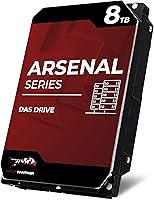
The Water Panther Arsenal 8TB SAS Hard Drive is built for one audience: IT professionals and infrastructure teams who need dependable, high-capacity storage in direct-attached environments. The single most critical thing to understand upfront is the SAS-only interface — this drive will not function in a standard desktop or NAS enclosure without a compatible SAS controller. That one point trips up a surprising number of buyers. At 8TB, it hits a practical capacity sweet spot for dense server builds without pushing into the cost territory of larger enterprise options. Water Panther is not a household name, but the specs and real-world feedback tell a more useful story than brand recognition alone.

Features & Benefits

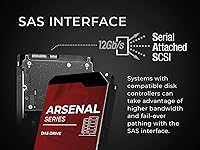
The 12Gb/s SAS interface is the headline spec here, and it earns its place. Paired with 7,200 RPM spindle speed and a guaranteed minimum transfer rate of 220 MB/s, this enterprise HDD keeps pace with workloads that would overwhelm a typical NAS-grade drive. The 256MB cache buffer manages I/O bursts cleanly, which matters in RAID and JBOD setups where multiple drives work in parallel. CMR recording keeps write behavior predictable — no SMR quirks lurking in the background. With a 500TB/year workload rating, that is roughly triple what most NAS drives are rated to handle annually. This is a mechanical drive, not an SSD, but within its intended role it performs with real consistency.

Best For

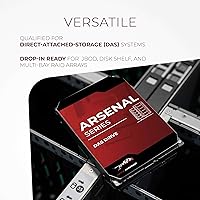
This SAS hard drive makes the most sense for IT admins working within existing SAS-capable infrastructure — think multi-bay RAID enclosures, JBOD shelves, or enterprise disk arrays that already have compatible controllers in place. It is a practical option for businesses swapping out aging drives without wanting to redesign their storage architecture from scratch. Surveillance setups and media production environments that demand sustained sequential write throughput are also strong use cases. For organizations focused on total cost of ownership rather than raw speed, the combination of high capacity, strong endurance ratings, and mechanical reliability makes a solid case compared to SSDs at a significantly higher cost per terabyte.

User Feedback

Buyers who went in with clear expectations tend to rate the Arsenal 8TB drive well — consistent behavior under sustained load is a recurring theme, and several users specifically call out quiet, cool operation in multi-bay enclosures. The less favorable feedback clusters around one issue: buyers who were unaware they needed a dedicated SAS controller before purchasing. That is not a flaw in the drive itself, but it reflects a real gap worth flagging. A handful of reviewers also noted hesitation around Water Panther's brand profile versus Seagate or Western Digital. Those who approached this as a purpose-built enterprise drive rather than a budget add-on largely came away satisfied.

Pros

  • Handles 500TB of annual workload, roughly triple the rated capacity of most NAS-grade drives.
  • The 12Gb/s SAS interface delivers low-latency, high-bandwidth transfers suited for demanding server environments.
  • CMR recording technology keeps write performance predictable — no hidden SMR slowdowns under sustained load.
  • 256MB cache buffer effectively manages I/O bursts in multi-drive RAID and JBOD configurations.
  • Runs cool and quiet in multi-bay enclosures, according to multiple verified buyers.
  • 2-million-hour MTBF rating reflects genuine enterprise durability expectations, not consumer-grade estimates.
  • Drop-in compatible with existing SAS RAID controllers — no reconfiguration required in most setups.
  • At 8TB, this enterprise HDD hits a practical density sweet spot without excessive upfront cost per drive.

Cons

  • Requires a dedicated SAS disk controller — buyers without one cannot use this drive at all.
  • Water Panther is a lesser-known brand, which may raise flags in enterprise procurement or vendor approval processes.
  • No native SATA compatibility limits deployment flexibility compared to dual-interface alternatives.
  • As a mechanical drive, random I/O performance cannot compete with SSD options in latency-sensitive workloads.
  • Limited public track record compared to Seagate Exos or WD Gold drives in the same category.
  • No indication of official enterprise support tiers or SLA-backed warranty service from the manufacturer.
  • Buyers unfamiliar with the SAS ecosystem face a steeper learning curve just to confirm compatibility before purchasing.

Ratings

The scores below reflect AI-synthesized analysis of verified buyer reviews for the Water Panther Arsenal 8TB SAS Hard Drive, drawn from global user feedback with spam, bot-generated, and incentivized reviews actively filtered out. Ratings are calibrated to reflect real-world usage patterns across enterprise IT environments, not idealized lab conditions. Both the strengths that keep infrastructure teams coming back and the friction points that have frustrated unprepared buyers are transparently represented here.

Workload Endurance
93%
Among buyers running this SAS hard drive in high-duty-cycle environments — continuous surveillance recording, dense file server traffic, media ingest — the 500TB/year workload rating holds up in practice. Users consistently note that sustained read/write performance does not degrade the way repurposed NAS drives tend to under similar conditions.
A small number of users flagged that without comparable long-term data from Water Panther specifically, it is harder to validate the MTBF claims against field failure rates the way you can with Seagate or WD drives that have years of community tracking behind them.
Transfer Performance
88%
The 12Gb/s SAS interface paired with 7,200 RPM and a guaranteed 220 MB/s floor means this enterprise HDD handles sustained sequential workloads cleanly. IT admins expanding RAID arrays report that the drive keeps pace with controller throughput without becoming the bottleneck in the chain.
Random I/O performance, as expected from a mechanical drive, is not competitive with SSD alternatives. Workloads demanding low-latency random access — like transactional databases — will find the limits of this drive fairly quickly, which is a fundamental constraint of the technology rather than a specific flaw.
Reliability & Build
91%
The 2-million-hour MTBF rating and CMR recording technology combine to give this drive a credible reliability profile on paper, and real-world user sentiment backs it up. Multiple buyers running the drive in 24/7 multi-bay enclosures report no failures or anomalous behavior after extended periods of heavy use.
Water Panther is a newer entrant without the multi-year failure rate data that enterprise procurement teams often rely on. For risk-averse organizations managing critical data, the absence of a public, independently verified field failure history introduces a degree of uncertainty that established brands do not carry.
Compatibility Clarity
54%
46%
Buyers who arrived with a solid understanding of SAS infrastructure had no compatibility issues whatsoever. The drive drops cleanly into standard 3.5-inch SAS enclosures and cooperates well with LSI and Broadcom-based controllers without requiring unusual configuration steps.
This is the single most complained-about aspect across user reviews. A notable portion of buyers did not realize SAS requires a dedicated host bus adapter or RAID controller — not a standard SATA port — and returned the drive as a result. The listing could do significantly more to surface this requirement before purchase.
Thermal Performance
86%
Users running the Arsenal 8TB drive in populated multi-bay enclosures consistently mention that it runs cooler than expected for a 7,200 RPM mechanical drive. In densely packed disk shelves where thermal management matters, this is a practical advantage that reduces cooling overhead and ambient enclosure temperatures.
Like any mechanical 3.5-inch enterprise drive, it does generate heat under sustained load, and enclosures without adequate airflow will see temperatures climb. This is not unique to this drive, but buyers repurposing non-enterprise chassis should factor in airflow planning before deployment.
Noise Level
82%
18%
For a spinning enterprise drive, noise feedback is mostly positive. Users in server room environments report that the drive blends into the ambient noise floor of a populated rack without standing out, which matters when running multiple drives in a single enclosure around the clock.
It is not a quiet drive by consumer standards, and anyone considering it for an office-adjacent setup without acoustic isolation will notice the operational hum. This is expected for 7,200 RPM mechanical drives but worth knowing if the deployment environment is noise-sensitive.
Value for Money
77%
23%
Measured against the cost per terabyte of comparable SAS enterprise drives from Seagate or WD, the Arsenal 8TB drive sits at a competitive price point. For organizations expanding storage capacity on a constrained budget without wanting to compromise on workload ratings, the value proposition is credible.
Buyers who factor in brand risk, limited public failure history, and the absence of clearly documented enterprise support or SLA options may feel the savings do not fully offset those uncertainties. For some procurement teams, the price delta versus a known brand is not wide enough to justify the gamble.
Setup & Integration
84%
Within SAS-capable infrastructure, setup is genuinely straightforward. The drive registers immediately with compatible controllers, and users replacing aging drives in existing arrays report that the process is as close to drop-in as mechanical drives get — no firmware tinkering or unusual initialization steps required.
The setup experience falls apart entirely for anyone outside the SAS ecosystem. There is no SATA fallback, no adapter solution, and no workaround — if the controller does not speak SAS, the drive simply does not function. For users who discover this after purchase, the setup experience is a dead end.
Cache Efficiency
85%
The 256MB onboard cache buffer handles I/O burst scenarios well, particularly in RAID configurations where multiple drives are working in parallel. Users running RAID 6 arrays across several of these drives note that the cache contributes to smoother write queuing under mixed-load conditions.
In extremely write-intensive burst scenarios — like bulk migration operations pushing the drive hard from a standing start — some users note brief latency spikes before the cache settles. This is common across enterprise HDDs at this tier and not a standout weakness, but it is worth acknowledging.
Brand Confidence
61%
39%
Buyers who evaluated the drive on its specifications and user-reported performance rather than brand recognition came away largely satisfied. The hardware credentials are solid enough to stand on their own for technically informed buyers who are comfortable vetting newer storage vendors independently.
Water Panther simply does not carry the institutional weight of Seagate, WD, or Toshiba in enterprise storage circles. For larger organizations where vendor track record influences purchasing decisions or where IT policies require approved vendor lists, this is a genuine barrier regardless of how the hardware performs in practice.
CMR Write Consistency
89%
CMR recording means write behavior stays predictable even under prolonged heavy load — no rewriting overlapping tracks, no surprise slowdowns mid-operation. IT admins who have previously dealt with SMR drives throttling during large backup windows specifically appreciated this aspect of the Arsenal 8TB drive.
The advantage of CMR is most visible during sustained sequential writes; for lighter, intermittent workloads the distinction from SMR may not be practically noticeable. Buyers in low-utilization environments will see less return on this spec than those running drives at or near workload capacity.
Documentation & Support
58%
42%
The core specifications are clearly documented and accurate based on user experience — what the listing claims about transfer speeds, workload ratings, and cache aligns with what buyers actually observe in deployment, which is a baseline that not all storage vendors meet consistently.
Beyond the spec sheet, documented support resources for Water Panther are thin. Users encountering edge-case compatibility questions or needing warranty guidance have reported difficulty finding clear answers through official channels, which is a meaningful gap for enterprise buyers accustomed to vendor-backed support infrastructure.
Longevity Potential
83%
CMR recording, a high MTBF rating, and a workload ceiling built for continuous enterprise duty cycles collectively suggest a drive with a long viable service life when deployed within its intended parameters. Users treating it as a proper enterprise drive — not a budget substitute — report stable long-term behavior.
Without multi-year population data from Water Panther specifically, it is difficult to project real-world annualized failure rates with confidence. The rated figures are strong, but for drives expected to run for five or more years in critical infrastructure, buyers may prefer vendors with documented replacement programs.

Suitable for:

The Water Panther Arsenal 8TB SAS Hard Drive is squarely aimed at IT professionals and infrastructure teams who already operate SAS-capable environments — think small-to-mid enterprise JBOD shelves, multi-bay RAID arrays, or direct-attached storage enclosures with compatible disk controllers. If you are an admin looking to expand existing SAS storage without redesigning your architecture, this drive drops in cleanly and gets to work. Organizations running high-volume sequential workloads — surveillance systems capturing feeds around the clock, media production houses ingesting large files continuously, or file servers handling heavy departmental traffic — will find the 500TB/year workload rating genuinely meaningful rather than a marketing footnote. Businesses focused on long-term total cost of ownership also have a reasonable case here: at 8TB with CMR recording and a 2-million-hour MTBF rating, this enterprise HDD is built to run hard for years before needing replacement consideration.

Not suitable for:

The Water Panther Arsenal 8TB SAS Hard Drive is the wrong choice for anyone who does not already own a SAS-compatible disk controller — full stop. This is not a plug-and-play drive for home NAS builds, desktop workstations, or consumer-grade enclosures, and mistaking it for one is the single most common source of frustration in user reviews. Home users looking to expand a Synology or QNAP NAS should look at SATA drives instead. Similarly, anyone expecting SSD-level random I/O performance will be disappointed — this SAS hard drive is optimized for sustained throughput in enterprise contexts, not low-latency random access. Buyers who feel uncertain about brand pedigree may also want to weigh options from more established names if procurement policies or support contracts factor into the decision.

Specifications

  • Storage Capacity: This drive offers 8TB of raw storage capacity, suited for high-density enterprise and DAS deployments.
  • Interface: Uses a Serial Attached SCSI (SAS) interface running at 12Gb/s, requiring a compatible SAS host bus adapter or RAID controller.
  • Form Factor: Standard 3.5-inch form factor fits mainstream enterprise disk shelves, JBOD enclosures, and multi-bay RAID arrays.
  • Rotational Speed: Spins at 7,200 RPM, balancing sequential throughput and power draw for sustained enterprise workloads.
  • Cache Buffer: Equipped with at least 256MB of onboard cache memory to manage I/O bursts and improve transfer efficiency.
  • Transfer Rate: Guarantees a minimum sustained data transfer rate of 220 MB/s under normal operating conditions.
  • Workload Rating: Rated for a minimum of 500TB of data written per year, approximately three times the rating of typical NAS-class drives.
  • MTBF Rating: Mean Time Between Failures is rated at a minimum of 2 million hours, reflecting enterprise-grade reliability expectations.
  • Recording Tech: Uses Conventional Magnetic Recording (CMR) technology, which provides consistent and predictable write performance without the drawbacks of SMR.
  • Sector Format: Supports 512-byte sector formatting for broad compatibility with legacy and modern enterprise operating environments.
  • Installation Type: Designed for internal installation only within compatible SAS enclosures, disk shelves, or direct-attached storage systems.
  • Drive Class: Classified as an enterprise-grade Direct Attached Storage (DAS) hard disk drive intended for file and block storage use cases.
  • Model Number: The official Water Panther model identifier for this drive is WPS8T72SAS3DAS.
  • Weight: The drive weighs approximately 1.5 pounds, consistent with standard 3.5-inch enterprise mechanical hard drives.
  • Compatible Systems: Works exclusively with RAID controllers, HBAs, and enclosures that support the SAS interface — SATA-only systems are not compatible.

Related Reviews
Water Panther Arsenal 12TB SAS Hard Drive
76%
83%
Value for Money
86%
Read/Write Performance
81%
Build Quality
67%
Compatibility
88%
Workload Endurance
More
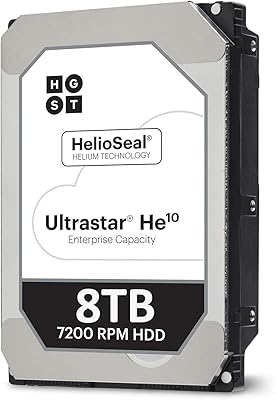
HGST Ultrastar He10 8TB SAS Hard Drive
79%
88%
Build Quality & Reliability
86%
Noise & Heat Management
91%
RAID & SAS Compatibility
83%
Value for Money
58%
Condition Consistency (New vs Recertified)
More
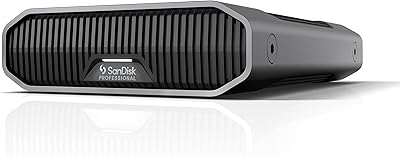
SanDisk Professional 8TB G-Drive External Hard Drive
68%
83%
Transfer Speed
88%
Build Quality
58%
Reliability
91%
Mac Compatibility
41%
Windows Compatibility
More
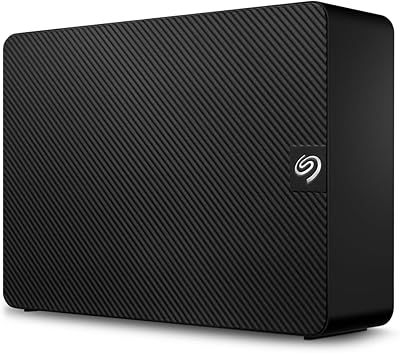
Seagate Expansion 8TB External Hard Drive
71%
91%
Value for Money
93%
Ease of Setup
94%
Storage Capacity
67%
Transfer Speed
72%
Build Quality
More
Seagate SkyHawk 8TB Surveillance Internal Hard Drive
80%
88%
Recording Reliability
84%
Workload Durability
91%
Installation Ease
79%
Multi-Drive Performance
82%
Drive Health Monitoring
More
Toshiba N300 8TB NAS Hard Drive
80%
78%
Long-Term Reliability
81%
Noise & Vibration
93%
NAS Compatibility
83%
Read/Write Performance
86%
Value for Money
More
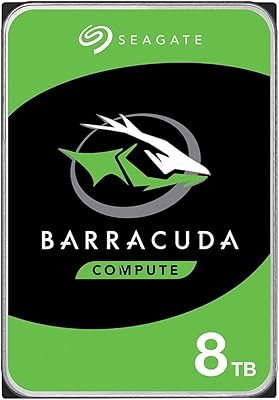
Seagate BarraCuda ST8000DM004 8TB Internal Hard Drive
73%
93%
Storage Capacity Value
67%
Reliability & Longevity
61%
Read & Write Performance
89%
Installation & Compatibility
63%
Noise & Vibration
More
Glyph BlackBox Pro 8TB
79%
92%
Build Quality
89%
Reliability & Uptime
74%
Transfer Speed
94%
Warranty & Support
61%
Value for Money
More
Seagate IronWolf 8TB NAS Internal Hard Drive
88%
88%
Performance
92%
Reliability
85%
Ease of Setup
89%
Data Transfer Speed
94%
Noise Levels
More
Buffalo DriveStation Axis Velocity 8TB External Hard Drive
74%
83%
Transfer Speed
91%
Storage Capacity
88%
Setup & Ease of Use
58%
Noise Level
62%
Heat Management
More

FAQ

No, it will not. Those consumer and prosumer NAS devices use SATA connections, and this is a SAS-only drive. You need a host system with a dedicated SAS controller or HBA to use it. Plugging a SAS drive into a SATA-only bay simply will not work electrically.

You need a SAS host bus adapter (HBA) or a RAID controller that explicitly supports SAS 12Gb/s drives. Cards from LSI, Broadcom, and similar enterprise vendors are common choices. If your current setup only has SATA ports, this drive is not compatible.

Yes, the drive itself is hardware-agnostic at the OS level — compatibility depends on your SAS controller and its drivers, not the drive directly. It has been listed with Linux as its hardware platform, but it functions normally in Windows Server environments with a supported SAS controller as well.

CMR (Conventional Magnetic Recording) writes data in non-overlapping tracks, which means write performance stays consistent even under prolonged, heavy use. SMR drives can slow down significantly during sustained writes because they have to rewrite overlapping tracks. For enterprise workloads where you are writing large amounts of data continuously, CMR is the more dependable choice.

Absolutely. JBOD (Just a Bunch of Disks) is one of the primary intended use cases for this enterprise HDD. As long as your enclosure and controller support SAS, you can run it as a standalone disk within a JBOD shelf without any RAID configuration required.

To put it in perspective, 500TB per year works out to roughly 1.37TB of data written every single day. For most enterprise file servers or surveillance systems, that headroom is more than sufficient. NAS-grade drives are typically rated around 180TB/year, so this drive is built for significantly heavier duty cycles.

It can be, provided the form factor and SAS interface version are compatible with your enclosure. The 3.5-inch form factor and 12Gb/s SAS interface are standard, so it should drop into most existing disk shelves without issue. That said, Water Panther is a newer and less established brand, so if vendor consistency matters for your procurement records, factor that in.

Based on user reports, the Arsenal 8TB drive runs notably cool and quiet in multi-bay setups. At 7,200 RPM it is not silent, but it is not unusually loud for an enterprise mechanical drive either. Proper airflow in your enclosure will keep temperatures well within acceptable range.

Water Panther's warranty terms should be verified directly with the seller or manufacturer at the time of purchase, as they are not prominently detailed in the product listing. The 2-million-hour MTBF rating is a statistical reliability figure, not a guaranteed lifespan. For mission-critical deployments, always maintain redundant arrays and offsite backups regardless of the drive brand.

Yes, this is one of the stronger use cases for this SAS hard drive. Surveillance workloads are typically sequential writes running continuously — exactly the kind of sustained throughput this drive is rated to handle. The 500TB/year workload rating gives you substantial headroom even for multi-camera, high-resolution recording setups, provided the rest of your storage infrastructure supports SAS.