
Overview

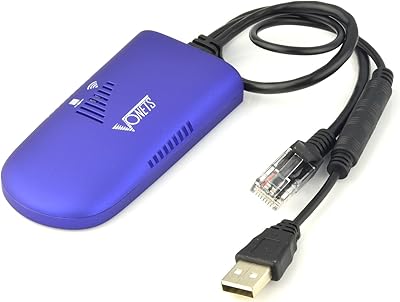
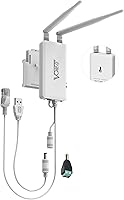
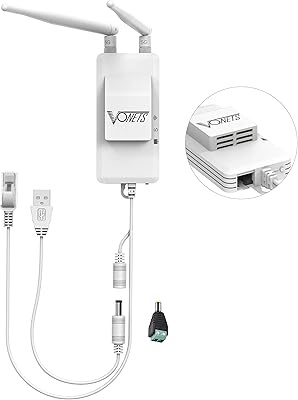
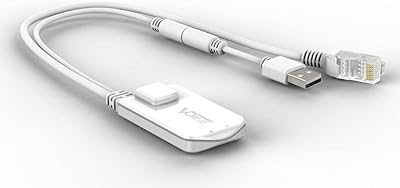
The Vonets VAP11S Industrial WiFi Bridge Router is a compact networking device built for one specific job: connecting wired-only equipment to a WiFi network without laying new cable. Think DVR systems mounted in ceilings, legacy PLCs on a factory floor, or an IP camera tucked in a corner with no Ethernet run nearby. This WiFi bridge occupies a practical middle ground — more capable than a basic consumer extender, far less expensive than enterprise-grade hardware. At just 3.54 x 0.47 x 1.57 inches, it tucks in behind or beside equipment discreetly. The dual RJ45 ports alone distinguish it from most single-port rivals at this price.

Features & Benefits

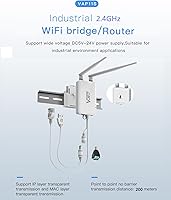
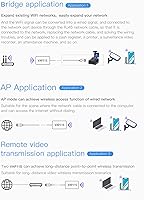
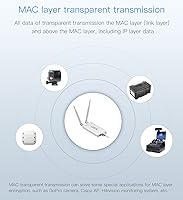
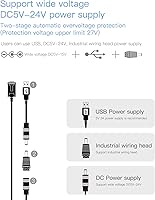
The VAP11S supports three distinct operating modes, and understanding the difference matters. In bridge mode, it passes network traffic transparently — your wired device essentially appears to be on the WiFi network directly. Repeater mode extends the wireless signal's reach. Router mode handles basic NAT and network separation. Power flexibility is a genuine strength: wide voltage input spanning DC 5V to 24V, plus USB, means it works with industrial power rails or a standard phone charger. Two external antennas push transmit power up to 23 dBm, and the claimed 200-meter range is realistic only outdoors with light traffic — expect 50 to 100 meters for video streams in real conditions.

Best For

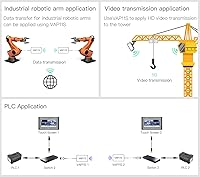
This industrial bridge module is a strong fit for installers and integrators working with equipment that has no native WiFi — think legacy DVR recorders, industrial PLCs, network printers, or IP cameras that only speak Ethernet. It also makes sense for small businesses needing connectivity resilience in electrically unstable environments, thanks to overvoltage protection rated to 27V. The ability to store and auto-connect to up to 100 hotspot profiles is genuinely useful for multi-site deployments. What it is not suited for is home entertainment or gaming — 2.4GHz single-band operation puts a real ceiling on throughput, and anyone expecting strong performance through thick concrete walls may be disappointed.

User Feedback

With a 4.0 out of 5 star average across roughly 94 ratings, the VAP11S earns solid marks from the audience it actually targets. Satisfied users consistently highlight reliable daily operation once the device is properly configured, and many specifically praise it for DVR and IP camera installations. The dual-port design gets frequent mentions from buyers who daisy-chain multiple wired devices. On the flip side, the setup process draws real complaints — the web configuration interface looks outdated, and the English documentation leaves gaps that frustrate first-time users. Range in dense or interference-heavy spaces is another sore spot. It rewards patient, technically capable installers; casual users may struggle.

Pros

  • Dual RJ45 ports let you connect two wired devices simultaneously, a rare feature at this price tier.
  • Wide DC 5V–24V input range plus USB means it runs off almost any available power source on site.
  • Two-stage overvoltage protection up to 27V adds meaningful resilience in industrial or electrically noisy environments.
  • Stores up to 100 hotspot profiles with auto-reconnect, making multi-site or rotating deployments far less tedious.
  • Three operating modes cover most real-world scenarios without needing additional hardware.
  • Compact enough at 3.54 x 0.47 x 1.57 inches to tuck discreetly behind or beside almost any device.
  • Strong track record for DVR and IP camera installs based on consistent user reports.
  • Selectable transmit power up to 23 dBm gives installers some control over range versus interference tradeoffs.
  • Lightweight at 3.17 ounces, so mounting or repositioning requires no special hardware considerations.

Cons

  • Web-based configuration interface is outdated and unintuitive, especially for first-time users.
  • English documentation is poorly translated, leaving real gaps that can stall setup without prior networking experience.
  • Single-band 2.4GHz only — no 5GHz option means higher congestion risk in dense wireless environments.
  • The 200-meter range claim is best-case open-air; concrete walls or interference can cut effective distance dramatically.
  • 300 Mbps is a theoretical maximum — actual throughput for video streams sits meaningfully lower in practice.
  • No mobile app or modern management interface; configuration is entirely browser-based with no remote access.
  • Some buyers report the device occasionally drops its saved hotspot connection and requires a manual reset.
  • Industrial DC connector and mounting kit add bulk to what is otherwise a minimal package, complicating clean installs.

Ratings

The scores below for the Vonets VAP11S Industrial WiFi Bridge Router were generated by our AI engine after analyzing verified buyer reviews worldwide, with spam, bot-submitted, and incentivized feedback actively filtered out. Every category reflects the honest spread of real user experiences — the specific deployment scenarios where this WiFi bridge genuinely delivers value alongside the recurring friction points that hold it back. Both strengths and pain points are weighted transparently, so the numbers you see tell the full story.

Ease of Setup
54%
46%
Once configured correctly, the VAP11S settles into a quiet, reliable routine — installers who have worked through the admin panel once say the device rarely needs attention afterward. For technically inclined users who already know their way around a browser-based router interface, the initial setup is manageable, if not exactly pleasant.
The setup process is the single most complained-about aspect across buyer reviews — the admin panel is visually dated, and the English manual has translation gaps that leave real ambiguity around key configuration steps. First-time users without prior networking experience consistently report spending significantly more time than expected just to get the device online.
Connectivity Reliability
84%
Among users who deploy this for DVR systems and IP camera networks, long-term connection stability is the most frequently praised attribute — many report weeks or months of uninterrupted operation once the initial setup is done correctly. The auto-reconnect function handles routine WiFi disruptions well without manual intervention in most reported cases.
A subset of buyers report occasional drops that require a full power cycle to resolve, which is a real concern for unattended or remote deployments where physical access is not always convenient. Reliability in environments with heavy RF interference or unstable WiFi signals is noticeably more variable than in clean office or home settings.
Value for Money
83%
For installers connecting wired security equipment to WiFi across multiple sites, the cost per deployment is genuinely low — especially given the dual-port design that would otherwise require two separate single-port adapters. Buyers consistently note that it does exactly what it promises without paying for enterprise features they do not need.
Buyers who pick this up expecting plug-and-play simplicity comparable to a consumer WiFi extender will feel the price is less justified given the configuration effort involved. If your use case only ever needs one wired device bridged to WiFi, the cheaper single-port sibling in the same product line covers that job at a lower outlay.
Power Flexibility
91%
The ability to accept anything from a standard 5V USB charger all the way up to a 24V industrial DC rail is a standout feature that makes deployment genuinely flexible across very different environments. Installers working in industrial facilities with dedicated power infrastructure appreciate not needing a separate voltage regulator or power adapter.
While the wide voltage range is excellent, the included USB cable and industrial DC connector can feel like an afterthought in terms of build quality — a minor irritant during installation rather than a functional concern. The ripple specification of under 100mV does require a reasonably clean power source for optimal operation.
Dual-Port Design
87%
Having two active 10/100 Mbps RJ45 ports in a device this compact is a meaningful practical advantage — users daisy-chaining an IP camera to a network switch, or running two separate wired devices off one bridge, report this is the feature that justified choosing the VAP11S over cheaper single-port alternatives.
One of the two ports ships as a 30 cm pigtail cable rather than a flush panel port, which can limit mounting options in tight or rack-style installations where a clean cable run matters. Both ports are capped at 100 Mbps, which is adequate for current use cases but closes the door on future Gigabit-class applications.
Wireless Range
63%
37%
In open-air conditions with minimal obstructions, the selectable 23 dBm transmit power and dual external antennas push effective range well beyond what a typical consumer bridge manages, making it viable for wide industrial spaces or large properties with clear sightlines between the bridge and the access point.
The advertised 200-meter range is a best-case ceiling that real-world buyers rarely approach — through concrete walls or in interference-heavy factories and warehouses, effective range drops considerably. Users deploying for video transmission should work from the more realistic 50 to 100-meter estimate and plan their layouts accordingly.
Throughput Performance
59%
41%
For its intended applications — IP camera feeds, IoT sensor data, PLC communication, and DVR connectivity — the 2.4GHz connection is more than sufficient, and buyers in those use cases rarely cite throughput as a limiting factor. Low-bandwidth industrial data tasks run without meaningful bottlenecks under normal conditions.
The single-band 2.4GHz limitation becomes a real constraint the moment use cases drift toward higher-bandwidth demands — anyone expecting it to handle multiple HD video streams or large file transfers simultaneously will hit throughput ceilings quickly. In congested wireless environments with overlapping networks, actual throughput drops noticeably below even modest expectations.
Operating Mode Range
77%
23%
Three distinct operating modes — transparent bridging, signal repeating, and full router function with NAT — mean this device can adapt to a wider range of deployment scenarios than most competing products in its class. Switching between modes through the admin panel, while not instant, is functional and covers most real-world connectivity needs.
The documentation does not do a great job of explaining the practical difference between MAC-layer and IP-layer bridge modes for users who are not already familiar with those concepts. In practice, many buyers simply default to bridge mode and never explore the full range of options available, partly out of confusion rather than choice.
Auto-Reconnect
82%
18%
The ability to store up to 100 WiFi profiles and auto-match on power-up is a well-executed feature that installers across multiple sites find highly practical — pre-configure once, deploy repeatedly without on-site reconfiguration. Signal strength detection adds further utility for monitoring-focused deployments where connection quality visibility matters.
Auto-reconnect works reliably under normal conditions, but some users report the device does not always recover gracefully after extended power outages or abrupt WiFi disconnections, occasionally requiring a manual power cycle. The reconnect behavior is not fully configurable through the UI, limiting fine-tuned control for critical uptime scenarios.
Build Quality
78%
22%
The unit feels solid and purposefully industrial, with a slim profile that does not feel cheap or fragile in hand. The included industrial DC connector and fixing kit suggest it was designed with repeated installation and physical durability in mind, not just casual desktop or shelf placement.
The external antennas feel less robust than the unit body itself and could be vulnerable in tighter mounting scenarios with repeated handling. There is limited information on operating temperature range, which means buyers deploying it in non-standard thermal environments are taking some risk on long-term component longevity.
Industrial Durability
76%
24%
The two-stage overvoltage protection rated to 27V is a thoughtful design choice for anyone running this off variable industrial power, offering genuine protection against voltage spikes that regularly damage less-protected consumer hardware. The compact solid housing holds up well in standard indoor industrial environments under continuous operation.
There is no published IP rating for dust or moisture resistance, which limits confidence for deployments in outdoor enclosures, dusty factory floors, or high-humidity environments. The absence of a clearly documented operating temperature range also leaves uncertainty for buyers considering extreme-environment installations.
Form Factor
89%
At just 3.54 x 0.47 x 1.57 inches and 3.17 ounces, this is among the most compact WiFi bridges in its class — it tucks neatly behind a DVR, mounts discreetly in a security cabinet, or slots alongside existing equipment without consuming meaningful space. Buyers consistently praise how unobtrusive it is once installed.
The slim profile, while excellent for discreet installs, limits passive heat dissipation — prolonged operation in enclosed or poorly ventilated spaces is worth monitoring, particularly when running at the higher transmit power setting. The external antennas also add to the real-world footprint in ways that the core body dimensions alone do not reflect.
Config Interface
43%
57%
The browser-based admin panel is functional and covers all necessary configuration options without requiring additional software installation — once familiar with the layout, experienced users can complete mode changes or network updates without too much difficulty. All settings are at least accessible, even if the path to them is not always obvious.
The interface design feels like it has not been meaningfully updated in years — cluttered layouts, inconsistent labeling, and navigation that does not follow modern UX conventions make even routine changes feel unnecessarily laborious. This UI alone is responsible for much of the setup frustration reflected in negative reviews from first-time buyers.
Documentation Quality
37%
63%
The core technical specifications are present in the provided documentation, and the product page lists main configuration parameters clearly enough for experienced network installers to work from. Users already familiar with similar Vonets products from prior deployments report less friction since the interface logic carries over between models.
The English translation of the user manual is genuinely poor — ambiguous phrasing on critical setup steps has led multiple buyers to configure the device incorrectly on the first attempt. This is the most consistently criticized aspect across all review sources and has a direct measurable negative impact on the setup experience for new users.

Suitable for:

The Vonets VAP11S Industrial WiFi Bridge Router is purpose-built for anyone who needs to get a wired-only device onto a WiFi network without pulling new Ethernet cable. Security system installers will find it particularly useful — connecting DVRs, IP cameras, and access control panels to an existing wireless network is exactly the scenario this device handles well. Industrial technicians working with PLCs, sensors, or legacy factory equipment that only speaks Ethernet will appreciate both the wide DC voltage input range and the built-in overvoltage protection, which adds real durability in electrically noisy environments. IT integrators managing multiple sites can take advantage of the stored hotspot profiles to pre-configure units before deployment, reducing on-site setup time considerably. IoT builders running low-to-moderate bandwidth applications — think sensor telemetry, remote monitoring, or small-data machine communication — will find the throughput more than adequate for their needs.

Not suitable for:

Anyone hoping to use the Vonets VAP11S Industrial WiFi Bridge Router as a home networking upgrade or entertainment hub will likely come away frustrated. The 2.4GHz single-band limitation means real-world throughput falls well short of what streaming video, online gaming, or large file transfers demand, and congested home WiFi environments will make things worse. Buyers who are not comfortable navigating a dated web-based admin interface — or who lack patience for working through poorly translated documentation — will hit a steep learning curve before the device even functions. The range claims of up to 200 meters should be treated as an ideal-conditions ceiling, not a practical expectation; through concrete walls or in RF-heavy industrial spaces, performance can drop significantly. If a single RJ45 port is sufficient and budget is the primary concern, Vonets' own VAP11G-300 sibling handles basic bridging at a lower price point and may be the smarter pick for simpler setups.

Specifications

  • Brand: Manufactured by Vonets (Shenzhen HouTian Network Communication Technology Co., Ltd.), a brand specializing in compact WiFi bridge and repeater hardware.
  • Model: VAP11S, positioned above the entry-level VAP11G-300 sibling with dual ports, higher transmit power, and broader voltage support.
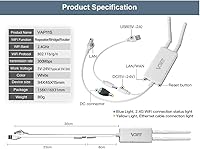
  • WiFi Standard: Supports IEEE 802.11b/g/n on the 2.4GHz band only; no 5GHz or dual-band capability.
  • Max Speed: Theoretical maximum WiFi throughput is 300 Mbps; real-world speeds for video and data applications will be substantially lower.
  • RJ45 Ports: Two adaptive 10/100 Mbps RJ45 Ethernet ports — one standard port and one 30 cm pigtail cable terminated with an RJ45 plug.
  • Transmit Power: Selectable transmit power of either 19 dBm or 23 dBm, allowing installers to balance range against potential interference.
  • Power Input: Accepts wide-range DC input from 5V to 24V (typical 5V/2A, ripple under 100mV) or standard USB power, with an included industrial DC connector.
  • Overvoltage Guard: Two-stage automatic overvoltage protection with an upper protection limit of 27V, designed to safeguard the unit in electrically unstable environments.
  • Antennas: Two external 2.4GHz antennas are included, contributing to the selectable transmit power levels and extended wireless reach.
  • Operating Modes: Supports three modes: WiFi Bridge (MAC Layer or IP Layer transparent transmission), WiFi Repeater for signal extension, and Router mode with WAN uplink and NAT support.
  • Hotspot Memory: Stores up to 100 saved WiFi hotspot profiles with automatic matching and reconnection, including both full-authentication and SSID-plus-password matching methods.
  • Dimensions: Measures 3.54 x 0.47 x 1.57 inches (approximately 90 x 12 x 40 mm), enabling discreet placement alongside or behind connected devices.
  • Weight: Weighs 3.17 ounces (approximately 90g), making it light enough to mount directly on a wall bracket or zip-tie to existing equipment.
  • Frequency Band: Single-band 2.4GHz only; this limits throughput headroom and increases susceptibility to interference in congested wireless environments.
  • Wireless Range: Claimed maximum of 200m in open air with minimal data load; realistic range for video transmission drops to 50–100m depending on obstacles and interference.

Related Reviews
Vonets VAP11S-5G 5GHz WiFi Bridge Router
72%
83%
Bridge Performance
62%
Ease of Setup
81%
Thermal Management
74%
Build Quality
78%
Antenna Signal Quality
More
Vonets VAP11N-300 Mini WiFi Bridge
85%
86%
Performance
91%
Ease of Setup
88%
Power Efficiency
84%
Connectivity Range
90%
Device Compatibility
More
Vonets VAP11G-300 WiFi Bridge Repeater

72%
58%
Ease of Setup
83%
Bridge Mode Performance
67%
Repeater Mode Performance
61%
Wireless Range
71%
Build Quality & Durability
More
Router Guard Large WiFi Router EMF Shield
74%
78%
EMF Shielding Effectiveness
61%
WiFi Signal Impact
84%
Build Quality
96%
Ease of Installation
71%
Router Compatibility
More
NETGEAR R6120 AC1200 Dual Band WiFi Router
74%
92%
Ease of Setup
89%
Value for Money
74%
Wi-Fi Coverage
51%
Wired Ethernet Performance
76%
Wireless Speed
More
Rockspace AC2100 Wi-Fi Router
74%
83%
Value for Money
63%
Wi-Fi Range & Coverage
78%
Multi-Device Performance
88%
Setup & Ease of Use
86%
Wired Connection Quality
More
BrosTrend EAP5 5KM Outdoor WiFi Bridge Kit
80%
91%
Ease of Setup
77%
Wireless Range
83%
Signal Stability
78%
Throughput Performance
86%
Build Quality
More
NETGEAR R6700AXS AX1800 WiFi 6 Router
76%
78%
Wireless Performance
91%
Setup Experience
83%
Multi-Device Handling
86%
Network Security
67%
Coverage Range
More
U-SPEED N300 T1 Pro WiFi Router
70%
88%
Ease of Setup
63%
WiFi Coverage
58%
Wireless Speed
83%
Value for Money
67%
Repeater Performance
More
Linksys MR7350 WiFi 6 Router
76%
91%
Setup & Onboarding
78%
WiFi Speed & Throughput
67%
Coverage & Range
83%
Device Handling & Congestion
72%
App & Remote Management
More

FAQ

The Vonets VAP11S Industrial WiFi Bridge Router acts as a translator between a WiFi network and wired Ethernet devices — it lets a device that only has an Ethernet port connect to your existing wireless network without any new cabling. A typical WiFi extender just rebroadcasts your wireless signal to improve coverage for other WiFi devices. This does something more specific: it gives Ethernet-only hardware a WiFi connection it would otherwise never have.

Yes, and this is honestly one of the strongest use cases for the VAP11S. You plug the Ethernet port of your DVR or IP camera into one of the RJ45 ports on the bridge, configure it once through the browser-based admin panel, and the device appears on your WiFi network. Buyers who use it specifically for security camera setups consistently report solid results.

Some basic familiarity with IP addresses and browser-based router interfaces will save you a lot of frustration. The admin panel works, but it looks dated and the English documentation has some translation gaps that can confuse first-time users. If you have set up a home router before, you will likely manage fine — just budget extra time for the initial configuration and have the manual open on a second screen.

Yes — the device accepts USB power in addition to DC input, so a standard 5V/2A USB charger works perfectly as a power source. This makes it easy to deploy in locations where a dedicated power supply is not available. For industrial environments with variable power rails, the wide DC input range of 5V to 24V gives you even more flexibility.

Treat 200 meters as an absolute best-case ceiling — think open fields, line-of-sight, and minimal data traffic. In real-world conditions like offices, warehouses, or homes with concrete walls, expect significantly shorter effective range. For video streaming specifically, Vonets themselves suggest 50 to 100 meters is a more practical target, and that still assumes reasonably clear signal paths.

Yes, that is one of the key upgrades this model offers over single-port competitors. You can connect two separate wired devices — say, an IP camera and a network switch — simultaneously through the two 10/100 Mbps ports. This is particularly useful when you want to daisy-chain additional equipment without adding another bridge unit.

No — this is strictly a 2.4GHz device. If your router runs a combined network where both bands share the same SSID, make sure the bridge connects to the 2.4GHz band specifically, or it will fail to associate. If your router only broadcasts 5GHz, this device will not work with it at all.

You can pre-save up to 100 different WiFi network credentials on the device. When powered on, it automatically scans for any saved network within range and connects without manual intervention. This is genuinely useful for installers who rotate equipment across multiple sites — you configure all the networks once and the device handles reconnection on its own going forward.

The VAP11G-300 is fine for simple, single-device bridging on a tighter budget. The VAP11S steps up in a few meaningful ways: two RJ45 ports instead of one, higher transmit power (up to 23 dBm versus roughly 16 dBm), a wider voltage input range that suits industrial power supplies, and the two-stage overvoltage protection. If you only need to bridge one device in a clean home environment, the cheaper model may be sufficient — but for anything more demanding, the VAP11S is worth the difference.

Yes, the device includes an auto-reconnect function that monitors signal strength and attempts to re-establish the WiFi connection if it drops. Most users report this works reliably under normal conditions. That said, a small number of reviewers have noted cases where the device required a manual power cycle to fully recover after a prolonged outage, so it is worth factoring that into any unattended or remote deployment.