Overview

The Topping E50 MQA DAC Decoder sits in a sweet spot for audio hobbyists who have outgrown their first USB stick DAC but aren't ready to spend serious money on flagship separates. At its core, it runs the ES9068AS chip, a newer ESS silicon that measurably outperforms the older ES9038Q2M found in many similarly priced competitors. The unit is compact, draws power straight from any USB port, and handles MQA Full Decode natively — genuinely useful if you subscribe to Tidal HiFi and want the signal unfolded in hardware rather than relying on software. Worth stating upfront: this is a DAC and preamp, not a headphone amplifier.
Features & Benefits

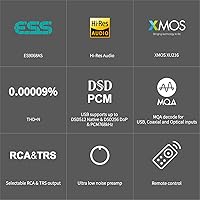
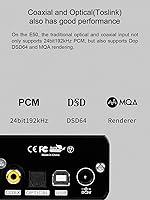
The E50's headline figure is a THD+N that sits below 0.0001% — in practical terms, distortion at that level is simply inaudible in any real listening scenario. The XMOS XU216 interface handles jitter suppression internally via CPLD clock processing, so there's no need for an external reclocker to get clean USB audio. USB handles native DSD512 and PCM up to 768kHz, though optical and coaxial inputs top out at 192kHz PCM. Output options include both balanced TRS and RCA, which gives real flexibility whether you're feeding a headphone amp or a pair of powered monitors. Power comes from any standard 5V USB source, no adapter required.

Best For

This desktop decoder is a strong match for PC audiophiles who already own or plan to buy a dedicated headphone amplifier — it hands off a clean, low-noise signal and stays out of the way. Tidal HiFi subscribers have a specific reason to consider it, since MQA Full Decode happens in hardware, sidestepping the software-unfolding debate entirely. It also works well as a source component feeding powered studio monitors where a neutral, stable output matters more than any added coloration. If you're stepping up from a generic USB DAC and want a measurable, audible improvement without jumping to a significantly higher price bracket, the E50 makes a compelling case.

User Feedback

The most consistent praise across reviews centers on the neutral sound character — owners describe the output as honest and uncolored, which is exactly what you want from a source component. In blind comparisons, a number of buyers found this Topping DAC competitive with units priced noticeably higher. On the critical side, the display and input-selection interface draw occasional complaints; it works, but the UX feels less polished than the internals suggest it could be. A fair number of buyers also wish a basic USB power adapter had been included in the box. Minor ergonomic gripes aside, the overall rating across more than a hundred reviews lands solidly in positive territory.

Pros

  • Distortion levels are so low they are effectively inaudible in any real-world listening scenario.
  • The ES9068AS chip is a genuine step up from older ESS silicon found in many competing units at this price.
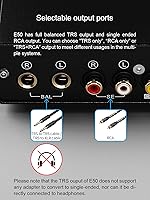
  • Both balanced TRS and unbalanced RCA outputs make it easy to integrate into a wide range of existing setups.
  • Native MQA Full Decode in hardware is a meaningful feature for Tidal HiFi subscribers who want the real thing.
  • USB bus power means you can run the E50 from a laptop, power bank, or phone charger without hunting for an adapter.
  • Auto On/Off across all inputs is a small but genuinely convenient feature for daily desktop use.
  • The noise floor is remarkably low, which matters when pairing with sensitive amplifiers or monitors.
  • A subset of owners found this Topping DAC competitive with units sold at noticeably higher price points in direct comparisons.
  • The compact footprint leaves room on a crowded desk without sacrificing connectivity or output quality.
  • Channel balance is tight, which translates to a stable, centered stereo image over long listening sessions.

Cons

  • No power adapter is included in the box, which is a minor but unnecessary inconvenience for new buyers.
  • The display and input-switching interface feel less refined than the internal hardware quality would suggest.
  • Optical and coaxial inputs are capped at 192kHz PCM, which may frustrate users with high-resolution digital sources beyond USB.
  • There is no headphone output, so this unit is useless as a standalone solution without a separate amp.
  • MQA as a format remains debated in the audiophile community, so that feature may hold no value depending on your perspective.
  • The unit does not include any bundled cables, so factor in additional accessory costs when budgeting.
  • At roughly 1.72 pounds, it is light enough to shift around on a desk if cables pull at it without being secured.
  • Users who prefer a warmer or more tonally colored sound will find the neutral tuning unsatisfying by design.

Ratings

The Topping E50 MQA DAC Decoder has been scored below by our AI system after analyzing verified global user reviews, actively filtering out spam, bot activity, and incentivized feedback to surface only genuine buyer experiences. Scores reflect a balanced synthesis of what real owners praised and where they ran into friction, so both the strengths and the honest shortcomings are represented without bias.
Sound Quality
93%
Owners consistently describe the output as clean, neutral, and transparent — exactly what you want when the DAC is feeding a quality amplifier. Several users who ran informal blind comparisons against units priced significantly higher found the E50 held its ground convincingly, particularly in terms of background silence and stereo separation.
A minority of listeners who prefer a warmer, more forgiving presentation find the neutrality somewhat clinical for long sessions with bright recordings. The E50 makes no attempt to flatter the source material, which is a feature for measurement-oriented buyers but a mild frustration for those chasing a more musical coloration.
Distortion & Noise Performance
96%
The measured performance here is genuinely exceptional for the price tier. A THD+N figure below 0.0001% and a noise floor under 1.3 microvolts mean that in practice, the unit adds nothing audible to the signal — a quality that becomes immediately apparent when pairing it with sensitive in-ear monitors through a good amp.
At this level of performance the numbers are largely academic for most listeners, and a handful of users noted they could not perceive any real-world difference versus slightly cheaper competitors in their specific systems. The gains are most meaningful in high-resolving setups; more modest systems will not reveal the full gap.
MQA Decoding
78%
22%
For Tidal HiFi subscribers, hardware MQA Full Decode is a genuine differentiator. Users who switched from software-only unfolding in desktop apps report a noticeably more complete decoding handshake, and the process is automatic once the unit is recognized by the player.
MQA as a format remains contested in the broader audiophile community, which limits how universally this feature is valued. Users on Qobuz, Apple Music, or other lossless platforms gain nothing from it, and a portion of buyers consider it a neutral-at-best addition rather than a meaningful reason to choose the unit.
Connectivity & Compatibility
88%
The combination of USB, optical, and coaxial inputs alongside both balanced TRS and unbalanced RCA outputs covers the majority of real desktop and semi-portable setups without requiring adapters. Android OTG users and PC audiophiles alike report reliable plug-and-play behavior once the XMOS driver is installed on Windows.
Optical and coaxial inputs are capped at 192kHz PCM, which can be a limitation for users with high-resolution digital sources beyond USB. A small number of iOS users also reported inconsistent behavior depending on the app and adapter combination, requiring some trial and error to confirm stable operation.
Build Quality & Form Factor
82%
18%
The chassis feels solid and well-machined for a unit in this price range, and the compact footprint sits comfortably on most desks without dominating the workspace. Users who have handled other Topping products note a consistent step up in physical quality compared to entry-level competitors at lower price points.
At 1.72 pounds, the unit is light enough that stiff cables can shift it on a smooth desk surface without a non-slip mat underneath. The front panel display, while functional, reads as a cost-saving measure rather than a premium touch, which some owners feel is slightly at odds with the internal component quality.
User Interface & Controls
61%
39%
Once you learn the input-switching logic, day-to-day operation is generally quick, and the auto On/Off feature removes the need to manually manage power in a typical desktop session. Users who set the unit up once and leave it in place rarely interact with the controls beyond volume adjustment.
A recurring complaint across reviews is that the input-selection and menu navigation are not intuitive for first-time setup, requiring a close read of the manual to understand the button combinations. The display font and contrast also drew criticism for being harder to read from typical sitting distances without leaning in.
USB Power Implementation
84%
Drawing power from a standard 5V USB source is genuinely convenient — a laptop port, a phone charger, or even a decent power bank all work reliably. Users who travel or move the unit between rooms particularly appreciate not carrying a proprietary wall adapter.
No power adapter is included in the box, which is a small but real friction point for buyers who do not have a spare USB-A charger or who want to run the unit from a dedicated, isolated power supply. A basic adapter bundled in the box at this price point would be a reasonable expectation.
Driver & Software Experience
71%
29%
On macOS the unit is recognized natively with no driver installation required, which makes initial setup very fast. Linux users with ALSA or PipeWire configurations also report clean detection at high sample rates without manual configuration in most common distributions.
Windows users must install the XMOS USB audio driver manually to unlock DSD and high-rate PCM, and a few users encountered conflicts with existing audio software during installation. The driver download process is not prominently signposted in the packaging, which caused confusion for less experienced buyers.
Auto On/Off Reliability
74%
26%
In standard PCM playback scenarios the auto On/Off behavior is reliable and unobtrusive, making the unit behave like a smart peripheral that does not need babysitting during a typical listening session at a desk.
Several users noted occasional false shutoffs during very quiet passages in DSD streams or when using certain media players that introduce brief inter-track gaps. While not a frequent occurrence, it is disruptive enough when it happens that some owners disable the feature entirely and manage power manually.
Value for Money
87%
Measured against what competing units at the same price deliver in terms of noise floor, distortion, and format support, the E50 consistently comes out ahead in objective terms. Buyers stepping up from a basic USB dongle DAC almost universally describe the improvement as immediately audible and well worth the investment.
Users who do not own a separate headphone amplifier may find the total cost of a functional desktop system higher than expected once an amp is factored in. A small number of buyers also felt the UX shortcomings and missing accessories were noticeable friction points at a price where polish is a reasonable expectation.
High-Resolution Format Support
91%
USB support for PCM up to 768kHz and native DSD512 puts the E50 well ahead of most competitors in raw format headroom. Users who work with high-rate DSD masters or ripped SACDs report clean, stable playback without dropouts or format negotiation issues when paired with compatible software like Roon or foobar2000.
The elevated format ceiling is more relevant to dedicated collectors than to streaming listeners, and some users noted that realizing the benefit requires careful software configuration. Optical and coaxial inputs do not share the same ceiling, which can catch buyers off guard if they planned to use a CD transport or gaming console as a source.
Channel Separation & Stereo Imaging
89%
A crosstalk figure of -130dB at 1kHz translates into a stereo image that feels genuinely wide and well-defined during critical listening, particularly on well-recorded acoustic material. Users who pair the E50 with headphone amplifiers describe noticeably better placement of instruments within the soundstage compared to their previous DACs.
The imaging benefit is most apparent in controlled desktop listening environments and through resolving headphones or nearfield monitors. In less optimized rooms or with entry-level speakers, the improvement over a competent budget DAC is subtle enough that some buyers questioned whether the difference justified the upgrade cost in their specific setup.
Long-Term Reliability
79%
21%
Among owners who have used the E50 for more than six months, reports of hardware failure or degradation are rare, and Topping's broader reputation for consistent build quality gives buyers reasonable confidence in the unit's longevity for daily desktop use.
The sample size of long-term reviews is smaller than for recently purchased units, so reliability data is less conclusive than for the audio performance categories. A few buyers noted that the USB input connector felt less robust than the rear analog jacks after extended plug-and-unplug cycles in semi-portable use.

Suitable for:

The Topping E50 MQA DAC Decoder is built for the kind of listener who has already caught the audio bug and wants their desktop setup to actually reflect that. If you own a dedicated headphone amplifier — or are planning to buy one — this unit slots in as a clean, transparent source that won't add coloration or noise to the chain. Tidal HiFi subscribers in particular get real value here, since native MQA Full Decode in hardware means you're getting the full signal unfold without depending on software or a player that supports it. It also works convincingly as a front-end for powered studio monitors, where a flat, low-distortion output is more useful than any hyped-up sound signature. Even if you just want to step up from the built-in audio on your PC or laptop, the E50 offers a measurable, audible improvement that justifies the move without demanding a major financial commitment.
Not suitable for:

Buyers expecting an all-in-one solution should look elsewhere — the Topping E50 MQA DAC Decoder is strictly a DAC and preamp, so if you need to drive headphones directly, you will need a separate amplifier in the chain. Casual listeners who are happy with Spotify at standard quality and don't have a dedicated amp already will find little practical benefit over a much cheaper USB DAC dongle. If you stream exclusively from platforms that do not support high-resolution or MQA formats, much of what this unit offers technically will go unused. Those who need a self-contained desktop unit with a built-in headphone output should consider alternatives like the Topping DX3 Pro or similar combo units. And if a clean, neutral sound is not your goal — if you prefer a warmer, more colored presentation — this is not the right tool, since the E50 is deliberately engineered to stay out of the way of the signal rather than shape it.
Specifications

  • DAC Chip: The unit uses the ESS ES9068AS, a high-performance converter chip known for its low noise floor and excellent channel separation.
  • USB Interface: Digital USB input is handled by the XMOS XU216 chip, which includes CPLD-based jitter suppression for a clean clock signal without external reclockers.
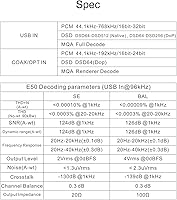
  • PCM Support: USB input supports PCM audio from 44.1kHz up to 768kHz at bit depths between 16-bit and 32-bit.
  • DSD Support: USB input supports native DSD up to DSD512 and DoP up to DSD256; optical and coaxial inputs support DSD64 via DoP only.
  • MQA Decoding: The unit performs MQA Full Decode in hardware, making it compatible with Tidal HiFi streams without relying on software-side unfolding.
  • Optical/Coaxial Input: SPDIF inputs via optical (TOSLINK) and coaxial (RCA) support PCM up to 192kHz at 24-bit and DSD64 over DoP.
  • THD+N: Total harmonic distortion plus noise measures below 0.0001% at 1kHz, indicating an exceptionally clean output signal.
  • Dynamic Range: Dynamic range is rated at 124dB (A-weighted at 1kHz), providing wide headroom between the noise floor and maximum output level.
  • Signal-to-Noise: SNR is rated at 124dB (A-weighted at 1kHz), meaning the unit introduces virtually no audible noise relative to the audio signal.
  • Output Level: Maximum analog output is 2Vrms at 0dBFS, which is standard and compatible with most downstream amplifiers and active monitors.
  • Output Impedance: Analog output impedance is 20 ohms, suitable for driving typical amplifier and preamplifier inputs without signal degradation.
  • Crosstalk: Channel crosstalk is rated at -130dB at 1kHz, ensuring left and right channels remain essentially isolated from each other.
  • Channel Balance: Channel balance is within 0.3dB, which translates to a stable, well-centered stereo image during listening.
  • Noise Floor: Output noise is rated below 1.3 microvolts RMS (A-weighted), making the unit well-suited for pairing with sensitive amplifiers.
  • Power Supply: The unit runs on 5V DC power supplied via USB, compatible with PC USB ports, phone chargers, and power banks; no adapter is included.
  • Analog Outputs: Analog outputs include one pair of unbalanced RCA jacks and one pair of balanced 6.35mm TRS jacks, both active simultaneously.
  • Auto On/Off: All inputs support automatic power-on when a valid signal is detected and auto-shutoff after approximately one minute of signal absence.
  • Dimensions: The unit measures approximately 11.1 x 7.95 x 3.03 inches, making it compact enough for most desktop setups.
  • Weight: The unit weighs 1.72 pounds, light enough for portable or semi-portable use but with enough mass to stay stable on a desk.
  • Frequency Response: Frequency response is rated at 20Hz to 20kHz within plus or minus 0.1dB, and extends to 40kHz within plus or minus 0.3dB.

Related Reviews

Topping D10s Hi-Res USB DAC
82%
89%
Sound Quality
84%
Build Quality
88%
Value for Money
91%
Connectivity & Outputs
78%
Driver & Software Compatibility
More
SMSL M300SE Desktop DAC Headphone Amplifier
81%
91%
Sound Quality
88%
Build Quality
89%
Value for Money
87%
Balanced Output
93%
Hi-Res Audio Support
More
TOP-ENERGY TE2024 DTMB Digital TV Decoder
76%
88%
DTMB Tuner Accuracy
76%
HD Picture Quality
82%
USB Recording
91%
Ease of Setup
58%
Remote Control
More
Topping DX3 Pro+
Topping DX3 Pro+
84%
91%
Sound Quality
88%
Headphone Amplifier Performance
93%
DAC Chip Performance
71%
Bluetooth & Wireless Performance
89%
Input & Output Versatility
More
Topping E30 II lite DAC Preamp
88%
94%
Sound Quality
89%
Value for Money
91%
Ease of Use
85%
Setup/Installation
88%
Build Quality
More
FiiO Q3 MQA Portable DAC Amplifier
80%
88%
Sound Quality
83%
MQA Decoding
86%
Battery Life
81%
Balanced Output Performance
91%
Build Quality
More
AIYIMA DAC-A2
AIYIMA DAC-A2
77%
83%
Sound Clarity Improvement
79%
Tone Controls (Bass & Treble)
86%
Input Versatility
74%
Headphone Amplifier Performance
53%
Build Quality & Materials
More
FX-Audio DAC-X6
FX-Audio DAC-X6
78%
83%
Audio Quality
79%
Headphone Amplifier Power
81%
Build Quality
88%
Input Versatility
61%
USB Audio Resolution
More
iFi Zen DAC V2 Desktop DAC
79%
88%
Sound Quality
91%
Balanced Output Quality
89%
Value for Money
74%
Build Quality
77%
Ease of Setup
More
Slash6 LDAC Bluetooth DAC Headphone Amp
83%
91%
Sound Quality
86%
Bluetooth Connectivity & Range
88%
Build Quality
78%
Value for Money
93%
Compatibility with Vintage Equipment
More

FAQ

You will need a separate headphone amplifier. The Topping E50 MQA DAC Decoder has no built-in headphone output — it outputs an analog signal via RCA or balanced TRS jacks, which are designed to feed an amplifier or powered monitors, not drive headphones directly.
The unit typically ships with a USB-A to USB-B cable for connecting to a computer. On Windows, you will need to install the XMOS USB audio driver to unlock the full range of high-resolution formats; on macOS and Linux, it works natively without additional drivers.

Yes, the E50 supports USB OTG connections, so Android devices with a compatible USB-C or Micro-USB OTG adapter can use it as an external DAC. iOS devices require a Lightning to USB camera adapter or a USB-C to USB-B cable depending on your iPhone model, and compatibility can vary by app.

That depends entirely on your streaming service and your own view of the format. If you subscribe to Tidal HiFi and want hardware-level MQA Full Decode rather than relying on software unfolding, this unit handles it natively. If you do not use Tidal or are skeptical of MQA as a format — a debate that remains active in the audiophile community — the E50 still performs excellently as a straightforward high-resolution DAC regardless.

Generally yes. The E50 runs on standard 5V DC and is designed to handle USB bus power without audible noise issues in most desktop scenarios. If you find ground noise or interference coming from a specific computer, using a USB power bank as an isolated supply is a simple fix.

Both the RCA and TRS outputs are active simultaneously, so you can connect an amplifier to one and powered monitors to the other and use them at the same time without any switching required.

The auto On/Off feature monitors the selected input for a valid audio signal and powers the unit on when one is detected. If no signal is present for about one minute, it powers down automatically. In practice this works well for desktop use, though some users find it occasionally triggers during quiet passages in DSD playback depending on the source setup.

The E50 does include analog volume control, so you can adjust the output level going to powered monitors or an amplifier directly from the unit. It functions as a basic preamp in that sense, though it does not have a remote control, so volume adjustment is done manually via the front panel.

Input selection is done via the front panel controls. The unit also supports auto-input switching, where it will detect and switch to an input that is receiving a valid signal. A few users have noted the switching UX is not the most intuitive to navigate initially, but it becomes straightforward once you are familiar with the control scheme.

The E50 pairs well with most integrated amplifiers, stereo power amps, and dedicated headphone amplifiers that accept a standard line-level RCA or balanced input. Its 2Vrms output level is a standard sensitivity that matches well with common units from Topping, SMSL, Schiit, and similar brands. The balanced TRS output is particularly useful if your amplifier has balanced inputs, as it can offer slightly lower noise in longer cable runs.