Overview

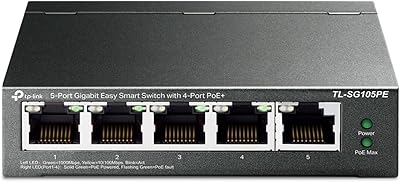
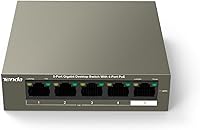
The Tenda TEG1105P 5-Port Gigabit PoE Switch is a no-frills, plug-and-play networking device built for home users and small businesses that need to power IP cameras or access points without the complexity of a managed switch. It packs four PoE+ output ports and one uplink port into a compact all-metal chassis barely 3.93″ wide, all running at full gigabit speeds. The total PoE budget sits at 58W, with up to 30W available per port — enough for most standard IEEE 802.3af/at devices. What makes this PoE switch stand out at its price is the inclusion of a limited lifetime warranty, a feature you rarely see on budget-tier hardware.
Features & Benefits

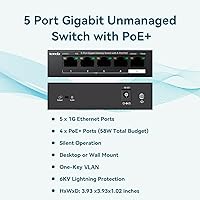
One of the more practical additions on this compact gigabit switch is One-Key VLAN mode, which isolates each PoE port from the others while keeping them all connected to the uplink — a simple but effective way to cut down on broadcast noise and guard against DHCP spoofing without touching any configuration menus. Extend Mode is another useful feature, pushing PoE reach up to 250 meters; just know that beyond the 100-meter mark, speeds drop to 10 Mbps, so it works best for static IP cameras rather than bandwidth-heavy devices. Add in 6KV surge protection, a completely fanless build, and a chassis rated to handle up to 70°C, and you have a surprisingly resilient little switch for its size.

Best For

This PoE switch hits a sweet spot for anyone running a small home surveillance setup, deploying a wireless access point in a garage or shed, or powering a handful of VoIP phones across a small office without pulling separate power cables to each device. It is also a solid pick for cable runs that push past the standard 100-meter Ethernet limit — Extend Mode handles that scenario reasonably well for low-bandwidth devices. If you want zero configuration overhead and have no need for port-level traffic monitoring or remote management, this compact gigabit switch fits the bill. It is not built for power-hungry enterprise gear, but for modest, well-planned installs it genuinely delivers.

User Feedback

Buyers consistently highlight effortless setup as the top strength — most report the switch working within a few minutes of connecting cables, with no software downloads or web interface required. The metal body draws regular praise too; it gets warm under load but not alarmingly so. The area where opinions diverge is power planning: users running three or four devices that each draw close to 30W quickly realize the shared 58W budget requires some thought upfront. Extend Mode beyond 150 meters also draws mixed results — reliable for some, inconsistent for others. Long-term owners report very few failures, and the minimal documentation is rarely a real complaint given how straightforward the device is to use.

Pros

  • Plug-and-play setup works out of the box — no software, no web login, no configuration required.
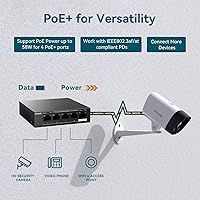
  • Four PoE+ ports support both IEEE 802.3af and 802.3at devices, covering nearly all common IP cameras and access points.
  • Fanless metal chassis runs completely silently, making it easy to place in living spaces or quiet offices.
  • Extend Mode pushes PoE transmission up to 250 meters, useful for distant outdoor camera installs.
  • One-Key VLAN isolation protects against broadcast storms and DHCP spoofing with a single hardware toggle.
  • 6KV lightning surge protection adds real-world durability for exposed or outdoor-adjacent deployments.
  • The metal body manages heat well — warm to the touch under load but never alarmingly hot.
  • Limited lifetime warranty is a genuine long-term value add that most switches at this price skip entirely.
  • Compact footprint makes it easy to stash behind a TV, inside a cabinet, or on a small shelf.
  • Long-term owners report very few hardware failures, pointing to solid build quality for the price tier.

Cons

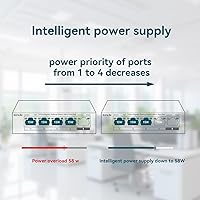
  • The 58W shared power budget requires upfront planning — four high-draw devices can easily push past its limits.
  • Extend Mode reliability beyond 150 meters is inconsistent and not dependable enough for critical camera runs.
  • Speeds drop to 10 Mbps past the 100-meter mark in Extend Mode, ruling out HD video at longer distances.
  • Only five ports total means most growing setups will outgrow this PoE switch fairly quickly.
  • Included documentation is minimal, which can trip up users who are new to PoE networking concepts.
  • No management interface means zero visibility into traffic, port status, or power draw per device.
  • Not suitable for rack-mount or DIN-rail installations common in structured cabling environments.
  • No QoS controls, so latency-sensitive VoIP traffic and bulk data share bandwidth without any prioritization.

Ratings

The scores below reflect an AI-driven analysis of verified global user reviews for the Tenda TEG1105P 5-Port Gigabit PoE Switch, with spam, bot-generated, and incentivized feedback actively filtered out before scoring. Each category is assessed against real-world usage patterns reported by buyers across home, small office, and DIY surveillance contexts. Both the genuine strengths and the honest limitations of this compact gigabit switch are transparently reflected in every score.

Ease of Setup
96%
Buyers across all technical skill levels consistently report having this PoE switch up and running within a few minutes of opening the box. There is no app to download, no browser interface to navigate, and no configuration steps — just plug in the uplink and connect your devices.
The included documentation is thin, so first-time PoE users who have questions about port behavior or VLAN mode may find themselves searching online for answers. A brief quick-start card covering Extend Mode and VLAN toggle would meaningfully improve the out-of-box experience.
Value for Money
91%
For a device at this price point, the combination of four PoE+ ports, gigabit speeds, 6KV surge protection, and a lifetime warranty is genuinely hard to match. Buyers who shopped around consistently note that comparable switches from other brands cost noticeably more for the same core functionality.
The 58W shared power budget starts to feel limiting as soon as buyers try to run three or four higher-draw devices simultaneously, which can force an upgrade sooner than expected. At full PoE load across four ports, the value equation weakens compared to switches with a larger power envelope.
PoE Power Delivery
74%
26%
For typical home surveillance setups with standard IEEE 802.3af cameras drawing 10 to 15W each, the switch handles power delivery cleanly and reliably. Users powering a single access point or two moderate-draw cameras report consistent, stable performance with no unexpected reboots.
The 58W shared budget is the most frequently cited frustration — buyers who populate all four ports with 802.3at devices near the 25 to 30W range quickly run into instability. Tenda labels the switch as 63W maximum but the usable PoE headroom requires careful upfront planning that many buyers do not anticipate.
Build Quality
88%
The all-metal chassis feels noticeably more solid than plastic-bodied competitors in the same price range, and buyers who have dropped or bumped the unit report no damage to ports or casing. The overall construction gives the device a durability that exceeds expectations for an entry-level switch.
The unit is compact enough that mounting options are limited without additional hardware, and the lack of any mounting brackets in the box means many users simply set it on a shelf. A few buyers also note that the white finish shows smudges and scuffs more readily than a matte or darker finish would.
Thermal Performance
89%
The fanless metal chassis manages heat remarkably well under typical loads — users report the body gets warm to the touch after extended use but never reaches a temperature that causes concern or throttling. In real-world installs tucked inside media cabinets or mounted near network equipment, thermal behavior is consistently described as a non-issue.
Under sustained full PoE load in poorly ventilated enclosures, the chassis can run hotter than comfortable, and a small number of users in warm climates report occasional instability they attribute to heat. The 70°C upper rating provides headroom, but airflow around the unit matters more in closed installations than the spec sheet suggests.
Noise Level
99%
With no fan and no moving parts whatsoever, this compact gigabit switch operates in complete silence regardless of load — a quality that home users placing it in living rooms or bedrooms specifically call out as a deciding factor. In noise-sensitive environments where even a low hum from a traditional switch would be disruptive, the fanless design is a genuine advantage.
There is genuinely little to criticize here from a noise standpoint. The only adjacent concern is that the passive cooling approach means the chassis accumulates heat rather than expelling it, which is a trade-off some buyers would prefer to manage with airflow rather than silence.
Extend Mode Reliability
63%
37%
For cable runs between 100 and 150 meters powering low-bitrate IP cameras, Extend Mode works well enough for most buyers — devices connect, power is delivered, and footage records without obvious interruption. Users with clean, uninterrupted Cat6 runs report better consistency than those with older or mixed cabling.
Beyond 150 meters, user experiences diverge sharply — some report stable connections while others deal with intermittent drops that require the switch to be power-cycled. The mandatory speed reduction to 10 Mbps past 100 meters is also a deal-breaker for any buyer expecting to stream higher-bitrate video at extended distances.
Port Count & Layout
71%
29%
The physical layout is clean and sensible — four PoE ports lined up with the uplink port clearly separated, making cable management straightforward even in tight spaces. For a two or three camera setup with one uplink, the port count is a natural fit.
Five ports total is a hard ceiling that buyers expanding their setups hit sooner than expected, often within the first year. Users who started with two cameras and later added an access point and a VoIP phone found themselves needing a second switch almost immediately.
VLAN Functionality
77%
23%
The One-Key VLAN isolation is a practical security feature for home surveillance installs where isolating cameras from each other — while keeping them reachable through the router — is exactly what most buyers need. Users who enabled it report it working as described with no noticeable performance impact.
The implementation is hardware-only with no granular control, so buyers who want to selectively isolate certain ports while allowing others to communicate are out of luck. It is an all-or-nothing toggle, which works for simple setups but falls short for anyone with more nuanced network segmentation needs.
Surge & Overload Protection
84%
The 6KV lightning protection and built-in PoE overload safeguards give buyers in storm-prone areas or outdoor-adjacent installs real peace of mind, and users in those environments specifically mention choosing this switch partly for that protection. Several buyers report the switch surviving nearby lightning events without damage.
Real-world protection depends heavily on the quality of the overall installation — grounding, cabling, and whether the switch itself is protected upstream by a proper surge protector all affect outcomes. A handful of users in high-exposure environments still recommend pairing this PoE switch with an additional line-level surge protector for full coverage.
Compatibility
87%
Compatibility with IEEE 802.3af and 802.3at devices is broad enough to cover virtually every mainstream IP camera, access point, and VoIP phone on the market, and buyers across multiple device brands report clean plug-and-play pairing. Users mixing different camera brands across the four ports report no compatibility conflicts.
Proprietary PoE systems — such as those used by some older Ubiquiti or Axis hardware that predate the 802.3at standard — may not negotiate power correctly, and a few buyers encountered this when repurposing older equipment. Checking device compliance before purchasing is strongly recommended for anyone with legacy hardware.
Long-Term Reliability
83%
Owners who have run this compact gigabit switch continuously for two or more years report very few hardware failures, which is encouraging for a budget-tier device used in always-on surveillance and access point roles. The metal chassis and passive cooling appear to contribute positively to longevity compared to plastic-housed competitors.
The sample of very long-term owners is still relatively small given the product age, so five-plus-year reliability data is limited. A small subset of buyers report port degradation or intermittent PoE delivery after extended use, though these cases appear to be outliers rather than a systemic pattern.
Documentation & Support
52%
48%
For straightforward setups, the minimal included documentation is not a practical barrier — the switch is simple enough that most buyers configure it correctly by intuition alone. Tenda does maintain online resources and firmware documentation for users who dig deeper.
Buyers attempting to understand Extend Mode behavior, VLAN isolation logic, or power budgeting in multi-device setups consistently find the included materials inadequate. Community forums and third-party YouTube guides fill the gap that official documentation leaves, which is a meaningful shortfall for a device positioned at less technically experienced buyers.
Physical Footprint
92%
At under 4 inches wide and roughly 1 inch tall, this PoE switch disappears easily behind a TV, inside a cable management box, or on a small network shelf — buyers who prioritize a tidy, low-profile install specifically praise how unobtrusive it is. The compact size also makes it straightforward to relocate if a setup changes.
The small size comes with no integrated mounting solution, so users who want to attach it to a wall or inside a panel need to source their own bracket or use adhesive mounting tape. The lack of ventilation slots on the casing is also a minor concern when placing it in very enclosed spaces.

Suitable for:

The Tenda TEG1105P 5-Port Gigabit PoE Switch is a strong fit for home users and small business owners who need to power a handful of IP cameras, a wireless access point, or a few VoIP phones without the learning curve of a managed switch. If you are putting together a basic home surveillance system, this compact gigabit switch handles the job cleanly — plug in your cameras, connect the uplink to your router, and you are done in minutes. The Extend Mode feature makes it particularly useful for outdoor camera setups where cable runs push past the standard 100-meter limit, provided the connected devices do not need high bandwidth. Small offices that want a silent, low-profile switch tucked out of sight will appreciate the fanless metal chassis that generates no noise whatsoever. Anyone stepping up from a basic unmanaged switch who now needs PoE but has no use for port monitoring, VLANs, or remote management will find this PoE switch hits exactly the right balance of capability and simplicity.
Not suitable for:

The Tenda TEG1105P 5-Port Gigabit PoE Switch is not the right tool if your devices collectively demand more than 58W of PoE power — running four cameras or access points that each draw close to 30W will immediately exceed that shared budget, causing instability or devices failing to power on. IT professionals or network administrators who need port-level traffic statistics, SNMP monitoring, LACP link aggregation, or any form of remote management should look elsewhere, since this is a fully unmanaged device with no web interface at all. The Extend Mode, while useful in principle, is not reliable enough for mission-critical surveillance runs beyond 150 meters, and the mandatory speed drop to 10 Mbps past 100 meters rules it out for anything requiring real-time HD video at long distances. With only five ports total, anyone managing more than four powered devices will find themselves outgrowing this compact gigabit switch almost immediately. It is also worth noting that businesses needing rack-mount form factor or DIN-rail installation will need a different class of hardware entirely.
Specifications

  • Port Count: The switch includes 5 Gigabit RJ45 ports total: 4 PoE+ output ports and 1 dedicated uplink port.
  • Data Rate: All five ports support 10/100/1000 Mbps auto-negotiation for full gigabit throughput.
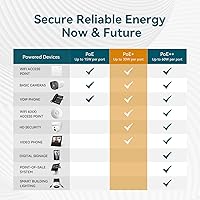
  • PoE Standard: PoE ports comply with IEEE 802.3af and IEEE 802.3at, covering the vast majority of powered network devices on the market.
  • PoE Budget: Total PoE power output is 58W shared across all four PoE ports simultaneously.
  • Per-Port Power: Each PoE port can deliver up to 30W individually, suitable for high-draw devices like dual-band access points.
  • Extend Mode: Extend Mode enables PoE data and power delivery up to 250 meters, though speeds are reduced to 10 Mbps beyond the 100-meter mark.
  • VLAN Support: One-Key VLAN mode isolates PoE ports 1 through 4 from each other while preserving uplink connectivity on port 5.
  • Surge Protection: Shielded ports and embedded circuitry provide lightning surge protection rated up to 6KV, plus PoE overload and short-circuit safeguards.
  • Chassis Material: The enclosure is constructed from metal, contributing to passive heat dissipation and overall build durability.
  • Cooling System: The switch is entirely fanless, relying on the metal chassis for passive thermal management with no moving parts.
  • Operating Temp: The unit is rated to operate in ambient temperatures up to 70°C, making it suitable for warm enclosed spaces.
  • Dimensions: The switch measures approximately 3.93″ wide by 1.02″ high, making it one of the more compact PoE switches in its class.
  • Weight: The unit weighs 1.54 lbs (0.7 kg), light enough to mount or place without additional hardware support.
  • Interface Type: All ports use standard RJ45 connectors compatible with Cat5e and Cat6 Ethernet cabling.
  • Voltage Input: The switch operates at 50 volts AC input with a current rating of 1.5 amps.
  • Max Power Draw: Maximum total power consumption of the unit is rated at 63W under full PoE load.
  • Management Type: This is a fully unmanaged switch requiring no software installation, web interface, or user login to operate.
  • Warranty: Tenda includes a limited lifetime protection warranty, which covers the unit against manufacturing defects for its operational lifespan.
  • Compatible Devices: Designed to power IP cameras, wireless access points, and VoIP phones that comply with IEEE 802.3af or 802.3at standards.
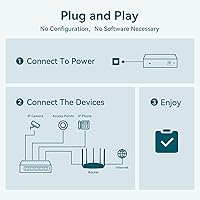
  • Setup Requirement: No configuration is required; the switch is plug-and-play straight out of the box with no companion app needed.

Related Reviews

MokerLink POE-G041GO Outdoor Gigabit PoE Switch
81%
93%
Ease of Setup
84%
PoE Power Delivery
78%
Build Quality
76%
Weather Resistance
88%
Value for Money
More
YuLinca 6-Port Gigabit PoE Switch with 4 PoE+ Ports
87%
95%
Ease of Installation
88%
PoE Functionality
91%
Build Quality
87%
Performance and Speed
94%
Fanless Operation (Noise)
More
Tenda TEG1005D 5-Port Gigabit Switch
89%
96%
Setup and Installation
88%
Performance During Heavy Use
85%
Build Quality and Durability
92%
Noise Level (Fanless Design)
90%
Traffic Handling and Optimization
More
MokerLink 5-Port Gigabit POE Switch
86%
94%
Ease of Setup
88%
Performance
85%
Build Quality
75%
PoE Power Output
91%
Fanless Design (Noise Level)
More
Cudy GS1005P 5-Port Gigabit PoE Switch
80%
91%
Value for Money
94%
Ease of Setup
87%
Build Quality
82%
PoE Performance
97%
Noise Level
More
STEAMEMO 5-Port Gigabit PoE+ Switch 52W
87%
91%
Value for Money
88%
Performance & Speed
89%
Ease of Setup
87%
Build Quality & Durability
90%
Network Stability
More
AUMOX PRO SG305P 5-Port PoE Gigabit Switch
78%
88%
Build Quality
93%
Ease of Setup
79%
PoE Performance
97%
Noise Level
91%
Value for Money
More
LINOVISION POE-Switch0504GD 5-Port Gigabit PoE Switch
78%
93%
DC Input Versatility
61%
PoE Compatibility
82%
Build Quality
89%
Redundant Power Design
74%
Port Count & Layout
More
NETGEAR GS305EP 5-Port PoE Gigabit Switch
79%
91%
Ease of Setup
78%
PoE Performance
97%
Noise Level
67%
Management Interface
72%
Build Quality
More
TP-Link TL-SG105PE 5-Port Gigabit PoE Switch
79%
91%
Value for Money
84%
PoE Performance
93%
Ease of Setup
76%
Network Management
62%
Web Interface
More

FAQ

No, nothing at all. The Tenda TEG1105P 5-Port Gigabit PoE Switch is completely plug-and-play — connect your uplink cable to port 5, plug your PoE devices into ports 1 through 4, and it just works. There is no web interface, no app, and no login screen involved.
Yes, it should handle that without issue. Each PoE port supports up to 30W, so a 25W access point fits within the per-port limit. Just keep in mind the total shared budget across all four ports is 58W, so if you are also running other powered devices simultaneously, plan your wattages accordingly.

Extend Mode lets this PoE switch push both data and power beyond the usual 100-meter Ethernet limit, reaching up to 250 meters. The trade-off is that speeds drop to 10 Mbps past the 100-meter mark, so it works well for static IP cameras that stream at lower bitrates but is not suited for high-bandwidth applications at long distances.

Yes, but only the uplink port (port 5) connects to your router or existing network. The four PoE ports will pass data to any Ethernet device, though a non-PoE device connected to a PoE port will simply not receive power — it will still get a data connection just fine.

Not at all — it is completely silent. The fanless design means there are zero moving parts and zero noise, which makes it a reasonable fit for living rooms, bedrooms, or home offices where fan hum would be noticeable.

When you enable VLAN mode, each of the four PoE ports is isolated from the others — so a device on port 1 cannot communicate directly with a device on port 2, but both can still reach your router through port 5. It is a basic layer of protection that helps prevent one compromised camera from talking to another device on your network.

The metal chassis does get warm, especially with multiple PoE devices running, but owners consistently report it never gets hot enough to be a concern. The metal body actually helps dissipate heat passively, which is part of why the fanless design works reasonably well here.

It depends on how much power each camera draws. If your cameras are standard IEEE 802.3af devices pulling around 10 to 15W each, four of them would total 40 to 60W — right at or just under the 58W shared budget. If your cameras are higher-draw 802.3at models near 25 to 30W each, you will exceed the budget running all four simultaneously, which can cause instability or devices failing to power on.

Tenda does back this compact gigabit switch with a limited lifetime warranty against manufacturing defects, which is genuinely uncommon at this price point. It does not cover physical damage or misuse, but for a device used in a normal installation, it offers reasonable long-term peace of mind compared to switches that only carry a one- or two-year warranty.

At 130 meters you are just into the zone where Extend Mode operates at 10 Mbps rather than full gigabit speed. User experiences at that distance vary — many report it working reliably for standard definition or moderate-bitrate cameras, but some have had inconsistent results. If your camera streams at a relatively low bitrate and the cable run is clean and uninterrupted, it is worth trying, but have a backup plan if the connection proves unstable.

Where to Buy