Overview

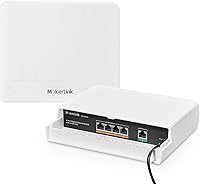
The MokerLink POE-G041GO Outdoor Gigabit PoE Switch is a compact, no-frills switch built for anyone who needs to power outdoor devices without running separate electrical cables or hiring a network specialist. Its weatherproof ABS housing holds up against rain, dust, and light snow reasonably well — though it is not rated for submersion or standing water, so placement still matters. The built-in power supply is a genuine convenience compared to units requiring a separate external adapter to mount and protect. At its price point, this outdoor PoE switch gives homeowners and small businesses a practical path to powering IP cameras or wireless access points without overcomplicating the installation.
Features & Benefits

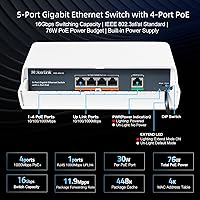
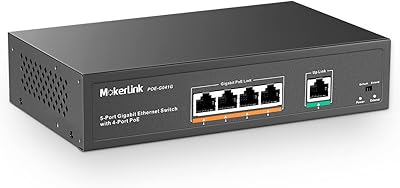
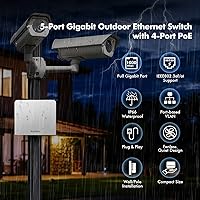
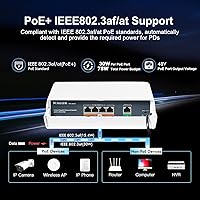
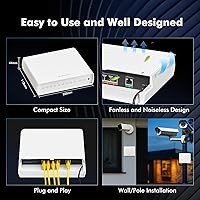
Four PoE+ gigabit ports cover the IEEE 802.3af and 802.3at standards, meaning each port can supply up to 30W — enough for most IP cameras and standard wireless access points. The fifth port is a dedicated gigabit uplink to your router or upstream switch, keeping the PoE side clean. What deserves attention upfront is the 78W shared budget: if you plan to run four power-hungry devices simultaneously, do the math before assuming everything will run at full draw. Auto power detection means you can mix PoE and non-PoE devices freely, and the fanless design keeps things silent while reducing the chance of mechanical failure in dusty or humid outdoor environments.

Best For

This weatherproof switch fits most naturally into small-scale outdoor deployments where simplicity matters more than advanced network control. Homeowners mounting two or three IP cameras on the eaves of a house will find the plug-and-play setup genuinely painless. Small businesses extending Wi-Fi coverage to a warehouse floor, garage, or outdoor area will appreciate the pole and wall mounting brackets that come in the box. If you need VLANs, traffic shaping, or managed features, look elsewhere — but that is a deliberate trade-off, not an oversight. Where the MokerLink gigabit switch earns its place is in situations where quick, clean deployment and weather resistance outweigh the need for granular network control.

User Feedback

Buyers consistently highlight how straightforward the setup is — power cord in, cables connected, done. The enclosure durability earns positive marks from users in wet or cold climates, though a handful note they added extra sealing around cable entry points before harsh winters. The most common complaint centers on the shared 78W power budget, with some users running four higher-draw devices finding themselves hitting the ceiling sooner than expected. A frequently missed detail is that this weatherproof switch does not support passive 24V PoE, which has caught buyers coming from certain Ubiquiti setups off guard. Most owners, however, consider the value for money solid given the outdoor-rated build and consistent port performance.

Pros

  • Plug-and-play setup requires no software, login, or configuration — ideal for non-technical installers.
  • Built-in power supply means one less external adapter to weatherproof and mount separately.
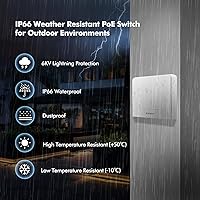
  • Weather-resistant ABS enclosure holds up well in rain, dust, and light snow based on real user reports.
  • Each PoE+ port supports up to 30W, covering the majority of IP cameras and standard wireless access points.
  • Fanless design operates silently and removes a common mechanical failure point in outdoor environments.
  • Included wall and pole mounting brackets make exterior installation straightforward right out of the box.
  • Auto power detection allows mixing PoE and non-PoE devices on the same switch without manual adjustment.
  • Compact footprint fits into tight installation spots where a full rack-mount switch would be impractical.
  • Gigabit speeds on all five ports ensure bandwidth is not a bottleneck for modern HD camera streams.
  • Competitively priced for an outdoor-rated gigabit PoE switch with a built-in power supply.

Cons

  • The 78W total PoE budget is shared across all four ports, leaving little margin when running multiple high-draw devices.
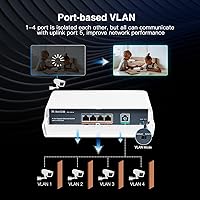
  • No managed features at all — no VLANs, no port mirroring, no traffic monitoring, no QoS controls.
  • Passive 24V PoE devices are explicitly unsupported, which can catch buyers migrating from certain legacy setups off guard.
  • Only four PoE ports available; anyone needing five or more powered connections must look at a larger unit.
  • Weather resistance has practical limits — installation placement still matters, and direct water ingress around cable entries can be an issue.
  • No redundant power input or failover option, which limits use in applications requiring high uptime guarantees.
  • The 2K MAC address table is modest and could become a constraint in busier or more complex network segments.
  • Long-term outdoor durability in extreme freeze-thaw cycles is mixed based on user reports, with some recommending additional cable sealing.

Ratings

The scores below for the MokerLink POE-G041GO Outdoor Gigabit PoE Switch were produced by our AI engine after analyzing verified buyer reviews from multiple global markets, with spam, incentivized, and bot-generated feedback actively filtered out. Each category reflects the honest balance of what real users praised and where they ran into friction — nothing is glossed over. Both the strengths and the genuine pain points are represented transparently so you can make a well-informed decision.
Ease of Setup
93%
Buyers consistently describe installation as one of the fastest they have experienced with any network hardware. The plug-and-play design means most homeowners have cameras or access points online within minutes of mounting the unit, with zero configuration steps required.
A small number of users with passive 24V PoE devices discovered the incompatibility only after mounting and wiring the switch, which made for a frustrating unboxing experience. Clearer labeling on the box about unsupported PoE types would prevent this.
PoE Power Delivery
84%
For standard IEEE 802.3af and 802.3at devices, port-level power delivery is stable and consistent. Users running two or three mid-draw cameras report rock-solid uptime with no unexpected reboots or power drops over extended periods.
The 78W shared budget becomes a real constraint when all four ports are occupied by higher-draw devices simultaneously. Users running PTZ cameras or dual-radio access points near the 25–30W range have reported that one port occasionally fails to power up at boot.
Build Quality
78%
22%
The ABS enclosure feels noticeably more solid than competing switches at this price tier, and the recessed port design adds genuine physical protection. Users mounting units under eaves or in covered outdoor alcoves report the housing holds up well after a year or more of exposure.
A few buyers in regions with extreme freeze-thaw cycles noted minor stress cracking around cable entry points after extended outdoor exposure. The enclosure is weather-resistant but was never designed for submersion or sustained water pooling, and some users learned that distinction the hard way.
Weather Resistance
76%
24%
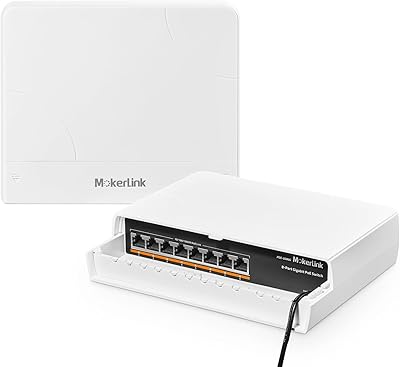
For typical outdoor conditions — rain, dust, light snow, and humidity — this weatherproof switch performs reliably without any additional enclosure needed. The sealed port area provides meaningful protection that separates it from indoor-only alternatives pressed into outdoor service.
The weather resistance has real-world limits that the product description does not fully communicate. Several users in particularly wet climates recommend adding silicone sealant around cable entry points, suggesting the factory seal alone is not always sufficient for heavy or prolonged rainfall.
Value for Money
88%
At its price point, finding a gigabit PoE switch with a built-in power supply, a weather-resistant enclosure, and mounting hardware included is genuinely unusual. Most buyers feel the feature-to-price ratio is strong for small surveillance or AP deployments where managed features are unnecessary.
Users who discover the PoE budget limitation after purchase often feel the value proposition weakens if they cannot fully load all four ports. Against a handful of competing products that offer slightly higher total wattage for a similar price, this unit can look less compelling for power-dense setups.
Port Performance
86%
All five ports sustain consistent gigabit throughput in real deployments, and the auto-detection negotiation works reliably across a wide range of camera and AP brands. Users running HD and 4K camera streams simultaneously report no throughput bottlenecks at the switch level.
The 2K MAC address table is modest and has drawn occasional criticism from IT installers deploying this as an edge switch in larger building networks. For simple home or small business use it is a non-issue, but it limits scalability if the network grows.
Mounting & Installation
89%
The included wall and pole mounting brackets are sturdier than the generic plastic clips often bundled with competing units. Installers working on exterior poles or fence-mounted applications particularly appreciate having both options available in the box without an extra parts order.
The mounting bracket attachment points on the unit itself feel slightly less robust than the bracket hardware, and a couple of users reported minor flex in the mount under heavier cable strain. Proper cable management to reduce pull on the switch body is advisable.
Fanless & Noise
96%
The completely passive cooling design means the unit operates in absolute silence, which matters in residential security installations where audible fan noise near a bedroom window or patio would be unacceptable. Users also credit the fanless approach for improving long-term reliability in dusty environments.
In very high ambient temperatures approaching the 50°C upper operating limit, passive cooling has no active fallback, so the switch relies entirely on ambient airflow. Enclosing it inside a sealed metal box in direct summer sun without ventilation could push internal temperatures beyond the rated range.
Compatibility
72%
28%
Compatibility with mainstream 802.3af and 802.3at devices from major surveillance and networking brands is broad and generally trouble-free. The auto power detection reliably handles mixed loads of PoE and non-PoE devices without requiring any manual configuration.
The lack of passive 24V PoE support is the single biggest compatibility gap, and it affects a meaningful segment of buyers who come from older Ubiquiti deployments. There is no workaround within this switch — passive 24V devices simply will not power up regardless of how they are connected.
Long-Term Reliability
74%
26%
The majority of buyers who have owned this outdoor PoE switch for 12 months or more report consistent operation with no port failures or power supply degradation. The fanless design removes the most common point of mechanical failure found in competing units.
A subset of users in harsh cold climates report issues emerging after the first or second winter, primarily related to moisture ingress rather than electronic failure. Long-term reliability appears strongly tied to how well the installation site is protected from direct water contact.
Indicator Lights
67%
33%
The per-port green LEDs provide quick visual confirmation that each device is linked and passing data, which simplifies troubleshooting during initial setup and after any network changes. The power LED is clearly visible even in daylight outdoor conditions.
There is no distinction between link speed and data activity in the LED behavior, so you cannot visually confirm whether a port has negotiated gigabit or a lower speed without connecting a management tool elsewhere on the network. Several technically minded users flagged this as a minor but recurring annoyance.
Documentation
61%
39%
The included user manual covers the basics clearly enough for a non-technical user to complete a standard installation without external help. The PoE power budget breakdown is explained in enough detail to help buyers plan their device loads before wiring everything up.
The manual does not address common troubleshooting scenarios, such as what to do when a port fails to supply power or how to calculate per-device draw for budget planning. Users frequently turn to online forums to answer questions the documentation should have covered directly.
Compact Footprint
91%
The small physical size is a genuine practical advantage for installs where space is tight — tucked under an eave, inside a shallow enclosure, or mounted on a narrow section of conduit. At under 700 grams, solo installation at height is comfortable without needing a second person to hold the unit.
The compact size does mean the ports are positioned quite closely together, and users running thick outdoor-rated Cat6 cables with large strain-relief boots sometimes find the adjacent ports partially obstructed. Angled RJ45 connectors or boots are worth considering before purchasing cables.

Suitable for:

The MokerLink POE-G041GO Outdoor Gigabit PoE Switch is a strong fit for homeowners and small business owners who need to power a handful of outdoor IP cameras or wireless access points without hiring an electrician or dealing with complex network configuration. If you are mounting two or three security cameras on the exterior of a house, garage, or small commercial property, this outdoor PoE switch handles that job cleanly and without fuss. IT installers working on edge deployments in warehouses, covered parking structures, or semi-industrial spaces will appreciate that the weather-resistant housing and built-in power supply reduce the number of components to protect and mount. The plug-and-play nature makes it genuinely approachable for users who are competent at running ethernet cable but have no interest in logging into a management interface. Compact and lightweight at under 700 grams, it tucks neatly into a junction box area or mounts flush on a wall or pole without drawing attention.
Not suitable for:

The MokerLink POE-G041GO Outdoor Gigabit PoE Switch is not the right tool if you are running a network that demands traffic prioritization, VLANs, port isolation, or any form of managed switching — this device simply does not offer those features, and no firmware update will change that. Users with four high-draw PoE devices, such as PTZ cameras or dual-radio access points each pulling close to 25W, should carefully total their power requirements before purchasing, because the 78W shared budget leaves very little headroom in that scenario. Anyone coming from a Ubiquiti ecosystem relying on passive 24V PoE devices will hit an immediate compatibility wall, as this weatherproof switch only supports the standard IEEE 802.3af and 802.3at protocols. It is also not designed for full submersion or prolonged exposure to standing water — placement still requires some thought about drainage and direct water intrusion. Larger deployments needing more than four powered ports will need a different solution entirely.
Specifications

  • Total Ports: The switch includes four PoE+ gigabit ports and one dedicated gigabit uplink port, for five RJ45 ports total.
  • PoE Standard: All four PoE ports comply with IEEE 802.3af (up to 15.4W per port) and IEEE 802.3at (up to 30W per port).
  • PoE Budget: The total shared PoE power budget across all four active ports is 78W.
  • Switching Bandwidth: The switch supports a total switching bandwidth of 12Gbps in a non-blocking architecture.
  • Forwarding Rate: Packet forwarding rate is rated at 8.92Mpps, suitable for high-throughput surveillance and AP traffic.
  • MAC Table: The MAC address table supports up to 2,000 entries, appropriate for small edge deployments.
  • Input Voltage: The built-in power supply accepts universal AC input from 100V to 240V at 50/60Hz.
  • PSU Output: The internal power supply delivers a regulated 52V DC at 1.5A to drive both switching and PoE functions.
  • Operating Temperature: The unit is rated to operate reliably in ambient temperatures ranging from -10°C to 50°C.
  • Enclosure Material: The housing is constructed from industrial-grade ABS plastic with weatherproofing around all ports and cable entries.
  • Dimensions: The unit measures 200 x 118 x 44mm, making it compact enough for discreet outdoor mounting.
  • Weight: Net product weight is 0.65kg, keeping installation manageable even at height on a pole or wall.
  • Mounting: Wall and pole mounting brackets are included in the box, supporting both flat-surface and cylindrical fixture installations.
  • Cooling Method: The switch uses entirely passive fanless cooling, with no moving parts to wear out or generate noise.
  • Management Type: This is a fully unmanaged switch with automatic power detection; no software interface or configuration is required or available.
  • Passive 24V PoE: Passive 24V PoE injection is explicitly not supported; only standard IEEE 802.3af and 802.3at devices are compatible.
  • Network Protocols: Supported protocols include IEEE 802.3 (10Base-T), 802.3u (100Base-TX), 802.3ab (1000Base-T), and 802.3x flow control.
  • Cable Requirement: All ports support Cat5 or better UTP cabling up to 100 meters for 10/100/1000Mbps operation.
  • Indicators: A single PWR LED confirms power status, and five green link and activity LEDs correspond to each individual port.
  • Package Contents: The package includes the switch unit, one power cord, and a printed user manual.

Related Reviews

MokerLink 8-Port Outdoor Gigabit PoE Switch
81%
93%
Ease of Setup
84%
Build Quality
81%
PoE Performance
77%
Weather Resistance
89%
Gigabit Throughput
More
MokerLink POE-G1604GS 20-Port Gigabit PoE Switch
85%
88%
Performance
93%
Ease of Setup
90%
Build Quality
89%
PoE Power Budget (200W)
91%
Noise Level
More
MokerLink POE-G082G 10-Port Gigabit PoE Switch
78%
94%
Ease of Setup
88%
PoE Reliability
83%
Build Quality
91%
Value for Money
71%
Thermal Management
More
MokerLink POE-G162G 18-Port Gigabit PoE Switch
77%
88%
Value for Money
93%
Port Density
94%
Ease of Setup
79%
Build Quality
76%
PoE Reliability
More
MokerLink 12-Port Gigabit PoE+ Unmanaged Switch
74%
93%
Ease of Setup
86%
PoE Reliability
88%
Build Quality
91%
Value for Money
94%
Fanless & Noise
More
MokerLink 26-Port Gigabit Unmanaged PoE Switch
79%
91%
Value for Money
88%
Port Count & Layout
73%
PoE Power Budget
93%
Ease of Setup
86%
Build Quality & Chassis
More
MokerLink 5-Port Gigabit POE Switch
86%
94%
Ease of Setup
88%
Performance
85%
Build Quality
75%
PoE Power Output
91%
Fanless Design (Noise Level)
More
MokerLink EXT-AT13GO Outdoor Gigabit PoE Extender
78%
93%
Ease of Setup
71%
Power Delivery
74%
Build Quality
77%
Weatherproofing
88%
Gigabit Performance
More
MokerLink 3-Port Gigabit PoE Passthrough Switch
86%
94%
Ease of Installation
88%
PoE Performance (Power Output)
85%
Build Quality
92%
Compact Design
90%
Value for Money
More
Binardat POE-AT13G Gigabit PoE Passthrough Switch
84%
92%
Value for Money
95%
Ease of Installation
88%
PoE Power Efficiency
86%
Design & Build Quality
89%
Compactness & Space Efficiency
More

FAQ

It works with any IP camera that supports standard IEEE 802.3af or 802.3at PoE — which covers the vast majority of cameras from Hikvision, Dahua, Reolink, Amcrest, and similar brands. The auto power detection takes care of negotiating the right power level automatically, so you just plug in and go.

Yes, just barely — four devices at 15W each totals 60W, which is within the 78W ceiling. That said, PoE devices can draw more power during startup or in cold weather, so you have reasonable headroom in that scenario. Where people run into trouble is mixing high-draw PTZ cameras or dual-radio access points that push toward 25W or 30W each, which would push the total well past 78W.

No, this weatherproof switch does not support passive 24V PoE. It only delivers standard 802.3af and 802.3at power. Ubiquiti UniFi access points that use 802.3af or 802.3at — like most of the newer UniFi models — will work fine, but older Ubiquiti gear requiring proprietary passive 24V injection will not.

It is weather-resistant rather than fully waterproof — there is an important difference. The enclosure handles rain, dust, and snow exposure well, and all the port interfaces are recessed within the shell for protection. That said, it is not rated for submersion or prolonged standing water contact, so avoid mounting it somewhere that water can pool around it. Most installers also recommend adding a small bead of silicone sealant around cable entry points before a harsh winter.

No. The MokerLink POE-G041GO Outdoor Gigabit PoE Switch is entirely unmanaged — there is no web interface, no CLI, and no app. It handles basic switching and PoE delivery automatically. If you need VLANs, port isolation, or traffic management, you will need a managed switch instead.
Yes, that works without any manual adjustment. The auto power detection function identifies whether a connected device requires PoE and only supplies power to those that do. A non-PoE device like a standard NVR or computer will receive data only, with no risk of being damaged by unwanted power injection.

The switch has built-in overload protection and will not simply push past its power limit in a way that damages hardware. In practice, if total demand exceeds the budget, one or more ports may not power up their connected devices, typically the last port to negotiate power. It will not fry your cameras, but you may find a device unexpectedly offline until the load is reduced.

Standard Cat5e or Cat6 ethernet cable works perfectly for the gigabit uplink connection. The same applies to the PoE device ports. Runs up to 100 meters are fully supported at gigabit speeds, which gives you plenty of flexibility for outdoor routing around a building perimeter.

Mounting brackets for both wall and pole installation are included in the box, so no extra hardware purchase is needed for standard installations. The unit is compact and light enough that a single person can manage the mounting comfortably.

The rated operating floor is -10°C, which covers typical winter conditions in most regions. Users in genuinely harsh climates — regular deep freezes or heavy ice accumulation — report mostly positive long-term results, though some recommend extra sealing around cable entry points to prevent moisture ingress during freeze-thaw cycles. If you are in an area with sustained temperatures below -10°C, a heated enclosure or indoor placement would be a safer choice.