Overview

The AUMOX PRO SG305P 5-Port PoE Gigabit Switch is a compact, no-fuss networking box aimed squarely at home users and small offices who want to add powered devices — cameras, wireless access points, IP phones — without hiring an electrician or pulling extra power cables. Power over Ethernet does exactly what it sounds like: it carries both data and electricity over a standard network cable, eliminating the need for a separate power adapter at each device. This little gigabit switch arrived on the market in late 2023 and has already earned a spot in Amazon's top 100 for its category. All-metal construction at this price point is genuinely uncommon, and that alone sets it apart from the plastic-bodied competition.
Features & Benefits

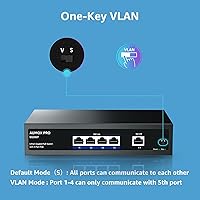
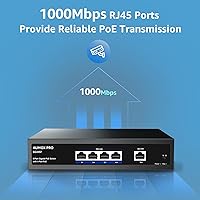
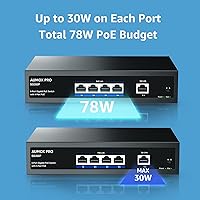
Four of the five ports deliver PoE, each rated at up to 30W and compliant with 802.3af/at standards, covering the vast majority of cameras and access points sold today. The fifth port is a dedicated gigabit uplink to your router. One thing worth understanding: the 78W shared power budget means you cannot run four 30W devices simultaneously — plan for roughly 19W average per port under full load. A one-key VLAN button isolates ports 1 through 4 from each other, letting traffic only reach the uplink; it is a simple hardware toggle, not a full managed-switch feature. The fanless chassis is completely silent, and the box includes a power cord plus a brief manual — amusingly listed as 'Munuel' on the packaging.

Best For

This PoE switch is a natural fit for anyone adding security cameras or a wireless access point to a home or small office without wanting to touch a configuration interface. It suits installers who need something quiet, mountable, and reliable in a utility closet or hallway — the fanless design means no worrying about dust clogging a fan over time. The one-key VLAN mode also appeals to users who want basic device isolation without the complexity of a managed switch. That said, if you are planning to power four high-draw devices simultaneously, do the math on that 78W ceiling before buying. Anyone needing more than four PoE ports or full Layer 2 management should look at a more capable unit.

User Feedback

With a 4.4-star average across nearly 200 ratings, buyer sentiment skews positive, with most praise landing on two things: how little effort setup requires and how substantial the metal housing feels relative to what you pay. Several reviewers specifically noted that the chassis does not feel like a budget product in hand, which is a fair observation. On the critical side, a handful of buyers ran into the 78W ceiling faster than expected — particularly those mixing a camera with a higher-draw access point. The one-key VLAN gets mixed marks; some find it genuinely useful for isolating IoT devices, while others missed having any documentation to explain it. Long-term heat management appears fine in most reports, though the box runs warm to the touch under full load.

Pros

  • All-metal enclosure feels genuinely solid and durable, not like a typical budget networking product.
  • Completely fanless design means zero noise — ideal for bedrooms, home offices, or quiet studio spaces.
  • Plug-and-play setup requires no software, no login, and no networking knowledge to get running.
  • Four PoE ports covering 802.3af/at support the vast majority of cameras, access points, and IP phones sold today.
  • One-key VLAN isolation lets you keep IoT or camera traffic separated from other devices without touching a config page.
  • Gigabit speed on all five ports ensures data throughput is not the bottleneck in any typical small-network scenario.
  • Wall-mount and desktop options give installers real flexibility for where and how to place the unit.
  • The compact footprint — under 8 inches wide — makes it easy to tuck away in tight spaces.
  • Earns a 4.4-star average from nearly 200 buyers, with consistent praise for build quality and ease of use.
  • Comes ready to use out of the box with a power cord included, no extra accessories needed for basic installs.

Cons

  • The 78W total power budget is shared across all four PoE ports, making simultaneous full-load operation impossible.
  • No per-port power monitoring means you have no visibility into how much each connected device is actually drawing.
  • The included documentation is minimal and contains at least one notable typo, leaving the VLAN feature under-explained.
  • Only four PoE ports available — users with five or more powered devices will need a second switch immediately.
  • No managed features whatsoever means you cannot set traffic priorities, monitor bandwidth, or assign true VLAN tags.
  • Runs noticeably warm under sustained full load, which may raise durability questions in poorly ventilated installations.
  • Single uplink port creates a hard dependency on one upstream connection with no redundancy option.
  • North American buyers need to confirm 220V AC input compatibility with their power setup before purchase.
  • Brand is relatively new and lacks the long-term reliability track record of established networking manufacturers.
  • No indicator lights beyond basic link and activity LEDs, making troubleshooting a guessing game for non-technical users.

Ratings

The AUMOX PRO SG305P 5-Port PoE Gigabit Switch scores below are generated by AI after analyzing verified global buyer reviews, with spam, bot activity, and incentivized feedback actively filtered out. Ratings reflect the honest distribution of real-world experiences — strengths and frustrations alike — to give you a transparent picture before you buy. Both what users love about this little gigabit switch and where it falls short are represented fairly in every category.
Build Quality
88%
The all-metal chassis consistently surprises buyers who expect plastic at this price tier. Several reviewers noted that the unit feels noticeably heavier and more rigid than competing switches in the same category, giving it a sense of durability that inspires confidence when wall-mounting or tucking it into a permanent installation.
A small number of users flagged that port labeling and button markings are minimal, which can make initial cable identification fiddly in low-light closet installs. The metal casing also retains heat more noticeably than a vented plastic chassis would under sustained full PoE load.
Ease of Setup
93%
Plug-and-play really does mean plug-and-play here — buyers with zero networking experience report having cameras and access points online within minutes of opening the box. There is no app to download, no browser interface to navigate, and no driver installation of any kind.
The included manual is thin and contains at least one notable typo on the packaging itself, so anyone wanting to understand the VLAN button behavior has to look online for clarification. First-time PoE users occasionally do not realize the uplink port does not supply power, which causes brief confusion during initial setup.
PoE Performance
79%
21%
Under typical home or small office loads — a couple of cameras and a single access point — the PoE delivery is rock solid and consistent. Devices power up cleanly with no flickering or renegotiation issues reported under moderate draw conditions.
The 78W shared budget becomes a real constraint once buyers start mixing higher-draw devices, and there is no per-port monitoring to tell you how close you are to that ceiling. Users powering four devices simultaneously, especially any drawing above 20W each, have reported devices cycling or failing to negotiate power correctly.
Noise Level
97%
Fanless operation means this switch produces absolutely no audible sound under any load condition, which buyers replacing noisy fan-cooled units in bedrooms, recording studios, or home offices describe as a noticeable quality-of-life improvement. Several reviewers specifically mentioned placing it in a bedroom closet with zero complaints.
There is genuinely little to criticize here. The trade-off is that without active airflow, the chassis surface runs warm under sustained load, which is a reasonable concern in a sealed or poorly ventilated enclosure — though not a noise complaint per se.
Value for Money
91%
At its price point, landing a fully gigabit, fanless, metal-encased PoE switch with four 802.3af/at ports is genuinely strong value, and the buyer sentiment around this consistently reflects that. Users regularly compare it favorably against pricier alternatives from better-known brands that offer no meaningful performance advantage for simple home setups.
Buyers who later discover the 220V input limitation or the 78W shared budget ceiling sometimes feel the product was not fully transparent about its constraints upfront, and a few felt the value proposition weakened once they needed a second switch to cover additional devices.
Network Performance
84%
Full gigabit throughput on all five ports handles video surveillance streams, NAS transfers, and simultaneous wireless backhaul without any apparent bottlenecking for typical small-network use cases. The 10 Gbps switching fabric provides comfortable headroom for multi-device activity.
Because this is an unmanaged switch, there is no quality-of-service configuration, so high-bandwidth traffic from one device can theoretically crowd out another with no way to set priorities. Power users who need traffic shaping or port mirroring will find the hardware fundamentally incapable of those tasks.
VLAN Functionality
61%
39%
For users who simply want to isolate IoT cameras or guest access points from the rest of their local network, the one-key hardware isolation button gets the job done without requiring any technical knowledge. Pressing it once is enough to enforce the separation.
The feature is frequently misunderstood because the documentation barely explains it, and several buyers expected something closer to proper managed-switch VLAN tagging. It cannot be configured granularly — it is all or nothing — and users who need per-port VLAN assignments will find this entirely inadequate.
Thermal Management
72%
28%
Passive cooling through the metal body works reliably in well-ventilated environments, and most buyers running the switch in open-air installations — on a shelf, in a ventilated cabinet, or wall-mounted — report no heat-related issues over months of continuous use.
In tighter spaces without airflow, the chassis surface can become uncomfortably warm, which raises durability questions for always-on installations in sealed enclosures. The unit lacks any thermal protection indicator or warning light, so users have no way to know if the switch is approaching its 55°C operating limit.
Port Density
58%
42%
For users with exactly three or four PoE devices to connect, the four powered ports are sufficient and the dedicated uplink keeps the topology clean. Small single-room camera setups or single-AP deployments fit perfectly within these constraints.
Four PoE ports is a hard ceiling with no expansion path, and buyers who start with three cameras and later add a fourth quickly realize they have no room for even a PoE-powered door sensor or IP phone. The single uplink port also means no redundant uplink option if the upstream connection fails.
Mounting & Form Factor
86%
The compact dimensions make this one of the easier switches to place discreetly, and the included wall-mount hardware means buyers do not need a separate trip to the hardware store. Installers appreciate being able to mount it flush to drywall in a utility space without the unit looking out of place.
The wall-mount bracket design is basic, and a few users noted the unit can feel slightly wobbly on the bracket if cables are tugged. Desktop placement without rubber feet on some units has been mentioned as a minor but recurring annoyance on smooth surfaces.
Compatibility
87%
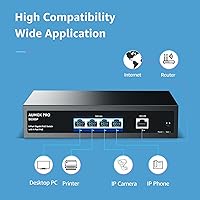
Broad 802.3af/at compliance means this PoE switch works with cameras and access points from virtually every major consumer and prosumer brand without any pairing or configuration steps. Auto-negotiation on all ports also removes the need to manually set speeds for older 100Mbps devices.
The 220V AC input rating creates a compatibility gap for North American buyers who need to verify their power situation before purchase. Devices using proprietary passive PoE — which some older Ubiquiti hardware requires — are not supported and will not power up correctly on this switch.
Reliability & Longevity
74%
26%
Early buyer reports and intermediate-term reviews suggest stable, continuous operation without unexpected reboots or port failures under normal loads. The metal chassis construction gives more confidence in long-term durability than plastic-bodied alternatives at a similar price.
AUMOX PRO is a relatively new brand without a multi-year reliability track record, and long-term data beyond 12 to 18 months of ownership is limited. A handful of buyers reported units failing outside the return window with no clear cause, which is a data point worth noting even if it represents a minority.
Documentation & Support
47%
53%
The basic setup is simple enough that most buyers never need the manual at all — plug in and go covers 90 percent of use cases without any reference material.
The included manual is thin to the point of being nearly useless for anything beyond the basics, and the VLAN feature in particular is almost completely undocumented. Brand support responsiveness is inconsistent based on buyer reports, and finding authoritative answers to compatibility or configuration questions often requires external forum research rather than official resources.

Suitable for:

The AUMOX PRO SG305P 5-Port PoE Gigabit Switch is a strong fit for home users and small office setups where the goal is simple: add a few powered network devices without dealing with extra power adapters or complicated software. Think of the person mounting a couple of security cameras in a garage or backyard, or the small business owner dropping a wireless access point in a back room — this little gigabit switch handles both jobs cleanly, with no configuration required beyond plugging in cables. It also works well for installers who need something discreet and quiet, since the fanless chassis makes it a natural choice for closets, shelves, or anywhere sound matters. The one-key VLAN button adds a layer of basic device isolation that appeals to anyone running IoT cameras or guest-network access points they want kept separate from the main LAN. If your needs are modest and your devices are standard 802.3af/at compatible, this PoE switch punches well above its price class.
Not suitable for:

The AUMOX PRO SG305P 5-Port PoE Gigabit Switch has clear limits that make it the wrong tool for certain buyers, and it is worth being direct about them. The 78W shared power budget is the most common sticking point: if you plan to run four devices simultaneously and any of them are power-hungry — a high-end outdoor camera or a tri-band access point, for example — you may hit that ceiling faster than expected and find devices throttling or dropping off. Anyone who needs more than four PoE ports will simply run out of room, and there is no expanding this unit. Network professionals or power users who rely on per-port statistics, traffic monitoring, or true managed VLAN tagging will find the one-key isolation mode far too basic for their needs. The input voltage is rated at 220V AC, so buyers in North America should verify compatibility with their local setup before purchasing. This PoE switch is also not a great fit for mission-critical environments where uptime documentation or warranty-backed enterprise support is expected.
Specifications

  • Total Ports: The switch includes five RJ45 gigabit ports: four PoE-capable data and power ports plus one dedicated uplink port for connecting to a router or upstream switch.
  • PoE Standard: All four PoE ports comply with IEEE 802.3af and 802.3at standards, ensuring broad compatibility with cameras, access points, and IP phones from virtually any major brand.
  • PoE Per Port: Each PoE port can deliver up to 30W of power individually, which covers the majority of standard and high-power PoE devices currently on the market.
  • Total PoE Budget: The shared power budget across all four PoE ports is 78W, meaning the combined draw of all connected powered devices must not exceed this figure simultaneously.
  • Port Speed: All five ports support auto-negotiation at 10, 100, and 1000 Mbps, providing full gigabit throughput on every connection without manual speed configuration.
  • Switching Capacity: The internal switching fabric operates at 10 Gbps, providing sufficient non-blocking bandwidth for simultaneous full-gigabit traffic across all five ports.
  • VLAN Mode: A one-key hardware VLAN button isolates ports 1 through 4 from each other so that each connected device can only communicate through port 5, the uplink.
  • Enclosure: The chassis is constructed from metal, providing physical durability and passive heat dissipation without relying on moving parts or ventilation fans.
  • Cooling: The unit is entirely fanless, relying on passive thermal management through the metal housing, which results in completely silent operation under all load conditions.
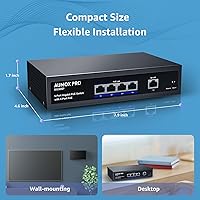
  • Mounting: The switch supports both flat desktop placement and wall mounting, with the necessary mounting hardware included in the box.
  • Dimensions: The unit measures 7.9 × 4.6 × 1.7 inches, making it compact enough to fit in a network cabinet shelf, on a desk, or mounted flush to a wall.
  • Weight: The switch weighs 1.79 pounds, light enough for wall mounting without requiring heavy-duty fasteners or additional structural support.
  • Max Temperature: The rated upper operating temperature is 55°C, meaning the switch is designed for standard indoor environments and should not be installed in unventilated or outdoor enclosures.
  • Input Voltage: The unit is rated for 220V AC input; buyers in 110V regions such as North America should verify compatibility with their local power infrastructure before purchasing.
  • In the Box: The package includes the switch unit, an AC power cord, and a brief setup manual — listed on the box itself as 'Munuel', a minor but harmless packaging typo.
  • Interface Type: All ports use standard RJ45 connectors; there are no SFP fiber slots or additional interface types on this model.
  • Management Type: This is an unmanaged switch with no web interface, command-line access, or SNMP support — configuration is limited to the physical one-key VLAN button on the chassis.
  • ASIN: The Amazon product identifier for this switch is B0CN2XKRB2, which can be used to locate the exact listing and verify you are purchasing the correct model.

Related Reviews

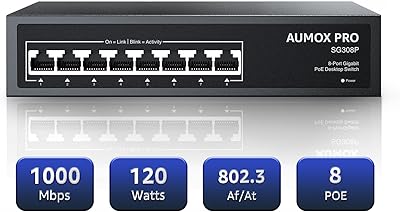
AUMOX PRO SG308P 8-Port PoE Gigabit Switch 120W
85%
85%
Performance
94%
Ease of Setup
89%
Build Quality
91%
Fanless Operation
87%
Power Efficiency
More
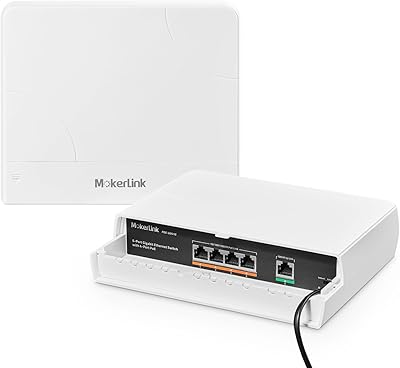
MokerLink POE-G041GO Outdoor Gigabit PoE Switch
81%
93%
Ease of Setup
84%
PoE Power Delivery
78%
Build Quality
76%
Weather Resistance
88%
Value for Money
More
YuLinca 6-Port Gigabit PoE Switch with 4 PoE+ Ports
87%
95%
Ease of Installation
88%
PoE Functionality
91%
Build Quality
87%
Performance and Speed
94%
Fanless Operation (Noise)
More
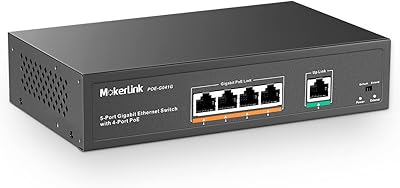
MokerLink 5-Port Gigabit POE Switch
86%
94%
Ease of Setup
88%
Performance
85%
Build Quality
75%
PoE Power Output
91%
Fanless Design (Noise Level)
More
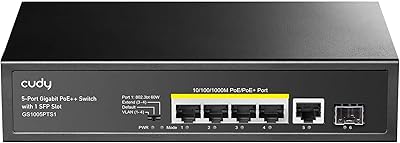
Cudy GS1005P 5-Port Gigabit PoE Switch
80%
91%
Value for Money
94%
Ease of Setup
87%
Build Quality
82%
PoE Performance
97%
Noise Level
More
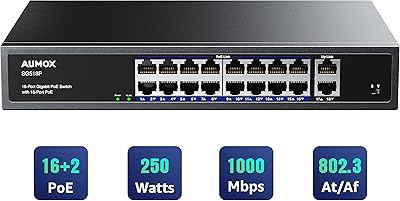
Aumox SG518P 16-Port PoE Gigabit Switch
79%
94%
Ease of Setup
88%
PoE Reliability
86%
Build Quality
58%
Fan Noise
91%
Value for Money
More
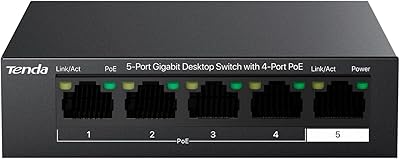
Tenda TEG1105P 5-Port Gigabit PoE Switch
82%
96%
Ease of Setup
91%
Value for Money
74%
PoE Power Delivery
88%
Build Quality
89%
Thermal Performance
More
STEAMEMO 5-Port Gigabit PoE+ Switch 52W
87%
91%
Value for Money
88%
Performance & Speed
89%
Ease of Setup
87%
Build Quality & Durability
90%
Network Stability
More
LINOVISION POE-Switch0504GD 5-Port Gigabit PoE Switch
78%
93%
DC Input Versatility
61%
PoE Compatibility
82%
Build Quality
89%
Redundant Power Design
74%
Port Count & Layout
More
NETGEAR GS305EP 5-Port PoE Gigabit Switch
79%
91%
Ease of Setup
78%
PoE Performance
97%
Noise Level
67%
Management Interface
72%
Build Quality
More

FAQ

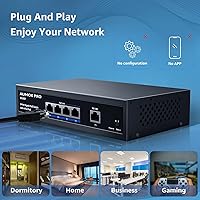
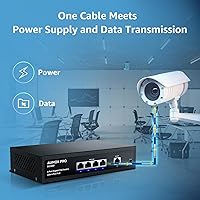
No, it is fully plug-and-play. Connect your router to the uplink port, plug your PoE devices into ports 1 through 4, and everything comes up automatically. There is no login page, no app, and no software to install.

Yes, but you need to be mindful of the total 78W power budget shared across all four ports. If your devices are all low-draw — like standard IP cameras pulling 8 to 12W each — you will have no problem. If you mix in a high-power access point drawing 25W or more, start adding up the numbers before you assume all four ports can run at maximum simultaneously.

When you press it, ports 1 through 4 become isolated from each other — they can only send traffic to port 5, the uplink. This is useful for keeping cameras or IoT devices off your main local network, or for preventing a misbehaving device from flooding the others. It is a simple hardware toggle, not a full managed VLAN system, so do not expect per-port tagging or anything that requires a configuration interface.

Almost certainly yes. The AUMOX PRO SG305P 5-Port PoE Gigabit Switch supports the 802.3af and 802.3at standards, which cover the PoE requirements of nearly every consumer and prosumer access point, including those from Ubiquiti, TP-Link, Netgear, and similar brands. Just confirm your access point is not one of the rare models that uses a proprietary passive PoE standard instead.
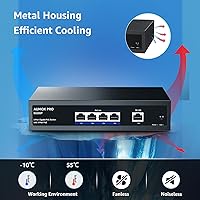
Completely silent. There is no fan anywhere in the unit — it uses the metal housing to passively manage heat. If you are replacing a buzzing or whirring fan-cooled switch in a bedroom or studio, this is a meaningful upgrade in that regard.

The switch is rated at 220V AC input, which is the standard in many parts of Europe, Asia, and Australia. In North America where outlets run at 110 to 120V, you will need to verify whether the power supply is dual-voltage or use a step-up converter. Check the label on the power brick before plugging it in directly.

Yes, it supports wall mounting and the necessary hardware is included in the box. The unit is light enough — under 2 pounds — that standard wall anchors handle it without issue. It can also sit flat on a desktop or shelf if wall mounting is not practical for your setup.

It runs warm to the touch under heavy load, which is expected given there is no active cooling. In a normally ventilated space — a shelf, a closet with some airflow, a desktop — it handles heat just fine within its rated 55°C upper limit. Avoid sealing it in an airtight enclosure or stacking other gear directly on top of it.

Ports 1 through 4 are your PoE ports — they supply both data and power to connected devices like cameras or access points. Port 5 is the uplink, meaning it connects this switch to your main router or a larger switch upstream; it carries data only and does not provide power to any device plugged into it.

No. The metal casing is durable for indoor use, but the unit carries no weather-resistance or ingress protection rating. It is designed for standard indoor environments and should be kept away from moisture, extreme temperatures, and direct sunlight. For outdoor deployments, you would need a separate weatherproof enclosure or an outdoor-rated switch.