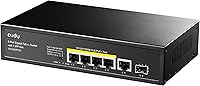
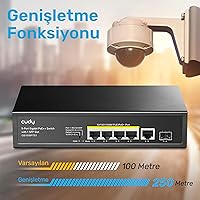
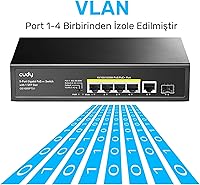

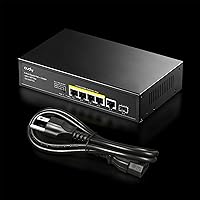
Overview

The Cudy GS1005P 5-Port Gigabit PoE Switch is a compact, no-frills networking device that punches above its weight for home and small-office deployments. Cudy has been quietly building a reputation in the budget networking space, and this compact PoE switch reflects that trajectory well. Four of its five ports deliver Power over Ethernet, meaning you can run an IP camera or wireless access point without hunting for a nearby outlet. The chassis is all-metal and completely fanless — a meaningful detail if you're tucking it into a living room cabinet or a bedroom shelf. Setup is genuinely as simple as plugging cables in and walking away.

Features & Benefits

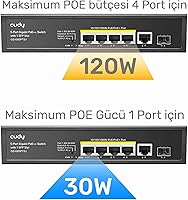
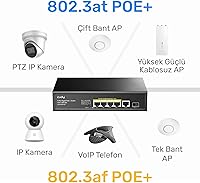
All five ports on this Cudy switch run at full Gigabit speeds, so there's no artificial bottleneck slowing down your network. The PoE+ support — specifically the 802.3at standard — matters more than it might seem; it means the GS1005P can power hungrier devices like pan-tilt cameras or dual-band access points, not just basic PoE hardware. The 60W shared budget does require planning though. Connect two devices drawing 25W each and you've already used 50W, leaving little headroom for anything else. The shielded ports and metal enclosure also help with heat dissipation and signal integrity in ways that plastic alternatives at this price simply don't deliver.

Best For

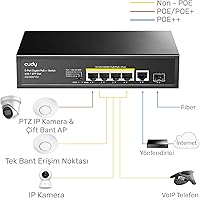
This compact PoE switch is a natural fit for home security setups — think two or three wired IP cameras covering a front door, driveway, and backyard, all powered and connected through a single box. It works equally well in a small office running a VoIP phone and a wireless access point without pulling extra power lines through the walls. Homelab users who want a capable switch without managed-feature complexity will find the GS1005P satisfying. For anyone installing in a bedroom, studio, or library, the complete absence of fan noise isn't a minor perk — it's the primary reason to choose this over a cheaper, louder alternative.

User Feedback

With a 4.4-star average across more than 175 reviews, buyer satisfaction with this Cudy switch is notably strong for a budget networking device. The most consistent praise centers on easy setup and quiet operation — exactly what the hardware promises. On the critical side, the GS1005P runs noticeably warm under sustained PoE load; the metal body handles passive cooling reasonably, but airflow matters if you're mounting it in an enclosed space. A smaller number of buyers have flagged pin assignment confusion — this switch uses Mode A only, so confirming compatibility with your PoE devices upfront saves headaches. Launched in mid-2019, the track record is decent, though long-term reliability data for a budget brand stays limited.

Pros

  • All five ports deliver full Gigabit speeds, so bandwidth is never the weak link in your setup.
  • PoE+ support (802.3at) means it can power more demanding devices, not just basic PoE cameras or phones.
  • The fanless design keeps operation completely silent — genuinely useful in bedrooms, studios, or quiet offices.
  • All-metal chassis feels noticeably more solid than plastic competitors at a similar price point.
  • Wall-mount and desktop placement options give you real flexibility for tight or unconventional installation spots.
  • Plug-and-play setup requires zero configuration — unbox, connect, done.
  • Shielded ports help with signal integrity, a small but meaningful edge over cheaper unshielded alternatives.
  • At its price tier, the GS1005P delivers a strong combination of build quality and PoE capability that few rivals match.
  • The compact footprint makes it easy to tuck behind a monitor, inside a cabinet, or mount discreetly on a wall.

Cons

  • The 60W total PoE budget is shared across four ports, which limits how many high-draw devices you can run simultaneously.
  • No management features at all — no VLANs, no QoS, no traffic monitoring, no loop protection.
  • The switch runs noticeably warm under sustained PoE load; avoid enclosed or poorly ventilated mounting spots.
  • Only five ports total means you'll outgrow this Cudy switch quickly if your device count expands.
  • Mode A pin assignment only — some older or non-standard PoE devices may not be compatible without checking first.
  • Cudy is a younger brand with a limited long-term reliability track record compared to more established networking manufacturers.
  • No CCTV mode or extended-distance PoE option, which some camera-focused competitors include at a similar price.
  • A single uplink port is all you get for connecting to a router or larger switch, with no redundancy options.

Ratings

Our AI rating system analyzed verified global buyer reviews for the Cudy GS1005P 5-Port Gigabit PoE Switch, actively filtering out incentivized, bot-generated, and outlier feedback to surface what real users consistently experience. The scores below reflect both the genuine strengths that make this compact PoE switch a popular pick and the real-world limitations that have frustrated a meaningful subset of buyers. Nothing is glossed over.

Value for Money
91%
Among budget PoE switches, few competitors offer an all-metal chassis, Gigabit speeds on all ports, and PoE+ support at this price tier. Buyers repeatedly note they expected a cheaper-feeling product and were pleasantly surprised by what arrived.
A handful of buyers feel the 60W shared PoE budget is too tight for the price and wish Cudy offered a slightly higher wattage model at a comparable cost. For users who outgrow it quickly, the value equation feels less convincing in hindsight.
Ease of Setup
94%
Plug-and-play really does mean plug-and-play here — buyers with zero networking experience report having cameras or access points up and running within minutes of opening the box. There is no app to download, no account to create, and no configuration page to navigate.
Because there is genuinely no configuration interface, users who need to troubleshoot a connected device have no diagnostic tools to fall back on. A small number of buyers found this frustrating when a PoE device failed to power on and they had no way to check port status.
Build Quality
87%
The all-metal enclosure with shielded ports feels noticeably more substantial than the plastic shells common on competing unmanaged switches at this price. Buyers who have had cheaper switches crack or warp in warm environments specifically call out the metal body as a differentiator.
The unit runs warm during sustained PoE operation, and some buyers noticed the bottom surface becomes uncomfortable to touch during heavy load. The mounting screw holes also feel slightly under-engineered for permanent wall installation in high-vibration environments.
PoE Performance
82%
18%
Powering two or three PoE cameras or a wireless access point works reliably and consistently, with no reports of random power drops during normal use. PoE+ headroom — up to 30W per port — means it handles more demanding devices that basic PoE switches struggle with.
The 60W total budget catches buyers off guard when they try to fully load all four PoE ports simultaneously with high-draw devices. Running four 18W cameras, for example, exceeds the ceiling, and the switch does not provide any warning before devices start dropping power.
Noise Level
97%
Completely and permanently silent — buyers installing this in bedrooms for NVR systems or in open-plan offices specifically highlight the fanless operation as the deciding factor in their purchase. Even under maximum load, there is no audible output of any kind.
There are essentially no cons here from a noise perspective; the only indirect trade-off is that the fanless passive cooling means the chassis absorbs heat rather than expelling it, which is a thermal consideration rather than a noise one.
Port Count & Layout
68%
32%
Five ports is sufficient for focused small-scale deployments — a router uplink plus three or four PoE devices covers most home security and small-office scenarios without anything left idle. The physical port spacing makes cable insertion easy without crowding.
Five total ports is a hard ceiling that buyers frequently outgrow, and there is no obvious upgrade path within the Cudy unmanaged lineup without jumping to a significantly larger and pricier model. Users who add a NAS, a second access point, or extra cameras will need a second switch faster than expected.
Thermal Management
71%
29%
The metal chassis does a reasonable job of passively dissipating heat in open-air environments, and the majority of long-term users report no thermal-related failures even after months of continuous operation. Keeping it on a desk or openly mounted on a wall works well.
In enclosed cabinets or tight AV closets without airflow, heat buildup becomes a legitimate concern that several buyers documented with follow-up complaints. Cudy provides no thermal guidance or operating temperature specifications in the included documentation, which is an oversight.
PoE Device Compatibility
74%
26%
Works correctly out of the box with the vast majority of standard 802.3af and 802.3at devices, including popular IP camera brands, consumer-grade access points, and SIP phones. Most buyers report zero compatibility issues with modern hardware.
Mode A pin assignment only is a real restriction that trips up buyers with older or less common PoE hardware using alternative wiring schemes. There is no passive PoE compatibility, and Cudy's documentation does not make the pin assignment limitation prominent enough to catch buyers before purchase.
Long-term Reliability
73%
27%
Having been on the market since mid-2019, there is now a meaningful base of multi-year users, and the majority report the switch still functioning without issue after two or more years of continuous use. That is a reasonable track record for a budget networking device.
Cudy does not yet have the multi-decade reliability data that established networking brands carry, and a small but notable number of reviews mention unit failure after 12 to 18 months. Buyers running mission-critical setups should factor in the brand's relative youth when evaluating risk.
Mounting & Placement
83%
Both desktop and wall-mount options are genuinely supported, and the compact footprint — roughly the size of a thick paperback — makes it easy to position discreetly behind equipment or alongside a router without dominating a shelf or desk surface.
The included wall-mount hardware is functional but basic, and a few buyers report that the mounting tabs feel less robust than the chassis itself. For permanent installations in high-traffic areas, some users opted for third-party mounting solutions.
Network Performance
89%
All five ports sustain true Gigabit throughput without throttling, which matters when transferring high-bitrate camera footage to a local NAS or streaming 4K content from a connected media server. No buyers report bandwidth bottlenecks under typical use conditions.
As an unmanaged switch, there is no traffic prioritization — all ports compete equally for bandwidth, which can occasionally cause latency spikes on VoIP phones sharing a switch with a high-throughput camera or backup task. This is a structural limitation of unmanaged switches generally.
Documentation & Support
58%
42%
Initial setup requires no documentation at all, which is genuinely the best-case scenario for a plug-and-play device. The quick-start card included in the box is sufficient for basic deployment.
When things do not work as expected — a PoE device not powering on, compatibility questions about pin assignments — the included documentation offers very little help. Cudy's online support resources are sparse compared to more established brands, leaving buyers to rely on community forums for troubleshooting.
Packaging & Unboxing
76%
24%
The switch arrives securely packed with the power adapter and mounting hardware included, and buyers generally report the unit arriving in perfect condition. The no-frills packaging is appropriate for a practical networking product at this tier.
The power adapter cable is relatively short, which restricts placement options in some installations and drew specific complaints from buyers who needed flexibility in where they positioned the switch relative to the nearest outlet.

Suitable for:

The Cudy GS1005P 5-Port Gigabit PoE Switch is a practical choice for homeowners and small-business operators who need to power and connect a handful of PoE devices without the complexity or cost of enterprise networking gear. If you're mounting two or three IP cameras around your property, adding a wireless access point to a back office, or running a VoIP phone at a reception desk — all without pulling separate power cables — this compact PoE switch handles those jobs cleanly. Homelab enthusiasts who want a quiet, capable switch for a small rack or shelf will also appreciate the fanless metal build, especially in a bedroom or living space where noise matters. DIYers comfortable with basic networking will find the plug-and-play setup genuinely effortless — power it on, plug in your devices, and it works. The 60W PoE budget is enough for most modest deployments, provided you're not trying to max out all four PoE ports with high-draw hardware simultaneously.

Not suitable for:

The Cudy GS1005P 5-Port Gigabit PoE Switch is not the right tool if your deployment demands more than four PoE devices, higher total power output, or any form of network management like VLANs, QoS controls, or traffic monitoring. The 60W shared PoE budget is a real constraint — if you're running three cameras that each draw 20W, you've already exceeded what this switch can safely deliver across all ports. Businesses or installers who require CCTV-mode functionality, link aggregation, or loop protection should look at managed alternatives in a higher category. Anyone relying on a brand with a long, proven enterprise track record should also set expectations accordingly — Cudy is a relatively young networking brand, and while user feedback since 2019 has been largely positive, it doesn't carry the same long-term reliability data as established names. Finally, if you need more than five total ports — for example, a growing office with several wired workstations plus PoE devices — this switch will run out of capacity quickly.

Specifications

  • Model: The unit is manufactured by Shenzhen Cudy Technology Co., Ltd. under the model designation GS1005P.
  • Total Ports: The switch provides 5 x Gigabit Ethernet ports, all operating at 10/100/1000 Mbps.
  • PoE Ports: Four of the five ports support Power over Ethernet, conforming to both the 802.3at (PoE+) and 802.3af standards.
  • PoE Budget: The total shared PoE power budget is 60W, with a maximum of 30W available on any single port.
  • PoE Pin Mode: The switch uses Mode A pin assignment only, with pins 1/2 carrying positive and pins 3/6 carrying negative polarity.
  • Data Rate: All ports support a maximum data transfer rate of 1000 Mbps (1 Gigabit per second) full duplex.
  • Cooling: The switch uses entirely passive, fanless cooling — there are no moving parts and no fan noise under any operating condition.
  • Chassis: The enclosure is constructed from metal with shielded Ethernet ports, providing improved heat dissipation and signal integrity.
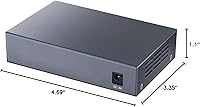
  • Dimensions: The unit measures 4.69″ in length, 3.35″ in width, and 1.1″ in height.
  • Weight: The switch weighs 1.65 pounds, making it suitable for desktop placement or lightweight wall mounting.
  • Mounting Options: The switch supports both desktop and wall-mount installation, with mounting hardware included for wall placement.
  • Input Voltage: The switch operates on 12V AC input power via the included external power adapter.
  • Configuration: The switch is fully unmanaged and plug-and-play — no software, web interface, or CLI configuration is required or available.
  • Switch Type: This is an unmanaged Layer 2 switch with no support for VLANs, QoS, SNMP, or traffic management features.
  • Compatibility: The switch is compatible with any 802.3at or 802.3af compliant PoE device, including IP cameras, VoIP phones, and wireless access points.

Related Reviews
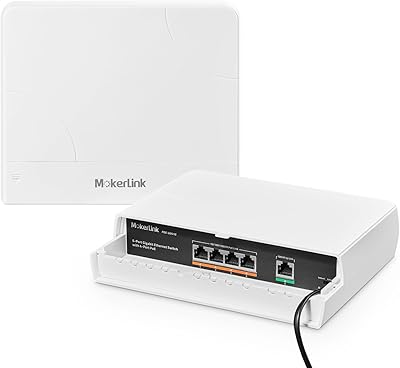
MokerLink POE-G041GO Outdoor Gigabit PoE Switch
81%
93%
Ease of Setup
84%
PoE Power Delivery
78%
Build Quality
76%
Weather Resistance
88%
Value for Money
More
YuLinca 6-Port Gigabit PoE Switch with 4 PoE+ Ports
87%
95%
Ease of Installation
88%
PoE Functionality
91%
Build Quality
87%
Performance and Speed
94%
Fanless Operation (Noise)
More
MokerLink 5-Port Gigabit POE Switch
86%
94%
Ease of Setup
88%
Performance
85%
Build Quality
75%
PoE Power Output
91%
Fanless Design (Noise Level)
More
Tenda TEG1105P 5-Port Gigabit PoE Switch
82%
96%
Ease of Setup
91%
Value for Money
74%
PoE Power Delivery
88%
Build Quality
89%
Thermal Performance
More
STEAMEMO 5-Port Gigabit PoE+ Switch 52W
87%
91%
Value for Money
88%
Performance & Speed
89%
Ease of Setup
87%
Build Quality & Durability
90%
Network Stability
More
LINOVISION POE-Switch0504GD 5-Port Gigabit PoE Switch
78%
93%
DC Input Versatility
61%
PoE Compatibility
82%
Build Quality
89%
Redundant Power Design
74%
Port Count & Layout
More
AUMOX PRO SG305P 5-Port PoE Gigabit Switch
78%
88%
Build Quality
93%
Ease of Setup
79%
PoE Performance
97%
Noise Level
91%
Value for Money
More
NETGEAR GS305EP 5-Port PoE Gigabit Switch
79%
91%
Ease of Setup
78%
PoE Performance
97%
Noise Level
67%
Management Interface
72%
Build Quality
More
NETGEAR GS305P v2 5-Port Gigabit Ethernet PoE Switch
87%
93%
Ease of Setup
89%
PoE Power Delivery
94%
Noise Level (Fanless Design)
85%
Build Quality
91%
Energy Efficiency
More
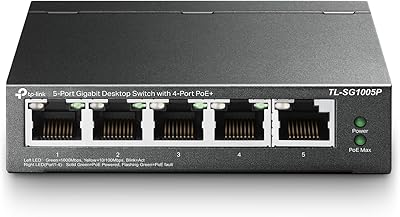
TP-Link TL-SG1005P
TP-Link TL-SG1005P
85%
96%
Ease of Setup
83%
PoE Power Delivery
91%
Build Quality
98%
Noise Level
89%
Gigabit Throughput
More

FAQ

None at all. You plug in the power adapter, connect your devices with Ethernet cables, and it starts working immediately. There is no web interface, no app, and no login — it is a pure plug-and-play device. If you have ever used a basic network switch before, this is even simpler.

It depends on how much power each camera draws. The GS1005P has a 60W total PoE budget shared across all four PoE ports. If your cameras each consume around 10–12W (which is typical for basic fixed cameras), you can comfortably run all four. But if you are using pan-tilt-zoom cameras or cameras with built-in heaters that pull 20–25W each, you will hit the ceiling quickly. Always check your camera's PoE power consumption spec before assuming four will work simultaneously.

Yes. All five ports on this compact PoE switch handle standard Ethernet traffic regardless of whether PoE is involved. You can connect a regular laptop, NAS, or desktop PC to any port and it will work exactly like a normal Gigabit switch port. PoE power is only delivered to devices that actively negotiate it, so there is no risk of damaging non-PoE equipment.

Completely silent. The fanless design means there are no moving parts whatsoever, so you will never hear it regardless of load. This is one of the main reasons people choose this unit for bedroom NVR setups or living room installations where a whirring fan would be annoying.

It does run warm under sustained PoE load — that is normal and expected for a passively cooled switch. The metal chassis acts as a heat sink and handles dissipation reasonably well in open air. What you want to avoid is mounting it inside a sealed enclosure or a crowded cabinet with no airflow. Give it a bit of breathing room and it should be fine for typical home or small-office use.

It supports both. The 802.3at standard (PoE+) is backward compatible with 802.3af, so older PoE devices that only draw up to 15.4W will work just as well as newer PoE+ devices drawing up to 30W. Just keep the total across all active PoE ports within the 60W shared budget.

Both options are fully supported. The unit ships with wall-mount hardware, and its compact size makes it easy to mount discreetly behind a TV, inside a utility closet, or near a ceiling-mounted access point. Desktop placement works equally well if you prefer that.

Possibly, depending on how old and how non-standard the equipment is. This Cudy switch uses Mode A pin assignment exclusively, meaning PoE power is carried on cable pairs 1/2 and 3/6. Most modern 802.3af and 802.3at devices follow this standard, so compatibility is broadly good. However, a small number of older or proprietary passive PoE devices use different pin arrangements and will not work correctly. Check your device's documentation if you are unsure.

No. This is a fully unmanaged switch, which means there is no management interface of any kind. You get no VLANs, no QoS, no port mirroring, no SNMP, and no loop protection. That is a deliberate trade-off for simplicity and cost — if you need any of those features, you will need to step up to a managed switch.

The switch first became available in mid-2019, so there is a reasonable sample of long-term users. Feedback has generally been positive, with most buyers reporting stable, uninterrupted operation over extended periods. That said, Cudy is a relatively young networking brand, and it does not have the multi-decade reliability track record of more established manufacturers. For a home or small-office deployment the risk profile is low, but enterprise or mission-critical environments would typically warrant a more proven brand.

Where to Buy