Overview

The LINOVISION POE-Switch0504GD 5-Port Gigabit PoE Switch exists to solve a problem that trips up a lot of installers: most standard PoE switches demand AC power, which is useless when your only source is a solar battery bank, a vehicle's 12V system, or an industrial DC rail. This DC-input PoE switch accepts anything from 9V to 54V and internally boosts it to proper PoE output — no external converter needed. Before you order, one thing must be clear upfront: it outputs Mode B PoE only, meaning power runs over the spare pairs. If your cameras or access points use Mode A, this is the wrong switch, full stop.
Features & Benefits

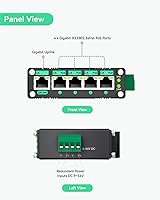
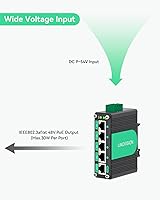
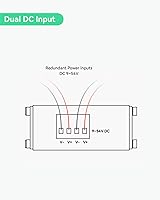
The built-in voltage booster is what sets this solar PoE switch apart from conventional options. Plug in a 12V battery and you get four live PoE ports — though at 12V the total power budget caps at 60W, enough to comfortably run two or three typical IP cameras. Step up to 24V or 48V and the budget doubles to 120W across all four ports, each capable of up to 30W individually. Every port, including the uplink, negotiates 10/100/1000Mbps automatically. The dual DC input channels with automatic failover mean a second power source stands by silently, taking over if the primary drops — a genuine reliability feature for remote or unattended installations.

Best For

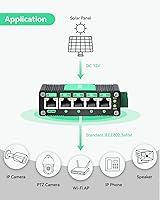
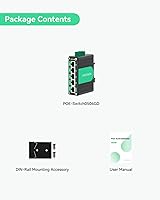
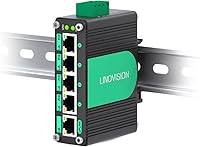
This DC-input PoE switch is a natural fit for off-grid solar builds — think a remote camera array running off a 12V or 24V battery bank where AC power is simply not an option. It works equally well in RVs, trucks, and buses where vehicle power needs to feed standard network equipment. VoIP installers working with 24V DC infrastructure will find it equally useful. The compact enclosure with DIN-rail mounting keeps things tidy inside electrical panels or custom enclosures. One firm prerequisite: confirm that your powered devices use Mode B pin assignment before purchasing. If you are unsure, check your camera or access point documentation first.

User Feedback

With a 4.5-star average across over a hundred ratings, the LINOVISION gigabit switch earns its marks primarily from off-grid and solar installers who could not find anything else that does this job cleanly. Easy DIN-rail installation comes up repeatedly, and the wide voltage input range gets credited specifically in RV and van build communities. On the downside, the Mode B-only constraint has frustrated buyers who skipped the compatibility check — several critical reviews trace directly back to this single issue. A handful of users in very hot climates have noted warmth in the enclosure under sustained full load, though no widespread thermal failures have been reported. Buyers who arrive informed tend to leave satisfied.

Pros

  • Accepts 9V to 54V DC input natively, eliminating the need for an inverter or AC adapter in off-grid setups.
  • The built-in voltage booster is a rare feature at this price point for industrial DC environments.
  • Dual redundant power inputs with automatic failover add genuine reliability for unattended remote installations.
  • All five ports run full gigabit speeds, so bandwidth is never the bottleneck.
  • DIN-rail and wall-mount options make panel integration clean and straightforward.
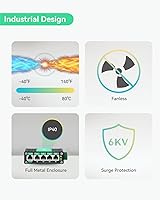
  • Rated for -40°F to 176°F, covering most real-world outdoor and vehicle temperature extremes.
  • Compact aluminum enclosure keeps the footprint small enough for tight enclosures or cramped mounting spaces.
  • Verified to work well in solar battery systems across a range of common voltages including 12V, 24V, and 36V.
  • At 120W total PoE budget on higher voltage inputs, it can realistically power four devices simultaneously without throttling.

Cons

  • Mode B-only PoE output is a dealbreaker for anyone with Mode A devices, and it is easy to overlook before purchasing.
  • Total PoE budget drops significantly to 60W when running on 12V, limiting how many high-draw devices you can connect.
  • No management interface means no per-port control, no traffic monitoring, and no VLAN capability whatsoever.
  • IP40 enclosure rating offers dust resistance only — it cannot be mounted in a directly exposed outdoor location without additional weatherproofing.
  • Only four PoE ports may feel limiting for installations that grow beyond the initial scope.
  • No PoE++ support caps individual port power at 30W, ruling out higher-draw devices like pan-tilt-zoom cameras with heaters.
  • Some users in sustained high-ambient-temperature environments have reported noticeable heat buildup under full load.
  • The spare-pair pin assignment (4/5+, 7/8-) can create compatibility headaches with older or non-standard PoE equipment.

Ratings

The scores below for the LINOVISION POE-Switch0504GD 5-Port Gigabit PoE Switch were generated by our AI rating engine after analyzing verified purchase reviews from buyers worldwide, with spam, incentivized, and bot-flagged submissions actively filtered out. Ratings reflect the honest consensus of real installers, RV builders, and systems integrators who put this DC-input PoE switch to work in the field. Both the standout strengths and the genuine frustrations are transparently baked into every score.
DC Input Versatility
93%
The wide 9V–54V input range is the single biggest reason buyers choose this switch over anything else in the category. Solar installers running 12V, 24V, or 36V battery banks and RV owners tapping a vehicle's house battery all report it working exactly as advertised without any external voltage conversion.
At 12V input the usable PoE budget drops to 60W, which catches some buyers off guard when they try to run four high-draw cameras simultaneously. The limitation is documented, but it still generates occasional disappointment from users who did not check the fine print before wiring everything up.
PoE Compatibility
61%
39%
For buyers who have confirmed their devices use Mode B (spare-pair) PoE, the switch delivers clean IEEE 802.3af/at power with no configuration needed. VoIP phone installers and IP camera builders in the 24V DC world report consistent, stable power delivery once the setup is correct.
The Mode B-only restriction is the single largest source of negative reviews for this solar PoE switch. Buyers whose cameras or access points use Mode A power delivery find their devices simply do not come on, and there is no workaround — it is a hardware limitation that results in returns and frustration for those who did not verify compatibility first.
Build Quality
82%
18%
The compact aluminum enclosure feels noticeably more robust than plastic-bodied switches in the same price range, and most installers comment that it slots cleanly into DIN-rail enclosures without any flex or wobble. The overall fit and finish is consistent with what you would expect from an industrial-grade component.
The IP40 rating covers dust ingress but nothing else — there is no moisture resistance, so any outdoor deployment requires a secondary weatherproof enclosure. A handful of users in hot climates also note the chassis runs noticeably warm under sustained full-load conditions, which is worth monitoring in poorly ventilated installs.
Redundant Power Design
89%
Dual DC input channels with automatic failover is a feature you rarely see at this price tier, and off-grid installers clearly value it. Remote camera sites pairing a solar panel with a backup battery charger benefit directly — the switch silently transfers to the secondary source with no interruption to connected devices.
The failover is automatic and unmanaged, meaning there is no alert, LED indicator, or log entry to tell you that the primary source has failed and the backup is now carrying the load. For unmanned remote installations, discovering a dead primary supply only after the backup also fails is a real operational risk.
Port Count & Layout
74%
26%
Four PoE ports and one uplink is a practical combination for small to mid-sized off-grid or vehicle deployments, covering the majority of single-site camera or access point installations without leaving unused ports to waste power budget.
For installations that grow beyond the initial scope — say, adding a fifth camera to a security setup — there is no expansion path short of adding another switch. The single uplink port also means there is no redundant network path option for more demanding reliability requirements.
Thermal Management
67%
33%
Passive aluminum cooling keeps the design simple, fanless, and silent — a genuine advantage in vehicle builds and sealed enclosures where fan noise or fan failure would be a problem. Most users in temperate or moderate climates report no heat-related issues across extended operation.
Users operating in desert environments or inside poorly ventilated enclosures during summer report the enclosure getting uncomfortably warm at sustained high loads. While no widespread thermal shutdown incidents have emerged in user feedback, it is a credible enough concern to warrant deliberate airflow planning in hot deployments.
Gigabit Throughput
88%
All five ports running at true gigabit speeds — including the uplink — means bandwidth is never the constraint in typical deployments. IP camera feeds, VoIP traffic, and access control data all move without any noticeable bottleneck, even when multiple ports are active simultaneously.
In practice, most devices connected to this switch in its target use cases do not come close to saturating a gigabit link, so the full-speed capability is somewhat underutilized. There are no QoS or traffic prioritization features to optimize bandwidth allocation if mixed device types are connected.
Ease of Installation
86%
DIN-rail mounting is consistently praised by installers who fit this DC-input PoE switch into control panels and electrical enclosures — it clicks in, cables up, and works without any software setup. Wall-mount hardware is also included for surface installations where a panel is not available.
Because the switch is unmanaged, there is no feedback mechanism to confirm a PoE port is actually delivering power to a connected device beyond checking whether the device itself has come online. First-time installers unfamiliar with Mode B compatibility can spend time troubleshooting what turns out to be a fundamental incompatibility rather than a wiring issue.
Value for Money
79%
21%
For buyers who need exactly what this switch does — DC-input PoE without an inverter — the price is genuinely competitive given the internal voltage booster, dual redundant inputs, and industrial temperature rating. There is very little direct competition that checks all these boxes at a similar price.
For buyers who do not strictly need DC input and just want a basic PoE switch, there are managed gigabit options with more ports and features available for similar or less money. The value proposition is strong only when the DC-input use case is the actual requirement.
Temperature Range
91%
The -40°F to 176°F operating range is legitimately broad and covers vehicle engine compartment adjacency, desert outdoor enclosures, and cold-climate deployments that would disable or damage consumer-grade switches. Mountain security cameras and northern RV builds both fall comfortably within spec.
The upper temperature limit is the rated spec for the switch itself, but real-world performance in sustained 176°F ambient conditions has not been broadly validated in user feedback. Most real deployments run well within the range, but operating at the absolute thermal ceiling without airflow is an untested edge case.
Management & Control
41%
59%
The zero-configuration unmanaged design is genuinely an advantage for simple deployments — plug it in and it works, with no firmware to update, no passwords to manage, and no interface to misconfigure. For straightforward off-grid camera setups this is perfectly adequate.
The complete absence of any management feature — no per-port PoE cycling, no traffic stats, no VLAN support, no SNMP — is a hard ceiling for anyone whose deployment grows in complexity. You cannot remotely reboot a locked-up camera by toggling its PoE port, which is a daily operational convenience many network managers take for granted.
Physical Footprint
87%
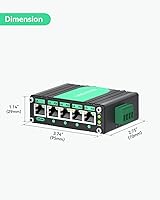
At 3.74″ x 2.75″ x 1.14″ and only 13 oz, this is one of the more compact industrial PoE switches available, and RV builders and panel integrators frequently comment that it fits into spaces where larger switches simply would not go. The weight is negligible for mobile installations.
The compact size does limit port density — four PoE ports is the maximum you get in this form factor, and there is no version of this unit with more ports for larger installations. Buyers who initially plan for four cameras but later want six will need to add a second switch.

Suitable for:

The LINOVISION POE-Switch0504GD 5-Port Gigabit PoE Switch was built for a specific and underserved need: powering standard PoE network devices from DC sources where AC power is unavailable or impractical. It is an ideal pick for off-grid solar installations — a remote gate camera, a barn access point, or a trail sensor array running off a 12V or 24V battery bank can all be fed from a single compact unit. RV owners and vehicle builders will appreciate that it runs cleanly off a 12V house battery without any inverter or AC adapter in the chain. Installers working with 24V DC infrastructure for VoIP phones or access control panels will also find it a natural fit. If your project lives inside an electrical enclosure or control panel, the DIN-rail mounting option makes integration clean and professional. Anyone who has already confirmed their PoE-powered devices use Mode B (spare-pair) power delivery will find this switch does exactly what it promises, reliably and without fuss.
Not suitable for:

The LINOVISION POE-Switch0504GD 5-Port Gigabit PoE Switch is a hard pass for anyone whose PoE cameras, phones, or access points use Mode A power delivery — that is, power over the data pairs rather than the spare pairs. This is not a workaround situation; the hardware simply will not power those devices, and no configuration will change that. It is also not the right tool for standard indoor office or home network use where AC power is readily available and a conventional managed switch would offer far more flexibility. Network administrators who need VLAN support, port monitoring, or any form of Layer 2 management should look elsewhere — this is an unmanaged switch by design. The IP40 rating means it handles dust reasonably well but offers no meaningful water resistance, so direct outdoor exposure without a proper weatherproof enclosure is a bad idea. Finally, if your total PoE load across four ports will consistently push near 120W, verify your input voltage is at 24V or higher, as a 12V source caps the budget at 60W.
Specifications

  • Power Input: Accepts DC 9V to 54V via dual input channels, covering common solar battery voltages as well as standard 12V, 24V, and 48V DC systems.
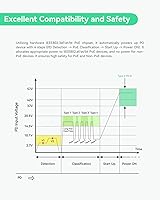
  • PoE Standard: Outputs IEEE 802.3af and 802.3at compliant PoE using Mode B (spare-pair) pin assignment only; Mode A devices are not supported.
  • PoE Ports: Four gigabit PoE output ports, each capable of delivering up to 30W to a connected powered device.
  • Uplink Port: One dedicated gigabit Ethernet uplink port for connecting to a router or upstream switch; this port does not supply PoE.
  • PoE Budget: Total PoE power budget is 120W when input is 24V or 48V DC, and reduces to 60W when running from a 12V source.
  • Port Speed: All five ports auto-negotiate 10/100/1000Mbps full-duplex, ensuring compatibility with both legacy and modern network equipment.
  • Voltage Booster: An internal boost converter steps up the DC input voltage to the level required for standard PoE output, eliminating the need for an external power converter.
  • Redundant Power: Two independent DC input channels support automatic failover, so a backup power source takes over immediately if the primary supply is interrupted.
  • Enclosure: Compact aluminum chassis with an IP40 ingress protection rating, offering resistance to solid particles but no protection against water or moisture.
  • Operating Temp: Rated for continuous operation between -40°F and 176°F (-40°C and 80°C), suitable for vehicle, outdoor enclosure, and extreme-climate deployments.
  • Mounting Options: Compatible with both DIN-rail and wall-mount installation, making it practical for electrical panels, custom enclosures, and surface-mounted applications.
  • Dimensions: The unit measures 3.74″ long by 2.75″ wide by 1.14″ high, making it one of the more compact industrial PoE switches in its class.
  • Weight: Weighs 0.37 kg (13 oz), light enough for vehicle and mobile installations where every gram matters.
  • PoE Pin Assignment: Power is delivered on pins 4/5 (+) and 7/8 (-), which is the Mode B spare-pair configuration defined by the IEEE 802.3af/at standard.
  • Management: This is an unmanaged switch with no web interface, CLI, SNMP, or Layer 2/Layer 3 management features of any kind.
  • Case Material: The outer enclosure is machined aluminum, which aids passive heat dissipation and contributes to the unit's overall ruggedness.
  • Interface Type: All ports use standard RJ45 connectors compatible with Cat5e and above Ethernet cabling.

Related Reviews
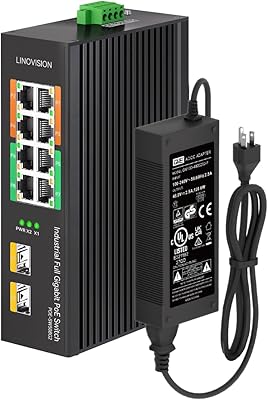
MokerLink POE-G041GO Outdoor Gigabit PoE Switch
81%
93%
Ease of Setup
84%
PoE Power Delivery
78%
Build Quality
76%
Weather Resistance
88%
Value for Money
More
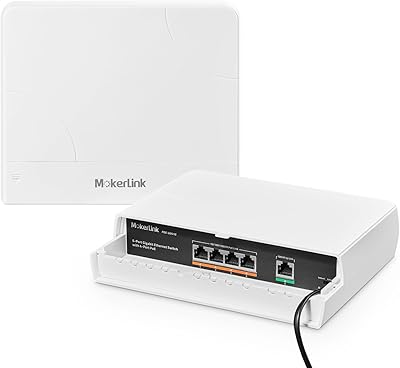
LINOVISION POE-SW508G Industrial 8-Port PoE++ Switch
77%
91%
Power Delivery
88%
Build Quality
93%
PoE Watchdog
84%
Installation Ease
86%
Thermal Performance
More
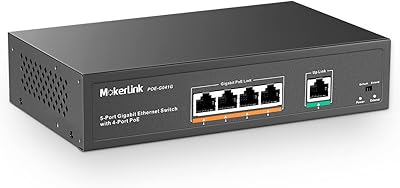
YuLinca 6-Port Gigabit PoE Switch with 4 PoE+ Ports
87%
95%
Ease of Installation
88%
PoE Functionality
91%
Build Quality
87%
Performance and Speed
94%
Fanless Operation (Noise)
More
MokerLink 5-Port Gigabit POE Switch
86%
94%
Ease of Setup
88%
Performance
85%
Build Quality
75%
PoE Power Output
91%
Fanless Design (Noise Level)
More
Cudy GS1005P 5-Port Gigabit PoE Switch
80%
91%
Value for Money
94%
Ease of Setup
87%
Build Quality
82%
PoE Performance
97%
Noise Level
More
STEAMEMO 5-Port Gigabit PoE+ Switch 52W
87%
91%
Value for Money
88%
Performance & Speed
89%
Ease of Setup
87%
Build Quality & Durability
90%
Network Stability
More
Tenda TEG1105P 5-Port Gigabit PoE Switch
82%
96%
Ease of Setup
91%
Value for Money
74%
PoE Power Delivery
88%
Build Quality
89%
Thermal Performance
More
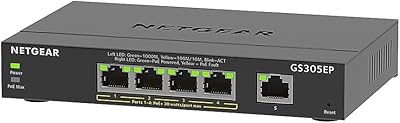
NETGEAR GS305EP 5-Port PoE Gigabit Switch
79%
91%
Ease of Setup
78%
PoE Performance
97%
Noise Level
67%
Management Interface
72%
Build Quality
More
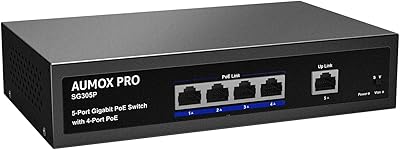
AUMOX PRO SG305P 5-Port PoE Gigabit Switch
78%
88%
Build Quality
93%
Ease of Setup
79%
PoE Performance
97%
Noise Level
91%
Value for Money
More
NETGEAR GS305P v2 5-Port Gigabit Ethernet PoE Switch
87%
93%
Ease of Setup
89%
PoE Power Delivery
94%
Noise Level (Fanless Design)
85%
Build Quality
91%
Energy Efficiency
More

FAQ

Yes, 12V is one of the most common use cases for this DC-input PoE switch. Just keep in mind that at 12V, the total PoE budget across all four ports is 60W rather than 120W. In practice that means you can comfortably power two or three typical IP cameras, but you will hit the ceiling faster than you would on a 24V or 48V input.

PoE can deliver power over two different sets of wire pairs inside an Ethernet cable. Mode A uses the same pairs that carry data, while Mode B uses the spare pairs that are not used for data transmission. This solar PoE switch only outputs Mode B. If your camera, access point, or phone is designed to receive power on Mode A pairs, it simply will not power on — no amount of configuration will fix that. Check your device's datasheet or manual before ordering.

Yes, and this is one of the more useful features on the LINOVISION POE-Switch0504GD 5-Port Gigabit PoE Switch. There are two independent DC input channels, and the switch automatically fails over to the secondary source if the primary drops. It is a clean solution for installations where uptime matters, like a remote security camera site with both a solar panel and a backup battery charger.

Not directly, no. The IP40 rating means the enclosure resists dust ingress reasonably well, but it offers zero protection against rain, humidity, or condensation. If you need to place it outdoors, mount it inside a proper weatherproof electrical enclosure or NEMA-rated box. Many installers do exactly that, and the DIN-rail option makes fitting it inside a panel straightforward.

At 12V, your total power budget is 60W across all four PoE ports. A typical fixed IP camera draws around 7W to 12W, so you can realistically run four lower-draw cameras or two to three mid-range ones before you approach the ceiling. If you are running PTZ cameras or devices with built-in heaters that pull 20W or more, factor that in carefully.

It supports IEEE 802.3af (up to 15.4W per port) and 802.3at, which is PoE+ (up to 30W per port). There is no support for PoE++, which goes up to 60W or 90W per port. Devices that require PoE++ will not be powered correctly by this switch.

Yes, that is a well-documented use case for this DC-input PoE switch. You can pull directly from the vehicle's 12V DC supply — no inverter required. Just be mindful of the 60W total PoE budget at that voltage, and make sure your cable runs are not so long that you get significant voltage drop before the switch.

No. This is a fully unmanaged switch, which means there is no interface of any kind — no browser-based dashboard, no mobile app, no CLI, and no SNMP. Ports come up automatically when devices are connected, and power is delivered without any configuration needed. If you need per-port control or traffic monitoring, you will need a different product.

Nothing damaging will happen to the switch itself, but the connected device will simply not receive power and will not come online. The switch will not be harmed, but you will need to either replace the powered device with a Mode B compatible one or use a PoE injector that supports Mode A instead.

The aluminum enclosure does get noticeably warm when running close to its maximum PoE budget, particularly in high-ambient-temperature environments. A few users in hot climates have mentioned this, though no widespread reports of thermal shutdowns or failures have surfaced. Installing it with some airflow around the enclosure, rather than packed tightly against other components, is a sensible precaution if you are in a warm location.