Tenda TEG1024D 24-Port Gigabit Ethernet Switch
Overview
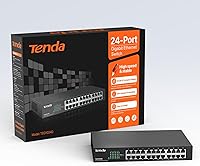
The Tenda TEG1024D 24-Port Gigabit Ethernet Switch has been quietly holding its ground in the unmanaged switch market since 2011 — which says something real about its staying power. Tenda is known for building affordable networking gear, and this 24-port gigabit switch fits squarely in that mold: a rackmount metal chassis, fanless operation, and zero configuration overhead. You unbox it, plug in your cables, and it works. No drivers, no web interface, no decisions to make. For a switch that has been around this long and still ranks in the top 70 of its Amazon category, the value proposition is hard to ignore.
Features & Benefits
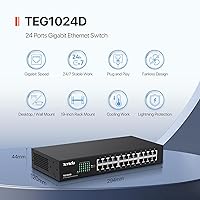
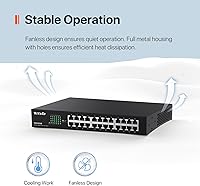
All 24 ports run at full gigabit speeds with Auto-MDI/MDIX, so there is no fussing over cable types — straight-through or crossover, it handles both without complaint. The switch fabric supports enough throughput to keep every port running simultaneously at wire speed, which matters when a busy NAS is offloading backups while someone else streams 4K footage. Jumbo frame support is a practical bonus for NAS and virtualization workloads. Flow control helps prevent dropped packets when traffic spikes. The steel housing with punched ventilation panels on three sides handles heat passively — no fan noise, no dust accumulating in a spinning motor.
Best For
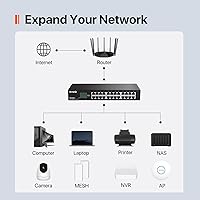
This Tenda switch makes the most sense for small offices and home labs where the goal is connecting a pile of devices quickly without touching a CLI or a web interface. Think server closets with limited airflow tolerance, or AV setups where fan noise would actually be noticeable. It works well for wiring up a NAS, a few workstations, a printer, and a smart TV on one switch at a price that leaves budget for other gear. What it is not built for is any environment requiring VLANs, QoS prioritization, or PoE-powered devices. If those are on your checklist, this 24-port gigabit switch is the wrong tool.
User Feedback
With over 1,200 ratings averaging 4.7 stars, the TEG1024D has earned genuine trust over a long run. Buyers most often praise the build quality for the price, the silent operation, and the fact that it works straight out of the box. A handful of long-term owners report running the same unit for several years without incident — encouraging, though that is user anecdote rather than a performance guarantee. On the critical side, some buyers wish there were per-port speed indicators to confirm link negotiation at a glance. Advanced users consistently flag the absence of any management interface. The lifetime warranty gets mentioned positively and does seem to factor into purchase decisions at this price tier.
Pros
- All 24 ports deliver full gigabit speeds simultaneously with no bottlenecks under normal workloads.
- Setup takes minutes — unbox, rack, plug in cables, and the switch is live with no configuration.
- The all-metal fanless chassis runs completely silent, which matters in open-plan or quiet environments.
- A limited lifetime warranty provides meaningful long-term coverage at this price point.
- Auto-MDI/MDIX on every port means cable type is never a concern when patching.
- Jumbo frame support makes it a practical choice for NAS backups and virtualization traffic.
- Multiple long-term owners report years of stable operation without hardware failures.
- The compact rackmount form factor fits cleanly into a 1U slot without wasted space.
- Flow control helps the switch hold up under traffic spikes without dropping packets.
- Strong community of satisfied buyers with a 4.7-star average across over 1,200 ratings reinforces purchase confidence.
Cons
- No per-port LED speed indicators make it hard to confirm whether a link negotiated at 100Mbps or 1Gbps.
- Zero management interface means no visibility into traffic, errors, or port utilization.
- No PoE support rules it out for powering access points, cameras, or IP phones.
- VLAN configuration is completely absent, which limits network segmentation options.
- No link aggregation support for bandwidth bonding between servers or NAS devices.
- The switch has no SFP uplink ports, so fiber connectivity is not an option.
- Buyers who need QoS to prioritize voice or video traffic will need a different switch.
- No console or web interface means troubleshooting is limited to physical observation only.
Ratings
Our AI rating system analyzed verified global user reviews for the Tenda TEG1024D 24-Port Gigabit Ethernet Switch, actively filtering out incentivized, duplicate, and bot-generated feedback to surface what real buyers actually experienced. The scores below reflect both the genuine strengths that keep this switch consistently well-rated and the recurring pain points that prevent it from earning a perfect mark in every category.
Value for Money
Ease of Setup
Build Quality
Port Performance
Noise Level
Long-Term Reliability
Heat Management
Port Density
Management Features
PoE Capability
Indicator Lights
Warranty Coverage
Cable Compatibility
Suitable for:
The Tenda TEG1024D 24-Port Gigabit Ethernet Switch was built for people who need a lot of ports fast, without the overhead of managed networking. Small business owners setting up a shared office, home lab enthusiasts wiring up servers and storage, and IT generalists who just need reliable gigabit connectivity across a rack will all find it does exactly what it promises. The fanless metal chassis makes it a natural fit for quiet environments like a home office server closet or a small AV rack where fan noise is genuinely unwanted. It also suits budget-conscious buyers who recognize that unmanaged simplicity is not a compromise — it is the right tool when VLANs and QoS are simply not part of the requirements. If your checklist is plug in, get gigabit speeds, and forget about it, this Tenda switch checks every box.
Not suitable for:
The Tenda TEG1024D 24-Port Gigabit Ethernet Switch is a poor fit for anyone whose network requires more than basic Layer 2 forwarding. There is no management interface, no VLAN support, no QoS, and no way to monitor individual port traffic or set up link aggregation — features that are standard expectations in even lightly managed environments. Organizations running VoIP systems that depend on traffic prioritization, or sysadmins who need to segment guest and corporate traffic, will hit a hard wall with this 24-port gigabit switch almost immediately. It also has no PoE capability, so anyone hoping to power access points, IP cameras, or desk phones directly from the switch will need a different solution. If your network has grown past the point of flat, unmanaged topology, the TEG1024D will feel limiting within weeks.
Specifications
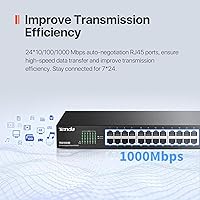
- Port Count: The switch provides 24 RJ45 ports, each capable of 10/100/1000 Mbps Auto-negotiation to accommodate legacy and modern devices on the same network.
- Auto-MDI/MDIX: All 24 ports support Auto-MDI/MDIX, eliminating the need to distinguish between straight-through and crossover cables during installation.
- Switch Capacity: The non-blocking switch fabric delivers 48 Gbps of total switching capacity, allowing every port to operate at full gigabit speed simultaneously.
- Packet Buffer: A 4 MB shared packet buffer helps absorb short traffic bursts and reduces the likelihood of dropped frames under moderate congestion.
- Jumbo Frames: The switch supports jumbo frames up to 12K bytes, which improves throughput efficiency for NAS transfers, iSCSI, and other large-payload workloads.
- Flow Control: IEEE 802.3x flow control is supported on all ports, allowing connected devices to signal the switch to pause transmission and avoid buffer overflow.
- Cooling Method: Passive fanless cooling is achieved through a full steel chassis with perforated ventilation panels on three sides, requiring no moving parts for heat dissipation.
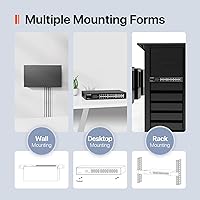
- Chassis Material: The enclosure is constructed from full steel with a rackmount-compatible form factor designed to seat in a standard 19-inch rack.
- Dimensions: The unit measures 13.58 x 3.66 x 10 inches, occupying a standard 1U rack space in depth-constrained enclosures.
- Weight: At 1.5 pounds, the switch is lightweight enough for single-person rack installation without additional support hardware.
- Input Voltage: The switch operates on 120V AC input, compatible with standard North American power outlets and rack-mounted PDUs.
- Max Temperature: The rated upper operating temperature is 70 degrees Celsius, providing adequate thermal headroom for typical enclosed rack environments.
- Management Type: The switch is fully unmanaged with no web interface, CLI, or SNMP support, operating entirely through plug-and-play auto-configuration.
- Interface Type: All ports use the RJ45 connector standard; there are no SFP or fiber uplink ports on this model.
- PoE Support: The switch does not support Power over Ethernet on any port, and cannot supply power to connected devices such as access points or IP cameras.
- Warranty: Tenda provides a limited lifetime warranty on this switch, covering manufacturing defects for the original purchaser.
- Product Vintage: This model was first introduced in December 2011, making it one of the longer-running unmanaged gigabit switches in its price segment.
- VLAN Support: No VLAN, QoS, or traffic prioritization features are available, as the switch operates as a flat Layer 2 forwarding device only.
Related Reviews
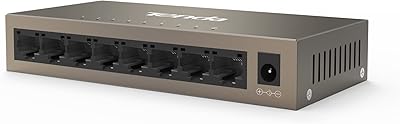
Tenda TEG1008M 8-Port Gigabit Ethernet Switch
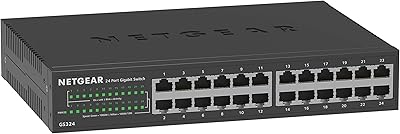
NETGEAR GS324 24-Port Gigabit Ethernet Switch
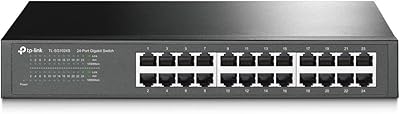
TP-Link TL-SG1024S 24-Port Gigabit Switch
STEAMEMO 16-Port Managed Gigabit Ethernet Switch
Tenda TEG1005D 5-Port Gigabit Network Switch
ienRon 10-Port Gigabit Ethernet Switch
STEAMEMO 26-Port Gigabit Managed Ethernet Switch
Goalake 16-Port Gigabit Managed Switch
NICGIGA GS2421P 24-Port PoE+ Gigabit Switch