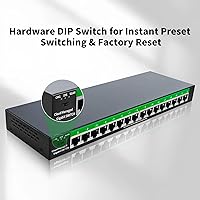
Overview

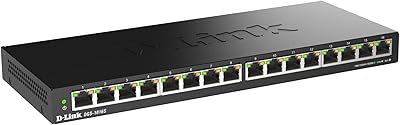
The STEAMEMO 16-Port Managed Gigabit Ethernet Switch arrives in a market long dominated by Netgear and TP-Link, and it makes a credible case for itself without the premium price tag. Manufactured by SSC and launched in mid-2024, STEAMEMO is not a household name — and that is worth acknowledging upfront. What you get is a compact metal chassis measuring 5.47″ x 1.46″ x 0.55″, light enough at 1.43 pounds to sit on a desk or mount on a wall without any fuss. For a brand this new, landing at #39 in Amazon's Networking Switches category with a 4.4-star average across 439 reviews is genuinely encouraging.
Features & Benefits

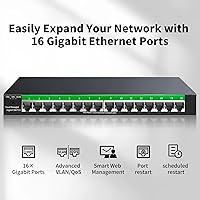
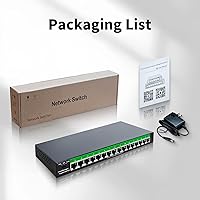
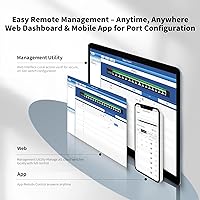
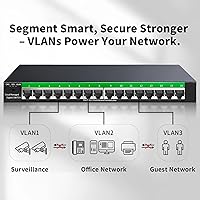
All 16 ports run at full gigabit speeds, so there is no bottlenecking when you connect NAS drives, VoIP phones, and workstations at the same time. The web-based management interface is approachable enough that CLI experience is not a requirement, and the free companion software adds useful flexibility for remote administration. VLAN support follows IEEE 802.1Q with up to 15 groups, alongside MTU and port-based segmentation for isolating traffic. QoS prioritization keeps latency-sensitive traffic like video calls stable under load. The fanless steel enclosure operates quietly and tolerates temperatures up to 60°C, and a power adapter ships in the box.

Best For

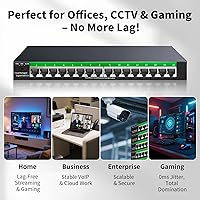
This managed switch hits a clear sweet spot for users who want more control than an unmanaged unit offers but have no appetite for enterprise-grade spending. Small business owners can segment guest traffic from internal systems without bringing in a network consultant. Home lab builders and IT students will find the VLAN and QoS configuration genuinely hands-on, not just a checkbox feature. Network installers also benefit from its compact, wall-mountable footprint in tight server closets. One honest caveat: if your environment demands more than 15 VLAN groups, this gigabit switch will likely feel limiting sooner than expected.

User Feedback

Buyers are broadly positive, and the 4.4-star average across nearly 440 reviews carries real weight for a brand that barely existed on Amazon before mid-2024. The most repeated praise centers on painless setup and surprisingly solid physical build quality for the price point — people genuinely do not expect a metal chassis here. On the critical side, reviewers flag thin documentation and reasonable uncertainty about long-term firmware support from a lesser-known manufacturer. A handful compare it directly to the TP-Link TL-SG1016DE, noting the STEAMEMO 16-port switch undercuts it on cost but leaves open questions around ongoing software updates.

Pros

  • All 16 ports run at full gigabit speed simultaneously — no shared bandwidth compromises.
  • Web-based management is genuinely beginner-friendly; no command-line experience required to get started.
  • The metal chassis feels noticeably more solid than plastic alternatives in the same price bracket.
  • Fanless operation keeps things quiet in open-plan offices or living spaces.
  • VLAN and QoS features work reliably for standard small-office traffic segmentation needs.
  • Setup is straightforward out of the box — most buyers report being up and running in minutes.
  • Wall-mount compatibility adds real installation flexibility in tight or unconventional spaces.
  • Free companion software extends management options beyond the browser interface at no extra cost.
  • Power adapter is included, so there are no hidden accessory costs after purchase.
  • For a brand launched in mid-2024, the 4.4-star average across nearly 440 reviews is a credible early signal of consistent quality.

Cons

  • VLAN support is capped at 15 groups, which may be too restrictive for growing or complex networks.
  • STEAMEMO has no established long-term track record — firmware update frequency and support responsiveness remain open questions.
  • Documentation quality has drawn criticism from buyers, making advanced configuration harder than it should be.
  • No clear indication of SNMP, RSTP, or link aggregation support limits its appeal for more sophisticated deployments.
  • Brand unfamiliarity creates genuine uncertainty around warranty claims and after-sales service.
  • The 0.55-inch height means port labeling and cable management in dense rack environments can be fiddly.
  • Buyers accustomed to TP-Link or Netgear ecosystems may find the management software less polished by comparison.
  • Long-term firmware support from a lesser-known manufacturer is not guaranteed, which matters for security-conscious deployments.

Ratings

The scores below for the STEAMEMO 16-Port Managed Gigabit Ethernet Switch were generated by our AI system after analyzing verified buyer reviews from global marketplaces, with spam, bot activity, and incentivized feedback actively filtered out. The ratings reflect a genuine cross-section of real-world experiences — both the aspects buyers consistently praised and the friction points that came up repeatedly. Nothing has been softened to protect the brand.
Value for Money
91%
For buyers stepping into managed switching without a large budget, this gigabit switch delivers a feature set that would have cost significantly more just a few years ago. Reviewers repeatedly noted that VLAN segmentation and QoS at this price point felt like a genuine bargain, especially compared to name-brand alternatives.
A small number of reviewers felt the value equation shifts if you factor in the uncertainty around long-term firmware support — paying less upfront is less appealing if the device stops receiving updates within a year or two.
Ease of Setup
88%
Most buyers reported being fully operational within minutes of plugging the switch in, with the web interface described as intuitive enough for users who had never configured a managed switch before. The plug-and-play behavior for basic connectivity meant even non-technical users could get started without reading a manual.
Users who pushed into more advanced configuration — particularly MTU VLAN and port isolation — found the documentation thin and occasionally ambiguous. A few IT students noted they had to rely on third-party tutorials to complete setups that should have been covered in the official guide.
Build Quality
84%
The steel enclosure consistently surprised buyers who expected a plastic shell at this price. Several reviewers compared it favorably to pricier units, noting that the chassis feels solid and shows no flex even when cables are plugged into every port simultaneously.
The switch is extremely slim at just 0.55″ in height, which means port labels can be hard to read in low-light server closets. A handful of buyers also noted that the finish showed minor scuffs from standard handling during installation.
Network Performance
86%
Buyers running mixed environments — VoIP phones, NAS drives, and workstations all active at once — reported stable throughput without noticeable bottlenecks. The QoS implementation held up well in real office scenarios where video conferencing needed priority over background file transfers.
A small segment of technically advanced users noted they could not independently verify non-blocking switching behavior under sustained maximum load, and the lack of detailed performance specs from the manufacturer made it harder to plan for high-density deployments with confidence.
VLAN Functionality
74%
26%
For small offices needing a clean separation between staff, guest, and printer traffic, the 15-group VLAN cap is workable and the 802.1Q implementation behaved reliably in tested configurations. Users running three to eight VLANs found the feature more than adequate for their day-to-day needs.
The 15-group ceiling is a hard stop that frustrated network administrators managing more complex environments — IoT device isolation, multiple department segments, and security zones can eat through that limit quickly. This single constraint was the most commonly cited reason buyers considered upgrading to a higher-tier alternative.
Web Management Interface
79%
21%
The browser-based interface is clean and organized well enough that first-time managed switch users could locate key settings without a steep learning curve. Common tasks like VLAN assignment and QoS configuration are reachable in just a few clicks, which reviewers appreciated.
More experienced network administrators found the interface lacking compared to platforms like TP-Link's Omada or Netgear's ProSAFE, with fewer diagnostic tools and limited visibility into real-time port statistics. The companion desktop software added some functionality but was not considered a substitute for a more mature management platform.
Noise & Thermals
93%
The completely fanless design means there is genuinely zero audible noise from this switch under any load condition, which office workers and home lab users both flagged as a standout practical benefit. The chassis stays comfortably cool even during extended operation in warm equipment rooms.
Without active cooling, placement in very poorly ventilated enclosures — like sealed wall boxes or stacked AV cabinets — carries a small thermal risk, though the 60°C operating ceiling provides reasonable headroom for most real-world installations.
Documentation Quality
52%
48%
The included setup guide covers the absolute basics well enough to get a non-technical user online with standard connectivity, and the web interface has enough inline labeling that common settings are self-explanatory. For straightforward deployments, buyers rarely needed to go beyond what was provided.
Advanced configuration documentation was widely criticized as incomplete and occasionally inaccurate, with some buyers reporting that described menu paths did not match the actual interface. The absence of a detailed online knowledge base or active community forum made troubleshooting noticeably harder than with established brands.
Brand Reliability
61%
39%
The volume of positive reviews accumulated in a short time since the August 2024 launch does suggest a consistent manufacturing baseline — units arriving defective or dead-on-arrival were not a common complaint theme, which is a meaningful early indicator.
STEAMEMO simply does not have the track record that gives buyers confidence in five-year scenarios. Questions about warranty claim responsiveness, parts availability, and whether firmware updates will continue past the initial launch window remain genuinely unanswered, and that uncertainty is priced into any honest assessment.
Firmware & Software Support
57%
43%
At the time of purchase, the switch ships with functional firmware that covers its advertised feature set without known critical bugs reported in the review pool. The companion software update process is straightforward for users who have gone through it.
The longer-term firmware roadmap from STEAMEMO is opaque — there is no published update schedule and no clear indication of how long the product will receive security or feature patches. For buyers who keep network hardware for three to five years, that ambiguity is a legitimate concern.
Port Density & Layout
82%
18%
Having 16 full gigabit ports in a chassis this compact is genuinely useful in space-constrained setups, and the port spacing is sufficient to accommodate standard RJ45 plugs without adjacent cables interfering with each other.
The ultra-slim form factor means the switch does not fit standard 19-inch rack rails without an adapter bracket, which some buyers assumed would be included or at least available as an official accessory. Wall mounting works well, but rack integration requires additional planning.
Energy Efficiency
78%
22%
Buyers running the switch continuously in small office environments noted it runs cool and draws modest power compared to older managed switches of similar port count, contributing to lower electricity overhead over time.
STEAMEMO does not publish specific idle or maximum wattage figures, which makes it difficult to calculate actual energy savings or plan UPS battery backup sizing accurately — an omission that more technically rigorous buyers found frustrating.
Compatibility
89%
The switch worked without configuration friction across a wide range of connected devices in reviewer setups — Synology NAS units, Ubiquiti access points, VoIP adapters, and standard workstations all negotiated speeds correctly and maintained stable connections.
A small number of buyers reported minor compatibility quirks with specific older network cards that required manual speed negotiation rather than relying on auto-detection, though these cases represented a clear minority of reported experiences.

Suitable for:

The STEAMEMO 16-Port Managed Gigabit Ethernet Switch is a practical fit for small business owners who need traffic segmentation and basic QoS without committing to an enterprise-grade budget. If you are running a small office with VoIP phones, shared printers, and a handful of workstations, this switch gives you the network visibility and control that an unmanaged unit simply cannot offer. IT students and home lab enthusiasts will find it a genuinely capable learning tool — configuring VLANs and QoS on real hardware is far more instructive than doing it in a simulator. Network installers handling retail fit-outs or small office renovations will also appreciate the compact, wall-mountable form factor that tucks away cleanly without a noisy fan. For anyone stepping up from a basic unmanaged switch for the first time, the web interface is accessible enough to get operational quickly without a deep technical background.
Not suitable for:

The STEAMEMO 16-Port Managed Gigabit Ethernet Switch is not the right call for environments where network reliability is mission-critical and vendor accountability matters. The 15 VLAN group ceiling will frustrate network administrators in mid-sized organizations who routinely run 20 or more segments for different departments, IoT devices, and security zones. Buyers who depend on regular firmware updates and long-term manufacturer support should think carefully — STEAMEMO is a young brand with an unproven track record in after-sales service, and that is a real risk in a production environment. If your deployment requires features like link aggregation, RSTP, or SNMP monitoring, this gigabit switch does not advertise those capabilities and likely falls short. Anyone comparing it head-to-head with established alternatives from TP-Link or Netgear for a permanent business installation should weigh brand longevity seriously before committing.

Specifications

  • Ports: The switch provides 16 x RJ45 ports supporting 10/100/1000BASE-T auto-negotiation, delivering full gigabit throughput on every port simultaneously.
  • VLAN Support: IEEE 802.1Q VLAN is supported with up to 15 configurable VLAN groups, plus MTU VLAN with port isolation and port-based VLAN segmentation.
  • QoS: Quality of Service prioritization is built in, allowing bandwidth-sensitive traffic such as VoIP calls and video streams to take precedence over lower-priority data.
  • Management: Network configuration is handled through a browser-based web interface or a free companion desktop application, supporting both local and remote administration.
  • Enclosure: The chassis is constructed from steel with a fanless passive heat dissipation design, keeping operation completely silent under normal load.
  • Dimensions: The unit measures 5.47″ in length, 1.46″ in width, and 0.55″ in height, making it one of the more compact 16-port switches in its class.
  • Weight: The switch weighs 1.43 pounds, light enough for wall mounting without requiring heavy-duty fixings.
  • Temperature Rating: The switch is rated to operate reliably in ambient temperatures up to 60°C, suitable for server closets and small equipment rooms.
  • Power Input: The unit runs on 120V AC and ships with a power adapter included in the box, requiring no separate purchase.
  • Mounting Options: The switch supports both desktop placement and wall mounting, with the compact profile accommodating tight installation environments.
  • Data Transfer Rate: Aggregate switching capacity across all 16 ports reaches 16 Gbps, assuming full gigabit utilization on every connected port.
  • Interface Type: All ports use the standard RJ45 connector, compatible with Cat5e, Cat6, and Cat6a ethernet cabling.
  • Manufacturer: The switch is manufactured by SSC and sold under the STEAMEMO brand, which entered the Amazon marketplace in August 2024.
  • ASIN: The Amazon Standard Identification Number for this product is B0DCVJ3TTP.
  • Voltage: Operating voltage is 120V AC, standard for North American wall outlets.
  • Case Material: The outer shell is made from steel, providing structural rigidity and basic electromagnetic shielding compared to plastic alternatives.
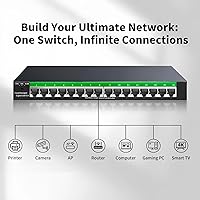
  • Compatibility: The switch is compatible with desktops, laptops, printers, NAS devices, VoIP phones, and any standard ethernet-connected equipment.
  • Launch Date: This product was first listed on Amazon on August 12, 2024, making it a relatively recent market entrant at the time of this review.

Related Reviews
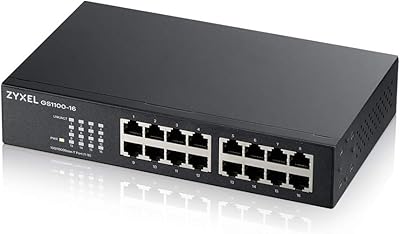
Zyxel GS1100-16 16-Port Gigabit Ethernet Switch
85%
88%
Performance
94%
Ease of Setup
91%
Energy Efficiency
85%
Build Quality
92%
Noise Levels
More
Goalake 16-Port Gigabit Managed Switch
79%
93%
Value for Money
88%
Build Quality
96%
Noise Level
79%
Ease of Initial Setup
66%
Management App Quality
More
STEAMEMO 26-Port Gigabit Ethernet Switch
84%
88%
Performance
91%
Ease of Setup
89%
Build Quality
85%
Network Stability
83%
Energy Efficiency
More
Cudy GS1016E 16-Port Managed Gigabit Switch
78%
88%
Value for Money
84%
Ease of Setup
83%
Build Quality
76%
Web Management Interface
81%
VLAN Functionality
More
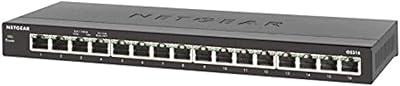
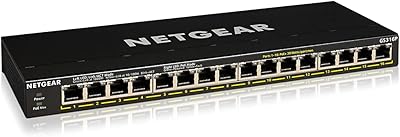
NETGEAR GS316 16-Port Gigabit Network Switch
85%
97%
Ease of Setup
96%
Noise Level
78%
Build Quality
91%
Port Performance
88%
Reliability & Longevity
More
NETGEAR GS316PP 16-Port PoE+ Gigabit Ethernet Switch
85%
92%
Value for Money
89%
Ease of Use
86%
Energy Efficiency
76%
PoE Power Delivery
90%
Quiet Operation
More
NETGEAR GS308E 8-Port Managed Network Switch
81%
93%
Reliability & Uptime
96%
Silent Operation
67%
Ease of Setup
78%
Web Management Interface
88%
Value for Tier
More
NETGEAR GS305E 5-Port Gigabit Managed Switch
76%
93%
Value for Money
84%
Setup & Ease of Use
81%
Build Quality & Durability
88%
Network Performance & Throughput
97%
Silent Operation
More
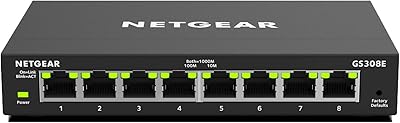
NETGEAR GS316P 16-Port PoE+ Gigabit Switch
77%
97%
Ease of Setup
94%
PoE Port Coverage
61%
PoE Power Budget
88%
Build Quality
96%
Noise Level
More
NETGEAR GS116LP 16-Port Unmanaged PoE+ Switch
86%
97%
Ease of Setup
93%
PoE Port Coverage
62%
PoE Power Budget
96%
Silent Operation
88%
Build Quality
More

FAQ

No specialized software is required to get started. The switch has a built-in web management interface you access through a browser on any device connected to the same network. There is also a free companion app available if you prefer a dedicated tool, but plenty of buyers skip it entirely and just use the browser interface without any issues.

Yes, it works plug-and-play out of the box for basic connectivity. You only need to log into the web interface if you want to set up VLANs, configure QoS, or adjust any managed features. For straightforward use cases where you just need more ports, no configuration is necessary at all.

For most small offices, 15 VLANs is more than adequate — typical setups might use separate segments for staff devices, guest Wi-Fi, printers, and VoIP phones, which easily fits within that ceiling. Where it starts to feel tight is in more complex environments with dedicated IoT networks, multiple security zones, or growing department structures. If you already know you need 20-plus VLANs, it is worth looking at a higher-tier switch before committing.

It runs completely silently. The design uses passive heat dissipation with no internal fan, so there is nothing to generate noise. That makes it a genuinely good fit for open-plan offices, reception areas, or any space where a humming fan would be noticeable.

Yes, all 16 ports use standard RJ45 connectors and support Cat5e, Cat6, and Cat6a cabling. Auto-negotiation handles the speed handshake automatically, so you do not need to worry about manually matching port settings to cable grade.

It works with any router or access point that has a standard ethernet port, regardless of brand. The switch is brand-agnostic at the network level, so whether you are running Ubiquiti, TP-Link, or a basic ISP-provided router, connectivity should not be an issue.

Firmware updates, if available, would typically be applied through the web management interface by downloading the update file from STEAMEMO and uploading it manually. The honest caveat here is that STEAMEMO is a newer brand, and how consistently they release firmware updates over time is not yet established. It is a reasonable concern to have for a production environment.

The switch is designed to support wall mounting, and its compact and lightweight build makes that practical. Check the box contents carefully, as some buyers have noted that mounting accessories may not always be included — having a couple of standard screws and anchors on hand before you install is sensible.

Both are managed gigabit switches aimed at similar buyers. The TP-Link carries stronger brand recognition and arguably more mature firmware support, while this gigabit switch undercuts it on price and offers a comparably solid metal build. The trade-off is brand longevity — TP-Link has a proven after-sales track record that STEAMEMO simply has not had time to establish yet. For a home lab or low-stakes deployment, the price difference may be worth it; for a production office environment, the TP-Link offers more peace of mind.

Warranty details should be confirmed directly with STEAMEMO or the seller at the time of purchase, as terms can vary. User feedback on support responsiveness is mixed — some buyers report satisfactory resolution, while others have noted difficulty getting timely responses. It is a fair point of caution with any newer or lesser-known brand, and worth factoring in if reliable post-purchase support is a priority for your setup.