Overview

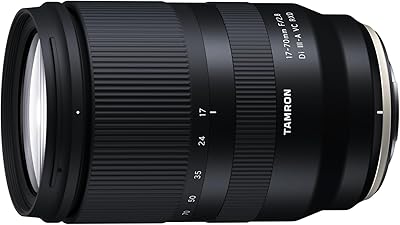
The Tamron 17-70mm f/2.8 Di III-A Zoom Lens occupies a genuinely interesting spot in the Sony APS-C ecosystem — it offers a constant f/2.8 aperture across a practical focal range that few competitors match on crop-sensor bodies. Tamron has built a solid track record in the mirrorless space by delivering real optical performance without the full-frame price premium, and this lens fits that pattern well. That said, it is worth being upfront: this fast standard zoom is aimed squarely at enthusiasts and working shooters who want a workhorse walk-around lens. Casual snapshooters or those prioritizing a featherlight kit may want to weigh their options carefully.
Features & Benefits

What makes the 17-70mm f/2.8 genuinely useful in practice is how its specs translate to real shooting situations. A constant f/2.8 aperture means you are not scrambling to compensate for light loss as you zoom in — critical when shooting indoors or under unpredictable event lighting. The RXD stepping motor is impressively quiet, which matters enormously for video work. Pair that with Tamron's upgraded VC system — which communicates with Sony's in-body stabilization and applies an AI-driven mode for smoother video pans — and you have a lens that handles motion well. The minimum focusing distance of 7.5 inches at the wide end also adds surprising close-up flexibility without ever reaching for a separate lens.

Best For

This fast standard zoom makes the most sense for photographers who shoot on the move and cannot afford to carry multiple lenses. Travel shooters, street photographers, and documentary-style videographers will find the 17-70mm focal range covers most real-world situations without a bag change. It is also a strong choice for Sony APS-C users — particularly those on bodies like the a6700 or ZV-E10 — who are outgrowing their kit lens but are not ready to commit to full-frame. The near-macro capability at the wide end is easy to underestimate; being able to move in close on a subject without switching lenses is a genuinely practical advantage in day-to-day use.

User Feedback

Across a wide range of buyers, sharpness earns consistent praise — particularly at the wide end, where many zoom lenses tend to soften. The autofocus draws frequent positive comments from video shooters, though performance can vary depending on which Sony body you are pairing it with; older bodies may not fully leverage the AF system. On the critical side, size and weight come up regularly — coming from a kit lens, the difference in bulk is real and some users find it less pocketable than expected. A smaller number of reviewers mention focus breathing during video and occasional chromatic fringing in high-contrast scenes. Minor issues overall, but worth factoring in before committing.

Pros

  • Constant f/2.8 aperture across the full zoom range keeps exposure consistent in changing light conditions.
  • Sharpness across the frame is impressive for a zoom lens, especially noticeable at the wide end.
  • The RXD autofocus motor is quiet enough to use comfortably during video recording without audio bleed.
  • VC system works cooperatively with Sony in-body stabilization for noticeably smoother handheld results.
  • Minimum focusing distance of 7.5 inches at 17mm adds genuine close-up flexibility without a second lens.
  • Moisture-resistant construction and fluorine coating make it viable to shoot in light rain or dusty conditions.
  • The 17-70mm range covers wide, standard, and short-tele shooting in a single, convenient package.
  • Firmware is updatable via USB-C, meaning Tamron can address AF behavior improvements after purchase.
  • Buyers consistently feel the optical output exceeds expectations relative to the price tier.
  • The 67mm filter thread is a common size, making polarizer and ND filter compatibility straightforward.

Cons

  • Noticeably heavier and longer than typical APS-C kit lenses — the size difference will catch some buyers off guard.
  • Focus breathing during video is a real issue for pull-focus shots and cannot be corrected in-camera.
  • Autofocus reliability varies meaningfully depending on which Sony APS-C body generation you are using.
  • Chromatic fringing appears in high-contrast backlit scenes and may require manual correction in post-processing.
  • The zoom ring can creep slightly when the lens is pointed downward, which some users find quietly annoying.
  • Bokeh in busy backgrounds can appear nervous and cluttered rather than smooth at close apertures.
  • Strictly an APS-C lens — not transferable if you upgrade to a full-frame Sony body down the line.
  • The included lens hood is relatively shallow and offers limited flare protection in harsh sunlight.
  • Close-focus advantage diminishes significantly at the telephoto end, limiting macro-style versatility at 70mm.
  • Optical quality at the 70mm corner edges trails the stronger wide-end performance under close inspection.

Ratings

The Tamron 17-70mm f/2.8 Di III-A Zoom Lens scores below are generated by an AI system trained to analyze verified global user reviews, actively filtering out incentivized, duplicate, and bot-generated submissions to surface what real buyers consistently experience. Across thousands of ownership accounts — from travel photographers to hybrid shooters — both the standout strengths and the genuine frustrations of this fast standard zoom are transparently reflected in every score.

Optical Sharpness
91%
Users shooting everything from city streets to indoor portraits consistently describe center-frame sharpness as outstanding, even wide open at f/2.8. Corner performance holds up well across most of the zoom range, which is not a given for lenses in this class.
A small segment of users note that the 70mm end shows slightly softer corners compared to the impressive wide-end performance. It is not a deal-breaker, but pixel-peepers shooting at the telephoto end on high-resolution bodies will notice.
Aperture Versatility
93%
A constant f/2.8 across the full zoom range is a real-world advantage that kit lens owners will feel immediately — no more losing stops of light as you zoom in during a dim reception or evening street scene. The consistency makes exposure management predictable and reliable.
Even at f/2.8, the lens cannot quite match the isolation or low-light headroom of fast primes. Buyers expecting prime-like subject separation at the long end may find the background rendering competent but not dramatic.
Autofocus Performance
84%
The RXD stepping motor is genuinely quiet — quiet enough that it disappears entirely in video recordings even with a built-in microphone. Tracking on moving subjects in decent light is responsive and confident on current Sony APS-C bodies like the a6700.
Performance is noticeably body-dependent; users on older Sony APS-C generations report occasional hesitation in low contrast or dim conditions. It is worth researching compatibility with your specific camera before assuming flagship-level AF behavior.
Image Stabilization
86%
The upgraded VC system earns consistent praise from handheld shooters and vloggers who notice a tangible reduction in micro-jitter, especially when the lens communicates with Sony in-body stabilization. The AI-assisted video mode produces noticeably smoother panning footage.
A handful of users report that the VC can occasionally introduce a subtle wobble during fast directional movement rather than the linear stabilization you might expect. It is an edge case, but worth knowing if you shoot fast-moving action handheld.
Build Quality & Durability
82%
18%
The moisture-resistant construction and fluorine-coated front element give real confidence when shooting in light rain or dusty environments — conditions where most photographers do not want to retreat indoors. The zoom and focus rings feel precise and well-damped.
The build is solid but does not feel premium in the way metal-barreled lenses do; the exterior material gives a slightly utilitarian impression. A few users mention that the zoom ring creeps slightly when the lens is pointed downward, which can be mildly frustrating.
Video Capability
83%
For APS-C hybrid shooters, this lens ticks most of the boxes: quiet AF, effective stabilization, and a focal range that covers vlogging wide shots through medium close-ups without switching glass. The combination works especially well on the ZV-E10.
Focus breathing — the slight change in framing as focus shifts — is a real and recurring complaint from dedicated video users. It is not severe, but shooters doing critical narrative work will notice it, and there is no optical or firmware correction available.
Bokeh Rendering
74%
26%
At f/2.8, background blur is pleasant and more convincing than most zoom lenses in this category. Portrait-distance subjects at the longer end of the range produce reasonably smooth separation that holds up well in social media or print at normal sizes.
Busy or high-contrast backgrounds can produce somewhat nervous bokeh with visible edge artifacts on out-of-focus highlights. Compared to a dedicated fast prime, the rendering lacks the smoothness that many bokeh-conscious photographers expect.
Close-Focus Capability
79%
21%
A minimum focusing distance of 7.5 inches at 17mm is genuinely impressive for a standard zoom and opens up shots — food details, small objects, environmental portraits — that would normally require a dedicated macro or close-up lens.
The close-focus advantage applies primarily at the wide end; at 70mm the minimum distance stretches to 15.4 inches, which limits the magnification ratio for traditional macro-style work. Users expecting macro-level detail across the range will be disappointed.
Size & Portability
63%
37%
For everything this lens offers — constant f/2.8, VC, weather sealing — the physical dimensions are a reasonable trade-off that many photographers accept once they start shooting with it regularly.
At 1.2 pounds and nearly 4.7 inches long, this is noticeably larger and heavier than the APS-C kit lenses most buyers are upgrading from. Users who prioritize a slim, pocketable setup find the bulk a consistent frustration, particularly on a full day out.
Value for Money
88%
The combination of constant f/2.8, effective stabilization, and strong optical performance at this price point is difficult to match in the Sony E-mount APS-C ecosystem. Buyers regularly note that the lens delivers results they associate with higher price tiers.
There is no direct Sony first-party competitor at this aperture and focal range, which limits comparison shopping. Some users feel the price has crept up since launch and that it no longer represents the same obvious value it once did relative to alternatives.
Chromatic Aberration Control
71%
29%
In most everyday shooting conditions — mixed natural light, standard cityscapes, portraits — chromatic aberration stays well controlled and rarely draws attention. In-camera correction handles the majority of remaining fringing acceptably.
In high-contrast scenes with bright backlighting or specular highlights, lateral chromatic fringing becomes visible and occasionally requires manual correction in post. It shows up more on higher-resolution sensors where pixel-level inspection is more revealing.
Filter Thread Usability
81%
19%
The 67mm filter thread is a common size shared across several Tamron and third-party lenses, making it straightforward for photographers who already own a polarizer or ND filters in this size to get immediate use without extra investment.
The front element does not rotate during focusing, which is helpful for polarizer use, but the filter size is larger than some competing APS-C lenses, meaning existing smaller filter sets do not carry over without step-up rings.
Zoom Range Practicality
89%
The 17-70mm range translates to roughly 25-105mm in full-frame terms on APS-C, covering wide environmental shots through short telephoto compression in a single lens. For a walk-around setup, that span handles the majority of real shooting scenarios without compromise.
Photographers who regularly need a longer reach — wildlife, sports, distant subjects — will find 70mm runs out of focal length quickly. The range excels at versatility for general use but is not a substitute for a dedicated telephoto.
Lens Flare Resistance
72%
28%
Under controlled lighting, flare is minimal and the fluorine coating provides some practical resistance to smudges and surface reflections that can degrade contrast when shooting toward light sources.
Shooting directly into strong backlight or toward the sun reveals some veiling flare and contrast reduction. A lens hood helps, but the supplied hood is modest in depth and users who shoot in harsh sun frequently recommend aftermarket alternatives.
Compatibility & Ecosystem Fit
87%
The lens communicates fluently with Sony APS-C bodies via the E-mount protocol, enabling features like in-body stabilization coordination and full EXIF data. Tamron also provides firmware update capability via USB-C, which has addressed some early AF behavior concerns.
The lens is strictly APS-C and will vignette heavily on full-frame bodies, closing off future upgrade paths without replacing the lens. Photographers already planning a move to full-frame should factor that limitation into the purchase decision.

Suitable for:

The Tamron 17-70mm f/2.8 Di III-A Zoom Lens is a strong match for Sony APS-C shooters who want a single, capable lens that handles a wide range of everyday situations without compromise. Travel photographers who hate swapping glass mid-trip will appreciate the practical focal range — wide enough for landscapes and interiors, long enough for compressed street shots and candid portraits. Hybrid shooters and vloggers on bodies like the ZV-E10 or a6700 will get real value from the quiet RXD autofocus and the VC system that works alongside Sony in-body stabilization to smooth out handheld footage. Event and documentary photographers who regularly shoot in dim venues — restaurants, receptions, conference halls — will find the constant f/2.8 aperture a genuine advantage over variable-aperture alternatives. Enthusiasts who have outgrown their kit lens and want a meaningful optical upgrade without committing to full-frame will find this fast standard zoom a compelling next step that grows with their skills.
Not suitable for:

Buyers who prioritize a lightweight, low-profile kit should think carefully before purchasing the Tamron 17-70mm f/2.8 Di III-A Zoom Lens, as it is noticeably bulkier and heavier than the APS-C kit lenses most Sony shooters start with. Photographers planning to migrate to a full-frame Sony body in the near future should also reconsider, since this lens is designed strictly for crop-sensor cameras and will vignette heavily on full-frame bodies — making the investment non-transferable. Those who need serious telephoto reach for wildlife, sports, or distant subjects will find 70mm runs out quickly and should look at dedicated longer zooms instead. Dedicated video professionals doing narrative or cinematic work may find the focus breathing during pull-focus shots a persistent frustration that is difficult to work around in post. Similarly, photographers chasing the smooth, creamy background separation of fast primes will find that f/2.8 on a zoom, while very good, does not fully replicate that look — particularly at the wide end of the focal range.

Specifications

  • Focal Length: The lens covers a 17-70mm zoom range, equivalent to approximately 25.5-105mm in full-frame terms when used on an APS-C sensor body.
  • Maximum Aperture: A constant f/2.8 aperture is maintained throughout the entire zoom range, ensuring consistent light intake and exposure behavior at every focal length.
  • Minimum Aperture: The minimum aperture is f/22, giving photographers full control over depth of field and exposure across a wide range of lighting conditions.
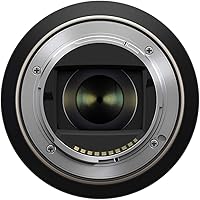
  • Lens Mount: Designed exclusively for Sony E-mount, this lens is optimized for APS-C mirrorless camera bodies and communicates fully with the camera's electronic systems.
  • Optical Formula: The optical design consists of 16 elements arranged in 12 groups, incorporating two GM (Glass Molded Aspherical) elements and one hybrid aspherical element to control aberrations and maintain edge-to-edge sharpness.
  • Stabilization: The lens features Tamron's upgraded Vibration Compensation (VC) system, which coordinates with Sony in-body image stabilization (IBIS) and includes a dedicated AI-assisted mode optimized for video shooting.
  • Autofocus Motor: An RXD (Rapid eXtra-silent stepping Drive) motor powers autofocus, delivering fast and near-silent focusing performance well-suited for both still photography and video recording.
  • Min. Focus Distance: The minimum focusing distance is 7.5 inches (19cm) at 17mm and 15.4 inches (39cm) at 70mm, enabling close-up shooting without a dedicated macro lens.
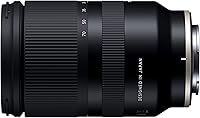
  • Filter Thread: The lens accepts 67mm screw-in filters on a non-rotating front element, making it straightforward to use polarizing, ND, or protective filters.
  • Dimensions: The lens measures 4.7 inches (119.3mm) in length and 2.94 inches (74.6mm) in diameter, making it larger than typical APS-C kit lenses.
  • Weight: The lens weighs 1.2 pounds (525g), which is noticeably heavier than variable-aperture standard zooms designed for Sony APS-C bodies.
  • Weather Sealing: Moisture-resistant construction is built into the lens barrel, offering practical protection against light rain and dusty shooting environments.
  • Front Coating: The front element features a fluorine coating that repels water, oil, and fingerprints, making field cleaning easier and helping maintain optical clarity.
  • Zoom Ratio: The lens offers a 4.1x zoom ratio, covering wide-angle through short-telephoto focal lengths in a single optic without optical compromises at either extreme.
  • Aperture Blades: The lens uses a 9-blade rounded aperture diaphragm, which contributes to smoother out-of-focus rendering and more circular bokeh highlights at wider apertures.
  • Firmware Updates: The lens supports firmware updates via a USB-C connection using Tamron's optional TAP-in Console, allowing owners to apply AF improvements and customizations post-purchase.
  • Lens Hood: A petal-style lens hood is included in the box and mounts via a bayonet fitting to provide basic flare and impact protection during shooting.
  • Model Number: The official Tamron model designation for this lens is AFB070S700, which identifies it as the Sony E-mount variant within the product line.

Related Reviews

Tamron 17-70mm F/2.8 Di III-A VC RXD Zoom Lens for Fujifilm X
86%
91%
Image Quality
88%
Vibration Compensation (VC) Effectiveness
84%
Autofocus Performance
90%
Build Quality and Durability
85%
Low Light Performance
More
Tamron 35mm f/2.8 Di III OSD M1:2 Lens for Sony E-Mount
85%
94%
Image Quality
75%
Autofocus Speed
90%
Macro Performance
88%
Build Quality
91%
Portability
More
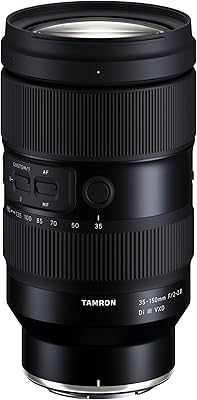
Tamron 35-150mm F/2-2.8 Di III VXD Lens
84%
92%
Optical Sharpness
89%
Autofocus Performance
94%
Aperture Versatility
87%
Build Quality
78%
Value for Money
More
Tamron 24mm F/2.8 Di III OSD Lens
79%
91%
Image Sharpness
93%
Value for Money
74%
Build Quality & Durability
71%
Autofocus Performance
88%
Macro Capability
More
Tamron 17-28mm f/2.8 Di III RXD Lens
80%
88%
Image Sharpness
91%
Autofocus Performance
79%
Build Quality
93%
Portability & Size
86%
Low-Light Performance
More
Tamron 20-40mm f/2.8 Di III VXD Lens
80%
91%
Image Sharpness
89%
Autofocus Performance
83%
Build Quality & Durability
94%
Size & Portability
67%
Zoom Range Versatility
More
Tamron 11-20mm F/2.8 Di III-A Wide-Angle Lens
84%
91%
Image Sharpness
88%
Autofocus Performance
86%
Build Quality & Weather Sealing
74%
Value for Money
67%
Distortion & Optical Corrections
More
Tamron 35-150mm F/2-2.8 Di III VXD for Nikon Z
85%
82%
Autofocus Performance
91%
Image Quality (Sharpness & Color Accuracy)
88%
Build Quality & Durability
85%
Ease of Use & Ergonomics
87%
Portability & Weight
More
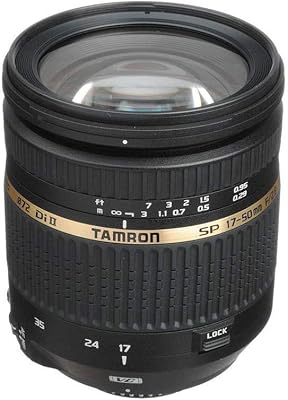
Tamron SP 17-50mm F/2.8 XR Di-II VC for Nikon
84%
88%
Image Quality
92%
Low Light Performance
74%
Autofocus Speed
80%
Build Quality
89%
Vibration Compensation (VC)
More
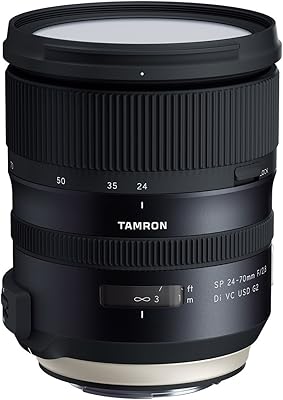
Tamron SP 24-70mm F/2.8 G2 Camera Lens
85%
91%
Image Sharpness
88%
Autofocus Performance
84%
Vibration Compensation
93%
Build Quality
82%
Weather Sealing
More

FAQ

Technically it will mount and fire, but it is designed strictly for APS-C sensors. On a full-frame body it will produce heavy vignetting around the edges unless you shoot in APS-C crop mode, which significantly reduces the effective resolution. If you are on full-frame or planning to move there, this is not the right lens for you.

In decent indoor light it tracks moving subjects reliably, and the RXD motor responds quickly enough for casual action. That said, AF consistency does vary depending on your Sony body — newer generation cameras like the a6700 get the most out of the system, while older bodies may show occasional hesitation in lower contrast or very dim conditions.

For most enthusiasts, yes — the Tamron 17-70mm f/2.8 Di III-A Zoom Lens represents a meaningful step up in low-light capability, sharpness, and overall image quality compared to the standard 16-50mm f/3.5-5.6 kit lens. The constant f/2.8 aperture alone changes how you can shoot in dim environments. Just be prepared for the increase in size and weight.
Yes, the front element takes 67mm filters and importantly does not rotate during focusing, which makes using a circular polarizer much easier. If you already own polarizers or ND filters in 67mm from another lens, they will work directly without any adapter.

It is present and noticeable if you are doing deliberate pull-focus shots or rack focusing between subjects — the frame subtly widens or narrows as focus shifts. For most vlogging or documentary-style shooting it is not a major issue, but if you are doing narrative filmmaking where clean focus pulls are critical, it is worth factoring into your decision.

It makes a genuine, measurable difference — especially for video. The VC system coordinates with Sony IBIS on compatible bodies, and the AI video mode applies a stabilization profile suited to the smoother motion of panning shots. Handheld photographers also notice reduced micro-jitter at slower shutter speeds compared to shooting without VC active.

At the wide end (17mm) you can focus from as close as 7.5 inches from the subject, which is genuinely useful for shooting food, small objects, or environmental details without switching to a macro lens. At 70mm the minimum distance stretches to about 15.4 inches, so the close-focus advantage is most useful at the wider focal lengths.

The moisture-resistant construction handles light rain and mist confidently — many users shoot in typical overcast, drizzly conditions without issue. It is not a fully sealed professional lens rated to specific weather standards, so you would want to avoid direct heavy downpours or submerging it, but for outdoor shooting in variable weather it provides practical real-world protection.

It is genuinely pleasant for a zoom lens, and most people shooting at normal social media or even print sizes will be happy with the background separation at f/2.8. That said, if you put it side by side with a dedicated 35mm or 50mm prime at f/2.8, the prime will typically produce smoother, more refined out-of-focus rendering — particularly in busy backgrounds. It is a good zoom, not a prime substitute.

Yes, you can update the firmware at home, but you will need to purchase Tamron's TAP-in Console accessory separately since the lens connects via USB-C to that dock rather than directly to your camera. The process itself is straightforward once you have the console — Tamron provides clear instructions and the updates have historically addressed real AF behavior improvements, so it is worth doing if you buy one.

Where to Buy