Overview

The Tamron 11-20mm F/2.8 Di III-A Wide-Angle Lens arrived in 2021 as a genuinely compelling option for Sony APS-C shooters who want fast, wide glass without committing to a full-frame system. Its 16.5–30mm full-frame equivalent range covers the sweet spot for tight interiors, expansive landscapes, and environmental portraits — situations where a slower kit lens simply falls short. At its price point, this Tamron wide-angle zoom sits in mid-to-premium territory, squarely competing with Sony's own native wide options. Years on from its debut, it still holds up as one of the stronger arguments for staying with the APS-C format.
Features & Benefits

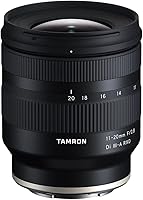
The most immediately useful thing about the 11-20mm f/2.8 is that constant f/2.8 aperture — pull back to 20mm for a tighter frame and your exposure does not shift. That consistency matters equally in low-light venues, wedding receptions, and astrophotography. The lens is also physically small: 3.4 inches long and just under 12 ounces, which feels meaningfully compact next to any full-frame wide-angle. Its minimum focus distance of under 6 inches at 11mm enables striking close-wide compositions most wide zooms cannot match. The RXD autofocus motor runs quietly enough for video, and native Sony E-mount integration means in-body stabilization works exactly as expected.

Best For

This compact ultra-wide lens makes the most sense for travel and street photographers shooting Sony APS-C bodies — the A6700 being an especially natural pairing — who want one wide lens that handles everything from cramped alleyways to open plazas. Videographers will appreciate the quiet motor and consistent exposure that makes it practical as a run-and-gun option. Landscape and architecture photographers benefit from close focusing, which lets you lead a composition with a foreground element in ways a typical wide zoom does not allow. It also makes a strong first upgrade for anyone stepping off a kit zoom and wanting noticeably better low-light performance.

User Feedback

With a 4.5-star average across over a hundred ratings, the reception for this Tamron wide-angle zoom is strongly positive but not unanimous. Sharpness and build quality come up repeatedly in favorable reviews, with many users noting that AF on Sony bodies is snappy and reliable. The sticking point for some buyers is barrel distortion at 11mm — it exists, and it is worth being upfront about, though in-camera or Lightroom correction handles it without much fuss. A handful of reviewers weigh it against the Sigma 10-18mm f/2.8 on price-to-performance grounds, while others note that Sony's 10-18mm f/4 simply cannot compete in low light. Video shooters tend to rate it especially highly.

Pros

  • Constant f/2.8 aperture across the full zoom range keeps exposure consistent in low-light venues.
  • Native Sony E-mount ensures full compatibility with eye-tracking AF and in-body stabilization.
  • Minimum focus distance under 6 inches at 11mm enables creative close-wide compositional options most wide zooms cannot match.
  • The 11-20mm f/2.8 weighs under 12 ounces, making it genuinely light enough for all-day travel shooting.
  • Moisture-resistant construction and fluorine front coating handle light rain and dusty environments confidently.
  • RXD autofocus motor runs quietly enough for video use without audible noise on the recording.
  • Center sharpness wide open at f/2.8 is strong enough that stopping down is a choice, not a necessity.
  • Standard 67mm filter thread does not rotate during focusing, making polarizer and ND use straightforward.
  • The zoom range covers everything from dramatic ultra-wide interiors to near-standard wide-angle environmental portraits.

Cons

  • Barrel distortion at 11mm in RAW files requires consistent lens correction in post-processing workflows.
  • Corner sharpness at the widest end and largest aperture is noticeably weaker than center performance.
  • The lens has no optical stabilization of its own, leaving older Sony APS-C bodies without IBIS at a disadvantage.
  • At the wide end, polarizer filters produce uneven sky gradation that cannot be fully corrected in editing.
  • Focus breathing during video close-up pulls is visible enough to matter in more controlled production work.
  • The plastic barrel finish does not match the tactile premium feel some buyers expect at this price point.
  • Flare and ghosting when shooting into strong light sources at 11mm can require extra effort to manage or reframe.
  • The zoom range caps at a 30mm full-frame equivalent, so it functions as a specialist wide tool rather than a versatile walk-around lens.

Ratings

The Tamron 11-20mm F/2.8 Di III-A Wide-Angle Lens has been scored using AI analysis of verified buyer reviews worldwide, with spam, bot-generated, and incentivized submissions actively filtered out before scoring. These ratings reflect the honest consensus of real photographers and videographers who use this compact ultra-wide lens in the field — from city travel shoots to low-light interiors. Both the standout strengths and the genuine friction points are represented transparently across every category below.
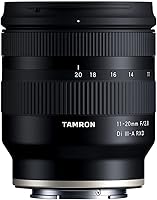
Image Sharpness
91%
Users consistently single out center sharpness as a genuine strength, even wide open at f/2.8. Photographers shooting architecture and tight interior scenes report clean, detailed results without needing to stop down to f/5.6 just to get usable edges.
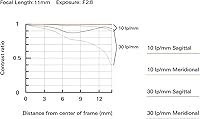
Corner sharpness at 11mm gets more mixed reactions, particularly at wider apertures. Some landscape shooters note that the extreme edges soften noticeably, which can be a frustration when a perfectly level horizon shot reveals slightly mushy sky corners.
Autofocus Performance
88%
The RXD motor earns real praise from video shooters who need AF that does not hum audibly into the microphone. On Sony A6700 and A6600 bodies, tracking stays locked reliably during handheld walking shots and event coverage.
A minority of users report occasional hesitation in very low-contrast scenes — flat white walls or heavily overcast skies can cause a brief hunting cycle. It is not a dealbreaker, but shooters in challenging lighting conditions should factor this in.
Build Quality & Weather Sealing
86%
The moisture-resistant construction and fluorine coating give this lens a confidence that cheaper wide zooms simply do not have. Travel photographers report taking it out in light rain and dusty conditions without any ill effects on performance or longevity.
The plastic exterior, while functional, does not feel as premium as some rivals at this price tier. A few users coming from metal-barreled lenses mention that the tactile experience feels slightly underwhelming for the asking price.
Value for Money
74%
26%
Compared to Sony's 10-18mm f/4, the faster aperture and closer minimum focus distance represent a genuine functional upgrade rather than a marginal one. For photographers who regularly shoot in dim venues or want creative close-wide compositions, the extra spend is justifiable.
Cross-shoppers seriously considering the Sigma 10-18mm f/2.8 will find the value equation less clear-cut. At similar or lower prices depending on the sale cycle, the Sigma pressures this Tamron on both specs and build perception, making the purchase decision less obvious than it once was.
Distortion & Optical Corrections
67%
33%
In-camera JPEG correction on Sony bodies handles barrel distortion automatically and mostly invisibly. For shooters who live in JPEG or do minimal post-processing, the lens performs cleanly without any manual intervention.
Shooting RAW at 11mm reveals noticeable barrel distortion that needs corrective adjustment in Lightroom or Capture One. It is entirely fixable, but photographers who prefer uncorrected files or shoot scenes with strong straight lines — architecture interiors, grid ceilings — will find it a recurring chore.
Size & Portability
93%
At just under 12 ounces and 3.4 inches long, this compact ultra-wide lens pairs with APS-C bodies in a way that feels genuinely balanced rather than front-heavy. Travel shooters who pack light specifically call out how it does not dominate a small camera bag or feel awkward hanging on a wrist strap all day.
Relative to a prime wide lens, it is still noticeably larger. Photographers who previously shot a compact 16mm or 20mm prime and are considering this for the zoom range should be aware the size increase is real, not just a spec-sheet number.
Low-Light Performance
89%
The constant f/2.8 aperture is the core reason many buyers choose this over the Sony 10-18mm f/4. In candlelit restaurants, dimly lit event halls, and blue-hour cityscapes, the extra stop of light makes a tangible difference in both shutter speed flexibility and autofocus reliability.
Wide open at f/2.8, some users notice slight vignetting in corners that requires compensation in post. It is a minor issue compared to the low-light gains, but it is worth knowing if you are composing shots where clean, evenly lit edges matter.
Video Usability
87%
The quiet RXD motor combined with native Sony E-mount integration makes this a genuinely useful video lens. Vloggers using A-series Sony bodies report that AF breathing is controlled enough for most run-and-gun work, and the wide field of view handles tight spaces where longer lenses fail completely.
A handful of videographers note that focus breathing — a subtle change in framing as the lens racks focus — is present and visible on close-range subjects. It is not severe, but dedicated video productions that require clinical focus pulls may prefer a lens specifically optimized for cinema use.
Close Focus & Macro Capability
82%
18%
A minimum focus distance of under 6 inches at 11mm is genuinely unusual for a wide zoom in this class. Food photographers, product shooters, and creative landscape photographers who want a foreground element in sharp focus while the background stretches wide will find this capability opens up compositions that comparable lenses simply cannot achieve.
The 1:4 maximum magnification ratio is useful but not true macro. Buyers expecting insect-level close-up detail will be disappointed; this is a compositional tool for environmental context shots, not a substitute for a dedicated macro lens.
Lens Coating & Flare Resistance
78%
22%
The fluorine coating does a solid job of repelling smudges, water droplets, and dust from the front element — practically useful when shooting outdoors without a UV filter. Photographers working near wet environments report that a quick wipe with a dry cloth restores the front element cleanly.
Shooting directly into bright light sources — particularly at 11mm where the angle of view is very wide — can produce visible flare and ghosting. Using a lens hood helps substantially, though the included hood's shallow depth limits its effectiveness against strong side-lighting.
Zoom Range Versatility
81%
19%
The 11–20mm range covers more ground than it might seem on paper. Shooting at 20mm on APS-C gives a perspective close to a standard wide-angle that works for environmental portraits, while 11mm pulls back far enough for dramatic architectural interiors or confined spaces where you simply cannot step further back.
Photographers who regularly shoot at longer focal lengths will find themselves reaching for a second lens frequently. The range tops out at the equivalent of 30mm full-frame, which is still quite wide, so it functions best as a specialist wide tool rather than a walk-around zoom.
Compatibility & Electronics Integration
94%
Full native Sony E-mount communication means every feature on the camera body works exactly as expected — real-time eye tracking, IBIS cooperation, and accurate EXIF data all function without any adapter quirks or firmware workarounds. This is a distinct advantage over third-party lenses on adapters.
The lens is exclusively APS-C compatible by design, so Sony photographers who later upgrade to a full-frame A7 or A9 body will find it only usable in crop mode. It is not a flaw, but buyers who see a full-frame upgrade in their near future should factor this into their long-term investment thinking.
Handling & Ergonomics
83%
The zoom ring operates smoothly without excessive resistance, and the focus ring provides enough tactile feedback for manual focus pulling in video work. The balanced weight distribution on compact APS-C bodies means one-handed shooting stays comfortable over extended periods.
The lens lacks an optical stabilization system of its own, relying entirely on the camera body's IBIS. On older Sony APS-C bodies without in-body stabilization — the A6000 or A6100 — handheld shooting at slower shutter speeds requires more discipline than it would with a stabilized optic.
Filter Usability
79%
21%
The 67mm filter thread is a standard size that most photographers already have ND and polarizer filters for, which keeps the cost of adding filters predictably low. The thread does not rotate during focusing, which is especially important for correctly orienting polarizers and graduated ND filters.
Ultra-wide lenses and circular polarizers are always a tricky combination — at 11mm, uneven polarization across the wide sky is visible and cannot be fully corrected in post. Photographers who rely heavily on polarizers for outdoor work may find this more limiting than the filter thread specification suggests.

Suitable for:

The Tamron 11-20mm F/2.8 Di III-A Wide-Angle Lens is purpose-built for Sony APS-C photographers who want a single wide zoom that handles a broad range of real shooting situations without dragging down a lightweight kit. Travel photographers will find the combination of compact dimensions, weather sealing, and fast aperture particularly well-matched to unpredictable conditions — whether that means a sudden drizzle in a European alley or a dimly lit guesthouse interior. Street photographers and documentary shooters benefit from the close focusing capability, which lets you work with a strong foreground subject while keeping the wider environment visible in the frame. Videographers using Sony APS-C bodies will appreciate the quiet RXD autofocus motor and the consistent f/2.8 exposure across the zoom range, both of which make it a practical run-and-gun option. Landscape and architecture shooters who want dramatic wide perspectives without carrying heavy full-frame glass will find this compact ultra-wide lens a genuinely capable everyday tool.
Not suitable for:

The Tamron 11-20mm F/2.8 Di III-A Wide-Angle Lens is not the right choice for every Sony shooter, and it is worth being direct about where it falls short. Photographers planning to move to a full-frame Sony body in the near term will find this lens limited to crop mode on those bodies, making it a poor long-term investment for anyone on a clear upgrade path. Buyers who shoot heavily in RAW and frequently photograph straight architectural lines should know that barrel distortion at 11mm requires consistent correction in post — it is manageable, but it adds a recurring step that some photographers would rather avoid. If your primary concern is ultimate portability and you shoot at a fixed focal length, a compact wide prime will be lighter and sharper in the corners. The 11–20mm range also tops out at the equivalent of 30mm full-frame, so photographers who want a true walk-around lens covering wider everyday focal lengths will still need a second optic. Finally, buyers who place high value on a premium metal-barrel tactile feel may find the build finish underwhelming relative to the price.
Specifications

  • Focal Length: Covers 11–20mm on APS-C sensors, equivalent to approximately 16.5–30mm on a full-frame camera.
  • Max Aperture: Constant f/2.8 maximum aperture is maintained across the entire zoom range without any exposure shift.
  • Lens Mount: Designed exclusively for Sony E-mount, with full native electronic communication for autofocus and metering.
  • Format Coverage: Engineered for APS-C mirrorless cameras only; using it on full-frame Sony bodies restricts operation to crop mode.
  • Min Focus Distance: Minimum focusing distance is 5.9 in at 11mm and 9.4 in at 20mm, enabling close-wide creative compositions.
  • Max Magnification: Maximum magnification ratio reaches 1:4 at 11mm, making it capable of near-macro environmental close-ups.
  • Autofocus Motor: RXD (Rapid eXtra-silent stepping Drive) motor delivers fast, near-silent autofocus suited for both stills and video recording.
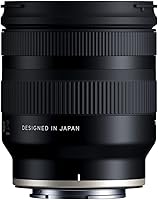
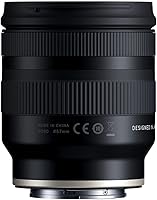
  • Dimensions: The lens measures 3.4″ in length and 2.9″ in diameter, keeping the overall footprint compact for an f/2.8 zoom.
  • Weight: Weighs 11.8 oz (335 g), which balances well on compact Sony APS-C bodies without causing front-heavy handling fatigue.
  • Filter Thread: 67mm filter thread diameter is a common standard size, and the thread does not rotate during autofocus operation.
  • Weather Sealing: Moisture-resistant construction provides protection against light rain and humidity during outdoor shooting sessions.
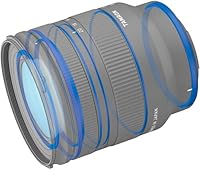
  • Front Coating: Fluorine coating on the front element repels water droplets, fingerprints, and dust, making field cleaning faster and easier.
  • Zoom Ring: Manual zoom ring operates smoothly with consistent resistance across the full 11–20mm focal length travel.
  • Stabilization: The lens contains no optical stabilization system and relies entirely on compatible Sony bodies with in-body image stabilization (IBIS).
  • IBIS Compatibility: Full electronic communication with Sony IBIS systems allows the camera body to apply optimal stabilization compensation automatically.
  • Model Number: Official Tamron model number is AFB060S700, which can be used to verify authenticity and check firmware update eligibility.
  • Release Year: The lens was first made available in June 2021 and has received firmware updates since its initial release.
  • Lens Hood: A petal-style lens hood is included in the box and attaches via a bayonet mount on the front of the lens barrel.

Related Reviews
Tamron 24mm F/2.8 Di III OSD Lens
79%
91%
Image Sharpness
93%
Value for Money
74%
Build Quality & Durability
71%
Autofocus Performance
88%
Macro Capability
More
Tamron 35-150mm F/2-2.8 Di III VXD Lens
84%
92%
Optical Sharpness
89%
Autofocus Performance
94%
Aperture Versatility
87%
Build Quality
78%
Value for Money
More
Tamron 35mm f/2.8 Di III OSD M1:2 Lens for Sony E-Mount
85%
94%
Image Quality
75%
Autofocus Speed
90%
Macro Performance
88%
Build Quality
91%
Portability
More
Tamron 20-40mm f/2.8 Di III VXD Lens
80%
91%
Image Sharpness
89%
Autofocus Performance
83%
Build Quality & Durability
94%
Size & Portability
67%
Zoom Range Versatility
More
Tamron 17-70mm F/2.8 Di III-A VC RXD Zoom Lens for Fujifilm X
86%
91%
Image Quality
88%
Vibration Compensation (VC) Effectiveness
84%
Autofocus Performance
90%
Build Quality and Durability
85%
Low Light Performance
More
Tamron 17-70mm f/2.8 Di III-A Zoom Lens
82%
91%
Optical Sharpness
93%
Aperture Versatility
84%
Autofocus Performance
86%
Image Stabilization
82%
Build Quality & Durability
More
Tamron 35-150mm F/2-2.8 Di III VXD for Nikon Z
85%
82%
Autofocus Performance
91%
Image Quality (Sharpness & Color Accuracy)
88%
Build Quality & Durability
85%
Ease of Use & Ergonomics
87%
Portability & Weight
More
Tamron 17-28mm f/2.8 Di III RXD Lens
80%
88%
Image Sharpness
91%
Autofocus Performance
79%
Build Quality
93%
Portability & Size
86%
Low-Light Performance
More
Tamron 28-75mm F/2.8 Di III VXD G2 for Sony E-Mount
87%
89%
Image Quality
92%
Autofocus Speed
85%
Build Quality
87%
Ease of Use
90%
Low-Light Performance
More
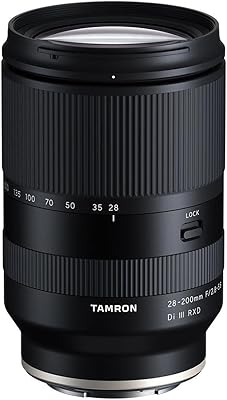
Tamron 28-200mm F/2.8-5.6 Mirrorless Zoom Lens
79%
93%
Versatility
74%
Image Sharpness
88%
Autofocus Performance
63%
Build Quality
41%
Weather Resistance
More

FAQ

It will physically mount on any Sony E-mount body, including full-frame A7 and A9 cameras, but it is designed for APS-C sensors. On a full-frame body, the camera will automatically switch to APS-C crop mode, which significantly reduces the effective resolution you are using. If you own or plan to buy a full-frame Sony body, this is not the lens to build your kit around long-term.

It is present and visible in RAW files, particularly when the frame contains strong horizontal or vertical lines like building edges or door frames. That said, it is entirely correctable — Lightroom, Capture One, and Sony's own software all include lens profiles that fix it in one click. Shooting JPEGs on a Sony body applies the correction automatically in-camera, so most casual shooters will never even notice it.

For everyday street shooting and casual action, the RXD motor on Sony APS-C bodies performs well. It is not the fastest AF system available at any price, but it locks reliably in normal to good light. Very fast and erratic movement — sports, for instance — may challenge it, but for the typical use cases this lens is designed for, AF speed is unlikely to be a frustration.

Yes, and this is one of the practical advantages of this compact ultra-wide lens. The 67mm thread is a standard size that many photographers already have polarizers and ND filters for. Importantly, the thread does not rotate during focusing, which is especially useful for oriented filters like circular polarizers and graduated NDs.

Yes, full native E-mount communication means IBIS on compatible Sony bodies works exactly as it would with any Sony-branded lens. The camera receives focal length data from the lens automatically, so you do not need to manually input any settings to get optimized stabilization.

The core practical difference is one full stop of light: f/2.8 versus f/4 means meaningfully better performance in dim conditions and more background separation potential. The Tamron also focuses closer, which opens up compositional options the Sony cannot match. The Sony has optical stabilization built in, which benefits shooters on older bodies without IBIS, but for anyone on a modern Sony APS-C body, the Tamron is generally considered the stronger all-around option.

That is a genuinely competitive alternative and the honest answer is that it depends on your priorities. The Sigma covers a slightly wider range at 10mm and has been praised for its optical performance. Pricing between the two fluctuates, so it is worth checking current prices before deciding. Neither lens is a clear winner in every category, and both are solid choices — the Tamron tends to have a slight edge in close-focusing versatility while the Sigma is sometimes preferred for build quality feel.

The constant f/2.8 aperture and ultra-wide field of view make it a reasonable option for Milky Way and wide-field night sky photography. At 11mm you capture a very large section of sky in a single frame, and f/2.8 lets in enough light to keep ISO and shutter speeds at manageable levels. Corner star sharpness wide open is not class-leading, but for casual night sky work rather than critical astrophotography, it performs well enough.

A petal-style bayonet lens hood is included in the box. A soft lens pouch or case is not typically included, so if you want padding for travel storage, you will need to pick one up separately. Given that it is a travel-oriented lens, a basic neoprene pouch is worth the small additional investment.

It works well for video on both bodies. The RXD autofocus motor is quiet enough that it does not bleed into audio recordings, which is a practical concern many video shooters overlook until they hear it in footage. The ZV-E10 lacks IBIS, so handheld video will be shakier unless you are using electronic stabilization or a gimbal, but the lens itself handles video duties capably on any Sony APS-C body.