

Overview

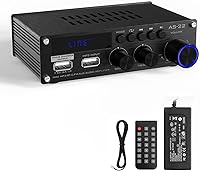
The Sunbuck AS-22BU Stereo Amplifier is a compact two-channel unit from JS Electronics Limited that punches well above its physical weight — roughly the size of a smartphone, yet loaded with enough inputs and controls to anchor a real home audio setup. Since its August 2023 launch, it has earned a 4.3-star rating from over 345 buyers and ranks #34 in Audio Component Amplifiers — numbers that suggest people are actually keeping it. One thing worth flagging upfront: the 300W peak figure is a marketing ceiling, not a real-world measure. The honest number is 50W RMS per channel, which is still solid for small rooms if your expectations are calibrated right.

Features & Benefits

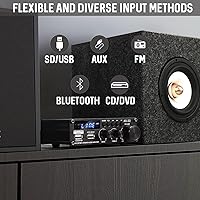
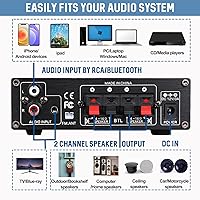
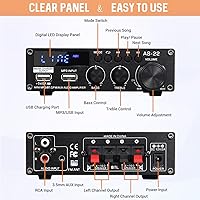
This mini amp packs a surprisingly versatile input lineup into its compact chassis. You get two RCA pairs, a 3.5mm AUX port, USB 2.0, built-in FM radio, and Bluetooth 5.0 — all selectable from a clearly labeled front panel. The wireless range reaches about 40 feet in open space, though the manufacturer openly cautions that walls will cut that down noticeably. Tone shaping is genuinely useful: independent bass and treble knobs swing ±15dB, which is enough range to compensate for a room's acoustic quirks. Speaker compatibility spans 4 to 16 ohms, so most passive bookshelf or desktop speakers will connect without issue. A remote handles volume from across the room — simple, but handy.

Best For

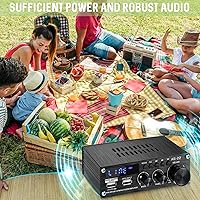
This compact stereo receiver makes the most sense for small, defined spaces — a home office desk, bedroom shelf, basement corner, or garage workshop. It's a natural fit for anyone who already owns passive bookshelf speakers and wants to skip the bulk of a full AV receiver without sacrificing basic tone control. It works equally well as a desktop audio hub, with the USB input cleanly handling a laptop or PC connection. That said, if you're trying to fill a large living room or drive speakers below 4 ohms, this isn't the right fit. Audiophiles and purists should look elsewhere — this unit is built around convenience and value, not critical listening sessions.

User Feedback

Among verified buyers, the most consistent praise centers on sound quality per dollar — people are repeatedly surprised by how full and clear the output sounds given the unit's size and price point. Setup gets high marks too, with the front panel described as intuitive and well-organized. On the flip side, the Bluetooth range concern is real: multiple users report drop-outs when a wall sits between the amp and their phone, which tracks with the manufacturer's own warning. The plastic housing also draws criticism — it feels light, and not always in a reassuring way. The remote control is considered a nice touch but limited to volume only, which some buyers found underwhelming after expecting broader functionality.

Pros

  • Remarkably small footprint — about the size of a smartphone — makes it easy to place almost anywhere.
  • Five input options (two RCA pairs, AUX, USB, Bluetooth, and FM radio) cover virtually every common source device.
  • Bluetooth 5.0 offers a stable wireless connection up to 40 feet in open space.
  • Bass and treble controls with a ±15dB range give you genuine room-tuning flexibility, not just token tone knobs.
  • Compatible with a wide 4–16 ohm speaker range, so most passive home speakers will work out of the box.
  • Total harmonic distortion under 0.4% keeps audio surprisingly clean for a unit at this price point.
  • Setup is fast and intuitive — buyers consistently report having it running within minutes of unboxing.
  • The included remote control adds everyday convenience for volume adjustments without leaving your seat.
  • A 4.3-star rating from hundreds of verified buyers signals that satisfaction is the norm, not the exception.

Cons

  • The 300W headline figure is a peak marketing spec — real-world RMS output is 50W per channel, which some buyers find misleading.
  • Bluetooth range drops noticeably through walls, making it unreliable for multi-room or through-wall wireless use.
  • The plastic housing feels lightweight in a way that raises durability questions over long-term daily use.
  • The remote control is limited to volume only — no input switching or tone adjustments from the couch.
  • No optical or digital audio input, which rules it out for modern TVs that lack analog output.
  • Runs on a DC power adapter rather than a standard AC power supply, adding a potential single point of failure.
  • No EQ presets or digital signal processing — what you set manually is what you get.
  • FM antenna performance in urban or obstructed environments may be inconsistent without a dedicated external antenna.

Ratings

The Sunbuck AS-22BU Stereo Amplifier scores are generated by AI after analyzing verified buyer reviews from multiple global markets, with spam, bot-generated, and incentivized feedback actively filtered out to ensure the data reflects genuine ownership experiences. This compact stereo receiver earns strong marks in versatility, ease of use, and value — but the analysis also surfaces honest trade-offs around build durability, Bluetooth limitations, and a wattage claim that regularly misleads buyers before purchase.

Sound Quality
78%
22%
For a unit this physically small and affordably priced, buyers consistently describe the audio as punchy and fuller than expected. In bedroom and desktop setups at moderate listening volumes, the output holds up well, and the wide tone control range gives enough room to shape the sound for the space.
At higher volumes, some listeners note a thinning in the midrange that becomes more noticeable through sensitive speakers. The true output ceiling of 50W RMS per channel also means that in larger rooms, the amp begins to strain before reaching satisfying loudness levels.
Value for Money
86%
Five input types, Bluetooth 5.0, FM radio, tone controls, and a remote at this price point is a combination that most competitors in the same bracket simply cannot match. Buyers who anticipated something basic routinely note that the actual feature set exceeded what they expected to receive.
The value equation weakens for anyone who needs reliable through-wall Bluetooth or long-term build durability — those are real concessions made at this price tier. Users comparing this to mid-range receivers will find the gap in construction quality and power headroom difficult to ignore.
Build Quality
54%
46%
The front-panel knobs and buttons feel tactile and responsive during daily use, and the overall assembly is solid enough for a stationary desktop or shelf setup that rarely gets moved. The light weight, while a concern for some, does mean easy repositioning without effort.
The all-plastic enclosure is the most frequently cited complaint across verified reviews — it feels noticeably hollow when picked up, and several buyers report cosmetic wear and slightly loose knobs after months of regular use. Anyone expecting a metal chassis at this price will be disappointed from the moment they unbox it.
Bluetooth Performance
61%
39%
In an open room with a direct line of sight to a phone or laptop, the Bluetooth 5.0 connection is stable and responsive with virtually no lag during normal music playback. For home office or studio setups where the source device stays in the same room, wireless connectivity works reliably.
Through walls, the signal degrades quickly — even a single interior wall is enough to cause intermittent drop-outs, which the manufacturer itself acknowledges in the product documentation. For buyers whose phone or streaming device sits in an adjacent room, this makes wireless the least dependable input option on the unit.
Input Versatility
88%
Having five distinct input sources — two RCA pairs, AUX, USB, Bluetooth, and FM radio — on a unit this compact is genuinely impressive and practically useful in daily life. Buyers frequently switch between a phone via Bluetooth, a PC via USB, and a turntable or TV via RCA without any rewiring.
There is no optical or coaxial digital input, making connection to modern smart TVs that lack analog outputs a frustrating workaround. The USB port supports only basic MP3 file playback from flash drives rather than functioning as a universal digital audio input, which surprises some buyers expecting broader compatibility.
Ease of Setup
92%
Multiple verified buyers highlight how quickly this mini amp goes from box to working audio — most report under five minutes from start to sound. The rear terminals are clearly labeled, the input selector is self-explanatory, and no companion app or technical knowledge is required to get started.
The proprietary DC power adapter is not a standard connector, so misplacing it or needing a replacement creates a sourcing headache. A small number of buyers also found the speaker terminal screws fiddly and slightly tight for thicker-gauge speaker wire, requiring extra patience during initial wiring.
Tone Control
77%
23%
The ±15dB bass and treble adjustment range is considerably wider than what most compact amps in this category offer, providing real flexibility for compensating a room's acoustic characteristics. Buyers who place the unit on a desk regularly use the bass boost to add warmth to bookshelf speakers that sound thin in isolation.
The absence of a midrange band or graphic EQ limits how precisely users can address resonant rooms or speaker coloration — there are only two adjustment points to work with. A few listeners also noted that pushing the bass knob toward its maximum setting introduces slight distortion on less efficient speakers.
Speaker Compatibility
83%
The 4-to-16-ohm impedance range covers virtually every passive bookshelf, desktop, and compact home speaker a typical buyer is likely to own. Most users connect their existing speakers immediately without any impedance-matching concerns, and transitions from older stereo equipment tend to go smoothly.
Users with specialized or vintage speakers that fall outside the supported impedance window cannot use this compact stereo receiver safely without additional hardware. There is also no dedicated subwoofer output, so buyers hoping to integrate a separate powered sub into a 2.1 system will need a workaround solution.
Remote Control
46%
54%
Receiving any remote at all on a unit at this price point is a genuine convenience, and for listeners who keep the amp across the room, adjusting volume without standing up is a small but real quality-of-life improvement during extended listening sessions.
The remote is limited strictly to volume adjustment — there is no input switching, tone control, mute, or power function — which makes it feel more like a token inclusion than a thoughtfully designed accessory. Several buyers who expected basic media controls like play and pause were clearly disappointed by how narrow the functionality turned out to be.
Size & Portability
94%
At roughly the footprint of a large smartphone and under 300 grams, this mini amp fits on the smallest desk corner or narrowest bookshelf without becoming a visual or spatial imposition. Buyers frequently cite the compact dimensions as the deciding factor when choosing it over a bulkier integrated receiver.
The small form factor means input jacks and speaker terminals are densely packed on the rear panel, which can make cable management visually cluttered when multiple inputs are connected simultaneously. The low weight, while convenient, also causes the unit to shift on smooth surfaces without a grip pad underneath.
FM Radio Quality
66%
34%
The built-in FM tuner is a functional and welcome addition that most compact amps at this price point skip entirely. In urban areas with strong broadcast signals, it locks onto stations cleanly and delivers listenable background audio, making it genuinely useful for workshop or kitchen listening.
In suburban or signal-weak environments, reception is inconsistent without an external antenna — and none is included in the box. Station navigation is fully manual rather than automatic, which several buyers found tedious when scanning for available channels in unfamiliar areas.
Power Transparency
41%
59%
The actual sustained output of 50W RMS per channel is adequate for small-room listening and performs honestly within those limits. Buyers who research the real figures before purchasing tend to be satisfied, finding the power more than sufficient for a bedroom or desktop system at reasonable volumes.
The prominently marketed 300W peak figure is the single largest source of pre-purchase frustration in the verified review pool, with multiple buyers explicitly describing it as misleading. It creates volume and capability expectations that the unit cannot meet in medium or larger rooms, leading to returns and negative reviews that have nothing to do with the amp's actual performance within its real operating range.

Suitable for:

The Sunbuck AS-22BU Stereo Amplifier is a strong match for anyone who wants to breathe life into a pair of passive bookshelf speakers without spending serious money or dedicating significant desk or shelf space to the effort. It fits naturally into small rooms — a home office, a bedroom, a basement workshop, or a garage — where a full-sized AV receiver would be overkill both physically and financially. Desktop PC users who want cleaner audio than a soundbar or computer speakers can offer will find the USB and AUX inputs particularly convenient. The built-in FM tuner and Bluetooth 5.0 also make it a genuinely versatile daily driver for casual listeners who switch between a phone, a laptop, and over-the-air radio throughout the day. If you already own 4- to 16-ohm passive speakers and just need a reliable, no-fuss amp to power them, this compact stereo receiver delivers real value without requiring any technical expertise to set up.

Not suitable for:

Buyers expecting audiophile-grade performance or robust build quality will likely walk away disappointed — the Sunbuck AS-22BU Stereo Amplifier is a budget-tier device, and its plastic chassis makes that clear the moment you pick it up. Anyone trying to fill a medium or large living room with sound will hit the unit's practical limits quickly; 50W RMS per channel is the honest output figure, and it is better suited to nearfield or small-room listening than room-filling volume. The Bluetooth range also becomes a real limitation in homes with thick walls or multiple rooms between the amp and the source device, making it a poor fit for whole-home wireless audio setups. Power users who want full remote functionality beyond simple volume adjustment will find the included remote underwhelming. And if your speaker collection includes anything below 4 ohms or above 16 ohms, this is not the unit to pair it with — compatibility outside that impedance window is not supported.

Specifications

  • RMS Output: Delivers a continuous 50W per channel into a stereo two-channel configuration, which is the reliable, real-world power figure buyers should use for speaker matching.
  • Peak Output: The manufacturer lists a peak figure of 300W per channel, which represents a momentary ceiling under ideal lab conditions and should not be used for practical comparisons.
  • Input Power: Powered by a DC 12V external adapter drawing between 3A and 5A, meaning the unit does not plug directly into a wall outlet via a standard AC cord.
  • Speaker Impedance: Compatible with passive speakers rated between 4 and 16 ohms, covering the vast majority of bookshelf, desktop, and compact home speakers on the market.
  • Bluetooth: Features Bluetooth 5.0 with a manufacturer-rated wireless range of up to 40 feet in unobstructed open space; performance degrades through walls or solid barriers.
  • Audio Inputs: Accepts audio from two RCA stereo pairs, a 3.5mm AUX jack, a USB 2.0 port, Bluetooth 5.0, and a built-in FM radio tuner — five sources in total.
  • Tone Controls: Provides independent bass and treble knobs each adjustable by ±15dB, along with a separate balance knob for left-right channel adjustment.
  • Frequency Response: Rated across the full audible spectrum from 20Hz to 20kHz, indicating the amplifier is designed to reproduce both low bass and high treble without intentional roll-off.
  • Distortion: Total harmonic distortion is specified at under 0.4%, which is acceptable for casual and mid-level listening at this price tier.
  • Signal-to-Noise: Signal-to-noise ratio exceeds 75dB, meaning background hiss should be minimal at moderate listening volumes in a quiet room.
  • Dimensions: The unit measures 134 × 104 × 43mm (approximately 5.3″ × 4.1″ × 1.7″), making it comparable in footprint to a large smartphone.
  • Weight: The amplifier body weighs 270g (roughly 0.6 lb), though the shipping package including adapter and accessories brings the total to approximately 1.39 lbs.
  • Remote Control: An infrared remote control is included in the box, but its functionality is limited to master volume adjustment only.
  • Build Material: The enclosure is primarily plastic construction, consistent with the budget-tier positioning of this unit.
  • Manufacturer: Designed and sold by JS Electronics Limited, with the product first listed for sale in August 2023.

Related Reviews
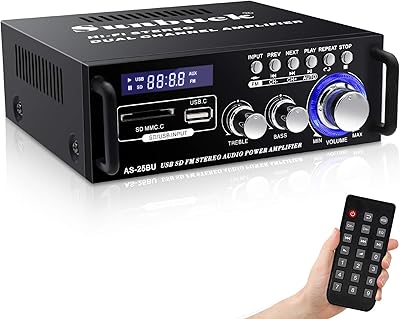
Sunbuck AS-25BU Stereo Amplifier
73%
88%
Value for Money
74%
Sound Quality
91%
Connectivity & Input Range
63%
Bluetooth Performance
51%
Power Output Accuracy
More
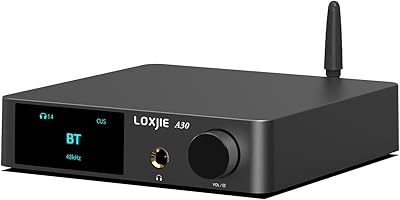
LOXJIE A30
LOXJIE A30
79%
86%
Sound Quality
82%
Build Quality
91%
Value for Money
89%
Input Versatility
63%
Bluetooth Performance
More
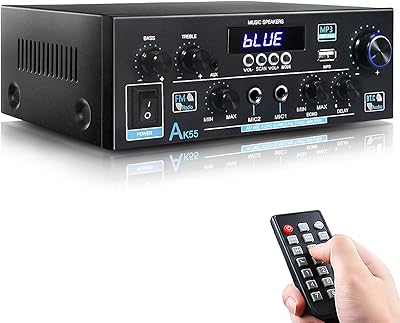
AK55 Stereo Amplifier
79%
88%
Value for Money
74%
Sound Quality
86%
Karaoke & Mic Performance
83%
Bluetooth Connectivity
91%
Input Variety
More
AK35 Stereo Mini Amplifier
71%
83%
Value for Money
67%
Sound Quality
71%
Bluetooth Performance
54%
Build Quality
89%
Setup & Ease of Use
More
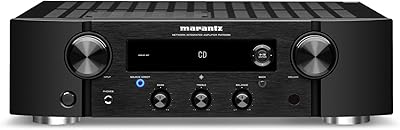
Marantz PM6007 Integrated Stereo Amplifier
79%
93%
Sound Quality
91%
Build Quality
74%
Phono Stage
78%
Value for Money
57%
Connectivity & Inputs
More
Yamaha A-S301 Integrated Stereo Amplifier
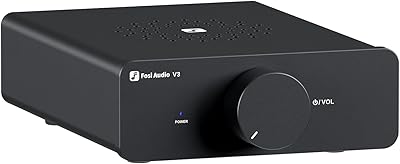
78%
91%
Sound Quality
88%
Build Quality
86%
Value for Money
71%
Phono Stage
84%
Connectivity
More
Marantz MM7025 Stereo Power Amplifier
86%
94%
Power Output
91%
Sound Quality
88%
Build Quality
90%
Cooling System
87%
Connectivity Options (RCA/XLR)
More
Pyramid PR2500 Stereo Preamplifier
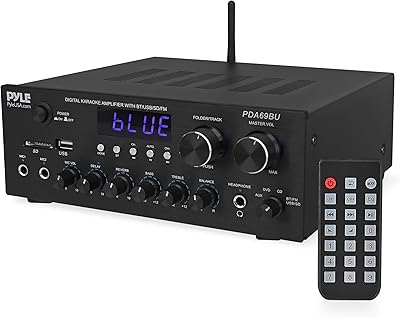
71%
83%
Value for Money
54%
Build Quality
51%
Signal Noise & Quiet Floor
74%
Phono Stage & Vinyl Filtering
81%
Source Selector Versatility
More
Pyle PDA5BU Bluetooth Stereo Amplifier
72%
83%
Value for Money
88%
Input Versatility
79%
Karaoke Performance
71%
Bluetooth Reliability
46%
Power Output
More
AIYIMA T9
AIYIMA T9
77%
83%
Sound Quality
88%
Value for Money
91%
Connectivity & Input Variety
67%
Bluetooth Performance
74%
Build Quality & Materials
More

FAQ

Not quite. The 300W figure is a peak marketing spec that represents a momentary maximum under controlled lab conditions. The number that actually matters is 50W RMS per channel, which is the sustained, real-world output. For a small or medium room, 50W per channel is genuinely sufficient, but go in with accurate expectations.

Yes, 8 ohms falls right in the middle of the supported 4–16 ohm range, so you will have no compatibility issues. The Sunbuck AS-22BU Stereo Amplifier is designed to handle most standard passive home speakers without any special wiring or adapters.

It depends on what outputs your TV has. If your TV has a 3.5mm headphone output or RCA audio outputs, you can connect it directly using the AUX or RCA inputs. Most modern smart TVs have dropped analog outputs in favor of optical or HDMI ARC, neither of which this amp supports, so check your TV's output options before purchasing.

In an open room with a clear line of sight, the 40-foot range holds up well. Through a wall, though, the connection can become unstable or drop intermittently — and the manufacturer openly acknowledges this in the product documentation. If your phone or laptop will always be in the same room, Bluetooth works reliably; if you need it to reach through walls, expect frustration.

The USB port on this mini amp is an audio input designed to read MP3 files from a USB flash drive — it is not a charging port. So you can load music onto a USB stick and plug it in directly, which is a handy feature if you want to play audio without a phone or computer involved.

Setup is genuinely straightforward. You connect your speakers to the speaker terminals on the back, plug in your audio source using whichever input fits, connect the DC power adapter, and turn it on. Most buyers report being up and running within a few minutes, and the front-panel controls are clearly labeled.

It is useful in a limited way — you can adjust volume from across the room without getting up, which is a real convenience for casual listening. That said, it only controls volume, so if you were hoping to switch inputs or adjust tone remotely, you will need to walk over to the unit. Treat it as a handy extra, not a full-featured remote.

Technically you can, as long as you have access to a power outlet and keep it protected from moisture and direct weather exposure — it is not rated for outdoor or water-resistant use. It works well in a covered garage or a screened porch, but leaving it outside in rain or high humidity is not advisable and would likely void any warranty.

For most people, absolutely yes. In a small room with efficient bookshelf speakers, 50W RMS per channel delivers plenty of volume — far more than most listeners use at comfortable listening levels. You would only run into limitations if you were trying to fill a large open-plan space or power inefficient, low-sensitivity speakers.

The plastic enclosure is the most common point of concern among longer-term owners — it feels light and does not inspire the same confidence as a metal-chassis amp. For everyday moderate use it has proven adequate, but it is not built to take physical abuse or heavy daily handling. If you treat it as a stationary desktop or shelf unit that rarely gets moved, durability should not be a major issue.

Where to Buy