

Overview

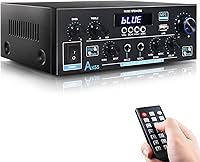
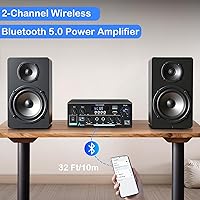
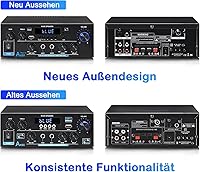
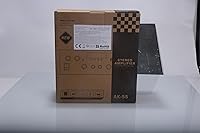
The AK55 Stereo Amplifier is a compact 2.0-channel unit that targets buyers who want real audio capability without spending a lot. Built around the TPA3116D2 chip and rated at 70W per channel, it represents a meaningful step up from its predecessor, the AK45. Worth noting: the listing throws around a 100W peak figure, but the honest rated output is 70W — still plenty for a bedroom or modest living room. Released in late 2023, it has climbed into the top 50 of Audio Component Amplifiers on Amazon, which suggests it is landing well with everyday buyers who simply want something reliable that does not cost a fortune.

Features & Benefits

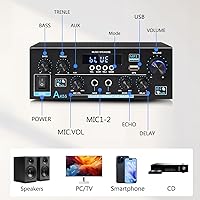
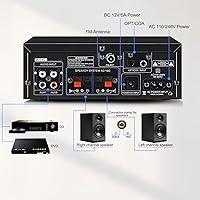
The connectivity options on this budget stereo receiver go well beyond what you would normally expect at this price. Bluetooth 5.0 handles wireless pairing cleanly, and on top of that you get AUX, RCA, USB stick playback, plus optical and coaxial inputs — covering nearly any source device you own. The dual microphone inputs are the genuine standout here: very few compact amplifiers in this category include even one mic jack, let alone two. A bright LED display keeps your active settings visible at a glance, and the included remote lets you adjust bass, treble, and volume without leaving your seat. The universal 110–240V power supply is a quiet but practical bonus.

Best For

This compact amplifier fits naturally into small spaces — a bedroom shelf, a desktop corner, a garage wall — where you need real speaker output but cannot justify a bulkier or pricier unit. It is a comfortable first step for anyone moving away from a basic Bluetooth speaker toward a proper passive speaker setup. Casual karaoke fans will get genuine use from the dual mic support without needing a dedicated machine. Home office users who want clean amplified audio through bookshelf speakers, and basement or garage listeners who just want decent sound on a tight budget, are both well served by what this receiver offers.

User Feedback

Buyers are generally satisfied with the AK55 for casual daily listening, with setup simplicity and the included remote drawing consistent positive comments. The karaoke capability earns particularly warm feedback — users seem pleasantly surprised that a unit at this price handles mic input well enough for home parties. On the downside, the wattage claim in the listing frustrates some buyers who expected more headroom at higher volumes than the 70W rated output actually delivers. A smaller number of owners mention a faint background hiss when using sensitive speakers. One practical note worth flagging before you buy: the remote requires a CR2025 battery that is not included in the box.

Pros

  • Dual microphone inputs are a rare find at this price, making casual karaoke genuinely practical.
  • Bluetooth 5.0 pairs quickly and holds a stable connection without constant reconnecting.
  • Input variety is exceptional — optical, coaxial, RCA, AUX, and USB are all covered in one box.
  • The compact build fits on a shelf or desk without demanding its own dedicated space.
  • Bass and treble knobs give enough tone control to compensate for different room acoustics.
  • Universal 110–240V power supply means no step-down converter needed for international use.
  • The included remote is a genuine convenience for bedroom or couch listeners.
  • Setup from unboxing to audio playback takes most users under five minutes.
  • The LED display clearly shows the active input and current volume level at a glance.
  • For the price paid, the overall feature count per dollar is difficult to match in this category.

Cons

  • Background hiss at higher volumes is noticeable, especially with sensitive speakers.
  • Advertised 100W peak power is misleading — the honest rated output is 70W per channel.
  • The remote requires a CR2025 battery that is not included in the box.
  • Build quality feels cost-driven; the plastic casing looks less premium in person than in photos.
  • No aptX or higher Bluetooth codec support limits wireless audio fidelity noticeably.
  • Input switching requires manual button presses — there is no auto-detect between sources.
  • The unit runs noticeably warm during extended high-volume sessions in enclosed spaces.
  • Mic preamp quality is functional but can make vocals sound thin with certain microphones.
  • The included documentation is poorly translated and unhelpful for troubleshooting.
  • Remote responsiveness degrades at wider angles, reducing its usefulness in larger rooms.

Ratings

The AK55 Stereo Amplifier scores below are generated by our AI engine after analyzing verified buyer reviews from global markets, with spam, bot activity, and incentivized feedback actively filtered out. The result is an honest, balanced picture of where this compact budget receiver genuinely delivers and where it falls short. Both its real strengths and its frustrating quirks are reflected in the numbers.

Value for Money
88%
For a unit at this price point, the sheer breadth of inputs and built-in features would normally cost significantly more. Buyers upgrading from a basic Bluetooth speaker to a proper passive speaker setup consistently describe it as one of the better budget audio purchases they have made.
A few buyers feel the value calculation shifts once they factor in the misleading wattage claims — paying for a 100W unit and receiving honest 70W output, however common in the industry, still leaves a sour taste for those who researched carefully.
Sound Quality
74%
26%
For casual listening at moderate volumes — background music at a gathering, desktop audio while working — most users find the output clean and balanced enough to satisfy daily needs. The bass and treble controls add enough flexibility to compensate for room acoustics in small spaces.
At higher volumes, a noticeable background hiss becomes apparent, especially when paired with sensitive bookshelf speakers. This is not a unit for critical listening or audiophile use cases; the noise floor is a real limitation that more demanding buyers will find hard to overlook.
Karaoke & Mic Performance
86%
The dual microphone inputs are the most talked-about feature among satisfied buyers. At house parties or casual family karaoke nights, having two independent mic jacks with dedicated volume control delivers a surprisingly capable experience without requiring a standalone karaoke machine.
The mic preamp quality is functional rather than impressive — voices can sound slightly thin or tinny depending on the microphone used. Users with higher-quality dynamic mics may notice the preamp introduces mild coloration that does not flatter vocal frequencies.
Bluetooth Connectivity
83%
Bluetooth 5.0 pairing is quick and stable across phones and tablets within a normal room range. Users appreciate that the connection holds reliably during extended sessions without the dropouts that plagued older budget receivers at similar prices.
There is no aptX or higher-codec support, so audio quality over Bluetooth is limited to standard SBC. For listeners who care about wireless fidelity, wired inputs will always sound noticeably cleaner on this receiver.
Input Variety
91%
Few competitors at this price level offer optical and coaxial digital inputs alongside Bluetooth, AUX, RCA, and USB stick playback all in one box. For users connecting a TV, a CD player, and a phone simultaneously, the input flexibility is a practical daily convenience.
Switching between inputs requires either using the physical button on the unit or the remote — there is no auto-detect or smart switching. Users with multiple active sources connected at once mention this adds minor friction to the experience.
Build Quality
63%
37%
The chassis feels acceptably solid for a sub-50-dollar unit, and the knobs have a decent rotational resistance that does not feel cheap. For shelf or desktop placement in a low-traffic room, it holds up well enough for everyday use.
The overall construction is clearly cost-driven — the casing has a plasticky finish that looks less premium in person than in product photos. A few buyers reported minor wobble in the input jacks after extended use, which raises some durability concerns for long-term reliability.
Ease of Setup
92%
Unboxing to audio playback takes under five minutes for most users. Speaker terminals accept bare wire cleanly, Bluetooth pairing is straightforward, and the LED display makes the active input immediately obvious without consulting a manual.
The included documentation is minimal and not well translated, which can confuse first-time amplifier buyers when troubleshooting input switching or adjusting EQ settings. A clearer quick-start guide would reduce the small but real number of setup-related complaints.
Remote Control
71%
29%
The remote is a genuine convenience for couch or bed listeners who want to adjust volume or switch tracks without getting up. Its range is adequate for small to medium rooms and the button layout is logical enough to use without looking.
The CR2025 battery required to operate it is not included in the box — a minor but irritating omission that catches buyers off guard. The remote also feels lightweight and cheap in hand, and a few users reported it becoming unresponsive at wider angles from the receiver.
Power Output Accuracy
51%
49%
The honest rated output of 70W per channel is sufficient for filling a bedroom or small living room with sound at reasonable volumes. Users who understood the spec upfront report no disappointment with what it actually delivers in practice.
The gap between the advertised 100W peak figure and the true 70W rated output is a recurring complaint. This kind of spec inflation is common in budget audio, but it damages buyer trust and has resulted in a meaningful number of negative reviews from buyers who felt misled.
Display & Controls
79%
21%
The LED display is bright and legible from across a small room, clearly showing the active input and volume level. Having dedicated knobs for bass, treble, mic volume, and master volume on the front panel means common adjustments never require menu navigation.
The display brightness has no dimming option, which some users find intrusive in dark bedroom environments. The knobs, while functional, lack the tactile precision of higher-end units — small adjustments can feel coarser than expected.
Compatibility with Speakers
82%
18%
The 4–16 ohm impedance range covers the vast majority of passive bookshelf, tower, and garden speakers that budget buyers are likely to own. Users pairing it with common entry-level speaker brands report a clean, stable connection with no audible distortion at moderate levels.
Users pushing high-impedance or highly sensitive speakers at loud volumes are more likely to encounter the noise floor issues. The unit is not designed to drive large floor-standing speakers in big rooms — attempting to do so pushes it noticeably into its limitations.
Size & Portability
85%
At under 2.3 pounds and roughly the footprint of a hardcover book, this budget stereo receiver fits on a shelf, a desk, or a side table without demanding dedicated space. Its small form factor is a genuine practical asset for apartment dwellers.
The compact size does constrain internal thermal headroom, and a handful of users mention the unit gets noticeably warm after extended high-volume sessions. It is not a concern for casual use, but worth monitoring in poorly ventilated enclosures.
International Usability
87%
The universal 110–240V power supply means buyers outside North America can use the unit without a step-down converter, which is a thoughtful inclusion at this price tier. International buyers on Amazon have noted this as an unexpected positive.
The unit ships with a North American plug configuration, so buyers in other regions will need an adapter. This is a standard inconvenience rather than a true flaw, but it is worth noting for international buyers expecting a fully plug-and-play experience.

Suitable for:

The AK55 Stereo Amplifier is a strong fit for anyone who wants a real speaker setup without spending serious money or sacrificing desk or shelf space. First-time passive speaker owners will find it approachable — setup is quick, inputs are clearly labeled, and the LED display removes most of the guesswork. Apartment and bedroom listeners who stream music from a phone and occasionally plug in a TV or CD player will get genuine daily use out of the wide input selection. It is also one of the few options in this price tier that actually supports casual karaoke, making it a practical pick for anyone who hosts small gatherings and wants mic support without buying a dedicated machine. Home office users who want clean, amplified sound from a pair of bookshelf speakers — without a bulky receiver dominating their workspace — will find the compact dimensions a welcome fit.

Not suitable for:

Buyers with serious audio expectations should look elsewhere before purchasing the AK55 Stereo Amplifier. The noise floor at high volumes is a real issue, and anyone pairing it with sensitive bookshelf speakers in a quiet room will likely notice background hiss that simply cannot be dialed out. The wattage marketing is also worth scrutinizing — the honest rated output is 70W per channel, not the 100W peak figure the listing emphasizes, so buyers expecting to fill a large open-plan space or drive large floor-standing speakers will find the real-world headroom falls short. Audiophiles or home theater enthusiasts expecting precise stereo imaging, low distortion at full range, or aptX Bluetooth codec support will be disappointed. If long-term durability is a priority, the plastic chassis and input jack construction are not confidence-inspiring for years of heavy daily use.

Specifications

  • Rated Power: Delivers 70W per channel into a 2.0 stereo configuration at standard listening conditions.
  • Peak Power: The manufacturer advertises a peak output of 100W per channel, though this reflects burst capacity rather than sustained rated output.
  • Amplifier Chip: Built around the TPA3116D2 Class D amplifier chip, known for efficient power delivery in compact designs.
  • Channel Config: 2.0 stereo channel layout with two independent speaker output terminals for left and right channels.
  • Impedance Range: Compatible with passive speakers rated between 4 and 16 ohms, covering the majority of consumer bookshelf and tower speaker models.
  • Bluetooth: Bluetooth 5.0 with standard SBC codec support for wireless audio streaming from phones, tablets, and computers.
  • Inputs: Accepts audio via Bluetooth, AUX (3.5mm), RCA stereo, USB stick, optical (TOSLINK), coaxial digital, and two 6.35mm microphone jacks.
  • Output: Two sets of screw-terminal passive speaker outputs for bare wire or pin-connector speaker cables.
  • Display: Front-panel LED digital readout showing active input source and volume level in real time.
  • Controls: Four front-panel knobs control master volume, microphone volume, bass, and treble independently.
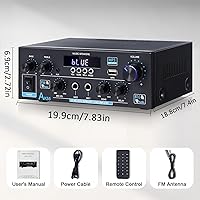
  • Remote Control: Infrared remote control included; requires one CR2025 coin cell battery, which is not supplied in the box.
  • Power Supply: Universal switching power supply supports AC input from 110V to 240V, compatible with standard outlets globally.
  • Dimensions: Unit measures 9.06 x 8.5 x 3.82 inches (length x width x height) for compact shelf or desktop placement.
  • Weight: Complete unit weighs 2.29 pounds, making it easy to reposition or transport between rooms.
  • Model Number: Official model designation is AK55, succeeding the earlier AK45 with an upgraded amplifier chip and increased power headroom.

Related Reviews
LOXJIE A30
LOXJIE A30
79%
86%
Sound Quality
82%
Build Quality
91%
Value for Money
89%
Input Versatility
63%
Bluetooth Performance
More
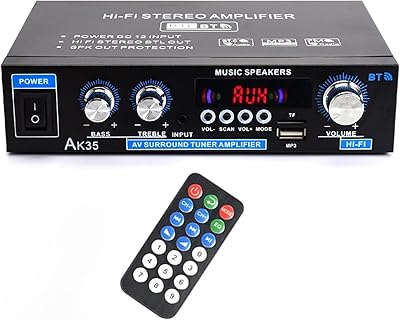
AK35 Stereo Mini Amplifier
71%
83%
Value for Money
67%
Sound Quality
71%
Bluetooth Performance
54%
Build Quality
89%
Setup & Ease of Use
More
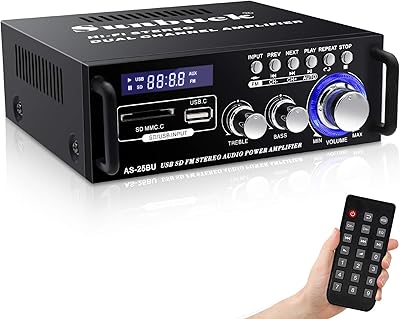
Sunbuck AS-25BU Stereo Amplifier
73%
88%
Value for Money
74%
Sound Quality
91%
Connectivity & Input Range
63%
Bluetooth Performance
51%
Power Output Accuracy
More
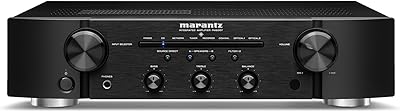
Marantz PM6007 Stereo Amplifier
84%
94%
Sound Quality & Clarity
90%
Build Quality & Durability
85%
Ease of Use & Setup
55%
Connectivity Options
88%
Power Output
More
AIYIMA T9
AIYIMA T9
77%
83%
Sound Quality
88%
Value for Money
91%
Connectivity & Input Variety
67%
Bluetooth Performance
74%
Build Quality & Materials
More
Pyramid PR2500 Stereo Pre-Amplifier
82%
88%
Sound Quality
91%
Versatility of Inputs
87%
Ease of Integration
80%
Build Quality
72%
User Controls Responsiveness
More
Marantz PM7000N
Marantz PM7000N
79%
93%
Sound Quality
88%
Build Quality
74%
Streaming & Connectivity
61%
HEOS App Experience
86%
Phono Stage Performance
More
Moukey MK0153 Karaoke Amplifier
73%
88%
Value for Money
91%
Ease of Setup
72%
Microphone Performance
78%
Bluetooth Connectivity
58%
Audio Output Power
More
Marantz MM7025 Stereo Power Amplifier
86%
94%
Power Output
91%
Sound Quality
88%
Build Quality
90%
Cooling System
87%
Connectivity Options (RCA/XLR)
More
Yamaha A-S701SL Integrated Stereo Amplifier
88%
94%
Sound Quality
91%
Build Quality
88%
Ease of Use
89%
Power Output
85%
Energy Efficiency
More

FAQ

Not in any sustained, practical sense. The AK55 Stereo Amplifier is rated at 70W per channel — the 100W figure refers to a brief peak burst capacity, not continuous output. This distinction matters if you are pairing it with speakers that need consistent power, so plan around the 70W rated spec rather than the headline number.

Yes, this compact amplifier has two separate 6.35mm microphone input jacks, both active simultaneously. Each mic runs through the shared mic volume knob, so you cannot independently adjust the level of each one — but for casual karaoke or party use, having two live inputs at once works well in practice.

Absolutely. The amplifier is designed to drive speakers between 4 and 16 ohms, so 8-ohm bookshelf speakers are right in its sweet spot. Just make sure your speakers can handle at least 70W of continuous power to avoid any risk of damage at higher volume levels.

Yes — the remote requires a CR2025 coin cell battery, and one is not included in the box. It is a small but easy-to-miss detail, so pick one up when you order the unit to avoid waiting before you can use the remote on day one.

A minority of users do report a faint background hiss, most noticeably at higher volume settings and when paired with sensitive speakers. At moderate listening volumes with typical bookshelf speakers, most buyers do not find it disruptive. If you are using highly sensitive speakers in a very quiet room, it is worth being aware of this limitation.

The internal power supply handles 110V to 240V automatically, so the electronics are globally compatible. However, the unit ships with a North American plug, so you will need a simple plug adapter for use in the UK, Europe, or other regions — not a voltage converter, just a physical adapter.

If your TV has an optical (TOSLINK) or coaxial audio output, you can connect it directly to the matching input on the budget stereo receiver. If your TV only has an AUX or RCA audio output, those inputs are also available. Most modern TVs support at least one of these output types, so compatibility is generally not an issue.

Yes, plug any standard USB stick loaded with MP3 or common audio files directly into the USB input port and the unit will play them back. It supports plug-and-play operation, so no additional setup is required — just insert the drive, switch to USB input, and it reads the files automatically.

For a typical small to medium living room — roughly up to 200 square feet — it performs well at moderate volumes when paired with efficient speakers. In larger open-plan spaces or rooms with high ceilings, the 70W rated output may start to feel limited at higher volumes, especially if your speakers are not particularly efficient. It is best thought of as a small-room amplifier.

Most first-time users find it straightforward — speaker wire connects via screw terminals on the back, inputs are clearly labeled, and the LED display shows which source is active. The included manual is sparse and not well translated, so if you run into any confusion, a quick search for the model name will surface helpful community guides faster than the documentation will.