Overview

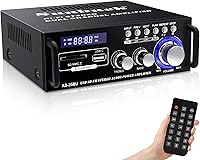
The Sunbuck AS-25BU Stereo Amplifier is a compact, budget-oriented receiver that packs a surprising amount of connectivity into a box barely larger than a paperback book. It comes from JS Electronics Limited under the Sunbuck brand and, while discontinued by the manufacturer, units remain findable through third-party sellers. One thing worth addressing upfront: the 300W peak figure on the packaging is a marketing number. Real-world output sits at 50W RMS per channel, which is honest power for a small room but won't rattle walls. With nearly 2,000 ratings averaging 4.2 stars, it clearly resonated with buyers who knew what they were getting into.
Features & Benefits

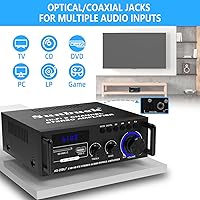
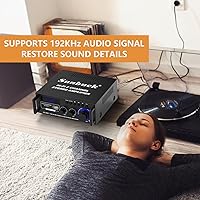
What makes this compact stereo receiver stand out at its price is the sheer number of ways you can feed it a signal. Bluetooth 5.0 handles wireless streaming from phones or laptops up to about 40 feet away, optical and coaxial digital inputs connect directly to a TV or disc player, and RCA, USB, and SD card slots cover everything else. There is even a built-in FM tuner. The unit supports 192kHz audio resolution, a spec rarely found this low in price. Bass and treble knobs let you nudge the sound without extra gear. One genuinely useful detail: a DC 12V power option means you can run it off a portable battery pack for outdoor use.

Best For

This mini amplifier makes the most sense in spaces where hauling in a full-size receiver would be excessive — think garages, workshops, spare bedrooms, or a desk setup where space is already tight. It works well for anyone pairing passive bookshelf speakers with a TV or streaming stick on a limited budget. Vinyl listeners can run a turntable through the RCA input without any additional hardware. College students and apartment renters tend to appreciate how much this little box does without demanding much shelf space. If you want FM radio, Bluetooth, and a digital optical input all in one tidy package without spending much, few alternatives exist at this price point.

User Feedback

Buyers who go in with grounded expectations tend to come away happy. The most common praise centers on easy setup and the value packed into such an affordable, small box. Sound quality gets described as clean and enjoyable for casual listening at moderate volumes. On the critical side, Bluetooth range through walls is a recurring frustration — walls genuinely kill the signal faster than the spec sheet implies. Long-term reliability is a softer concern; a portion of reviewers mention units failing after months of regular use, which is not unusual for budget electronics but worth knowing before buying. For light everyday listening this amp earns its stars; push it hard and disappointment becomes more likely.

Pros

  • Exceptional connectivity for the price — optical, coaxial, RCA, Bluetooth, USB, SD card, and FM radio in one small box.
  • Bluetooth 5.0 pairs quickly and streams reliably in open rooms with direct line of sight.
  • The DC 12V power input lets this compact stereo receiver run off a portable battery for outdoor use.
  • Tiny footprint of roughly 6 by 5 by 2 inches fits on the most space-constrained desk or shelf.
  • 192kHz audio support is a genuine spec advantage rarely found at this price tier.
  • Setup takes minutes — connect speakers, plug in, and sound comes out without any complicated configuration.
  • Bass and treble controls allow basic sound shaping without needing a separate equalizer.
  • FM radio tuner adds a convenient everyday source that many competing mini amps skip entirely.
  • Widely compatible with passive speakers from 4 to 16 ohms, covering most common bookshelf and garden speaker setups.
  • At its asking price, the range of features delivered represents honest, tangible value for secondary-room use.

Cons

  • The 300W figure is a peak marketing number — actual continuous output is 50W per channel, which surprises buyers who did not read the fine print.
  • Bluetooth range drops sharply through walls, making adjacent-room streaming unreliable in practice.
  • No remote control is included, which becomes genuinely inconvenient when the amp sits across the room.
  • A notable share of real-world owners report hardware failures — channel dropout, hum, or total power loss — after months of use.
  • Discontinued manufacturer status means no official warranty support exists if your unit develops a fault.
  • The input selector cycles through sources one press at a time with no display confirmation of the active input.
  • USB playback has limited file format support, reducing its usefulness for buyers with diverse digital music libraries.
  • The unit runs noticeably warm during extended sessions, suggesting limited thermal headroom under sustained load.
  • The included documentation is thin and unhelpful for troubleshooting anything beyond basic setup.
  • Tone control sweep is narrow and lacks a mid-range band, limiting how much you can compensate for speaker coloration.

Ratings

The Sunbuck AS-25BU Stereo Amplifier has been scored using an AI-driven analysis of verified global buyer reviews, with spam, bot-generated, and incentivized feedback actively filtered out before any score was calculated. What you see below reflects the honest consensus of real owners — the genuine strengths that keep this compact receiver popular, and the recurring frustrations that pulled certain scores down. Nothing has been softened or inflated.
Value for Money
88%
Buyers consistently flag this as one of the strongest arguments for picking up this mini amplifier. For the asking price, the combination of Bluetooth, optical input, FM radio, and RCA in a single box is genuinely hard to match. Most owners feel they got more than their money's worth for a secondary-room setup.
A handful of buyers who expected near-audiophile performance felt let down once they understood the real power output. The discontinued status also creates some uncertainty around long-term parts availability, which chips away slightly at the overall value proposition for buyers thinking long-term.
Sound Quality
74%
26%
At casual listening volumes the Sunbuck amp delivers a clean, unfatiguing sound that works well for background music, podcasts, or TV audio in a bedroom or office. The 192kHz audio support gives it a subtle edge over cheaper rivals, and the bass and treble knobs let most users get to a comfortable tonal balance without extra gear.
Push the volume past the midpoint and clarity starts to soften, with some buyers noting a slightly compressed quality at higher levels. It is not the amp for a serious listening session with demanding speakers, and audiophiles will find the signal-to-noise ratio just barely adequate rather than impressive.
Connectivity & Input Range
91%
Few amplifiers in this price bracket offer optical, coaxial, RCA, USB, SD card, Bluetooth, and FM radio simultaneously. Real-world owners appreciate being able to switch between a TV via optical, a turntable via RCA, and a phone via Bluetooth without any rewiring. That kind of flexibility in a box this small is a legitimate standout.
The input switching relies on a push-button cycle rather than a labeled selector, which can feel fiddly when you are toggling between sources in a dimly lit room. Some users also noted that the USB playback is limited in the file formats it recognizes, which narrows its usefulness for anyone with a varied digital music library.
Bluetooth Performance
63%
37%
In open-plan spaces or rooms where the source device stays within direct line of sight, Bluetooth 5.0 performs reliably and pairs quickly. Streaming music from a phone or laptop on a desk a few feet away works without dropouts, which covers the most common use case for this type of compact receiver.
Walls are its weakness. Multiple owners report that even a single interior wall reduces range noticeably, and signal dropouts become frequent when the source device is in an adjacent room. For buyers who planned to leave their phone charging in another room while music plays, this is a real limitation rather than a minor inconvenience.
Power Output Accuracy
51%
49%
The actual RMS output of 50W per channel is genuinely adequate for small to medium passive speakers in a bedroom or office, and for that use case it does the job without strain. Users who went in knowing the RMS figure rather than fixating on the peak marketing number were largely satisfied with what the amp could drive.
The 300W peak figure plastered on the product listing has frustrated a notable portion of buyers who felt misled. In practice, the amp cannot cleanly drive inefficient or power-hungry speakers to satisfying levels, and several users reported audible strain when attempting to fill a larger room. The gap between advertised and realistic output is one of the most common complaints.
Build Quality & Materials
67%
33%
The chassis feels solid enough for a budget unit, and the control knobs have a reasonable amount of resistance that does not feel cheap on first use. The compact metal-accented enclosure looks presentable sitting on a shelf or desk and does not immediately betray its price point.
Longer-term durability is a legitimate concern. A portion of reviewers describe units developing issues — buzzing, channel dropout, or complete failure — after several months of regular use. At this price tier some attrition is expected, but the rate of failure reports is enough to recommend treating this as a short-to-medium-term purchase rather than a lasting investment.
Ease of Setup
87%
Unboxing and getting sound out of this compact stereo receiver takes only a few minutes for most people. The rear panel labels are clear, Bluetooth pairing is straightforward, and buyers with no prior amplifier experience consistently describe the setup process as intuitive and stress-free.
The manual is thin and not particularly helpful if something does not work as expected on first connection. Users trying to troubleshoot optical input priority or FM antenna sensitivity had to rely on online forums rather than the included documentation.
Size & Form Factor
93%
The footprint — roughly the size of a hardcover novel — is one of the most praised physical attributes. It tucks into a corner of a desk, sits on a narrow shelf, or fits inside an entertainment unit without demanding any rearrangement. For space-constrained setups this is a meaningful practical benefit.
The small size comes with a small heat sink, and a few users mention the unit running noticeably warm during extended listening sessions. It is not dangerous, but it does suggest the thermal headroom is limited, which may contribute to the durability concerns some longer-term owners have reported.
Tone Controls & Sound Shaping
71%
29%
Having physical bass and treble knobs rather than a digital menu is appreciated by users who want quick, tactile adjustments. For the majority of listeners using this with standard bookshelf speakers, getting to a pleasant sound balance takes seconds and rarely requires revisiting.
The tone control range is modest. Buyers who wanted to compensate for bright or bass-heavy speakers found the adjustment sweep too narrow to fully correct the imbalance. There is no mid-range control, no loudness contour, and no EQ preset, so listeners with more demanding tastes will hit the ceiling of what these knobs can do fairly quickly.
FM Radio Reception
69%
31%
For buyers who still use FM radio as a daily source — morning news, local stations, background music at work — the built-in tuner adds genuine convenience. Stations in urban areas with strong signals come in cleanly without any additional antenna beyond the included wire.
Reception in suburban or rural areas, or in buildings with thick walls, tends to be hit-or-miss. The included wire antenna is functional but basic, and there is no digital display showing exact frequency in a way that makes station-hunting intuitive. Users in fringe reception zones reported frustrating static on otherwise listenable stations.
DC Power & Portability
78%
22%
The DC 12V input is a quietly useful feature that most buyers discover only after purchase. It means the amp can run off a standard car adapter or a portable power station, making it genuinely usable for garden parties, garage workshops, or any outdoor setting with a power bank available.
Sunbuck does not heavily market this capability, so many buyers never explore it. The DC cable and any portable power source are not included, meaning buyers have to source compatible accessories separately, which adds a small but real extra cost and effort to unlocking this particular benefit.
Input Switching & Controls
62%
38%
The physical push buttons are responsive and the unit does switch sources reliably once you learn the cycle order. For users with a fixed setup — say, TV via optical and phone via Bluetooth — the switching routine becomes second nature fairly quickly.
There is no remote control included, which is a noticeable omission when the amp is placed across the room from a couch. Cycling through inputs one press at a time also means there is no way to jump directly to a specific source, and the lack of any display makes it hard to confirm which input is currently active without listening for a signal.
Compatibility with Speakers
76%
24%
The 4-to-16 ohm impedance range means this mini amplifier plays nicely with most common passive bookshelf, desktop, and garden speakers without any matching concerns. Owners running standard 8-ohm bookshelf speakers reported clean, trouble-free operation at everyday listening levels.
Pairing it with low-sensitivity or high-power floor-standing speakers exposes the real limits of the 50W RMS output. Those combinations either sound underwhelming at volume or push the amp into territory where distortion becomes noticeable. It is best matched with efficient, smaller speakers rather than anything designed for a large room.
Long-Term Reliability
54%
46%
Many buyers report months of trouble-free use for casual daily listening, and the core circuit — when it holds up — performs consistently within its design limits. For buyers using it gently in a low-demand setup, a reasonable service life is achievable.
The subset of negative reviews citing hardware failure after extended use is large enough to be statistically meaningful. Common failure modes include one channel going silent, persistent hum developing over time, and complete power loss. The discontinued manufacturer status means no official warranty support channel exists for buyers who encounter these issues.

Suitable for:

The Sunbuck AS-25BU Stereo Amplifier is a strong fit for anyone who needs a capable, no-fuss audio hub in a secondary space without spending much. College students furnishing a dorm or first apartment will appreciate how much connectivity it crams into a small footprint — Bluetooth for daily phone streaming, an optical input for a TV, and RCA for a turntable, all without needing separate boxes. Homeowners who want background music in a garage, workshop, or garden room will find this compact stereo receiver punches well above its price, especially since the DC 12V input means it can run off a portable power station during outdoor gatherings. Casual listeners who just want clear, pleasant sound at moderate volumes — morning news over FM, an album through Bluetooth, or a movie via optical — will be genuinely satisfied. It is also a practical choice for anyone replacing a blown or outdated amp in a low-priority room and who simply cannot justify spending several times more for a feature set they would never fully use.
Not suitable for:

Buyers with serious audio expectations should think carefully before choosing the Sunbuck AS-25BU Stereo Amplifier, because its real-world output of 50W RMS per channel, while adequate for small efficient speakers, will disappoint anyone trying to drive larger, power-hungry floor-standers or fill a spacious open-plan room. This mini amplifier is also a poor fit for anyone who relies heavily on whole-home or multi-room Bluetooth streaming, since even a single interior wall can cause noticeable dropouts — it simply was not designed for that use case. Buyers who want long-term reliability as a primary living room receiver should also look elsewhere; the discontinued manufacturer status means no official warranty or support channel exists, and a subset of real-world owners have experienced hardware failures after several months of regular use. Home theater enthusiasts expecting surround sound processing or any kind of digital signal management will find this unit far too basic, as it is a straightforward stereo-only design with no such capabilities. Finally, anyone who values precise source switching via remote control will find the lack of any remote a persistent daily frustration.

Specifications

  • RMS Power Output: The amplifier delivers a continuous 50W per channel into a stereo 2.0 configuration, which is the figure that matters for real-world speaker driving.
  • Peak Power: The manufacturer lists a peak power figure of 300W per channel, which represents a momentary maximum under ideal conditions and should not be used to assess everyday performance.
  • Supported Impedance: The unit accepts passive speakers with an impedance rating anywhere between 4 and 16 ohms, covering the vast majority of common bookshelf and garden speaker models.
  • Frequency Response: Audio reproduction is rated from 40Hz at the low end to 20kHz at the high end, spanning the full range of human hearing with a modest low-frequency floor.
  • Audio Resolution: The onboard audio processing chip supports input signals up to 192kHz, enabling playback of high-resolution audio files when connected via digital inputs.
  • Signal-to-Noise Ratio: The SNR is specified at 65dB or greater, which is functional for casual listening but represents the lower boundary of acceptable performance by modern amplifier standards.
  • Distortion: Total harmonic distortion is rated at 0.1% or below, indicating clean signal reproduction at normal operating levels within the amp's rated power envelope.
  • Bluetooth Version: Bluetooth 5.0 is built in, offering a theoretical wireless range of up to 40 feet in open, unobstructed environments for cable-free audio streaming.
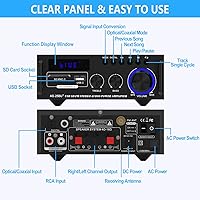
  • Digital Inputs: One optical (TOSLINK) and one coaxial S/PDIF input are provided on the rear panel for connecting televisions, disc players, and other digital audio sources.
  • Analog Inputs: A stereo RCA input handles analog sources such as turntables, CD players, or any device with a standard line-level output.
  • Additional Inputs: A USB 2.0 port and a full-size SD card slot allow direct playback of audio files stored on flash drives or memory cards without a separate source device.
  • FM Radio: An integrated FM tuner with a wire antenna input is included, enabling reception of broadcast radio without any additional hardware.
  • Power Supply: The unit operates on AC 110V mains power and also accepts a DC 12V/5A input, making portable or vehicle-based operation possible with a suitable adapter.
  • Tone Controls: Dedicated physical knobs for bass and treble adjustment are located on the front panel, allowing basic tonal shaping without external processing equipment.
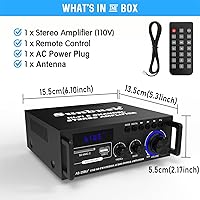
  • Dimensions: The chassis measures 6.1″ deep by 5.31″ wide by 2.17″ tall, making it one of the most compact full-featured stereo receivers in its category.
  • Weight: The complete unit weighs 2.2 pounds, light enough to reposition easily or carry for outdoor use with a portable power supply.
  • Channel Configuration: This is a 2.0 stereo amplifier with no subwoofer output or surround-sound processing; it drives two passive speakers only.
  • Manufacturer: The product is made by JS Electronics Limited and sold under the Sunbuck brand name, with original availability beginning in May 2019.
  • Product Status: The Sunbuck AS-25BU Stereo Amplifier has been officially discontinued by the manufacturer, meaning no new units are produced and no official warranty support channel currently exists.

  • Connector Types: Rear panel connections include TOSLINK optical, coaxial RCA, stereo RCA, USB Type-A, SD card slot, and a DC barrel jack for 12V power input.

Related Reviews
LOXJIE A30
LOXJIE A30
79%
86%
Sound Quality
82%
Build Quality
91%
Value for Money
89%
Input Versatility
63%
Bluetooth Performance
More
AK55 Stereo Amplifier
79%
88%
Value for Money
74%
Sound Quality
86%
Karaoke & Mic Performance
83%
Bluetooth Connectivity
91%
Input Variety
More
AK35 Stereo Mini Amplifier
71%
83%
Value for Money
67%
Sound Quality
71%
Bluetooth Performance
54%
Build Quality
89%
Setup & Ease of Use
More
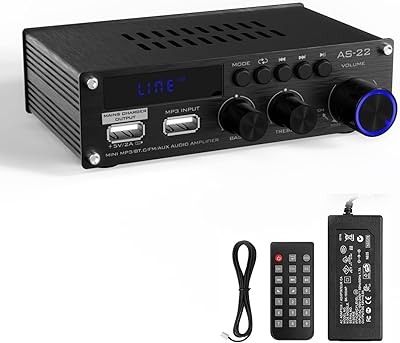
Sunbuck AS-22 Mini Amplifier
85%
87%
Sound Quality
74%
Bluetooth Range
91%
Ease of Use
80%
Build Quality
93%
Setup & Installation
More
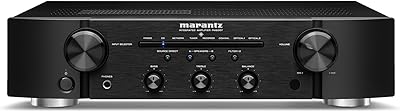
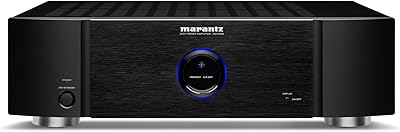
Marantz PM6007 Stereo Amplifier
84%
94%
Sound Quality & Clarity
90%
Build Quality & Durability
85%
Ease of Use & Setup
55%
Connectivity Options
88%
Power Output
More
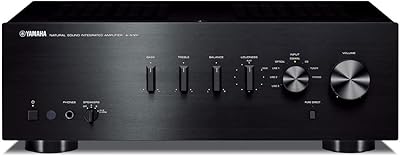
Yamaha A-S301BL Integrated Stereo Amplifier
82%
88%
Sound Quality
91%
Build Quality
92%
Value for Money
60%
Connectivity Options
85%
Ease of Setup
More
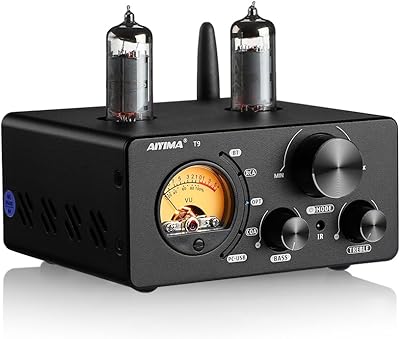
AIYIMA T9
AIYIMA T9
77%
83%
Sound Quality
88%
Value for Money
91%
Connectivity & Input Variety
67%
Bluetooth Performance
74%
Build Quality & Materials
More
Pyle PDA69BU Stereo Amplifier Receiver
75%
83%
Bluetooth Connectivity
74%
Sound Quality
79%
Build Quality
86%
Value for Money
88%
Input Versatility
More
Yamaha A-S701SL Integrated Stereo Amplifier
88%
94%
Sound Quality
91%
Build Quality
88%
Ease of Use
89%
Power Output
85%
Energy Efficiency
More
Marantz PM7000N
Marantz PM7000N
79%
93%
Sound Quality
88%
Build Quality
74%
Streaming & Connectivity
61%
HEOS App Experience
86%
Phono Stage Performance
More

FAQ

Any passive bookshelf or shelf speaker rated between 4 and 16 ohms will pair well with this compact stereo receiver. Efficient speakers — typically those rated at 85dB sensitivity or higher — will sound the best, since the real continuous output is 50W per channel. Avoid large floor-standing speakers designed for high-power amplifiers, as the amp will run out of headroom before those speakers perform properly.

Only if your turntable has a built-in phono preamp, which many modern entry-level turntables do. If your turntable outputs a raw phono-level signal, you will need an external phono preamp between the turntable and the RCA input on this mini amplifier, since there is no built-in phono stage.

In the same room with no walls between your phone and the amp, Bluetooth 5.0 works reliably and pairs quickly. The problem starts when you put a wall in the way — even a standard interior wall noticeably degrades the signal. If you plan to leave your phone in another room while music plays here, expect dropouts. Keep the source device in the same room and you will have a much better experience.

Not in any practical sense. The 300W figure is a peak measurement taken under very specific, brief conditions — it is a marketing number, not a performance guarantee. The figure that actually matters for daily use is the RMS output, which is 50W per channel. That is genuinely adequate for a bedroom or small office, but it is important to go in with that expectation rather than the headline peak number.

Yes, and this is one of the more underrated things about this receiver. The DC 12V input means you can power it from a car adapter or a portable power station, which makes it practical for garden use, garage setups, or anywhere a standard outlet is not nearby. You will need to source a compatible DC cable and power bank separately, but the capability is genuinely there.

Yes, and this is one of the most common ways people use it. Connect a standard TOSLINK optical cable from your TV's optical audio output to the optical input on the rear panel, select that input using the front panel button, and you get the TV's audio through your speakers. It works cleanly with most modern televisions that have an optical output.

Unfortunately, no. The manufacturer has discontinued this product, which means there is no official warranty or support channel available. If your unit develops a fault after purchase, you are essentially on your own. Some third-party sellers may offer their own return windows, so it is worth checking the seller's policy before buying. This is a real consideration for anyone thinking of this as a long-term primary amplifier.

USB playback works with common formats like MP3 and WAV, but the supported format list is limited compared to a dedicated media player. Buyers with FLAC libraries or less common formats have reported that some files simply do not play. If USB playback from a varied digital collection is important to you, it is worth testing early after purchase to confirm your files are compatible.

No, there is no remote control included, and no compatible remote is officially sold for it. All source switching, volume adjustment, and tone control happens via the front panel buttons and knobs. If the amp will sit across the room from where you typically sit, this is a genuine everyday inconvenience worth factoring into your decision.

It does run warm, particularly during extended listening sessions or when pushed to higher volumes. This is not unusual for a compact amplifier where the chassis itself acts as the heat sink, but the thermal headroom is limited given the small enclosure. Leaving a few inches of clearance around the unit and avoiding enclosed spaces with no airflow will help keep temperatures in a safe range during longer use.