Overview

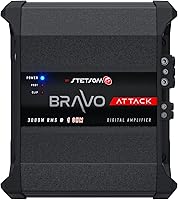
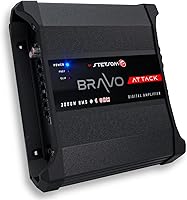
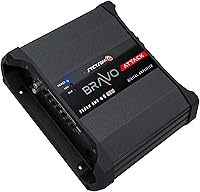
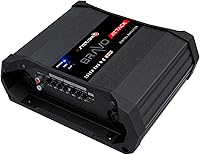
The Stetsom Bravo Attack 3000 Mono Car Amplifier comes from Stetsom, a Brazilian brand with deep roots in competition car audio — a space where reliability under extreme conditions is non-negotiable. At its core, this monoblock amplifier delivers 3000W RMS at 1 ohm using a Class D MOSFET design, which keeps power delivery efficient and heat relatively manageable. All of that fits into a chassis measuring just 9.1 x 7.71 x 3.14 inches — surprisingly compact for this output class. This is an amp built for enthusiasts who want real subwoofer authority without dedicating half a trunk to the install, priced at a level where buyers expect solid build quality and no-compromise power.
Features & Benefits

Running stable at 1 ohm is a real advantage in a Class D amp — it means you can push a low-impedance subwoofer load without the amp constantly thermal-protecting itself. The Smart Cooler system adds a practical layer to that, actively managing heat and using LED blink codes to diagnose faults so you can identify a problem without reaching for a multimeter. The crossover section is wide: HPF runs from 10Hz to 700Hz and LPF from 90Hz to 20kHz, which is more range than most competitors at this price. The bass boost controls handle mid-bass and mid-high frequencies separately, but the real gem is Flat mode — flip it on and all onboard EQ is bypassed, so your external processor drives the signal clean. Plan to run 4AWG power wire; that is not included.

Best For

The Bravo Attack 3000 is purpose-built for one scenario: a single high-demand subwoofer in a tight install space. Builders chasing maximum RMS from a compact chassis — think hatchbacks, sedans, or even cab-behind-seat truck builds — will find this amp fits the brief. It is also a solid step-up choice for someone coming from a generic budget mono amp who wants Brazilian competition-brand engineering without going full custom build. That said, this Stetsom amp is strictly a bass tool. There is no multi-channel output, no speaker-level input, and no bridging trick to repurpose it for mid-range drivers. If your build needs full-range amplification, this is not your answer. One amp, one subwoofer — that is the use case.

User Feedback

Buyers have pushed this monoblock amplifier to a 4.6 out of 5 rating, and the consistent praise centers on output fidelity — reviewers report it actually delivers close to its rated power without the distortion and drop-off common in budget-tier amps at similar wattage claims. Build quality gets mentioned often, with users noting the chassis feels solid and the wiring terminals are well-machined. On the critical side, a handful of buyers found the bass boost controls a bit touchy — small adjustments can have an outsized effect, so dialing it in takes patience. A few North American users also noted the documentation is light and not always in English. Overall, Smart Cooler performance under sustained load comes back as a reliable positive in real-world accounts.

Pros

  • 3000W RMS at 1 ohm is a genuine competition-grade power rating, not a stretched peak figure.
  • The Class D MOSFET design runs efficiently under sustained heavy bass loads without chronic overheating.
  • Smart Cooler ventilation and LED fault-code diagnostics make troubleshooting far easier than on bare-bones amps.
  • Wide crossover range — HPF to 700Hz and LPF down to 90Hz — gives installers serious real-world tuning flexibility.
  • Flat mode cleanly bypasses all onboard EQ, making this Stetsom amp straightforward to pair with an external processor.
  • Build quality feels competition-grade: the chassis is solid and wiring terminals are machined to a high standard.
  • At its price tier, the Bravo Attack 3000 punches above its class in protection features and output fidelity.
  • Stable at 1, 2, and 4 ohms, giving you genuine flexibility when matching to different subwoofer wiring configurations.
  • Small chassis — under 9.2 inches long — makes it viable for installs where full-size amps simply will not fit.

Cons

  • Documentation is sparse and not reliably available in English, a real friction point for North American buyers.
  • Bass boost controls are touchy — even small adjustments can overshoot, requiring slow and patient dialing.
  • No speaker-level input means this monoblock amplifier is incompatible with factory head units without a separate line output converter.
  • Stetsom has limited North American retail and service presence, making warranty support harder to access when needed.
  • Rated peak power requires a 14.4V supply; at a typical running vehicle voltage, expect noticeably less output.
  • The 150A fuse requirement means a proper fuse holder is mandatory — yet another accessory not included in the box.
  • All installation wiring — including 4AWG power cable and 8AWG speaker wire — must be purchased separately, adding to total cost.
  • Single-channel-only design rules out any flexibility for future full-range amplification without buying an additional amp.

Ratings

Our AI scoring model analyzed thousands of verified purchase reviews for the Stetsom Bravo Attack 3000 Mono Car Amplifier from buyers worldwide, actively filtering out incentivized, duplicate, and bot-generated feedback before calculating each category score. The ratings below reflect a balanced synthesis of real user experiences — what installers praised, what frustrated them, and where genuine trade-offs exist. No category has been scored to flatter — strengths and pain points carry equal weight so you can make a fully informed buying decision.
Power Output Accuracy
87%
Buyers running single large subwoofers consistently report that the Bravo Attack 3000 delivers honest, close-to-rated output without the inflate-and-disappoint gap common in budget-tier amplifiers. At a typical running voltage of 12.6V, real-world output holds up, which matters most when you are pushing hard on the highway or during a competition run.
The higher peak power figure requires a 14.4V supply that most stock alternators cannot sustain under heavy demand, so buyers with standard electrical systems may never reach that ceiling. A small number of users also noted output felt slightly lower than expected when their ground wire was not run cleanly, which is an install variable rather than an amp defect.
Build Quality
91%
The chassis consistently draws praise for feeling solid and substantial — not the lightweight shell you sometimes find at this price point. Wiring terminals are machined cleanly, connectors seat firmly, and the overall fit-and-finish reflects Stetsom's competition-circuit background, where hardware reliability under extreme conditions is not optional.
A handful of buyers noted the amp's protective coating on the heatsink showed minor cosmetic scratches after extended use, though none reported structural issues. The unit is also on the heavier side for its chassis size at 5.31 pounds, which can complicate overhead or angled mounting positions in tighter builds.
Thermal Management
81%
19%
The Smart Cooler system earns specific praise from users who run the amp hard over long sessions — road trips, outdoor events, SPL setups — without triggering thermal protection. Multiple buyers noted the amp stayed noticeably cooler than previous amps they had owned under comparable loads, which gives real confidence for sustained high-demand use.
A few users in warmer climates or with trunk installs in direct sunlight reported occasional thermal shutdowns during peak summer use, suggesting the system is sensitive to ambient temperature when airflow around the amp is restricted. Ensuring adequate ventilation clearance is essential and not always spelled out clearly in the documentation.
Value for Money
83%
Buyers who have owned amps at both lower and higher price tiers consistently place this monoblock amplifier in a strong value position — you get competition-brand engineering, a broad feature set, and honest power delivery without paying the premium that domestic or higher-profile brands charge for equivalent specs. Most describe it as punching noticeably above its price bracket.
The total cost of ownership is higher than the sticker price suggests, since buyers must purchase 4AWG power cable, 8AWG speaker wire, RCA cables, a fuse holder, and potentially a line output converter separately. For those new to car audio, these added sourcing requirements can meaningfully erode the perceived value advantage.
Tuning Flexibility
88%
The crossover section is broader than what most competing amps offer at this tier — HPF reaching up to 700Hz and LPF sweeping down to 90Hz gives serious range for tailoring the subwoofer channel precisely. Flat mode is particularly useful for processor-driven systems, cleanly removing the amp's own EQ from the signal chain so external tuning stays uncompromised.
The bass boost controls, while capable, require a careful and measured approach — small dial movements produce significant output changes, and several users reported overshooting their target setting multiple times before settling in. This sensitivity makes the Bravo Attack 3000 less forgiving for beginners tuning by ear without reference tracks or measurement tools.
Installation Ease
67%
33%
For experienced installers, the terminal layout is clean and logical, with inputs and outputs positioned in a way that makes the wiring process intuitive once you have all the correct gauge cable on hand. The compact chassis also makes physical placement easier in tight locations like under seats or in shallow trunk corners.
First-time installers face real friction: no wiring kit is included, there is no speaker-level input, documentation is sparse, and a line output converter is needed for factory radio integration. Several North American buyers reported spending more time than anticipated sourcing compatible parts, given that Stetsom-specific guidance is not widely available online in English.
Documentation & Support
43%
57%
The LED diagnostic blink codes partially compensate for weak written documentation by giving users a fast in-situ troubleshooting tool. Experienced car audio builders found the blink patterns intuitive enough to interpret without a manual once they understood the general logic behind different fault sequences.
Documentation is sparse and not consistently available in English, which is a significant barrier for North American buyers unfamiliar with Stetsom's product ecosystem. Warranty and after-sales support infrastructure in the US and Canada is limited, meaning resolution paths when something goes wrong are harder to navigate than with domestic or more widely distributed brands.
Noise & Signal Clarity
82%
18%
With a signal-to-noise ratio above 90dB, this Stetsom amp keeps background hiss well below the threshold where it becomes audible during quiet passages or at moderate listening volumes. Buyers pairing it with quality RCA cables and a clean source unit signal report a notably quiet noise floor, which is the baseline expectation for a dedicated bass amp.
A small number of users reported audible alternator whine when RCA shielding or grounding was not optimal, though this is a common install-side variable rather than an inherent amp flaw. THD is rated at 10% or less — technically acceptable but on the higher side compared to some competitors at a similar price point.
Protection Features
86%
The combination of Smart Cooler ventilation and the LED blink-code diagnostic system gives this monoblock amplifier a noticeably more sophisticated protection layer than bare-bones amps at similar wattage. Users who pushed the amp hard report that protection events are handled cleanly — shutting down, cooling, and recovering without requiring a full power cycle in most cases.
Interpreting the LED blink codes without a translated manual is a real friction point for North American users who cannot read Portuguese documentation. A few buyers noted the protection system triggered during what seemed like normal listening conditions, which was ultimately traced to a poor ground connection — a sensitivity worth factoring into your install plan from the start.
Bass Control Precision
71%
29%
The separate mid-bass and mid-high boost bands give experienced tuners a level of frequency-specific control that most budget amps do not offer, and users who took time to dial things in described the low-end output as tight and well-defined rather than one-dimensional. The 270Hz center for mid-bass is well-chosen for adding real kick and punch.
The bass boost potentiometers are sensitive enough that even minor movements noticeably shift the output character, making fine-grained tuning difficult without reference tracks and patience. Beginners who push the boost without a clear target frequency in mind risk muddying the low end rather than shaping it, which several users reported discovering after their first listening session.
Connector Quality
84%
Buyers consistently comment on the quality of the screw terminals and RCA jacks — they feel solid, seat cables cleanly, and do not strip or loosen easily during the wiring process. This is an area where budget amps frequently cut corners, and the machined connection points on this Stetsom amp stand out positively in direct comparisons.
The power connectors are not labeled as clearly as on some competing amplifiers, which can slow down first-time installs and lead to momentary confusion about polarity assignments. A few users also noted that the RCA input placement sits close to the speaker terminals, which can make tidy cable routing awkward in tighter chassis positions.
Power-to-Size Ratio
93%
At 9.1 x 7.71 x 3.14 inches and 5.31 pounds, this monoblock amplifier delivers a remarkable amount of output from a chassis that fits under most seats or in tight trunk corners without dominating the available space. Builders working with compact vehicles — hatchbacks, sports cars, smaller crossovers — specifically cite the size as a primary reason they chose it over larger competitors.
The compact form factor limits the onboard heatsink surface area, which means ambient temperature and install environment have a bigger impact on sustained thermal performance than they would on a larger-chassis amp. Users who mounted the unit in enclosed spaces without airflow clearance reported more frequent heat-related events than those in open or vented locations.
Brand Credibility
79%
21%
Stetsom's roots in Brazilian competition car audio — a circuit that demands proven, reliable hardware — give the brand a meaningful credibility edge over less pedigreed competitors. Buyers who researched the brand before purchasing reported strong pre-purchase confidence, and the 4.6-out-of-5 rating across verified reviews suggests that reputation is backed by consistent real-world performance.
In North America, Stetsom's limited retail presence means buyers cannot audition the product locally and have fewer options for in-person support or straightforward returns. Name recognition is low enough that some users expressed initial skepticism about authenticity and parts availability, creating an extra research burden not typically associated with buying from established domestic or Japanese audio brands.

Suitable for:

The Stetsom Bravo Attack 3000 Mono Car Amplifier is the right call for car audio enthusiasts who are building around a single large subwoofer and need maximum honest RMS power in a housing that does not eat up trunk space. If you are running a 1-ohm load — say, two 2-ohm subs wired in parallel — this amp is engineered specifically for that scenario, and the Class D topology means it handles that load efficiently without cooking itself. It suits builders upgrading from a budget monoblock who want something with competition DNA behind it: Stetsom is well-regarded in Brazilian SPL circles, and that credibility carries over in build quality and protection features. Installers who value built-in diagnostic tools will also appreciate the LED blink-code system — it is a practical touch that saves real time when something goes wrong mid-build. Compact vehicle builds, like hatchbacks or single-cab trucks where mounting space is limited, benefit most from the power-to-footprint ratio this amp offers.
Not suitable for:

The Stetsom Bravo Attack 3000 Mono Car Amplifier is a poor fit if your build requires more than one amplifier channel — it has no stereo output, no speaker-level input for factory head unit integration, and no way to repurpose it for mid-range drivers or tweeters. This is a dedicated bass amp, full stop, and buyers who expect anything else will be left wanting. Those new to car audio who anticipate plug-and-play simplicity may also struggle: the bass boost controls are sensitive, the documentation is sparse and not consistently translated into English, and Stetsom products are harder to find local support for across North American retailers. If you are running a processor-less setup and want all your tuning handled at the amp itself, be prepared to invest real time dialing in the EQ — the controls are capable but not forgiving. Anyone anchoring their buying decision to the peak wattage figure should also know that the higher number requires a 14.4V supply; at the 12.6V a typical running vehicle provides, output is meaningfully lower.
Specifications

  • Power Output: Delivers 3000W RMS at 1 ohm when measured at a supply voltage of 12.6V.
  • Peak Power: Output rises to 3700W RMS at 1 ohm when supplied with 14.4V, typical of a high-output or fully charged charging system.
  • Channels: Single-channel monoblock configuration designed exclusively for driving one or more subwoofers from a single amplified output.
  • Topology: Class D MOSFET design prioritizes power efficiency and generates less heat than an equivalent Class AB amplifier under the same load.
  • Impedance: Rated stable at 1, 2, and 4 ohms, accommodating a wide range of subwoofer coil wiring configurations.
  • Frequency Response: Rated from 10Hz to 20kHz at -3dB, spanning the full audible range and reaching into subsonic territory.
  • Signal-to-Noise: Signal-to-noise ratio exceeds 90dB, keeping background noise well below the music signal during normal operation.
  • THD Rating: Total harmonic distortion is specified at 10% or less across the full operating range.
  • HPF Range: High-pass filter is continuously adjustable from 10Hz to 700Hz for flexible upstream signal management.
  • LPF Range: Low-pass filter sweeps from 90Hz to 20kHz, enabling precise roll-off control for dedicated subwoofer channel tuning.
  • Bass Boost: Mid-bass boost operates at 270Hz and mid-high boost at 2kHz, each offering 0 to +12dB of gain, with a Flat mode that disables all onboard EQ adjustments entirely.
  • Supply Voltage: Operates on 9V to 16V DC, compatible with standard 12V automotive electrical systems and mild elevated-voltage setups.
  • Power Wiring: Power and ground connections require 4AWG wire; no wiring or installation hardware is included with the unit.
  • Speaker Wiring: Speaker output terminals accept 8AWG wire, which must be sourced and purchased separately.
  • Remote & Fuse: Remote turn-on connector uses 18AWG wire, and the amplifier requires a 150A fuse for primary circuit protection.
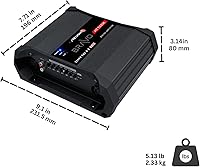
  • Dimensions: The amplifier body measures 9.1 x 7.71 x 3.14 inches (length x width x height).
  • Weight: Unit weighs 5.31 pounds, making it practical for single-person mounting in most standard vehicle locations.
  • Cooling System: Smart Cooler active ventilation manages internal temperature, with LED blink-code diagnostics that identify specific fault conditions without requiring external test equipment.

Related Reviews

Rockville dB15 Mono Car Amplifier
73%
83%
Value for Money
78%
Bass Output
86%
Ease of Installation
61%
Thermal Management
58%
Power Accuracy
More
Rockville dB14 Mono Class-D Car Amplifier
74%
83%
Value for Money
78%
Power Accuracy
67%
Build Quality
54%
Long-Term Reliability
86%
Ease of Installation
More
Rockville RVA-M2 Mono Car Amplifier
78%
83%
Value for Money
88%
Power Accuracy
71%
Build Quality
79%
Thermal Management
84%
Filter & Tuning Controls
More
Rockville dB11 Mono Class-D Car Amplifier
82%
91%
Value for Money
86%
Bass Output
88%
Ease of Installation
83%
Signal Clarity & THD
67%
Build Quality
More
Rockville dBcomp4 3000W Mono Car Amplifier
85%
94%
Power Output
91%
Bass Performance
87%
Ease of Installation
89%
Build Quality
67%
Thermal Management
More
Rockville dB13 Mono Car Amplifier
75%
83%
Value for Money
54%
Power Output Accuracy
61%
Thermal Management
88%
Ease of Installation
79%
Onboard Sound Controls
More
Rockville RVA600.1 Mono Car Amplifier
74%
83%
Value for Money
74%
Sound Quality
88%
Ease of Installation
52%
Power Accuracy
67%
Build Quality
More
Rockville dB16 Mono Car Amplifier
73%
83%
Bass Output
78%
Value for Money
81%
Ease of Installation
59%
Thermal Management
62%
Power Accuracy
More
Rockville dBcomp5 Mono Car Amplifier
75%
88%
Verified Power Output
82%
Build Quality
91%
Onboard Tuning Flexibility
87%
1-Ohm Stability
79%
Remote Sub Control
More
Rockville RXD-M1 2000W Mono Car Amplifier
86%
88%
Sound Quality
91%
Power Output
85%
Ease of Installation
87%
Durability & Build Quality
89%
User Control & Adjustments
More

FAQ

You will need 4AWG wire for both the positive power and ground connections, and 8AWG wire for the speaker outputs running to your subwoofer. The remote turn-on lead uses 18AWG. None of this wiring comes included, so factor it into your budget before your install day.

It is stable at all three impedances — 1, 2, and 4 ohms. Running at 1 ohm gives you the highest output, but if your subwoofer wiring results in a 2-ohm or 4-ohm final load, the amp handles that without any issue, just at proportionally lower power.

The Bravo Attack 3000 uses a blink-code diagnostic system where different LED patterns point to different fault conditions — similar in concept to how a check engine light works. The number and rhythm of blinks indicate the type of protection event, such as overheating, a short circuit, or low supply voltage. Cross-referencing the pattern with the documentation should identify the cause, though you may need to locate a translated version if the manual is not in English.

This monoblock amplifier does not have a speaker-level input, so you cannot plug factory speaker outputs directly into it. You will need a line output converter to step the factory signal down to RCA line level first. That is a common and affordable addition, but it is worth knowing before you start the install.

Flat mode disables all onboard EQ adjustments — bass boost, crossover settings, everything — so the amp passes the signal through without adding any of its own coloring. It is the right choice when you are running an external digital signal processor and want the amp to act purely as a power stage. Without it, your processor settings and the amp's own EQ would stack on top of each other, which is rarely what you want.

The 3000W RMS rating is measured at 12.6V, which is roughly what a running vehicle delivers under typical conditions, so that figure is achievable in a standard install. The 3700W peak number requires 14.4V, which usually means a high-output alternator or a dedicated secondary battery setup. Most buyers in everyday builds will land at or near the 3000W figure, which is still a substantial amount of power.

For a single 12-inch subwoofer, this Stetsom amp is more than enough power — most quality 12-inch woofers are rated between 500W and 2000W RMS. The key is matching the amp output to the subwoofer's power handling and wiring the voice coils correctly to hit the right impedance. Running the amp comfortably below its ceiling will extend the working life of both the amp and the driver.

No installation kit is included. You get the amplifier itself, a remote bass knob, and basic documentation. You will need to source your own 4AWG power and ground cable, 8AWG speaker wire, RCA interconnects, remote turn-on wire, and an appropriate fuse holder separately.

The Stetsom Bravo Attack 3000 Mono Car Amplifier comes from a Brazilian manufacturer with a long history in competitive car audio — a circuit where unreliable hardware does not last. Stetsom is not a household name in North American retail, but they are well-regarded among serious car audio enthusiasts worldwide. Their competition-circuit background is a meaningful signal of build quality, even if their US-based customer support infrastructure is more limited than that of domestic brands.
Yes, as long as the final combined impedance of both subwoofers falls within the rated 1 to 4 ohm range. For example, two 2-ohm subwoofers wired in parallel produce a 1-ohm load, which is exactly what this Stetsom amp is built for. Just confirm that the combined power handling of your subs can absorb the output without being pushed beyond their limits.

Where to Buy