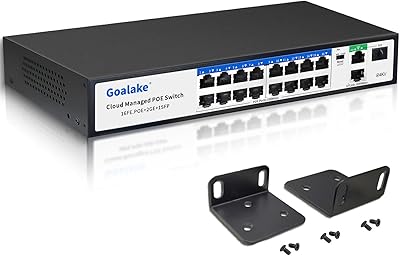
STEAMEMO 16-Port 240W PoE+ Unmanaged Switch
Overview
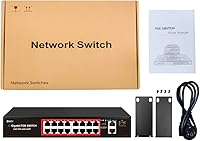
The STEAMEMO 16-Port 240W PoE+ Unmanaged Switch sits in a crowded budget segment but earns its place with a port count and build quality that typically cost considerably more. You get 16 PoE+ ports, two gigabit uplinks, and an SFP slot in a solid all-metal chassis — no flimsy plastic here. The built-in power supply keeps the installation tidy, and since there is no management interface to configure, anyone can have it running in minutes. One thing to set straight early: the PoE ports run at 100Mbps, which is perfectly adequate for IP cameras and VoIP phones but won't suit high-bandwidth workloads like video editing over the network.
Features & Benefits
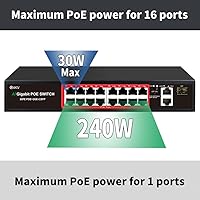
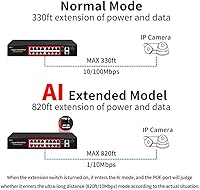
The 240W power budget is spread across all 16 ports, each capable of delivering up to 30W — enough for PTZ cameras or dual-band access points. A physical toggle activates extend mode, stretching each port's reach from the standard 100 meters out to 250 meters; speed may be reduced at those distances, so it's best reserved for cameras rather than latency-sensitive traffic. The SFP slot adds a fiber uplink option for connecting into a core switch or spanning longer backbone runs. AI PD Detection and 4KV lightning protection on both ports and the power supply round out a feature set that punches well above the price point for an unmanaged device.
Best For
This 16-port PoE switch is the kind of hardware that makes sense for someone wiring up a multi-camera security system in a small office or home, where plug-and-play is a priority and nobody wants to log into a web interface to make things work. It's also a solid pick for deploying PoE access points or VoIP phones across a single floor. The 250-meter extend capability makes it genuinely useful for outbuildings or parking lots where running power alongside cable isn't feasible. Where it falls short: if your environment calls for VLANs, QoS prioritization, or link aggregation, this unmanaged PoE+ switch simply isn't built for that. Know your use case before you buy.
User Feedback
Across well over 2,100 ratings, the STEAMEMO switch holds a 4.4-out-of-5 average — a strong signal that most buyers are getting what they paid for. Consistent themes in positive reviews are reliable power delivery, a no-fuss setup experience, and a build that feels more substantial than the price suggests. On the critical side, a meaningful minority report power inconsistencies when all ports are loaded near capacity, and there are scattered accounts of individual port failures over time. The extend mode draws specific praise from camera installers dealing with long runs, while a smaller group flags the 100Mbps port speed as a real constraint when mixing in devices that need more than camera-grade throughput.
Pros
- Sixteen PoE+ ports in a metal chassis at this price point is genuinely hard to beat in the budget segment.
- Plug-and-play setup means most installers have it running in under ten minutes with no configuration required.
- The built-in power supply eliminates the need for a separate power brick, keeping installations clean and compact.
- Extend mode lets the STEAMEMO switch push data and power well beyond the standard Ethernet distance limit.
- Fanless passive cooling means it runs completely silent — ideal for closets, reception areas, or quiet office spaces.
- AI PD Detection protects non-PoE devices from accidental power delivery without any manual configuration.
- 4KV lightning protection on ports and the power supply adds a meaningful layer of durability for exposed or outdoor-adjacent runs.
- The SFP uplink slot gives installers a fiber backbone option that most switches at this price simply do not offer.
- Wall, rack, and desktop mounting options make placement flexible across a wide range of installation environments.
- A 4.4-star average across thousands of real-world buyers reflects consistent satisfaction for a security-focused use case.
Cons
- The 100Mbps PoE port speed becomes a real bottleneck the moment you introduce any non-camera, higher-bandwidth device.
- Some buyers report power delivery inconsistencies when multiple high-draw devices are connected simultaneously under full load.
- A minority of owners have experienced individual port failures within the first year of use.
- Extend mode trades speed for distance, so it is not a reliable option for anything more demanding than low-bitrate camera streams.
- No management interface means zero visibility into port status, traffic load, or device connectivity — troubleshooting is entirely blind.
- The total power budget spread across sixteen ports leaves limited headroom if you frequently mix 802.3at high-draw devices.
- Brand recognition and long-term support history are thin compared to established networking vendors, which may matter for business deployments.
- No VLAN or traffic segmentation support makes it unsuitable for any network with basic security isolation requirements.
Ratings
The scores below reflect AI-driven analysis of verified global buyer reviews for the STEAMEMO 16-Port 240W PoE+ Unmanaged Switch, with spam, bot-submitted, and incentivized feedback actively filtered out before scoring. Each category is rated independently based on real-world usage patterns reported by installers, small business owners, and DIY security enthusiasts worldwide. Both the genuine strengths and the recurring frustrations are transparently factored into every score.
Value for Money
Ease of Setup
PoE Power Delivery
Port Speed Performance
Build Quality
Extend Mode Effectiveness
Thermal Management
Lightning & Surge Protection
Port Count & Layout
Long-Term Reliability
Compatibility
Mounting Flexibility
Documentation & Support
Suitable for:
The STEAMEMO 16-Port 240W PoE+ Unmanaged Switch is a strong fit for anyone setting up a multi-camera security system at home or in a small office and wants the whole job done without touching a configuration screen. If you are running eight to sixteen IP cameras from a single wiring closet, the port count and power budget here are genuinely well-matched to that workload. Small business owners deploying PoE access points and VoIP handsets across a single floor will find the setup refreshingly straightforward — plug in, power on, done. The physical extend mode toggle is a real advantage for installers dealing with outbuildings, parking structures, or any location where the device sits more than 100 meters from the switch. Budget-conscious buyers who want a metal-chassis, fanless switch without paying a premium for managed features they will never use are squarely in the target audience for this hardware.
Not suitable for:
Anyone managing a network that requires VLANs, QoS traffic prioritization, link aggregation, or per-port monitoring should look elsewhere, because this unmanaged PoE+ switch offers none of those controls by design. The 100Mbps ceiling on the PoE ports is worth taking seriously if your deployment includes devices beyond IP cameras — file servers, NAS units, or workstations will feel that constraint immediately. IT professionals responsible for segmented or multi-tenant networks will find the lack of any management interface a hard blocker rather than a minor inconvenience. Users who consistently load all sixteen ports near their individual power limits have reported occasional instability, so environments with a dense mix of high-draw devices may need a switch with a more conservatively rated power budget. If long-term reliability in a mission-critical deployment is the priority, a tier-up to a managed switch from an established enterprise networking brand is the more defensible choice.
Specifications
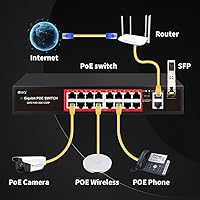
- PoE Ports: Sixteen 100Mbps PoE+ ports support both 802.3af and 802.3at standards, making them compatible with most IP cameras, access points, and VoIP phones.
- Uplink Ports: Two dedicated Gigabit Ethernet uplink ports provide a fast connection to a router, NVR, or upstream switch without consuming PoE port bandwidth.
- SFP Slot: One 1.25G SFP slot accepts standard SFP modules for fiber uplink connectivity, useful for long-distance backbone runs between buildings or floors.
- PoE Budget: The total shared PoE power budget is 240W, with each individual port delivering up to 30W when demand across all ports allows.
- Extend Mode: A physical toggle switch activates extend mode, stretching data and power transmission from the standard 100-meter limit up to 250 meters at reduced throughput.
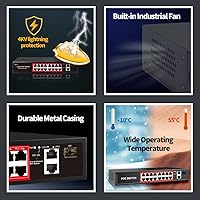
- Lightning Protection: Both the data ports and the internal power supply carry 4KV surge and lightning protection, adding a layer of resilience for installations near outdoor cabling.
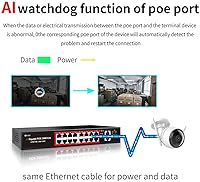
- AI PD Detection: Onboard PD detection automatically identifies whether a connected device requires PoE power, preventing the switch from energizing ports connected to non-PoE equipment.
- Chassis Material: The enclosure is fully metal construction, which improves passive heat dissipation and adds physical durability compared to plastic-bodied alternatives at this price tier.
- Cooling System: The switch uses entirely passive fanless cooling, producing zero operational noise and removing the fan as a potential point of mechanical failure over time.
- Power Supply: The AC power supply is built directly into the switch body, eliminating the need for an external power brick and keeping the installation tidy.
- Management Type: This is a fully unmanaged switch with no web interface, CLI, or software configuration required — it is operational immediately upon powering on.
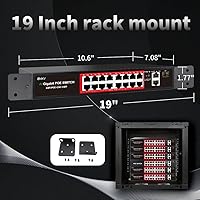
- Dimensions: The unit measures 10.6″ long by 7″ wide by 1.8″ tall, fitting comfortably on a desktop shelf or in a standard 19″ rack with appropriate brackets.
- Weight: At 3.87 pounds, the switch is dense enough to feel solid without being difficult to mount or reposition during installation.
- Mounting Options: The switch supports desktop, wall, and rack mounting configurations, giving installers flexibility depending on the available space in the wiring location.
- Total Port Count: The switch provides 19 total ports: 16 PoE+, 2 Gigabit uplinks, and 1 SFP, covering a broad range of connection types in a single 1U-height unit.
- Operating Temp: The rated upper operating temperature is 55 degrees Celsius, which is adequate for enclosed wiring closets but worth monitoring in poorly ventilated spaces during summer.
Related Reviews
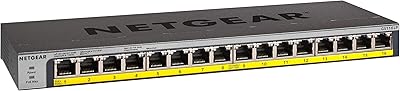
NETGEAR GS116LP 16-Port Unmanaged PoE+ Switch
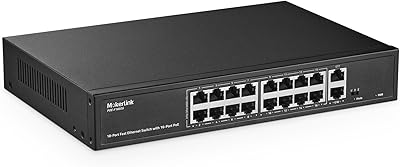
MokerLink POE-F1602G 16-Port PoE Switch
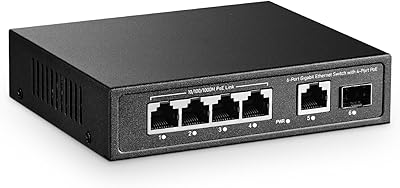
YuLinca 6-Port Gigabit PoE Switch with 4 PoE+ Ports
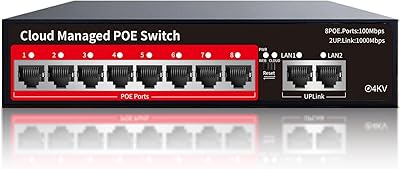
STEAMEMO 8-Port 120W Managed PoE+ Switch
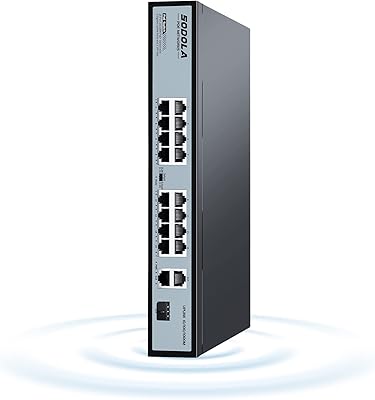
Sodola SL-S0181P-200W 16-Port PoE Network Switch
STEAMEMO 16-Port Managed Gigabit Ethernet Switch
NETGEAR GS116PP 16-Port PoE+ Gigabit Switch
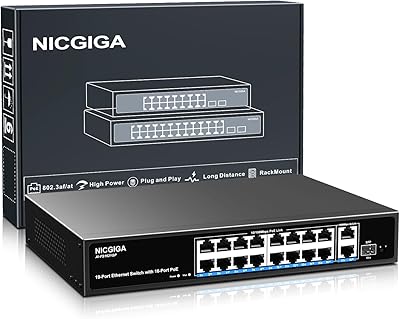
NICGIGA NIC-AI-FS1621GP 16-Port Unmanaged PoE Switch
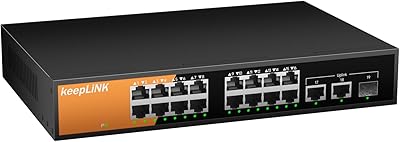
keepLiNK 16-Port Gigabit PoE Unmanaged Switch