Overview

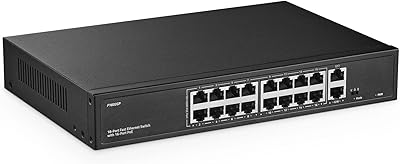
The keepLiNK 16-Port Gigabit PoE Unmanaged Switch landed on Amazon in mid-2024 as a no-frills option for anyone who needs to power a lot of network devices without a large budget. It targets small businesses, home labs, and security camera setups where simplicity matters more than granular control. There's no management interface, no VLAN configuration, no CLI — you plug it in and it works. The chassis is all metal, fanless by design, making it practical for offices or closets where noise is a concern. With a 4.2-star average across 54 ratings, early buyer sentiment looks solid, though that's still a relatively small sample for a product launched less than a year ago.
Features & Benefits

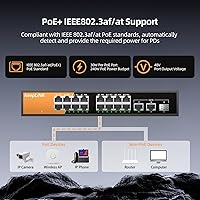
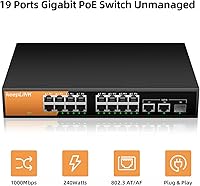
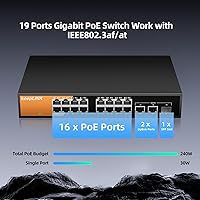
What makes this PoE switch stand out at its price point is the combination of port density and extras you wouldn't always expect. All 16 ports support 802.3at/af, each capable of delivering up to 30W — but keep in mind the shared 240W power budget applies across the whole unit. Running cameras or access points at moderate draw, that's plenty; push all 16 ports hard simultaneously and you'll need to plan your load carefully. The two dedicated uplink ports handle your backbone connection, and the SFP slot is a genuine differentiator here — fiber uplinks at this price tier are rare among competing switches. Auto-detection also protects non-PoE gear from accidental power delivery, which matters in mixed environments.

Best For

This unmanaged gigabit switch earns its keep in IP camera deployments — retail stores, small offices, and warehouses where you need to power a dozen or more cameras without running separate power injectors to each one. Home lab builders on a budget will appreciate the port count and the rackmount option; it fits neatly into a standard 1U rack slot with the included brackets. The fanless operation makes it worth considering anywhere acoustics matter, like a recording space or a front-of-house AV setup. The SFP uplink also makes it a clean choice for connecting to a fiber backbone, which is handy when your network closet sits far from the core switch.

User Feedback

With only 54 ratings collected so far, it's too early to draw firm conclusions, but the early signals are encouraging. Buyers consistently praise the plug-and-play experience — no drivers, no web interface, just working connectivity straight out of the box. The value-for-money angle comes up frequently, particularly given the SFP slot and sturdy metal build. On the cautious side, a handful of reviewers note the unit can run warm under sustained heavy load, which is worth monitoring in a poorly ventilated rack space. There's also a recurring power-budget question: buyers planning to run high-draw PoE devices across all 16 ports simultaneously should calculate their total wattage needs before purchasing.

Pros

  • Sixteen PoE+ ports in a single unit eliminates the need for individual power injectors throughout your installation.
  • The SFP uplink slot is a rare inclusion at this price point, enabling fiber backbone connectivity most competitors skip.
  • Plug-and-play operation means zero configuration time — ideal for quick deployments or non-technical users.
  • Metal housing feels solid and contributes to passive cooling without relying on fans.
  • Desktop and 1U rack-mount flexibility suits both closet installations and open desk setups.
  • Auto-detection protects non-PoE devices from accidental power delivery, reducing risk in mixed-device environments.
  • Early buyers consistently praise the value-to-port-count ratio as genuinely strong for the price category.
  • Operating temperature range of 14°F to 122°F makes it viable in less climate-controlled spaces like garages or warehouses.
  • At under 2.5 pounds, the switch is lightweight and easy to reposition during installation.

Cons

  • The 240W shared power budget can become a bottleneck if many high-draw devices are connected simultaneously.
  • With only 54 ratings at time of writing, long-term reliability and failure rate data remain largely unknown.
  • No management interface means you cannot diagnose port issues, monitor traffic, or set priorities remotely.
  • Fanless cooling keeps it quiet but may lead to higher operating temperatures in poorly ventilated rack spaces.
  • No PoE port power limiting per-port, so uneven power distribution across all 16 ports requires manual planning.
  • The brand is relatively new to the market, with limited independent third-party testing or professional reviews available.
  • No Link Aggregation or redundancy features, which limits its use in more resilient network designs.

Ratings

The scores below were generated by our AI engine after analyzing verified buyer reviews for the keepLiNK 16-Port Gigabit PoE Unmanaged Switch from multiple global sources, with spam, bot-submitted, and incentivized feedback actively filtered out. The result is an honest, balanced snapshot of where this switch genuinely delivers and where real users have run into friction. Both the strengths and the frustrations are reflected as accurately as the available data allows.
Value for Money
91%
Buyers consistently call out the port-to-dollar ratio as exceptional, particularly given that most competing 16-port PoE switches at this tier drop the SFP slot entirely. For small businesses or home lab builders trying to power a fleet of cameras or access points without breaking the bank, the value proposition is hard to argue with.
A handful of reviewers note that the savings come with trade-offs in brand maturity — keepLiNK is a newer name, and some buyers feel the lower price introduces a degree of uncertainty around long-term reliability that established brands do not carry.
Ease of Setup
93%
The plug-and-play experience earns some of the most enthusiastic feedback in the entire review pool. Non-technical users deploying camera systems in retail or office environments report being fully up and running within minutes of unboxing, with zero configuration required.
A small number of users who came from managed switch backgrounds found the complete absence of any interface — even a basic status page — mildly disorienting at first, though this is an inherent feature of unmanaged switches rather than a defect.
PoE Power Delivery
78%
22%
For typical deployments running standard IP cameras or wireless access points, the 240W shared budget proves more than sufficient, and the auto-detection feature reliably identifies compatible devices without any manual intervention.
Users attempting to load all 16 ports with high-draw devices — such as PTZ cameras or dual-radio access points — have hit the shared power ceiling and experienced devices dropping offline. The 240W budget requires real planning if your deployment is power-dense.
Build Quality
84%
The all-metal chassis draws consistent praise from buyers who have handled cheaper plastic switches before. It feels solid on a desktop and holds up well in rack installations, with several users noting the unit shows no signs of flex or rattling even after months of continuous use.
The metal finish, while sturdy, can show surface scratches during installation, and a few buyers noted the mounting bracket screws felt slightly under-torqued from the factory. Nothing functionally serious, but noticeable on close inspection.
Thermal Performance
71%
29%
In lightly to moderately loaded deployments, the fanless design keeps operating temperatures well within acceptable ranges, and the metal housing does a reasonable job of spreading heat passively. Users in open-rack or ventilated closet setups report no thermal issues after months of 24/7 operation.
Several reviewers running the switch in enclosed or poorly ventilated rack cabinets report the unit getting noticeably hot under sustained heavy load. The side ventilation slots need clear airflow to function properly, and ignoring this in a dense rack installation is a real risk.
Port Density
89%
Sixteen PoE ports in a 1U form factor at this price range is genuinely hard to find, and buyers deploying multi-camera security systems or distributed Wi-Fi networks appreciate not having to chain multiple smaller switches together to reach the port count they need.
The two uplink ports are non-PoE Gigabit only, which suits most use cases but limits flexibility slightly for users who want to daisy-chain PoE switches or use the uplinks for powered devices.
SFP Uplink
82%
18%
The inclusion of an SFP slot is a standout feature at this price point, and users connecting to fiber backbones or bridging across longer cable runs particularly appreciate it. IT professionals setting up small branch offices note it removes the need for a separate media converter.
The SFP module itself is not included in the box, which catches some first-time buyers off guard. Users also note that only 1G SFP modules are supported, which is fine for most setups but rules out 10G uplink scenarios entirely.
Noise Level
96%
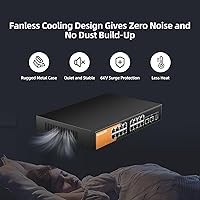
The fanless operation is universally praised by buyers placing the switch in noise-sensitive environments. Recording spaces, open-plan offices, and home setups all benefit from the complete absence of fan hum, which becomes noticeably irritating in otherwise quiet rooms with traditional switches.
There is essentially no downside to the silent operation itself, though it is worth understanding that the trade-off is reduced active cooling — in very warm environments, silence comes at the cost of higher surface temperatures.
Compatibility
88%
Buyers report broad compatibility across major IP camera brands, VoIP phones, and wireless access points including Ubiquiti, TP-Link EAP, and Hikvision hardware. The auto-detection logic works reliably across a wide range of 802.3at and 802.3af devices without any configuration.
A small number of users have reported compatibility quirks with older or non-standard PoE implementations on legacy devices. As with any unmanaged switch, there is no diagnostic tooling to identify which port or device is causing an issue when problems arise.
Rackmount Design
81%
19%
The included mounting brackets and compact 1U profile make rack installation straightforward, and buyers appreciate that the hardware comes in the box rather than being sold separately. The lightweight chassis also simplifies cable management during installation.
The bracket design positions the switch ports at a slightly awkward depth relative to standard rack cable management panels, which a few rack-conscious installers found required extra cable length to route cleanly.
Indicator Lights
74%
26%
Per-port LED activity and link indicators help users quickly identify which ports are active and whether PoE is being supplied, which is useful during initial deployment and basic troubleshooting without any management interface.
Several reviewers note the LEDs are quite dim in brightly lit environments, making them difficult to read from a distance. There is also no aggregate power consumption indicator, so users have no visual way to gauge how close they are to the 240W total budget.
Packaging & Documentation
67%
33%
The unit arrives well-protected and includes all the hardware needed for both desktop and rack deployment. The quick-start guide covers the essentials, which is genuinely all most plug-and-play users need to get started.
The full user manual is fairly sparse, and buyers looking for guidance on power budget calculations or SFP module compatibility lists will need to seek answers elsewhere. For more technically oriented users, the documentation leaves noticeable gaps.
Long-term Reliability
63%
37%
Units that have been in continuous operation for six or more months show no widely reported failure patterns in the current review pool, and several buyers have noted stable uptime across camera and access point deployments running around the clock.
With only 54 reviews at the time of analysis and a launch date of mid-2024, the dataset is simply too small to draw firm reliability conclusions. The brand is new, third-party durability testing is absent, and it is too early to know how the switch holds up past the one-year mark.

Suitable for:

The keepLiNK 16-Port Gigabit PoE Unmanaged Switch is a strong fit for small business owners, IT generalists, and home lab enthusiasts who need to power a large number of network devices without the overhead of a managed switch. It's particularly well-suited for IP camera installations in retail stores, small offices, or warehouses, where running individual power injectors to each camera would be messy and expensive. The plug-and-play setup means you don't need networking expertise to get it running — unbox it, connect your devices, and you're done. The included rack-mount brackets make it equally at home in a tidy server closet or sitting flat on a desktop, and the fanless chassis means it won't become an annoyance in quiet environments. Anyone who needs an SFP uplink to bridge a fiber backbone at a budget-friendly price will also find it hard to beat at this tier.
Not suitable for:

The keepLiNK 16-Port Gigabit PoE Unmanaged Switch is not the right choice for network administrators who need granular control over traffic, VLANs, QoS prioritization, or port-level monitoring. If your environment requires managed switching features — for example, separating guest Wi-Fi from internal systems, or prioritizing VoIP traffic — you'll need to look at a managed switch instead. Power-hungry deployments also deserve careful thought: the 240W shared budget sounds generous, but if you plan to simultaneously run 16 devices that each draw close to their maximum, you could hit the ceiling faster than expected. The switch is also a relatively new product with a limited review base, so long-term reliability data is still thin. Buyers in high-demand enterprise or multi-site environments would be better served by established brands with deeper support infrastructure and proven track records.
Specifications

  • PoE Ports: The switch includes 16 RJ45 ports with PoE+ support, each compliant with IEEE 802.3at and 802.3af standards.
  • Power Per Port: Each PoE port can deliver up to 30W of power to connected devices.
  • Total PoE Budget: The shared power pool across all 16 PoE ports is capped at 240W total.
  • Uplink Ports: Two dedicated Gigabit RJ45 uplink ports are provided for connecting to a router or upstream switch.
  • SFP Slot: One SFP slot supports fiber or copper SFP modules for longer-distance or fiber backbone uplinks.
  • Data Transfer Rate: All ports operate at 1 Gbps (Gigabit Ethernet), supporting full-speed wired network throughput.
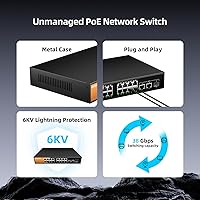
  • Management: The switch is fully unmanaged and requires no configuration, software, or web interface to operate.
  • Housing Material: The chassis is constructed from metal, providing durability and contributing to passive heat dissipation.
  • Cooling System: The switch uses a fanless design with ventilation slots on both sides for silent thermal management.
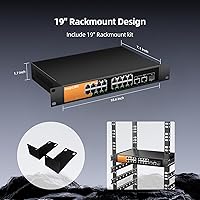
  • Mounting Options: The unit supports both flat desktop placement and 1U rack installation using the included mounting brackets.
  • Dimensions: Physical dimensions are 7.12″ (L) x 10.63″ (W) x 1.73″ (H).
  • Weight: The switch weighs 2.42 pounds, making it lightweight enough for easy repositioning during installation.
  • Operating Temp: The unit is rated for operating temperatures between 14°F and 122°F (−10°C to 50°C).
  • PoE Detection: Automatic PoE device detection ensures power is only delivered to compatible devices, protecting non-PoE equipment.
  • Compatible Devices: The switch is compatible with IP cameras, VoIP phones, wireless access points, laptops, and other PoE-enabled network devices.
  • Included Items: The package includes the switch unit, a power cable, mounting brackets, and a user manual.
  • Form Factor: The switch follows a standard 1U rackmount profile, fitting into any standard 19-inch equipment rack.
  • Brand: Manufactured and sold by keepLiNK, a networking hardware brand that launched this model in July 2024.

Related Reviews
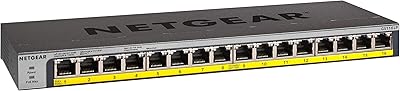
NETGEAR GS116LP 16-Port Unmanaged PoE+ Switch
86%
97%
Ease of Setup
93%
PoE Port Coverage
62%
PoE Power Budget
96%
Silent Operation
88%
Build Quality
More
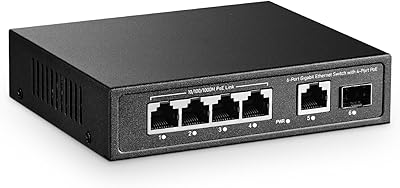
YuLinca 6-Port Gigabit PoE Switch with 4 PoE+ Ports
87%
95%
Ease of Installation
88%
PoE Functionality
91%
Build Quality
87%
Performance and Speed
94%
Fanless Operation (Noise)
More
keepLiNK 48-Port Gigabit PoE Switch
86%
89%
Performance
85%
Ease of Setup
91%
Build Quality
88%
Power Delivery (PoE+)
84%
Security Features
More
TRENDnet TEG-S16DG 16-Port Gigabit Switch
84%
96%
Ease of Setup
91%
Build Quality
89%
Network Performance
97%
Noise Level
84%
Value for Money
More
NETGEAR GS316PP 16-Port PoE+ Gigabit Ethernet Switch
85%
92%
Value for Money
89%
Ease of Use
86%
Energy Efficiency
76%
PoE Power Delivery
90%
Quiet Operation
More
NETGEAR GS316P 16-Port PoE+ Gigabit Switch
77%
97%
Ease of Setup
94%
PoE Port Coverage
61%
PoE Power Budget
88%
Build Quality
96%
Noise Level
More
Linksys LGS124P 24-Port Gigabit Unmanaged PoE Switch
90%
91%
Ease of Setup
88%
Build Quality
93%
PoE Performance
85%
Durability
89%
Energy Efficiency
More
TP-Link TL-SG1016PE 16-Port Gigabit PoE Switch
80%
91%
PoE Reliability
88%
Build Quality
67%
Power Budget
63%
Management Interface
86%
Setup & Ease of Use
More
YuLinca F1602GP 16-Port PoE Switch with 2 Gigabit Uplink
84%
72%
Performance at Extended Ranges
92%
Setup & Installation Ease
88%
Build Quality & Durability
85%
Value for Money
90%
PoE Power Output
More
STEAMEMO 16-Port 240W PoE+ Unmanaged Switch
79%
91%
Value for Money
93%
Ease of Setup
78%
PoE Power Delivery
63%
Port Speed Performance
87%
Build Quality
More

FAQ

None at all. It is a true plug-and-play device — connect your uplink to a router or modem, plug in your PoE devices, and they will start receiving power and data immediately. There is no web interface, no app, and no driver to install.

Technically no. The total power budget across all 16 ports is 240W, which works out to an average of 15W per port if all are in use at once. If your devices draw close to 30W each, you will need to be selective about how many high-draw devices you connect simultaneously to avoid hitting the ceiling.

As long as your cameras support IEEE 802.3at or 802.3af PoE standards, yes. The switch auto-detects compatible devices and supplies power accordingly. Most modern IP cameras from brands like Hikvision, Dahua, Reolink, and similar are fully compatible.

The SFP slot accepts standard 1G SFP modules, including both fiber-optic transceivers and copper SFP adapters. This lets you connect to a fiber uplink or extend your network over longer distances than standard Ethernet cable allows. The module itself is not included and must be purchased separately.

The fanless design means all heat is dissipated passively through the metal housing and side ventilation slots. Under moderate load it stays comfortably warm to the touch, but a few users report it runs noticeably hotter when many ports are active for extended periods. Good airflow around the unit is recommended, especially in a closed rack.

Yes. The switch auto-detects whether a connected device supports PoE, and if it does not, the port simply functions as a standard Gigabit Ethernet port without supplying power. You can freely mix PoE and non-PoE devices across the 16 ports without any risk to your equipment.

Yes, mounting brackets are included in the box. The switch fits a standard 19-inch rack in a 1U slot. If you prefer to leave it on a desktop or shelf, that works just as well — it is a compact and lightweight unit either way.

No. As an unmanaged switch, it has no VLAN, QoS, port mirroring, or traffic prioritization capabilities. All ports operate in a single broadcast domain. If you need any of those features, you would need to step up to a managed switch.

keepLiNK does not prominently publish a warranty duration in the Amazon listing, so it is worth reaching out to their support directly before purchasing if warranty coverage is important to you. As a newer brand, verifying their after-sales support process upfront is a reasonable precaution.

Absolutely. It works well for powering PoE-enabled access points throughout a home or small office, eliminating the need for power outlets near each access point. Just confirm your access points draw within the per-port limit of 30W, which virtually all consumer and prosumer access points do comfortably.