Overview

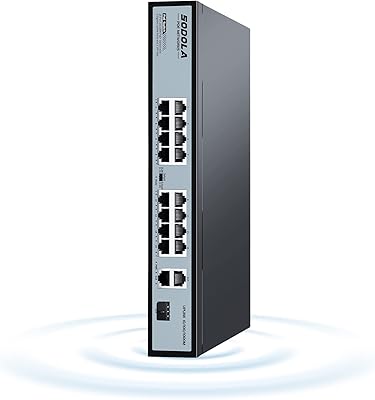
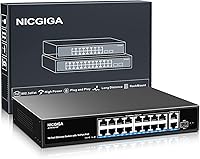
The NICGIGA NIC-AI-FS1621GP 16-Port Unmanaged PoE Switch is a practical, no-frills option for small businesses and home security installers who need to power multiple devices without the overhead of managed networking gear. You get 16 PoE+ ports, two Gigabit RJ45 uplinks, and a single SFP slot — 19 ports total — in a compact metal chassis that fits a standard 19-inch rack. NICGIGA isn't a household name in networking, but the brand has been quietly building a following among value-conscious buyers on Amazon. Just set expectations accordingly: this is a plug-and-play switch built for simplicity, not a platform you'll configure with CLI commands or a web interface.
Features & Benefits

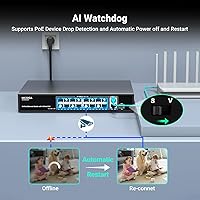
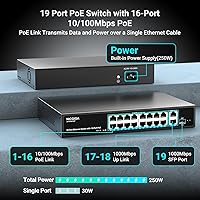
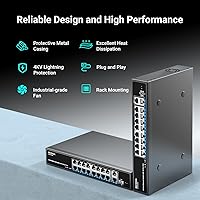
The 250W shared power pool gives you up to 30W per port, which comfortably covers most IP cameras and VoIP phones. What stands out more than the raw numbers, though, is the AI Watchdog — a built-in function that monitors connected PoE devices and automatically cycles power to any unit that stops responding. It's not enterprise-grade automation; think of it as a smart workaround that saves you from driving to a remote location just to reboot a frozen camera. The One-Key VLAN mode isolates the 16 PoE ports from each other while keeping uplink communication intact, useful for camera networks where device-to-device traffic is a security concern. Topping it off, 4KV lightning surge protection adds meaningful resilience on all ports.

Best For

This 16-port unmanaged switch makes the most sense for installers putting together IP camera systems in small offices, retail spaces, or residential properties — anywhere you need to power a dozen or more cameras without juggling a management interface. It also suits home lab users who want a solid chunk of PoE ports without paying for managed features they'll never touch. Wiring up a network closet? The 1U rack-mountable metal body keeps things tidy. VoIP deployments on a lean budget are another solid fit, provided the 100Mbps PoE port speed isn't a bottleneck for your phones. Where it falls short: high-throughput environments where every PoE device genuinely needs full Gigabit connectivity at the drop.

User Feedback

The NIC-AI-FS1621GP sits at 4.2 stars — cautiously positive, the kind of score where most buyers are happy but a meaningful minority has real concerns. Reviewers frequently praise how easy setup is: unbox, plug in, done. The AI Watchdog draws specific callouts for actually working as advertised, which isn't something you can assume with every budget brand. The most consistent complaint worth flagging upfront is that the PoE ports cap out at 100Mbps — buyers expecting Gigabit throughput on every port are often caught off guard by this. A few users also report the unit runs noticeably warm under a full load. Since this listing only launched in August 2024, the review pool is still relatively thin and the full picture may shift over time.

Pros

  • Plug-and-play setup requires zero configuration — unbox, cable, and go.
  • Nineteen total ports, including two Gigabit uplinks and an SFP slot, offer strong connectivity for the price.
  • The 250W shared PoE budget comfortably powers up to 16 cameras or phones simultaneously.
  • AI Watchdog auto-reboots unresponsive devices, cutting down on remote-site service calls.
  • One-Key VLAN mode adds real port isolation without needing a managed switch.
  • 4KV lightning surge protection is a meaningful inclusion for outdoor or exposed cable runs.
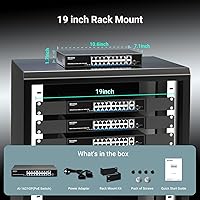
  • Standard 19-inch rack-mountable 1U form factor keeps network closets organized.
  • Metal housing feels durable and dissipates heat better than plastic-bodied competitors at this price.
  • Broad IEEE 802.3af/at compatibility means it works with virtually any standard PoE device.

Cons

  • PoE ports are capped at 100Mbps — not Gigabit — which can catch buyers off guard.
  • NICGIGA is a lesser-known brand with a limited long-term support and warranty track record.
  • The switch runs noticeably warm under heavy load, which could be a concern in poorly ventilated spaces.
  • No web interface or app means zero visibility into per-port traffic, power draw, or device status.
  • The 16-port review pool is still thin given the August 2024 launch date, making reliability patterns harder to confirm.
  • One-Key VLAN is an all-or-nothing toggle — there is no ability to create custom VLAN groupings.
  • No fanless option mentioned; heat management under sustained full-load conditions remains an open question for some buyers.
  • Total 250W budget shared across 16 ports limits average per-port power if many devices are connected at once.

Ratings

The scores below for the NICGIGA NIC-AI-FS1621GP 16-Port Unmanaged PoE Switch were generated by our AI engine after analyzing verified buyer reviews from global markets, with spam, bot-generated, and incentivized submissions actively filtered out. We've deliberately weighted both the enthusiastic praise and the recurring frustrations equally, so the numbers reflect real-world ownership — not a curated highlight reel.
Value for Money
88%
For the port count and the power budget you get, most buyers feel this 16-port unmanaged switch punches well above its price tier. Installers deploying small camera systems consistently note that getting 16 PoE+ ports, two Gigabit uplinks, and an SFP slot together at this price is genuinely hard to beat in the unmanaged category.
A handful of buyers who expected Gigabit speed on every PoE port feel the value proposition weakens once they realize the 100Mbps ceiling. If your use case demands full Gigabit throughput across the board, the effective value drops sharply because you would need to step up to a more expensive switch entirely.
Ease of Setup
93%
Out of the box, this is about as frictionless as network hardware gets — plug in the uplink, connect your devices, and everything is live within minutes. Small business owners without IT staff and first-time installers both highlight how stress-free the initial deployment is compared to managed alternatives that require interface navigation.
The simplicity is a deliberate design choice, so experienced users who want even basic setup confirmation — like per-port link speed indicators or a status dashboard — will find the feedback loop frustratingly minimal. There is no app, no browser interface, and no way to verify what the switch is actually seeing beyond the physical LED indicators.
PoE Port Speed
54%
46%
For the majority of PoE use cases — standard-definition and 1080p IP cameras, VoIP desk phones, and basic wireless access points — the 100Mbps port speed is practically sufficient and rarely causes real-world throughput issues in everyday deployments.
This is the single most divisive spec in buyer feedback. The PoE ports are Fast Ethernet, not Gigabit, and a significant number of buyers discover this only after purchase. Anyone running high-bitrate 4K cameras or heavy-traffic access points will hit this ceiling noticeably, and there is no firmware path or workaround to change it.
PoE Power Delivery
84%
The 250W total budget, with up to 30W available per port, handles mixed deployments of cameras and phones reliably according to the majority of installer feedback. Users note that the switch correctly identifies and powers both 802.3af and 802.3at devices without needing manual configuration.
The shared power pool means heavier deployments require careful planning upfront — connecting 16 power-hungry devices simultaneously without budgeting could trigger port shutdowns. A few buyers also report that the switch does not clearly communicate when it is approaching its power ceiling, making troubleshooting harder than it should be.
AI Watchdog Reliability
79%
21%
For a budget unmanaged switch, the AI Watchdog generates genuine surprise among buyers — it demonstrably works, catching frozen cameras and cycling their power without any human intervention. Installers managing remote sites specifically call this out as a feature that has saved them service calls.
The recovery logic is not configurable; you cannot adjust ping intervals, response thresholds, or reboot delays. A small number of users report occasional false triggers where a healthy device gets rebooted unnecessarily, which can be disruptive in live environments where uptime continuity matters.
Build Quality
76%
24%
The all-metal chassis feels solid and purposeful for the price tier — buyers consistently describe it as noticeably sturdier than plastic-bodied competitors in the same segment. The rack-mounting hardware is included and functional, and the port labeling is clear enough for quick cable management.
Some buyers note the unit runs warm under sustained full-load conditions, raising questions about long-term thermal performance in enclosed rack cabinets with poor airflow. The build feels adequate for the price but does not inspire the same confidence as established networking brands with published MTBF data.
VLAN Functionality
67%
33%
For a camera installation where port isolation is the primary security goal, the One-Key VLAN mode does exactly what it claims — keeps PoE devices from talking to each other while maintaining clean uplink communication to the NVR or router. It removes one genuine network security concern with zero configuration effort.
The all-or-nothing nature of the VLAN toggle frustrates anyone with a slightly more nuanced segmentation need. You cannot group specific ports together, create multiple VLANs, or fine-tune traffic flow — if your setup needs anything beyond blanket port isolation, this feature offers no path forward.
Thermal Management
61%
39%
In light-to-moderate load scenarios — say, eight to twelve cameras running simultaneously — buyers generally report the switch operating without concerning heat levels or intrusive noise. Desktop deployments in open-air environments tend to attract the least thermal-related complaints.
Under heavy sustained load, a recurring theme in buyer feedback is the unit getting noticeably hot to the touch. Users mounting the switch in closed rack enclosures without active cooling report more concern, and the lack of a published thermal specification makes it difficult to assess long-term reliability in warmer operating environments.
Port Count & Layout
91%
Nineteen total ports in a 1U chassis is a genuinely practical configuration — the physical layout is clean, the port spacing is comfortable for standard RJ45 plugs, and having both Gigabit RJ45 uplinks and an SFP slot gives meaningful flexibility for different uplink scenarios.
The SFP slot, while a welcome inclusion, has attracted a few complaints about limited compatibility with third-party modules. Buyers using non-standard or off-brand SFP transceivers report occasional link instability that disappears when switching to more common modules.
Lightning & Surge Protection
78%
22%
The 4KV surge rating on all ports is a meaningful spec for outdoor camera installations where cable runs are exposed to electrical interference or nearby lightning strikes. Installers working in rural or storm-prone areas specifically cite this as a differentiator over cheaper switches with no surge protection mention at all.
Surge protection claims from value-tier brands are difficult to independently verify, and NICGIGA does not publish third-party certification data for this rating. Buyers in extremely high-risk electrical environments may want to pair this switch with additional external surge suppression rather than relying solely on the built-in protection.
Brand Trust & Support
58%
42%
NICGIGA has been responsive to buyer questions in the Amazon listing, and the product itself has attracted enough repeat purchases to suggest a baseline level of confidence in the brand. For buyers whose primary concern is getting the hardware working day one, most report no need to contact support at all.
As a relatively newer brand without a long public track record, there is limited data on long-term durability, warranty follow-through, or product longevity. Buyers deploying this in mission-critical or always-on environments have a harder time justifying the brand risk compared to established names with proven support infrastructure.
Rack Mounting Experience
83%
The standard 1U rack form factor fits correctly into 19-inch enclosures without modification, and buyers setting up network closets appreciate how cleanly the switch integrates alongside other rack-mounted gear. Rack ears and mounting screws are included in the box, which avoids a common frustration with budget hardware.
A small number of buyers note minor alignment inconsistencies with the rack ears, requiring slight adjustment before the unit sits flush. Nothing structurally problematic, but worth knowing if you are installing into a tightly managed rack where aesthetics and precision alignment matter.
LED Indicator Clarity
71%
29%
Port activity LEDs are bright enough to read across a dimly lit server closet, and the PoE status indicators give basic at-a-glance confirmation that devices are powered. For a plug-and-play switch with no management interface, the LED feedback is about as informative as you can reasonably expect.
There is no per-port speed indicator to confirm whether a link has negotiated at 10, 100, or 1000Mbps, which makes troubleshooting speed-related issues more guesswork than diagnosis. Buyers who need that level of port-level visibility end up using a separate testing tool, which adds friction.
Compatibility
86%
Standard IEEE 802.3af/at compliance means this 16-port unmanaged switch works reliably with the overwhelming majority of PoE-powered devices on the market, and buyers report no significant interoperability issues with popular camera brands, VoIP phone systems, or consumer-grade access points.
A small subset of users with older or non-standard PoE devices report occasional detection hiccups where the switch does not immediately recognize and power a connected device. Power-cycling the device typically resolves it, but it can create initial confusion during first-time setup with less common hardware.

Suitable for:

The NICGIGA NIC-AI-FS1621GP 16-Port Unmanaged PoE Switch is a strong fit for small business owners and independent installers who need to power a fleet of IP cameras or VoIP phones without the complexity of a managed network setup. If you are wiring up a retail shop, a small office, or a residential security system with a dozen or more cameras, this switch gives you the port count and power budget to handle it at a price point that won't require a lengthy budget approval. Home lab enthusiasts who want a rack-mountable PoE switch for experimentation — without paying for managed features they'll never use — will also find it punches above its weight. The AI Watchdog function is particularly valuable for remote or unattended installations where manually rebooting a frozen camera simply isn't practical. Anyone building a network closet on a lean budget who needs a tidy 1U rack solution will appreciate the solid metal construction and the no-software-required setup.
Not suitable for:

The NICGIGA NIC-AI-FS1621GP 16-Port Unmanaged PoE Switch is not the right tool if your devices demand full Gigabit throughput at every drop — the 16 PoE ports run at Fast Ethernet speeds (100Mbps), which is a hard ceiling that surprises many first-time buyers. If your cameras stream high-bitrate 4K video or your PoE access points are handling heavy client loads, that bandwidth cap will become a real bottleneck quickly. Businesses that need per-port traffic monitoring, granular QoS controls, or detailed network diagnostics should look at a proper managed switch instead, since there is simply no web interface or CLI here to work with. IT professionals managing complex multi-VLAN environments will find the one-key VLAN mode far too blunt an instrument for their needs. And if long-term brand support and enterprise-level warranty terms matter to your organization, NICGIGA's relatively short track record in the market is worth factoring into that decision.
Specifications

  • PoE Ports: 16 ports running at 10/100Mbps, each compliant with IEEE 802.3af/at Power over Ethernet standards.
  • Uplink Ports: 2 dedicated Gigabit RJ45 uplink ports operating at 1000Mbps for connecting to a router or core switch.
  • SFP Port: 1 Gigabit SFP slot supports fiber or copper SFP modules for flexible uplink connectivity.
  • PoE Power Budget: Total shared PoE power budget of 250W across all 16 PoE ports combined.
  • Max Port Power: Each individual PoE port can deliver up to 30W, sufficient for most IP cameras and VoIP phones.
  • VLAN Support: One-Key VLAN mode isolates ports 1 through 16 from each other while allowing all ports to communicate through the uplink ports.
  • AI Watchdog: Built-in AI Watchdog automatically detects unresponsive PoE devices and cycles their power to restore connectivity without manual intervention.
  • Surge Protection: All ports are rated for 4KV lightning surge protection to reduce risk of damage from electrical spikes.
  • Housing: Full metal chassis designed for standard 19-inch rack mounting in a 1U form factor, also suitable for desktop placement.
  • Dimensions: The switch body measures 10.6 x 7.1 x 1.7 inches, with packaged dimensions of 13.94 x 9.61 x 3.62 inches.
  • Weight: The switch itself weighs 3.31 lbs; the full packaged unit including accessories weighs 4.49 lbs.
  • Total Port Count: 19 total ports: 16 PoE+ data ports, 2 Gigabit RJ45 uplinks, and 1 Gigabit SFP uplink slot.
  • Installation: Fully plug-and-play with no configuration software, web interface, or app required to get up and running.
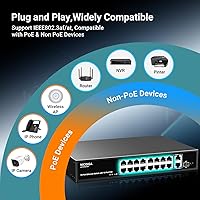
  • PoE Standard: Supports both IEEE 802.3af (up to 15.4W) and IEEE 802.3at (up to 30W) PoE standards for broad device compatibility.
  • Compatible Devices: Designed to power and connect IP cameras, VoIP phones, wireless access points, and other standard PoE-enabled network devices.
  • Model Number: The official manufacturer model number is NIC-AI-FS1621GP, as listed on the product and packaging.
  • Launch Date: This product was first made available for sale in August 2024.

Related Reviews

NETGEAR GS116LP 16-Port Unmanaged PoE+ Switch
86%
97%
Ease of Setup
93%
PoE Port Coverage
62%
PoE Power Budget
96%
Silent Operation
88%
Build Quality
More
MokerLink POE-F1602G 16-Port PoE Switch
88%
91%
Setup and Installation
93%
Power Output Reliability
88%
Build Quality
87%
Network Stability
90%
Performance for Surveillance Systems
More
YuLinca 6-Port Gigabit PoE Switch with 4 PoE+ Ports
87%
95%
Ease of Installation
88%
PoE Functionality
91%
Build Quality
87%
Performance and Speed
94%
Fanless Operation (Noise)
More
keepLiNK 16-Port Gigabit PoE Unmanaged Switch
81%
91%
Value for Money
93%
Ease of Setup
78%
PoE Power Delivery
84%
Build Quality
71%
Thermal Performance
More
NICGIGA NOS-FS0820GP 10-Port Outdoor PoE Switch
77%
93%
Ease of Setup
87%
Weatherproofing
84%
PoE Reliability
79%
Build Quality
82%
Lightning Protection
More
NETGEAR GS116PP 16-Port PoE+ Gigabit Switch
83%
96%
Ease of Setup
93%
PoE Port Coverage
68%
Power Budget Adequacy
88%
Build Quality
97%
Noise Level
More
Sodola SL-S0181P-200W 16-Port PoE Network Switch
78%
94%
Ease of Setup
88%
PoE Power Delivery
82%
Build Quality
61%
Port Speed & Bandwidth
79%
Extend Mode Performance
More
NICGIGA GS2421P 24-Port PoE+ Gigabit Switch
77%
91%
Value for Money
93%
Ease of Setup
78%
PoE Performance
84%
Build Quality
62%
Thermal Management
More
NICGIGA GS4802P 48-Port Gigabit PoE+ Switch
85%
89%
Value for Money
85%
Performance
92%
Setup & Installation
90%
Power Delivery for PoE Devices
87%
Build Quality & Durability
More
BV-Tech 16 Ports PoE+ Switch 230W
87%
92%
Power Delivery
88%
Ease of Installation
90%
Build Quality
86%
Reliability
94%
Fan Noise
More

FAQ

No, and this is the most important thing to know before buying. The 16 PoE ports max out at 100Mbps (Fast Ethernet). Only the two dedicated uplink ports and the SFP slot run at true Gigabit speeds. For most IP cameras and VoIP phones, 100Mbps is more than enough — but if you need Gigabit throughput at every drop, this switch is not the right fit.

The switch periodically pings each connected PoE device. If a device stops responding — like a camera that has frozen — the switch automatically cuts and restores power to that port, effectively rebooting the device. You do not need to log into anything or press any buttons. It is a straightforward passive recovery tool, not a sophisticated network monitoring system.

Not simultaneously. The 250W total budget is shared across all 16 ports. If every port drew its maximum 30W, that would require 480W — nearly double the available capacity. In practice, most IP cameras and phones draw between 5W and 15W, so 250W covers a typical mixed deployment comfortably, but it is worth adding up your devices' actual power draws before assuming full saturation is possible.

None at all. You plug in the uplink cable and connect your PoE devices, and it just works. There is no web interface, no mobile app, and no driver to install. The One-Key VLAN mode is toggled via a physical button on the unit itself.

When you enable it, the switch isolates each of the 16 PoE ports from one another — devices on those ports cannot communicate directly with each other, only with whatever is connected to the uplink ports. This is useful in camera networks where you do not want individual cameras talking to each other, only to the NVR or recorder upstream. It is an all-or-nothing setting; you cannot create custom VLAN groups.

Yes. The NICGIGA NIC-AI-FS1621GP 16-Port Unmanaged PoE Switch is designed to mount in a standard 19-inch rack and occupies a single 1U slot. Rack ears are included. It can also sit flat on a desktop shelf if rack mounting is not an option.

Yes, the SFP slot accepts standard Gigabit SFP modules, including fiber transceivers. This gives you the option to run a longer-distance uplink to a core switch or router if your setup requires it. The SFP module itself is not included and must be purchased separately.

Some buyers have noted the unit runs warm under a heavy load, which suggests passive or semi-active cooling. Feedback on fan noise is mixed — a small number of users mention audible airflow, while others report it being quiet. If your installation is in a noise-sensitive area, it is worth confirming the current revision's cooling design with the seller before purchasing.

NICGIGA states that each switch has been tested before shipping and they encourage buyers to reach out directly if issues arise. However, the brand does not have the same established support infrastructure as larger networking names, so long-term warranty coverage terms are worth confirming with the seller before buying, especially for business-critical deployments.

Yes, for most consumer and prosumer access points. The 802.3at standard (up to 30W per port) covers the majority of popular access points from brands like Ubiquiti, TP-Link, and similar. Just verify your specific access point's PoE power requirement and check it against both the per-port limit and your overall budget headroom before deploying.