Overview

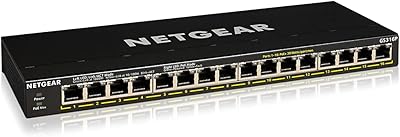
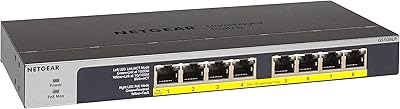
The NETGEAR GS116PP 16-Port PoE+ Gigabit Switch is one of the more straightforward options in the unmanaged PoE space — and that simplicity is largely the point. All 16 ports deliver both Gigabit speeds and PoE+, with no software to install, no login portal to navigate, no configuration required at all. Plug it in and it works. The metal chassis is solid and compact enough to sit on a desk, hang on a wall, or slide into a 1U rack slot — hardware for all three mounting options ships in the box. One thing to understand upfront: the 183W power budget is shared across all ports, not per port. That distinction matters once you start adding up the wattage of every connected device.
Features & Benefits

What sets this NETGEAR PoE switch apart from cheaper alternatives is that every single port carries PoE+ — not just 8 of them, not just the first four. That means you can run IP cameras, VoIP handsets, or wireless access points on any port without hunting for a powered slot. The fanless design is a genuine plus in offices or closets where noise matters; no moving parts means silent operation around the clock. It also complies with IEEE 802.3az, which automatically cuts power draw on idle or low-activity ports. The lifetime limited warranty with next-business-day replacement is the kind of coverage that quietly earns its keep when something fails years down the road.

Best For

The GS116PP fits a specific type of buyer well. If you're a small business owner deploying IP cameras across an office, a school adding access points room by room, or a retail operation needing reliable PoE distribution without putting an IT specialist on retainer, this 16-port gigabit switch checks the right boxes. Home lab enthusiasts powering multiple access points from a single switch will find the port count and shared power budget genuinely useful. One honest caveat: if your setup requires VLANs, QoS, or any traffic prioritization, this switch cannot do that. It's strictly unmanaged — a feature for the right buyer and a dealbreaker for the wrong one.

User Feedback

Across nearly 3,000 ratings, this NETGEAR PoE switch holds a 4.6-star average — notably consistent for a networking product. The most repeated compliment is hassle-free setup; buyers appreciate that nothing needs configuring out of the box. Build quality earns regular praise too, with the metal enclosure feeling solid for the price tier. On the other side, the shared power budget trips up some users — those running 15 or 16 high-draw devices simultaneously occasionally find themselves short on headroom. Heat comes up occasionally as well; the unit can run warm in tight enclosures without airflow, so placement matters. A small number of long-term owners report failures, though most describe NETGEAR's warranty response as prompt and reliable.

Pros

  • All 16 ports support both Gigabit and PoE+, so no port is a second-class citizen.
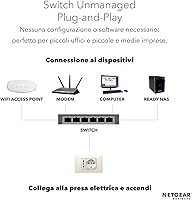
  • Zero configuration needed — unbox it, plug it in, and it works immediately.
  • Fanless operation keeps things completely silent, which matters more than people expect.
  • The solid metal enclosure feels durable and holds up well in demanding environments.
  • Ships with a rackmount kit included, so you avoid an extra purchase for 1U deployment.
  • IEEE 802.3az compliance automatically reduces power draw on idle ports, which adds up over time.
  • Flexible mounting options — desktop, wall, or rack — suit a wide range of install scenarios.
  • The lifetime limited warranty with next-business-day replacement provides real long-term peace of mind.
  • Holds a 4.6-star average across nearly 3,000 user ratings, reflecting consistently positive real-world experiences.
  • NETGEAR warranty support is generally well-regarded by owners who have needed to use it.

Cons

  • The 183W total power budget is shared, not per port — heavy loads across all 16 ports can exhaust it.
  • No management features at all; VLANs, QoS, and port monitoring are completely off the table.
  • Fanless cooling means placement in a confined or poorly ventilated space can cause the unit to run hot.
  • A small but notable share of long-term owners have reported hardware failures after extended use.
  • No 10G uplink ports, which limits the switch as a network grows and bandwidth demands increase.
  • The shared power budget requires upfront planning — you need to tally device wattage before buying.
  • No link aggregation support, which rules it out for higher-availability network designs.
  • Wall or rack mounting requires some pre-planning around cable routing given its 12.6-inch footprint.

Ratings

The scores below reflect an AI-driven analysis of verified global user reviews for the NETGEAR GS116PP 16-Port PoE+ Gigabit Switch, with spam, incentivized submissions, and bot-generated feedback actively filtered out. Each category is scored based on patterns across thousands of real buyer experiences, and both the strengths and the genuine frustrations are weighted into every number. Nothing here is polished to look better than it is.

Ease of Setup
96%
Among nearly 3,000 reviewers, plug-and-play simplicity is the single most praised characteristic. Small business owners with no dedicated IT staff report having the switch fully operational within minutes of unboxing, with cameras and access points powering up immediately.
A small number of users expected some form of status dashboard or indicator feedback beyond the port LEDs, and felt slightly in the dark about what was happening on the network. There is genuinely no feedback mechanism beyond the physical lights on the front panel.
PoE Port Coverage
93%
Having all 16 ports carry PoE+ is a real differentiator that buyers notice after comparing against competing switches that cap PoE at 8 ports. For surveillance deployments or access point rollouts, this means no guesswork about which ports can power a device.
The shared 183W budget becomes a limiting factor when all 16 ports are in active use with higher-draw devices. Users deploying 15 or more power-hungry devices simultaneously have reported needing to carefully calculate load in advance to avoid unexpected port shutdowns.
Power Budget Adequacy
68%
32%
For typical mixed deployments — a combination of IP cameras drawing 8 to 12W and access points pulling around 13W — the 183W budget holds up well and leaves comfortable headroom. Most small business users with 10 to 14 connected PoE devices report no issues.
Fully loaded deployments with 16 high-draw devices push right against or over the ceiling, which surprises buyers who assumed 183W would be more than enough. This is the most frequently mentioned practical limitation in negative reviews, and it requires upfront planning that the product packaging does not clearly emphasize.
Build Quality
88%
The all-metal enclosure consistently earns positive remarks, with buyers contrasting it favorably against plastic-bodied competitors at lower price points. Users who have mounted it in server rooms or above ceiling tiles note that it feels like a device built for continuous, long-term operation.
A subset of long-term owners — those running the switch for two or more years in high-load environments — report occasional hardware failures. While NETGEAR's warranty typically resolves these situations, the occurrence itself is a reliability data point worth acknowledging.
Noise Level
97%
Fanless operation delivers genuinely silent performance, which owners in open offices, reception areas, and home labs consistently highlight as a deciding factor in their purchase. Several reviewers specifically mention choosing this switch over louder alternatives for noise-sensitive spaces.
The absence of active cooling is a double-edged characteristic — it eliminates noise but also means heat management depends entirely on the installation environment. Users who placed the unit in enclosed cabinets without ventilation have reported the chassis running noticeably warm over time.
Thermal Management
62%
38%
Under light to moderate load in open or well-ventilated spaces, the metal chassis handles heat dissipation adequately without any active cooling assistance. Users who mount it in open racks or on shelves with ambient airflow rarely report heat-related concerns.
In sealed enclosures or tightly packed network cabinets with poor airflow, the unit runs warm enough to concern some users. While no widespread thermal failures are documented, heat is among the most common environmental complaints in longer-term reviews, particularly for users in warmer climates.
Value for Money
79%
21%
For an all-port PoE+ gigabit switch from a reputable brand with a lifetime warranty included, buyers broadly agree the pricing is justified. The absence of a separately purchased rackmount kit adds tangible value for rack deployments.
Budget-conscious buyers note that cheaper unmanaged alternatives exist, even if they offer PoE on fewer ports. Those who push the power budget to its limit sometimes feel the effective value diminishes, since they need to either constrain their deployment or invest in a second switch.
Reliability & Uptime
81%
19%
The majority of owners running this switch in continuous small business environments report stable, uninterrupted operation over months and years. For unmanaged switches in always-on deployments like surveillance systems, consistent uptime is the baseline expectation and this switch largely meets it.
A statistically small but notable group of users has experienced unit failures after extended use, typically between the one and three year mark. These cases are not widespread, but they appear often enough in review data to suggest the hardware is not entirely without longevity risk.
Warranty & Support
86%
The lifetime limited hardware warranty is a genuine differentiator that buyers notice when comparing against competitors offering only 1 or 3-year coverage. Next-business-day replacement means a failed unit in a small business setting does not translate into days of network downtime.
A few users report that warranty claim processing requires navigating NETGEAR's support channels, which can involve troubleshooting steps before a replacement is approved. The experience is generally rated positively, but it is not universally friction-free.
Mounting Flexibility
91%
Shipping with rackmount brackets, wall-mount hardware, and rubber feet for desktop use means the switch adapts to almost any physical deployment scenario out of the box. IT admins setting up a mixed-use network closet particularly appreciate not needing to source additional hardware.
The unit's 12.6-inch width is on the wider side for a 16-port switch, which can make wall-mounting in tight or unusual spaces slightly awkward. A small number of reviewers also note that the included screws and brackets feel utilitarian rather than premium.
Energy Efficiency
83%
IEEE 802.3az compliance automatically reduces power on ports where devices are idle or disconnected, which accumulates into meaningful savings in larger deployments running around the clock. Users managing energy-conscious or green-certified office spaces specifically call this out as a valued feature.
The energy savings, while real, are incremental rather than dramatic in typical small deployments. Users running fewer than 8 devices simultaneously are unlikely to notice any measurable difference in electricity costs compared to a non-compliant switch.
Port LED Visibility
74%
26%
Front-panel LEDs provide immediate visual confirmation of link status and PoE activity on each port, which is useful during initial installation when you need to verify that each device is powered and connected. Most users find them clear and readable from a short distance.
The LEDs do not distinguish between different PoE power levels or provide any indication of per-port traffic load, which makes diagnosing issues in a fully loaded deployment more difficult. Users accustomed to managed switch diagnostics find the LED-only feedback loop quite limiting.
Compatibility
89%
IEEE 802.3at compliance ensures broad compatibility with the vast majority of modern PoE+ devices — cameras, WAPs, phones — without any pairing issues. Buyers report using the GS116PP with hardware from Ubiquiti, Axis, Cisco, and a wide range of other vendors without incident.
Devices that rely on proprietary passive PoE standards are not compatible, and a handful of reviewers discovered this the hard way after assuming all PoE was interchangeable. While this is an industry-wide caveat rather than a product flaw, it catches uninformed buyers off guard.
Documentation & Packaging
71%
29%
The box includes all necessary mounting hardware with reasonably clear labeling, and the quick-start guide covers the basics adequately for a plug-and-play device. Most users report needing no documentation at all given the zero-configuration design.
The documentation provides little guidance on power budget planning or thermal placement recommendations — two topics where real-world users frequently need help. Buyers who run into issues with overloaded budgets or warm enclosures often find they had to discover those limitations on their own.

Suitable for:

The NETGEAR GS116PP 16-Port PoE+ Gigabit Switch is purpose-built for anyone who needs to power a fleet of network devices without running separate power cables or dealing with complex switch configuration. Small business owners installing IP surveillance cameras throughout an office or warehouse will get the most out of it — 16 PoE+ ports means 16 cameras, access points, or VoIP phones powered from one box, no injectors needed. IT administrators who want a dependable, silent network closet appliance without the overhead of managed switch setup will appreciate the zero-configuration approach. Schools, retail spaces, and multi-room deployments are also a natural fit, especially where the people managing the network are not full-time IT staff. Home lab users consolidating multiple wireless access points onto one switch will find the port density and total power budget genuinely practical for the investment.
Not suitable for:

The NETGEAR GS116PP 16-Port PoE+ Gigabit Switch is the wrong tool for anyone whose network demands traffic control, segmentation, or prioritization. If your setup requires VLANs, QoS policies, port mirroring, or IGMP snooping, this switch simply cannot provide those features — it is strictly unmanaged by design, and no firmware update will change that. Power-heavy deployments also need careful thought: the 183W budget is shared across all 16 ports, so if you are running 16 devices that each draw 15W or more, you will hit the ceiling fast. Users in enclosed, poorly ventilated server rooms should also take note — without a fan, heat dissipation depends entirely on ambient airflow, and the unit can run warm in tight spaces. Finally, anyone who needs link aggregation, redundant uplinks, or 10G connectivity will need to look at a different product tier entirely.
Specifications

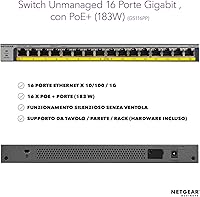
  • Port Count: The switch provides 16 RJ45 Gigabit Ethernet ports, all of which support PoE+ simultaneously.
  • PoE Standard: All 16 ports comply with IEEE 802.3at (PoE+), supporting up to 30W per port subject to the total shared power budget.
  • PoE Budget: The total PoE power budget is 183W, shared dynamically across all active PoE+ ports.
  • Data Rate: Each port delivers a maximum data transfer rate of 1 Gbps (1000 Mbps) full duplex.
  • Switch Type: The GS116PP is an unmanaged switch with no configuration interface, software, or management protocols.
  • Form Factor: The unit supports desktop, wall-mount, and 1U rackmount installation, with all required mounting hardware included in the box.
  • Dimensions: The switch measures 1.97 x 12.6 x 8.66 inches (H x W x D), fitting a standard 1U rack slot.
  • Weight: The unit weighs 1.94 pounds, making it easy to handle for both desktop placement and rack installation.
  • Case Material: The enclosure is constructed from metal, contributing to structural durability and passive heat dissipation.
  • Cooling: The switch uses fanless passive cooling, producing zero audible noise during operation.
  • Energy Efficiency: The switch complies with IEEE 802.3az (Energy Efficient Ethernet), automatically reducing power consumption on idle or low-activity ports.
  • Operating Voltage: The unit operates at 54V DC internally to support PoE+ power delivery across all ports.
  • Max Temperature: The rated upper operating temperature is 122°F (50°C), which should be considered when choosing an installation location.
  • Wireless Support: The switch does not include wireless functionality; the 802.11n reference in product data relates to compatible downstream devices, not the switch itself.
  • Warranty: NETGEAR covers this switch with a Lifetime Limited Hardware Warranty, including next-business-day replacement for verified failures.
  • Included Accessories: The box includes the switch unit, a rackmount kit with brackets and screws, a power adapter, and wall-mount hardware.
  • Interface Type: All ports use standard RJ45 connectors, compatible with Cat5e, Cat6, and Cat6a Ethernet cabling.
  • Switching Type: The GS116PP operates as a store-and-forward switch with auto-MDI/MDIX support on all ports, eliminating the need for crossover cables.

Related Reviews

NETGEAR GS316PP 16-Port PoE+ Gigabit Ethernet Switch
85%
92%
Value for Money
89%
Ease of Use
86%
Energy Efficiency
76%
PoE Power Delivery
90%
Quiet Operation
More
NETGEAR GS316P 16-Port PoE+ Gigabit Switch
77%
97%
Ease of Setup
94%
PoE Port Coverage
61%
PoE Power Budget
88%
Build Quality
96%
Noise Level
More
NETGEAR GS116LP 16-Port Unmanaged PoE+ Switch
86%
97%
Ease of Setup
93%
PoE Port Coverage
62%
PoE Power Budget
96%
Silent Operation
88%
Build Quality
More
YuLinca 6-Port Gigabit PoE Switch with 4 PoE+ Ports
87%
95%
Ease of Installation
88%
PoE Functionality
91%
Build Quality
87%
Performance and Speed
94%
Fanless Operation (Noise)
More
keepLiNK 16-Port Gigabit PoE Unmanaged Switch
81%
91%
Value for Money
93%
Ease of Setup
78%
PoE Power Delivery
84%
Build Quality
71%
Thermal Performance
More
NETGEAR GS316 16-Port Gigabit Network Switch
85%
97%
Ease of Setup
96%
Noise Level
78%
Build Quality
91%
Port Performance
88%
Reliability & Longevity
More
NETGEAR GS308EP
NETGEAR GS308EP
81%
88%
PoE+ Performance
91%
Ease of Setup
74%
Build Quality
82%
Network Management Features
93%
Value for Money
More
NETGEAR GS308PP 8-Port PoE+ Gigabit Ethernet Switch
85%
93%
Setup & Installation
88%
Performance & Reliability
90%
PoE+ Functionality
84%
Build Quality & Design
91%
Noise Level (Fanless Design)
More
NETGEAR GS305EP 5-Port PoE Gigabit Switch
79%
91%
Ease of Setup
78%
PoE Performance
97%
Noise Level
67%
Management Interface
72%
Build Quality
More
NETGEAR GS108PP 8-Port Gigabit Ethernet PoE+ Switch
88%
95%
Ease of Setup
90%
PoE Performance
88%
Reliability
92%
Noise Level
87%
Build Quality
More

FAQ

All 16 ports support PoE+ — that is one of the main reasons buyers choose this switch over cheaper alternatives that limit PoE to 8 or fewer ports. Every port can power a camera, access point, or VoIP phone without needing a separate injector.

It means the switch can deliver a combined maximum of 183W across all powered devices at once. So if you have 16 IP cameras that each draw around 10W, your total draw is 160W — well within the budget. But if you start mixing in devices that pull 15W or more per port, you need to add up the numbers before assuming everything will power up. The switch will prioritize ports in order if the budget is exceeded.

None at all. Plug it into your network, connect your devices, and it starts working immediately. There is no web interface, no app, and no login credentials to set up. That simplicity is a deliberate design choice, and most buyers find it refreshing.

No — the NETGEAR GS116PP 16-Port PoE+ Gigabit Switch is strictly unmanaged, meaning it has no traffic management features whatsoever. If your network needs VLANs, QoS, port mirroring, or IGMP snooping, you will need a managed switch instead.

Fanless operation is generally reliable for this class of switch, but placement matters. The metal chassis dissipates heat passively, so if you mount it in a sealed enclosure with no airflow, it can get noticeably warm. Leave a few inches of clearance around it and you should have no issues under normal loads.

Yes, and no extra purchase is needed. A full rackmount kit — brackets and screws — ships inside the box, so you can install it in a 1U rack slot straight out of the packaging.

NETGEAR's Lifetime Limited Hardware Warranty covers the switch for manufacturing defects for as long as you own it. If the unit fails under covered conditions, NETGEAR offers next-business-day replacement, which is meaningfully faster than the standard warranty service most competitors offer. Real-world reports from owners suggest the support experience is generally positive.

Yes, any device that supports the IEEE 802.3at PoE+ standard will work with the GS116PP. That covers the vast majority of modern IP cameras, WAPs, and VoIP phones. Just double-check that your devices do not require proprietary passive PoE, which is a different, incompatible standard.

It produces absolutely no noise — there are no fans or moving parts of any kind. You could put it on a desk in a quiet room and never notice it is there. For open-plan offices or client-facing spaces, that is a real practical benefit.

Add up the maximum wattage listed on each device you plan to connect. Most modern IP cameras draw 7 to 12W, standard indoor access points typically use 10 to 15W, and VoIP phones usually need 3 to 5W. If your total comes in comfortably under 183W with some headroom, you are in good shape. If you are close to the limit or over it, consider a switch with a higher power budget.

Where to Buy