Overview

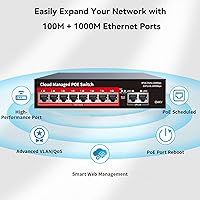
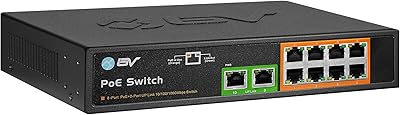
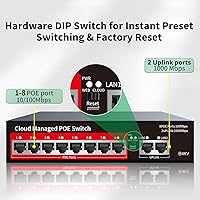
The STEAMEMO 8-Port 120W Managed PoE+ Switch enters a crowded budget segment dominated by TP-Link and Netgear, but it brings a few genuine differentiators worth considering. The layout gives you 8 PoE+ ports for powered devices plus 2 uplink ports for connecting to your router or core switch — a practical arrangement for small deployments. One standout feature at this price point is the ability to toggle between managed and unmanaged modes, so you can run it plug-and-play on day one and grow into the advanced settings later. The fanless metal chassis keeps things quiet and cool, making it a reasonable fit for always-on environments where fan noise would be intrusive. STEAMEMO is a newer brand, so expect less third-party documentation than you would find with more established names.
Features & Benefits

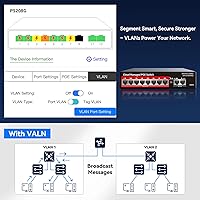
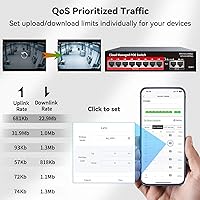
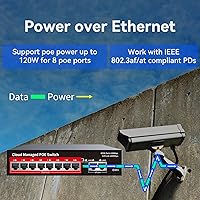
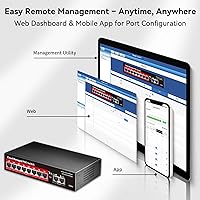
The 120W total PoE budget is the headline spec here. Split across 8 ports, that averages 15W per device — enough for standard IP cameras and wireless access points, though you will want to plan carefully if you are mixing in high-draw devices like PTZ cameras that can pull up to 30W each. Management options include a web interface, desktop software, and a mobile app; each works adequately for basic tasks, though do not expect the polish of enterprise-grade tools. On the security side, you get VLAN segmentation to keep IoT devices isolated from your main network, QoS for traffic prioritization, DHCP Snooping to block rogue servers, and port mirroring for troubleshooting. Built-in 4KV lightning protection rounds out a surprisingly complete feature set for the price tier.

Best For

This managed PoE switch is a strong fit for anyone building out a small camera system — think 4 to 8 IP cameras covering a home office, retail shop, or small warehouse — where you also want basic network segmentation without hiring a consultant. DIY smart home builders who need PoE to power access points, video doorbells, or intercoms without running extra power cables will find it equally useful. It also suits the IT-curious crowd: people who want to dabble with VLANs and QoS settings but are not ready to navigate a full Cisco or Ubiquiti setup. The wall-mountable form factor makes it a natural pick for closets, reception areas, or any space where a humming fan would be unwelcome.

User Feedback

With over 2,100 ratings averaging 4.4 stars, this STEAMEMO switch has earned genuine goodwill — particularly from home users and small-business owners who praise the straightforward setup and consistent PoE delivery to cameras. The metal build gets frequent positive mentions for feeling sturdy relative to the price. That said, a recurring complaint is worth flagging plainly: the ports are Fast Ethernet (100Mbps), not Gigabit — easy to miss if you skim the listing, and some buyers are understandably frustrated after the fact. A handful of users note the mobile app feels basic, though most find the web interface sufficient for day-to-day changes. Warranty and support responses appear reasonably prompt, which is reassuring given the brand's limited track record.

Pros

  • Managed features like VLAN, QoS, and DHCP Snooping at a budget price point most competitors do not match.
  • Fanless design runs completely silently — ideal for noise-sensitive environments.
  • Up to 30W per port supports demanding PoE+ devices like PTZ cameras and dual-band access points.
  • Toggle between managed and unmanaged modes, so less technical users can start simple and add complexity later.
  • Solid metal chassis feels noticeably more durable than plastic alternatives in this price range.
  • Supports both desktop and wall-mount installation, adding real flexibility for tight or unconventional spaces.
  • 4KV lightning protection and short-circuit safeguards offer a meaningful layer of hardware reliability.
  • Web UI, desktop app, and mobile app all provide remote management options without needing on-site access.
  • Over 2,100 buyer ratings at 4.4 stars reflects a consistently positive ownership experience across diverse setups.
  • 1-year replacement warranty provides a basic but meaningful safety net for a budget-tier purchase.

Cons

  • All ports are 100Mbps Fast Ethernet — not Gigabit — which is a dealbreaker for bandwidth-heavy workflows.
  • The mobile app feels bare-bones and is not a reliable primary management tool for ongoing configuration.
  • STEAMEMO is a newer brand with limited third-party documentation, forums, or community troubleshooting resources.
  • 120W shared across 8 ports leaves little headroom if you mix several high-draw PoE+ devices simultaneously.
  • The web interface, while functional, lacks the refinement and depth found in more established managed switch platforms.
  • No Layer 3 routing capabilities, which limits usefulness as your network grows more complex.
  • Only a 1-year warranty — competitors at similar or slightly higher prices often offer 2 to 3 years of coverage.
  • Long-term firmware support and update cadence from a newer brand remains an open question.
  • No rack-mount option, which may rule it out for anyone building a structured wiring closet or server rack setup.

Ratings

The scores below for the STEAMEMO 8-Port 120W Managed PoE+ Switch were generated by our AI after analyzing thousands of verified global buyer reviews, actively filtering out incentivized, duplicate, and bot-flagged submissions to surface what real users actually experience. We weigh both the enthusiastic praise and the recurring frustrations equally, so these numbers reflect an honest cross-section of ownership — not just the highlights. Whether this switch earns a place in your setup or falls short depends heavily on your specific needs, and our category breakdowns are designed to make that call straightforward.
Value for Money
91%
For buyers who need a managed PoE+ switch without a large budget, the value proposition here is difficult to argue with. Features like 802.1Q VLANs, QoS, DHCP Snooping, and port mirroring typically show up on switches that cost two to three times more, making this a surprisingly capable option for home offices and small businesses watching their spend.
The value calculation shifts if you need Gigabit speeds, since 100Mbps ports at this price are increasingly common but still feel like a compromise in 2024. Buyers who later discover the port speed limitation after purchasing often feel they did not get the deal they expected, which drags satisfaction down for a specific subset of users.
PoE Power Delivery
83%
Users running 4 to 6 standard IP cameras report consistently stable and reliable PoE delivery with no dropped power events during normal operation. The 802.3at compliance means it handles more demanding devices like dual-band access points and PTZ cameras without issue, as long as total draw stays within the 120W ceiling.
The shared 120W budget becomes a real constraint when users try to maximize all 8 ports with higher-draw devices simultaneously — several buyers report unexpected power cycling when approaching the limit. Planning is required upfront, and buyers who populate all 8 ports with power-hungry cameras without calculating total wattage often run into problems.
Ease of Setup
88%
The plug-and-play unmanaged mode is a genuine strength for less technical users — connect it, power it on, and devices start getting PoE immediately without any configuration. Buyers who do want managed features report the web interface is accessible enough to configure basic VLANs and QoS settings within an hour, even without a networking background.
A small but consistent group of reviewers ran into initial confusion around switching between managed and unmanaged modes, particularly when the web interface did not behave as expected after a mode change. The user manual is described as basic by several buyers, leaving some to rely on trial and error for more nuanced configurations.
Build Quality
79%
21%
The all-metal chassis is consistently mentioned as one of the most appreciated physical qualities, especially given the price tier where plastic enclosures are the norm. Buyers who have installed this in closets or small server areas report no warping, flexing, or heat-related deformation even after months of continuous operation.
A handful of users note that port labeling and LED indicators, while functional, feel less refined than branded competitors — text is small and the indicators can be hard to read in low-light environments. The overall fit of the unit is solid but lacks the premium tactile feel of more established brands at slightly higher price points.
Port Speed Performance
52%
48%
For the intended use case — powering and connecting IP cameras, intercoms, or basic IoT devices — 100Mbps is technically sufficient, since standard HD and even 4K IP cameras rarely saturate a 100Mbps link under normal recording conditions. Users deploying this purely for camera networks report no meaningful performance bottleneck in day-to-day use.
This is the single most complained-about aspect across reviews — buyers expecting Gigabit speeds are frequently disappointed because the 100Mbps limitation is easy to miss in the listing. For any user who needs to transfer large files across the network, stream high-bitrate video to a local NAS, or future-proof their setup, this switch simply does not deliver, and no firmware update will change that.
Management Software
67%
33%
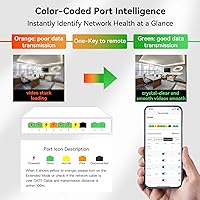
The web interface covers the core managed switch functions — VLAN configuration, QoS rules, port mirroring, and traffic monitoring — without demanding any prior enterprise networking experience. For a budget-tier managed switch, having three management options (web, desktop app, and mobile) is a genuine convenience that buyers in remote or multi-site setups appreciate.
The mobile app in particular draws criticism for feeling unpolished, with some users reporting inconsistent connectivity and a UI that lags behind the web interface in functionality. The web UI itself is functional but dated in design, and advanced users transitioning from TP-Link Omada or Ubiquiti UniFi will find it notably less capable and less intuitive.
Network Security Features
81%
19%
Having DHCP Snooping, storm control, static MAC binding, and 802.1Q VLAN support in a switch at this price point gives small business owners a meaningful set of tools to isolate sensitive devices and guard against common local network threats. Users who want to separate their camera network from their office LAN find this feature set covers their needs without requiring additional hardware.
The security features work as advertised for basic segmentation tasks, but there is no support for more advanced controls like 802.1X port-based authentication or ACL (Access Control List) rules, which more security-conscious buyers may need. Documentation on configuring these features is thin, and without community forums or third-party guides specific to this brand, troubleshooting can be slow.
Silent Operation
94%
The fanless design delivers exactly what it promises — total silence during operation, regardless of network load or ambient temperature. Buyers who have placed this switch in bedrooms, home offices, and customer-facing reception areas consistently highlight the absence of fan noise as a standout practical benefit compared to similar switches that rely on active cooling.
While there are no noise complaints, a few users in hotter climates or enclosed environments note that the metal shell does get noticeably warm under sustained heavy load — this is expected for passive cooling, but worth monitoring if the switch is installed in a space without any air circulation.
Thermal Management
76%
24%
The metal body serves as an effective passive heatsink for typical deployments, and the 55°C maximum operating temperature rating gives reasonable headroom for most indoor environments. Long-term buyers report no heat-related failures or reboots under normal camera or access point loads over extended periods.
Fanless designs inherently trade active cooling headroom for silence, and in tight, unventilated enclosures or during hot summers, some users report the unit running hotter than expected. There is no thermal warning indicator or automatic load reduction, so buyers in warm environments should ensure adequate airflow around the unit.
Mounting & Installation
82%
18%
The compact footprint and low weight make both desktop placement and wall mounting straightforward for a single person, and buyers setting up small security systems in closets or hallways appreciate not needing a full rack enclosure. The overall installation process, including physical mounting and initial device connections, is consistently described as quick and uncomplicated.
A few buyers noted that wall-mounting hardware details are not fully explicit in the packaging, creating minor friction during installation. The unit also lacks rack ears or rack-mount compatibility, which is a non-issue for most buyers but rules it out for anyone building a structured patch panel or rack environment.
Lightning & Surge Protection
84%
The 4KV lightning protection on network ports is a spec that buyers in storm-prone regions specifically call out as a purchase motivator, and it is not universally offered at this price point. Combined with the built-in overcurrent and short-circuit protection, the switch has a credible hardware safety story for always-on deployments.
Real-world surge protection is difficult to verify without failure events, and there are limited user reports of the protection being actually tested against lightning. It is a reassuring spec on paper, but buyers in extreme lightning-risk areas should still use a quality surge-protected power strip or UPS in addition to the switch's built-in protection.
Reliability & Uptime
86%
A consistent theme across long-term reviews is that this switch just keeps running — buyers who have had it in place for 12 to 24 months report very few unexpected reboots or port failures. For a budget managed switch handling camera systems that need to stay online continuously, this track record of stable uptime is one of its most reassuring qualities.
Because STEAMEMO is a relatively new brand, the long-term reliability data beyond two to three years of ownership is limited compared to more established manufacturers. Buyers relying on this switch for business-critical infrastructure are taking on more uncertainty about longevity than they would with a Netgear or TP-Link equivalent.
Warranty & Support
63%
37%
The 1-year replacement warranty covers the most likely failure window for this type of hardware, and a subset of buyers report reasonably responsive direct support from the manufacturer when issues arise. For a budget purchase, having any direct manufacturer support channel is better than what some competing no-name brands offer.
One year is a noticeably shorter warranty than the 2 to 3 year coverage offered by TP-Link and Netgear on comparable products, which is a real gap for buyers planning a long-term installation. There is also limited community infrastructure — no active forums, third-party wikis, or YouTube teardowns — so buyers who run into unusual issues have few places to turn outside of direct manufacturer contact.
Compatibility
87%
IEEE 802.3at compliance means this switch works reliably with the overwhelming majority of PoE-powered devices on the market — Hikvision, Dahua, Reolink, Amcrest, Ubiquiti access points, and similar hardware all connect without any compatibility friction. Buyers plugging in devices from multiple brands in the same setup report no cross-compatibility issues.
The 100Mbps port speed creates a compatibility ceiling for network-attached storage devices, high-throughput workstations, or multi-gigabit access points that are designed to operate above Fast Ethernet speeds. Buyers who mix this switch into a predominantly Gigabit network will create a bottleneck at every port this switch serves.

Suitable for:

The STEAMEMO 8-Port 120W Managed PoE+ Switch is a practical choice for small business owners and home office users who need to centralize power and data for a handful of IP cameras, wireless access points, or IoT devices without spending a significant amount on infrastructure. If you are running a retail shop, a small office, or a home security setup with 4 to 8 PoE cameras and you want basic network controls like VLANs to keep your camera traffic separate from your main network, this switch covers those needs competently. DIY smart home enthusiasts who want to add PoE-powered intercoms, sensors, or access points — and want the option to manage them remotely via a web interface — will find the feature set punches above its price tier. It also suits anyone who values silent operation; the fanless metal chassis means you can tuck it into a bedroom closet, a reception area, or a quiet office without it ever making a sound. The wall-mount option and compact footprint make it easy to deploy in tight spaces where a rack-mounted unit would be overkill.
Not suitable for:

Buyers expecting Gigabit port speeds should stop here — every port on this switch, including the uplinks, runs at 100Mbps (Fast Ethernet), which is a hard ceiling that matters if you are moving large files across your network or streaming high-bitrate footage to a local NAS. The STEAMEMO 8-Port 120W Managed PoE+ Switch is also not the right tool for anyone who needs robust vendor support, extensive community documentation, or third-party integrations, since STEAMEMO is a newer brand with a limited support ecosystem compared to TP-Link, Netgear, or Ubiquiti. Power users or network administrators who need advanced routing, LACP link aggregation, or Layer 3 features will hit a wall quickly. If you are powering multiple high-draw devices — several PTZ cameras pulling near 30W each — the 120W shared budget can become a real constraint, so do the math before committing. Businesses that anticipate rapid network growth or need enterprise-grade reliability guarantees should invest in a more established platform.
Specifications

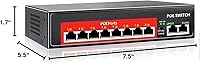
  • PoE Ports: 8 x 100Mbps Fast Ethernet ports, each capable of delivering Power over Ethernet to connected devices.
  • Uplink Ports: 2 x 100Mbps uplink ports for connecting the switch to a router, modem, or upstream network device.
  • PoE Standard: Compliant with IEEE 802.3at (PoE+), supporting up to 30W of power delivery per individual port.
  • Total PoE Budget: 120W shared across all 8 PoE ports simultaneously, requiring careful planning when using multiple high-draw devices.
  • Management Options: Supports network management via a web-based interface, a Windows desktop application, and a mobile app.
  • VLAN Support: Implements 802.1Q VLAN tagging to allow logical network segmentation across connected devices.
  • Security Features: Includes DHCP Snooping, storm control, static MAC address binding, and port mirroring for network monitoring and protection.
  • Traffic Control: Quality of Service (QoS) support enables prioritization of time-sensitive network traffic such as video feeds or VoIP.
  • Lightning Protection: Built-in 4KV surge protection on network ports guards against damage from electrical spikes and nearby lightning strikes.
  • Cooling System: Fully fanless design relies on passive heat dissipation through the metal chassis, producing zero operational noise.
  • Case Material: Constructed from metal for improved heat dissipation, structural rigidity, and longer operational lifespan.
  • Dimensions: Measures 7.5″ long by 5.5″ wide by 1.7″ tall, making it compact enough for desktop or wall-mount installations.
  • Weight: Weighs 2.03 pounds, light enough for single-person wall mounting without additional structural support in most cases.
  • Max Temperature: Rated for continuous operation in ambient temperatures up to 55°C, suitable for enclosed or poorly ventilated spaces.
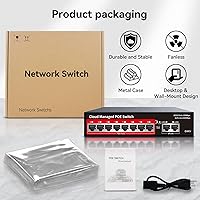
  • Mounting Options: Supports both flat desktop placement and wall mounting via included or standard mounting hardware.
  • Operating Modes: Can be switched between fully managed mode with all configuration features enabled and simplified plug-and-play unmanaged mode.
  • Circuit Protection: Equipped with built-in overcurrent, overload, and short-circuit protection for connected devices and the internal power supply.
  • Warranty: Backed by a 1-year replacement warranty with customer support provided directly by the manufacturer.
  • In the Box: Package includes the switch unit, one AC power cable, and a printed user manual.
  • Data Transfer Rate: Maximum data transfer rate of 100 Megabits per second across all ports, including uplinks — Fast Ethernet, not Gigabit.

Related Reviews
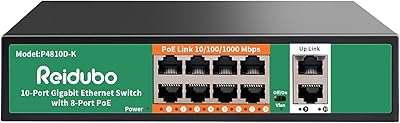
Reidubo 8-Port Gigabit PoE Switch 120W
86%
92%
Value for Money
89%
Ease of Setup
90%
Power Delivery
88%
Build Quality
85%
Performance Stability
More
YuanLey 8-Port 120W Gigabit PoE Switch
80%
91%
Value for Money
94%
Ease of Setup
78%
PoE Power Delivery
83%
Build Quality
74%
Thermal Performance
More
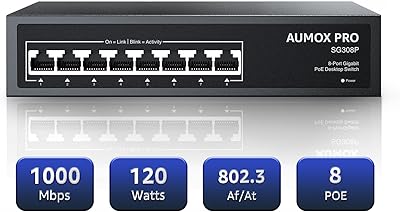
AUMOX PRO SG308P 8-Port PoE Gigabit Switch 120W
85%
85%
Performance
94%
Ease of Setup
89%
Build Quality
91%
Fanless Operation
87%
Power Efficiency
More
TP-Link TL-SG2210P V3 8-Port PoE Switch
83%
91%
Value for Money
74%
PoE Performance
83%
Ease of Setup
86%
Omada SDN Integration
88%
Build Quality
More
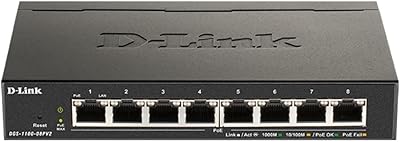
D-Link DGS-1100-08PV2 8-Port Gigabit Smart Managed PoE+ Switch
87%
85%
Performance & Reliability
88%
PoE Power Delivery
90%
Ease of Setup
91%
Fanless Design & Noise Levels
87%
Value for Money
More
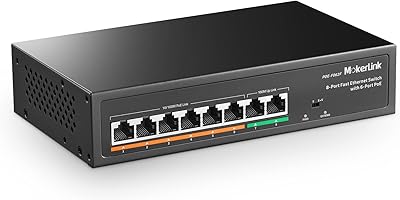
MokerLink POE-F062F 8-Port PoE Switch
86%
91%
Value for Money
88%
Performance Stability
95%
Ease of Installation
85%
PoE Power Output
82%
Build Quality
More
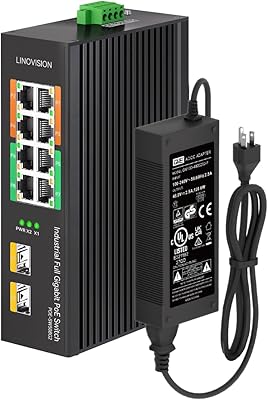
LINOVISION POE-SW508G Industrial 8-Port PoE++ Switch
77%
91%
Power Delivery
88%
Build Quality
93%
PoE Watchdog
84%
Installation Ease
86%
Thermal Performance
More
BV-Tech POE-SW802G 8-Port Gigabit PoE+ Switch
79%
94%
Ease of Setup
88%
PoE Reliability
67%
Power Budget
61%
Build Quality
91%
Value for Money
More
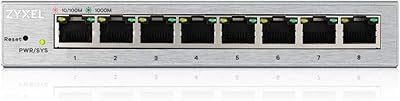
Zyxel GS1200-8 8-Port Gigabit Web Managed Switch
84%
88%
Ease of Setup
85%
Performance
84%
Build Quality
92%
Fanless Operation (Noise Level)
90%
Energy Efficiency
More
D-Link DES-1008PA 8-Port PoE Fast Ethernet Switch
82%
94%
Ease of Setup
88%
PoE Port Reliability
91%
Build Quality & Durability
58%
Network Speed & Throughput
97%
Noise Level
More

FAQ

All ports — including the two uplinks — are 100Mbps Fast Ethernet. There are no Gigabit ports on this switch. For most IP camera and basic IoT setups that is perfectly adequate, but if you are moving large files between devices or need high-throughput video storage to a NAS, this limitation will matter.

It depends on how much power each camera draws. The switch has a 120W total budget across all 8 ports, which averages out to 15W per device. Standard IP cameras typically draw 5 to 12W, so 8 of those will be fine. If you are using high-power PTZ cameras that pull 25 to 30W each, you will need to do the math carefully — running 5 or 6 of those simultaneously could max out the budget.

Most buyers with basic tech confidence manage it without much trouble. You can run it in unmanaged mode right out of the box — just plug in your devices and it works like a regular switch. If you want to dig into VLANs or QoS settings, the web interface is accessible enough for a motivated beginner, though it is not as polished as what you get from TP-Link's Omada or similar platforms.

DHCP Snooping is a security feature that prevents unauthorized devices on your network from acting as a fake router and handing out bad network addresses to your other devices. For most home users it is optional, but if you are running IoT devices or IP cameras on a shared network, enabling it adds a useful layer of protection with very little effort.

Yes, it is compatible with any camera or device that follows the IEEE 802.3af or 802.3at PoE standard, which covers the vast majority of IP cameras on the market including Hikvision, Dahua, Reolink, Amcrest, and others. Just verify your camera's PoE standard in its spec sheet before assuming compatibility.

Completely silent. The switch uses a fanless design with no moving parts, so the only heat management is passive through the metal shell. It is one of the more practical aspects of this unit — you can place it in a bedroom, a quiet reception area, or a living room closet without any noise concern whatsoever.

Remote management from outside your local network is not natively built in the way a cloud-managed platform like Ubiquiti or TP-Link Omada handles it. The web interface and app work well within your local network, but for off-site access you would need to configure your router with a VPN or port forwarding, which adds setup complexity.

In practical terms, VLANs let you divide your single physical network into separate logical sections. For example, you could put your IP cameras on one VLAN and your office computers on another, so that camera traffic never mixes with employee data and a compromised camera cannot reach your file server. It is a meaningful security step for small businesses, and this switch supports it without requiring any extra equipment.

The switch is designed to support wall mounting and the compact size and low weight make the installation physically straightforward. That said, check the box contents carefully — the listing specifies an AC cable and manual are included, but mounting hardware specifics can vary. Most standard network switch wall-mount kits are inexpensive if not included, and the unit itself has the appropriate mounting points.

After the warranty period, you would be outside the covered replacement window, which is worth factoring into your decision. STEAMEMO is a newer brand, so long-term parts availability and support infrastructure are less certain than with established players. For a low-cost switch used in non-critical deployments, most buyers accept that trade-off, but if you need guaranteed multi-year support, a brand like TP-Link or Netgear with longer warranty options would be a safer bet.