Overview

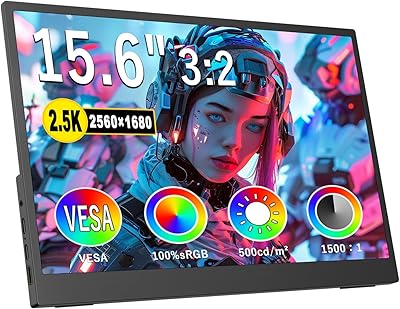
The StarXnDa 14-inch 2.5K 144Hz Portable Gaming Monitor enters a crowded field of travel-friendly displays, but it brings a few genuinely interesting choices to the table. The 16:10 aspect ratio alone sets it apart from the sea of 16:9 portable screens — that extra vertical space is surprisingly useful whether you're coding, editing, or just browsing. It launched in late 2024 and sits in a competitive mid-range bracket. One thing worth flagging upfront: the listing describes the weight as roughly 400g, yet the spec sheet states 3.19 pounds — a notable discrepancy that prospective buyers should clarify before purchasing.
Features & Benefits

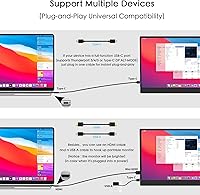
At its core, this portable monitor packs a 2560×1600 resolution into 14 inches, producing noticeably crisp text and detailed visuals — a real advantage for close-up creative work. The 144Hz refresh rate with FreeSync is the headline spec for gamers, delivering fluid motion that most portable displays simply don't offer at this size. Connectivity runs through a single USB-C cable for both video and power, though your device's port must support DisplayPort Alt-Mode or Thunderbolt — standard USB-C won't work. An HDMI port covers broader compatibility, and the included magnetic case folds into a functional stand without needing a separate accessory.

Best For

This 14-inch gaming panel makes the most sense for a specific kind of buyer. Gamers heading to LAN events or hotel setups will appreciate having 144Hz on the road without carrying a full-size display. Designers and photo editors who need reliable sRGB accuracy while traveling will find it capable for color-critical tasks, though hardware calibration wouldn't hurt. Students and remote workers who multitask heavily benefit from the extra vertical real estate the 16:10 ratio provides. It's less suited for anyone relying on sunlit workspaces where 400 nits may fall short, or for devices limited to basic USB-C ports.

User Feedback

The StarXnDa travel display is a newer entrant from a relatively unfamiliar brand, so real buyer reviews carry meaningful weight here. Positive impressions tend to focus on out-of-box color quality and the convenience of the all-in-one magnetic case setup. On the downside, some buyers encounter USB-C compatibility frustrations when connecting laptops without proper Alt-Mode support — a caveat buried in the listing rather than prominently communicated. Build quality opinions are split; occasional concerns about backlight consistency appear alongside reports of solid construction for the price tier. The conflicting weight figures in the listing itself remain an unresolved point of confusion among buyers.

Pros

  • Sharp 2.5K resolution on a 14-inch matte panel makes text and images genuinely crisp for both work and play.
  • 144Hz refresh rate is rare at this size and price range, giving gamers a real competitive advantage on the road.
  • FreeSync support reduces screen tearing without requiring any additional software setup.
  • The included magnetic case doubles as a stand, so there is nothing extra to buy or pack.
  • Single USB-C cable setup keeps the desk or travel bag tidy when connecting compatible laptops.
  • 100% sRGB coverage is a meaningful spec for color-sensitive work like photo editing or design reviews.
  • HDMI port ensures compatibility with consoles and older laptops that lack USB-C video output.
  • The 16:10 aspect ratio provides more usable vertical space than most competing portable monitors.
  • Compact footprint roughly matching an A4 sheet makes it easy to slip into most laptop bags.

Cons

  • Conflicting weight information in the listing — 400g versus 3.19 lbs — makes it hard to know what you are actually getting.
  • USB-C connectivity only works with DisplayPort Alt-Mode or Thunderbolt ports, which rules out many budget and older laptops.
  • At 400 nits, brightness may struggle in well-lit rooms or any environment with ambient glare.
  • HDR is technically supported but the brightness ceiling makes real HDR impact minimal in practice.
  • StarXnDa is a newer brand with limited independent review coverage, making long-term reliability harder to assess.
  • The magnetic case, while convenient, has raised durability questions from some buyers using it for daily commuting.
  • Occasional reports of backlight inconsistency suggest panel quality control may not be perfectly uniform across units.
  • No mention of a built-in battery, so power delivery depends entirely on the connected device or an external charger.

Ratings

Our AI rating system analyzed verified buyer reviews from multiple global markets to produce the scores below for the StarXnDa 14-inch 2.5K 144Hz Portable Gaming Monitor, actively filtering out incentivized, bot-generated, and unverified feedback to ensure the results reflect genuine ownership experiences. Both the standout strengths and the real frustrations buyers have encountered are transparently reflected in every category score.

Display Sharpness
88%
Buyers consistently praise how crisp text and images look at 2.5K resolution on a 14-inch panel — particularly those using it for coding or document work where fine detail matters. The high pixel density makes it noticeably sharper than most portable 1080p competitors at the same size.
A small number of users note that running at native 2.5K resolution can feel small for some applications without scaling adjustments, and not all devices handle the unusual 16:10 resolution without minor UI scaling quirks.
Refresh Rate Performance
91%
For a portable display, 144Hz is genuinely impressive and buyers who use it for competitive gaming or fast-scrolling productivity work report a smooth, responsive feel that stands out against 60Hz alternatives in travel setups. FreeSync integration keeps the experience consistent even when frame rates fluctuate.
Reaching the full benefit of 144Hz depends heavily on the host device pushing adequate frame rates, and some users find their mid-range laptops cap out well below that threshold in demanding titles, making the high refresh ceiling partially theoretical for that segment of buyers.
Color Accuracy
83%
Photo editors and designers using this portable monitor on the road report that colors look reliable and consistent out of the box, with the 100% sRGB coverage translating to natural-looking skin tones and saturated-but-not-oversaturated visuals in everyday creative work.
Some buyers note that factory calibration varies slightly between units, and without a colorimeter calibration, a faint color cast has been observed on a portion of panels — an acceptable variance for casual use but worth noting for precision color work.
Brightness & HDR
62%
38%
For dim hotel rooms, offices, and evening use, 400 nits is workable and the matte coating helps reduce reflections where raw brightness falls short. Users watching HDR-tagged streaming content note slightly improved contrast versus SDR on compatible platforms.
In practice, 400 nits is the weak point of this display — bright indoor offices and any environment near a window push the screen toward washed-out territory. HDR support is nominal at this brightness level, and buyers expecting cinematic HDR contrast will be disappointed.
Portability
79%
21%
The compact 14-inch footprint slips into most laptop bags without any rearranging, and the overall form factor is genuinely travel-friendly for professionals hopping between offices or students moving between campus locations throughout the day.
The weight information in the listing is contradictory — the description implies a very light panel while the spec sheet lists a significantly heavier figure — and several buyers express frustration at not knowing what to expect before the package arrived, which affects packing and travel planning.
Build Quality
71%
29%
Most buyers describe the chassis as solid-feeling for the price tier, with no obvious flex in the display panel and a reasonably premium finish that does not feel plasticky in hand during everyday handling and setup.
Occasional reports of backlight bleed at the panel edges and isolated dead pixel complaints suggest quality control is not perfectly uniform across production batches, which is a known risk with newer brands operating at competitive price points.
Magnetic Case & Stand
68%
32%
The included magnetic case pulling double duty as a stand is a genuinely practical design choice — most buyers appreciate not having to source a separate accessory, and the setup process is quick enough for people switching between desk and travel configurations frequently.
Durability of the magnetic closure is the most common complaint tied to this accessory; daily commuters report the mechanism feeling less secure after a few months of regular use, and the stand angle adjustment range is limited compared to dedicated aftermarket stands.
USB-C Connectivity
74%
26%
For laptop users with Thunderbolt 3 or 4 ports, the single-cable experience is clean and reliable — one USB-C handles video, power, and data simultaneously without adapters or extra cables cluttering the workspace during travel or hoteling setups.
Buyers with standard USB-C ports on budget laptops or older Windows machines frequently hit a wall and only discover the Alt-Mode requirement after purchase, making this a recurring source of one-star reviews that could be avoided with clearer communication upfront.
HDMI Compatibility
81%
19%
The full-size HDMI port broadens the monitor's appeal considerably, particularly for console gamers who want a compact secondary display for hotel gaming sessions or for professionals connecting to projectors and older workstations that lack USB-C video output.
Using HDMI requires a separate power source for the monitor since HDMI cannot carry power, which introduces an extra cable into the setup and somewhat undermines the one-cable convenience that is a core selling point of this panel.
Setup & Plug-and-Play
77%
23%
Compatible device owners — especially MacBook and Thunderbolt laptop users — frequently describe the setup as genuinely effortless: plug in the USB-C cable and the display is recognized and running within seconds, with no driver installation required on modern operating systems.
For buyers outside the Thunderbolt ecosystem, setup quickly becomes a troubleshooting exercise involving adapter research, compatibility checks, and in some cases realizing their device simply cannot drive the monitor via USB-C at all.
Gaming Experience
82%
18%
The combination of 144Hz, FreeSync, and a matte panel makes this a genuinely capable portable gaming monitor for LAN events and travel gaming, with motion clarity that holds up well in fast-paced titles when the connected GPU can feed the frame rates.
The display lacks local dimming or high-contrast panel technology, which means darker gaming environments with shadow detail can look flat compared to OLED or Mini-LED alternatives, though those options come at a substantially higher price point.
Value for Money
84%
Relative to the features packed in — 2.5K resolution, 144Hz, FreeSync, magnetic case, and dual connectivity — buyers in the portable monitor category broadly agree this panel punches above its weight financially, particularly for first-time secondary monitor buyers.
The brand is new and largely unproven over the long term, which introduces a risk premium that experienced buyers factor in — a slightly higher spend on an established brand name can feel more justified when warranty support and post-sale service reliability are priorities.
Text & Productivity Clarity
86%
The 16:10 aspect ratio combined with 2.5K resolution creates an unusually productive display surface for a 14-inch portable panel — developers, writers, and spreadsheet-heavy users specifically call out the extra vertical real estate as a daily workflow improvement.
Scaling behavior on Windows can be inconsistent at the native 2560×1600 resolution depending on app and OS version, occasionally resulting in blurry text in legacy applications that do not respond well to fractional DPI scaling settings.
Brand Reliability
58%
42%
The product arrived in functional condition for most buyers with no immediate issues, and the manufacturing quality at the hardware level suggests reasonable production standards for a brand at this price tier entering the market in late 2024.
StarXnDa has a limited track record, sparse customer service reviews, and minimal presence in independent testing communities, making it difficult to assess long-term durability or after-sales responsiveness — a legitimate concern for buyers planning to use this monitor heavily for years.

Suitable for:

The StarXnDa 14-inch 2.5K 144Hz Portable Gaming Monitor is a strong fit for anyone who regularly works or games away from a fixed desk setup. Gamers who attend LAN parties or set up in hotel rooms will genuinely benefit from having a 144Hz FreeSync display that fits in a bag without drama. The 16:10 aspect ratio and 2.5K resolution also make it a practical tool for designers and photo editors who need reasonably accurate color reproduction on the road — 100% sRGB coverage is not a given at this price tier. Students juggling multiple apps or browser tabs will find the extra vertical screen space more useful than a standard widescreen panel. Business travelers who want a second screen for presentations or multitasking can connect with a single USB-C cable and be productive within seconds, assuming their laptop supports DisplayPort Alt-Mode.

Not suitable for:

The StarXnDa 14-inch 2.5K 144Hz Portable Gaming Monitor is not the right choice for everyone, and a few deal-breakers are worth naming plainly. Buyers who primarily work outdoors or in brightly lit environments may find 400 nits underwhelming — this is not a display built for sunlit cafes or outdoor use. Anyone expecting true HDR performance should temper expectations; at 400 nits, HDR support is nominal at best, and the experience won't compare to dedicated HDR panels. If your laptop or device only has a basic USB-C port without DisplayPort Alt-Mode or Thunderbolt support, you will need an external adapter or rely solely on HDMI, which complicates the clean one-cable promise. Buyers who prioritize brand reliability and long-term after-sales support may also hesitate, as StarXnDa is a newer and relatively unknown manufacturer with a limited track record compared to established display brands.
Specifications

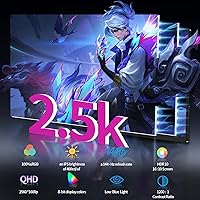
  • Screen Size: The display measures 14 inches diagonally, comparable in footprint to an A4 sheet of paper.
  • Resolution: Native resolution is 2560×1600 pixels, commonly referred to as 2.5K, delivering a pixel density well above standard 1080p portable displays.
  • Aspect Ratio: The panel uses a 16:10 aspect ratio, providing more vertical screen space than the more common 16:9 widescreen format.
  • Refresh Rate: Maximum refresh rate is 144Hz, enabling smooth motion rendering for fast-paced gaming and fluid scrolling in productivity applications.
  • Adaptive Sync: FreeSync support dynamically matches the display refresh rate to the GPU output, reducing screen tearing without requiring manual configuration.
  • Brightness: Peak brightness is rated at 400 nits, which is adequate for indoor use but may be limiting in high-ambient-light environments.
  • Color Gamut: The panel covers 100% of the sRGB color space, making it suitable for color-sensitive work such as photo editing and graphic design.
  • HDR Support: HDR is supported at a basic level; given the 400-nit brightness ceiling, dynamic range improvements over SDR content will be modest.
  • Screen Surface: The display uses a matte anti-glare coating to reduce reflections and eye strain during extended use sessions.
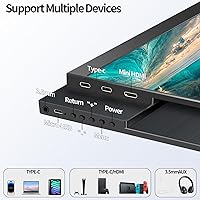
  • Connectivity: Two ports are included: one USB-C port supporting DisplayPort Alt-Mode for video and power delivery, and one full-size HDMI port.
  • USB-C Requirement: The USB-C port requires the host device to support DisplayPort Alt-Mode or Thunderbolt 3, 4, or 5; standard USB-C data-only ports will not transmit video.
  • Included Accessory: A magnetic protective case is included in the box, which also functions as a folding stand for the monitor.
  • Footprint: The monitor body measures approximately 12×8 inches, fitting comfortably inside most laptop bags alongside a 14-inch or 15-inch notebook.
  • Advertised Weight: The product description cites approximately 400g, though the listed spec sheet states 3.19 pounds — buyers should confirm actual weight before purchasing.
  • Brand: Manufactured by StarXnDa, a newer consumer electronics brand that entered the portable monitor market in late 2024.
  • Availability: The product first became available for purchase in October 2024.

Related Reviews

MAGICRAVEN MRPM-17305 17.3″ 2.5K 144Hz Portable Gaming Monitor

89%
94%
Display Quality
91%
Color Accuracy
92%
Refresh Rate & Smoothness
88%
Portability
90%
Connectivity Options
More
AHXJKA 16″ 2.5K Portable Gaming Monitor
85%
93%
Display Quality
90%
Gaming Performance (144Hz/1ms)
89%
Portability/Size/Weight
87%
Connectivity Options (USB-C, HDMI)
91%
Ease of Setup
More
MagicRaven 18″ 2.5K Portable Gaming Monitor
86%
88%
Display Quality
93%
Portability
90%
Ease of Setup
92%
Gaming Performance
85%
Build Quality
More
UPERFECT 14″ Mini LED Portable Monitor 2.5K
85%
88%
Display Quality
92%
Portability & Weight
94%
Outdoor Visibility
85%
Build Quality
90%
Gaming Performance
More
CAPERAVE 17.3-inch 144Hz Portable Gaming Monitor
86%
88%
Display Quality
92%
Portability
91%
Gaming Performance
85%
Connectivity Options
90%
Design & Build Quality
More
UPERFECT 17.3-inch 2K 144Hz Portable Gaming Monitor
86%
91%
Display Quality
95%
Portability
90%
Gaming Performance
88%
Ease of Setup
83%
Build Quality
More
FMC 15.6-inch 2.5K Portable Monitor 400 nits
86%
89%
Display Quality
94%
Portability
87%
Gaming Performance (144Hz)
78%
Brightness
91%
Connectivity
More
Topmonitor P15.6/2.5K Portable Monitor 15.6-inch 2560×1680
86%
94%
Display Quality
90%
Portability/Size/Weight
91%
Color Accuracy
87%
Connectivity (USB-C, HDMI)
85%
Build Quality
More
Dell P1424H 14-inch Portable Monitor
79%
93%
Portability
91%
Setup & Ease of Use
88%
Display Clarity
61%
Brightness & Visibility
58%
Stand & Adjustability
More
Dell 14 Plus Laptop DB14250-14-inch 2.5K, Intel Core Ultra 7, 16GB RAM, 1TB SSD
85%
91%
Performance
94%
Display Quality
85%
Battery Life
88%
Build Quality
86%
Keyboard Usability
More

FAQ

It depends on which MacBook you have. If your MacBook has a Thunderbolt 3 or Thunderbolt 4 port — which most MacBooks from 2018 onward do — then yes, a single USB-C cable should handle both video and power. Older MacBooks or models with basic USB-C ports that lack Thunderbolt may not transmit video through USB-C, so you would need to use the HDMI port instead with a separate adapter.

In most cases it draws power directly from the connected laptop via the USB-C cable. However, lower-powered devices — like budget laptops or tablets with limited power delivery — may not supply enough wattage to run it at full brightness. In those situations, plugging in an external USB-C PD charger to the monitor resolves the issue.

Yes, through the HDMI port. Connect a standard HDMI cable from your console to the monitor, then power the monitor separately via USB-C from a wall charger or USB power bank. Keep in mind that most consoles cap output at 60Hz even if the display supports higher rates.

For fast-paced titles, the difference between 60Hz and 144Hz is genuinely noticeable — motion looks cleaner and input response feels tighter. Combined with FreeSync, you avoid the stuttering that can occur when frame rates fluctuate. That said, your laptop GPU needs to push enough frames to make 144Hz meaningful; if your system struggles to exceed 60 fps, the higher refresh rate won't make a visible difference.

It covers 100% of the sRGB color space, which is a solid baseline for photo editing, digital illustration, and general design work. It won't replace a factory-calibrated professional monitor, but for on-the-go creative tasks it performs well above average for its price tier. Running a basic color calibration with a colorimeter would improve accuracy further if your work demands it.

User impressions are mixed on this point. Many find it convenient and functional as a stand, but some report that the magnetic closure feels less robust after repeated daily use. If you're commuting every day and tossing your bag around, adding a light sleeve or padding around the monitor inside your bag would be a sensible precaution.

For most indoor environments — offices, dorm rooms, hotel rooms, coffee shops with controlled lighting — 400 nits is workable. Where it starts to fall short is next to a bright window or in any space with strong overhead lighting directly on the screen. The matte coating helps reduce glare, but it is not a substitute for raw brightness in those situations.

This is a legitimate point of confusion. The product description mentions around 400g, which would make it very light, while the technical spec sheet lists 3.19 pounds — a significant difference. Before buying, it would be worth checking recent buyer reviews or contacting the seller directly to confirm the real shipped weight, especially if portability is a primary reason you are considering it.

The product listing does not confirm built-in speakers, which is common for ultra-slim portable monitors at this thickness. If audio output is important to you, plan to use your laptop speakers, wired headphones, or a small Bluetooth speaker alongside it.

Physically, yes — the magnetic case stand can be adjusted, and most operating systems allow you to rotate the display output in software settings. However, the 16:10 aspect ratio in portrait orientation results in a tall, narrow layout that works well for reading long documents or browsing code, though it may feel cramped for other tasks.