Overview

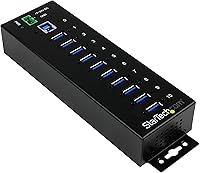
The StarTech ST1030USBM 10-Port USB 3.0 Hub is not the kind of device you buy because it was on sale — it exists to solve a specific problem in demanding environments, and it does so with a no-nonsense metal chassis that feels built to last. Around since 2015, this industrial USB hub has quietly earned a place in server rooms and automation cabinets where consumer-grade hubs simply fail under pressure. The compact DIN-rail form factor keeps cable runs tidy in rack deployments, and the price reflects professional-grade engineering, not retail markup. If you need a plug-and-play desktop hub, look elsewhere.
Features & Benefits

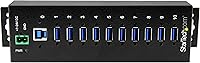
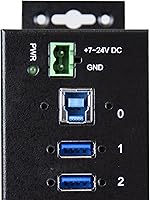
Each of the ten USB-A ports operates independently at 5Gbps, meaning one saturated port won't choke the others — a critical distinction when you're running simultaneous data transfers across multiple devices. The ESD protection rated at 15kV air and 8kV contact, combined with 350W surge protection, keeps connected equipment safe in environments where static discharge is a real operational hazard. Power comes via a terminal block accepting 7–24V DC, which suits industrial setups well but catches buyers off guard — the 65W external adapter is sold separately. TAA compliance and broad OS support across Windows, macOS, and Linux round out a genuinely practical feature set.

Best For

This rack-mount USB expander is purpose-built for IT administrators who need reliable, permanent USB expansion in server rooms, labs, or factory floors where conditions are harsh and downtime is costly. It's a natural fit for government and public-sector procurement teams where TAA compliance is non-negotiable. Manufacturing and R&D environments with elevated ESD risk will appreciate the hardware-level protection on every port. It also works well for anyone running multiple USB peripherals concurrently — barcode scanners, industrial sensors, or storage devices — where bandwidth contention on cheaper hubs has already caused problems. This is infrastructure hardware, not an accessory.

User Feedback

With a 3.8 out of 5 rating across roughly 60 reviews, the StarTech 10-port hub sits in solid but not universally praised territory. Users who bought it for the right reasons consistently highlight the sturdy build quality, dependable port performance, and the flexibility of the mounting options. The recurring frustrations center on two things: the power adapter not being included, which feels like an oversight at this price point, and the terminal block wiring, which has a learning curve for anyone unfamiliar with industrial power connectors. Several critical reviews seem to come from buyers expecting a consumer experience. Post-purchase support through StarTech's 24/5 multilingual helpline is genuinely appreciated by those who've needed it.

Pros

  • All-metal enclosure holds up in demanding rack and industrial environments where plastic hubs fail quickly.
  • Independent port architecture means one saturated port never degrades performance on the others.
  • Hardware-level ESD and surge protection on every port provides real defense against static discharge events.
  • Wide 7–24V DC input integrates cleanly into existing industrial power rails without an additional converter.
  • DIN rail, wall, and under-desk mounting options make permanent installation tidy and flexible.
  • TAA compliance removes procurement friction for government and regulated-industry buyers entirely.
  • Driver-free operation across Windows, macOS, and Linux simplifies deployment in mixed-OS environments.
  • Lifetime 24/5 multilingual technical support is a meaningful differentiator for enterprise buyers.
  • Compact dimensions keep rack footprint minimal even at a 10-port count.
  • Two-year warranty provides reasonable coverage for a device intended for long-term fixed installation.

Cons

  • The 65W power adapter is not included, which is a frustrating omission at this price point.
  • Terminal block power input has a real learning curve for anyone outside the industrial IT world.
  • No USB-C ports whatsoever — a growing limitation as modern peripherals shift away from USB-A.
  • No visual indicator when an ESD or surge event has been absorbed, leaving protection status opaque over time.
  • DIN rail clips feel noticeably less robust than the main chassis and can loosen in high-vibration settings.
  • Legacy USB 2.0 and USB 1.1 device compatibility is inconsistent across certain port configurations.
  • No standard 19-inch rack-ear mounting option, which surprises buyers expecting full rack integration.
  • Tightly packed terminal block and port area makes initial cable management fiddly during installation.
  • With roughly 60 reviews, the feedback pool is too small to draw high-confidence conclusions about long-term reliability.
  • Premium pricing is difficult to justify for any use case that does not specifically require industrial-grade protection or TAA compliance.

Ratings

The StarTech ST1030USBM 10-Port USB 3.0 Hub earns a nuanced verdict — our AI has analyzed verified buyer reviews from global sources, actively filtering out incentivized and bot-generated feedback to surface what real IT professionals and industrial users actually experience. The scores below reflect both the genuine strengths that make this rack-mount USB expander a trusted workhorse and the friction points that have frustrated buyers who came in with the wrong expectations.
Build Quality
88%
The all-metal enclosure is consistently praised by users who have mounted this industrial USB hub in server racks and on factory floors. It feels dense and purposeful in a way that plastic consumer hubs simply do not, and reviewers note zero flex or port wobble even after extended use in vibration-prone environments.
A small number of users reported minor cosmetic inconsistencies on the enclosure finish out of the box, and the terminal block housing feels slightly less refined than the main chassis. Nothing structural, but noticeable at this price tier.
Port Performance & Reliability
84%
The independent port architecture is where this hub earns its keep — users running simultaneous data transfers across multiple USB storage devices report no throttling or dropped connections between ports, which is the core reason IT administrators choose it over cheaper alternatives. Consistent 5Gbps throughput under load is a recurring positive.
A handful of reviewers noted intermittent recognition issues with specific legacy USB 2.0 devices on certain ports, and a few reported one or two ports failing after extended deployment. Isolated cases, but worth noting for mission-critical applications.
ESD & Surge Protection
91%
Users in manufacturing and lab environments specifically called out the ESD protection as the deciding factor in their purchase. Several reviewers noted that previous unprotected hubs had caused equipment damage during static events, and this hub handled similar conditions without incident — giving real confidence in industrial settings.
There is no visible indicator light or alert mechanism when a surge or ESD event is absorbed, so users have no way of knowing if the protection has been partially degraded over time. For long-term deployments, this lack of feedback is a minor but genuine concern.
Mounting Flexibility
83%
The included DIN rail brackets and multiple mounting options received consistent praise from sysadmins who appreciate being able to integrate this rack-mount USB expander cleanly into existing rack infrastructure without fabricating custom mounts. Wall and under-desk installations are equally straightforward with the included hardware.
The DIN rail clips, while functional, feel slightly flimsy compared to the hub body itself, and a few users reported they loosened over time in high-vibration environments. Dedicated rack-ear mounting for standard 19-inch racks is also absent, which surprises some buyers.
Power Setup & Included Accessories
51%
49%
The wide 7–24V DC input range is genuinely useful in industrial deployments where 12V or 24V rails are already present, allowing the hub to integrate into existing power infrastructure without a separate adapter. Users who understood this going in found it a smart, flexible design choice.
This is the single most complained-about aspect across reviews. The 65W power adapter is not included, and the terminal block power connection catches a significant number of buyers off guard — especially those expecting a standard barrel jack or USB-C input. The omission feels like a cost-cutting measure that generates disproportionate frustration.
Ease of Setup
63%
37%
For IT professionals familiar with terminal block wiring and DIN rail systems, setup is described as straightforward and well-documented. OS detection on Windows, macOS, and Linux is driver-free and reliable, which removes one common headache from the deployment checklist.
For buyers outside the industrial IT world, the terminal block power connection is a genuine barrier. Multiple reviews mention confusion and frustration getting the hub powered correctly, and the documentation, while present, assumes a baseline familiarity with industrial wiring that not all buyers have.
TAA Compliance & Procurement Suitability
89%
Government and regulated-industry buyers specifically sought out this hub for its TAA compliance, and several reviews come from federal contractors who confirmed it passed procurement review without issue. For public-sector IT teams, this alone justifies the purchase over non-compliant alternatives at a lower price.
TAA compliance is binary — you either need it or you do not — so this score reflects its value to those buyers. For private-sector users, it adds no practical benefit and contributes to a price premium they may not want to pay.
Value for Money
67%
33%
Users who deployed this in professional environments consistently felt the build durability and protection features justified the premium over consumer alternatives. The lifetime 24/5 technical support is cited as a meaningful value-add, particularly for enterprise buyers who factor support costs into procurement decisions.
For anyone outside the target use case, the price is hard to justify — especially when the power adapter costs extra. Several reviewers explicitly stated they would not repurchase at this price for non-industrial use, and the modest review count suggests it is not winning over a broad audience.
Thermal Management
74%
26%
The metal enclosure doubles as a passive heat sink, and users running the hub under sustained load in warm server rooms noted it stays warm to the touch but never uncomfortably hot. No active cooling means no fan noise, which is appreciated in quiet rack environments.
In enclosed rack deployments with poor airflow, a few users reported the hub running hotter than expected during extended high-load sessions. There is no thermal throttling indicator, so users have no feedback loop if temperatures approach problematic levels.
OS & Device Compatibility
82%
18%
Cross-platform support across Windows, macOS, and Linux works as advertised with no driver installation required in most configurations. IT administrators managing mixed OS environments particularly appreciated not having to maintain separate driver packages for different machines.
Compatibility with some older or niche USB 2.0 and USB 1.1 devices was flagged as inconsistent by a small subset of users. Edge cases aside, this is a minor concern for most enterprise deployments but relevant for labs running legacy instrumentation.
Cable & Port Design
71%
29%
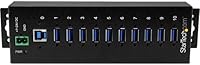
The linear port layout along the front face is clean and practical in rack installations, keeping cables organized and easy to label. Port spacing is sufficient to accommodate most standard USB-A connectors without awkward overlap.
Wider USB adapters or dongles can block adjacent ports depending on their form factor, and the upward-facing port orientation on some mounting configurations makes cable management slightly less elegant than a downward-facing design would allow.
Technical Support Quality
78%
22%
StarTech's 24/5 multilingual support is one of the more tangible differentiators in this category, and reviewers who contacted support for wiring guidance or compatibility questions generally reported prompt, knowledgeable responses. For enterprise buyers, responsive support is a meaningful part of the total cost of ownership equation.
A few users noted that support response quality varied depending on the agent and time zone, with some interactions feeling scripted rather than technically substantive. The 24/5 window, while better than most, still leaves a gap for teams operating around the clock.
Physical Footprint & Form Factor
81%
19%
At 7.8 x 2.2 x 1.2 inches and just under 13 ounces, this industrial USB hub occupies minimal rack or wall space relative to its port count. Users managing dense server environments appreciated that it does not eat into limited real estate the way bulkier hubs do.
The slim profile, while space-efficient, means the terminal block and port connections are tightly packed, which can make cable management slightly fiddly during initial installation. A bit more depth would have made the wiring side notably more comfortable to work with.

Suitable for:

The StarTech ST1030USBM 10-Port USB 3.0 Hub was built for a specific kind of buyer, and those buyers tend to love it. IT administrators managing server rooms or industrial automation environments will find it fits naturally into existing infrastructure — the wide DC input range works with standard 12V and 24V rails already present in most rack setups, and the DIN rail mounting keeps deployments clean and professional. Organizations operating in high ESD-risk environments like electronics manufacturing floors, testing labs, or industrial control rooms will genuinely benefit from the hardware-level surge and static protection on every port, not just as a checkbox feature but as real insurance against equipment loss. Government agencies and regulated-industry procurement teams will appreciate the TAA compliance, which removes a common procurement barrier entirely. Anyone managing multiple USB peripherals simultaneously — barcode scanners, industrial sensors, external drives — who has already been burned by bandwidth contention or port failures on cheaper hubs will find the independent port architecture a meaningful operational improvement.
Not suitable for:

The StarTech ST1030USBM 10-Port USB 3.0 Hub is genuinely the wrong tool for a large portion of people who might consider it. Home users, remote workers, or anyone looking for a straightforward desktop hub to connect a keyboard, mouse, and a couple of drives should look elsewhere — the terminal block power input alone requires comfort with industrial wiring that most people simply do not have, and the power adapter needed to run it from a standard wall outlet is sold separately at additional cost. The premium price tier makes no sense if you are not specifically benefiting from the ESD protection, TAA compliance, or rack-mounting capabilities, since consumer-grade hubs with similar port counts exist at a fraction of the cost. If your environment involves USB-C devices, you will also be disappointed — every port is USB-A, and there is no adapter included. Buyers expecting a simple unbox-and-plug experience will find the setup process frustrating, and the modest 3.8-star rating reflects, in part, the fallout from mismatched expectations.
Specifications

  • Port Count: Provides 10 independent USB-A 3.0 ports, each operating at up to 5Gbps without shared bandwidth contention.
  • Data Speed: Each port supports USB 3.0 SuperSpeed data transfer at 5Gbps, with backward compatibility for USB 2.0 and 1.1 devices.
  • ESD Protection: All ports are protected against electrostatic discharge at 15kV air gap and 8kV contact discharge ratings.
  • Surge Protection: Upstream and downstream USB ports are protected against power surges up to 350W.
  • Power Input: Accepts 7–24V DC input via an integrated terminal block connector; no standard barrel jack or USB-C power input is present.
  • Power Adapter: An optional 65W external power adapter can be used but is sold separately and not included in the box.
  • Charging Spec: Supports USB Battery Charging Specification 1.2 for compatible devices connected to the hub.
  • Enclosure: Full metal construction provides passive heat dissipation and structural durability suitable for industrial rack environments.
  • Dimensions: The unit measures 7.8 x 2.2 x 1.2 inches (LxWxH), enabling a compact footprint in space-constrained deployments.
  • Weight: Weighs 12.6 ounces, reflecting the solid metal build without being impractical for wall or DIN rail mounting.
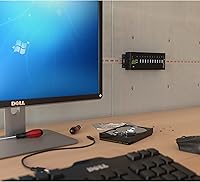
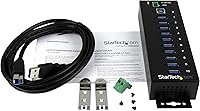
  • Mounting Options: Supports DIN rail, wall surface, and under-desk installation using built-in brackets and included DIN mount rails.
  • OS Compatibility: Operates without driver installation on Windows, macOS, and Linux operating systems.
  • TAA Compliance: Fully compliant with the Trade Agreements Act, making it eligible for U.S. federal government and regulated-industry procurement.
  • Warranty: Backed by a 2-year hardware warranty and lifetime access to 24/5 multilingual technical support at no additional cost.
  • Voltage Rating: Rated for 24V DC operation at the upper end of its input range, compatible with standard industrial power rails.
  • Interface Type: All host and downstream connections use USB-A 3.0 connectors; no USB-C or Thunderbolt ports are present on this unit.
  • ASIN: The Amazon Standard Identification Number for this product is B015ZNWBYE.
  • Manufacturer: Designed and manufactured by StarTech.com, a brand focused on IT connectivity and infrastructure hardware for professional environments.

Related Reviews

MaxLax 10-Port Aluminum USB 3.0 Hub
85%
88%
Performance
91%
Build Quality
85%
Usability
78%
Portability
92%
Connectivity
More
StarTech PEXUSB3S3GE USB 3.0 PCIe Card
75%
83%
Ease of Installation
78%
USB Port Performance
57%
Ethernet Reliability
61%
Build Quality
68%
Value for Money
More
StarTech PEXUSB3S7 7-Port PCIe USB 3.0 Card
79%
91%
Ease of Installation
84%
Build Quality
88%
Port Count & Layout
76%
Transfer Performance
78%
Driver & OS Compatibility
More
SABRENT HB-PU16 16-Port USB 3.0 Hub
83%
91%
Data Transfer Reliability
94%
Per-Port Power Switches
68%
Power Delivery
83%
Build Quality
96%
Ease of Setup
More
ikuai 3.5″ USB 3.0 Hard Drive Enclosure
80%
93%
Ease of Setup
71%
Build Quality
62%
Cable Quality & Reliability
88%
Drive Compatibility
74%
Data Transfer Speed
More
CALIONLTD USB Outdoor Power Strip with 3 Outlets and 3 USB Ports
85%
87%
Overall Performance
91%
Durability
84%
Ease of Use
92%
Waterproofing & Weather Resistance
89%
Safety Features (Surge Protection & Overload)
More
ACASIS HS082 16-Port USB 3.1 Hub
84%
88%
Data Transfer Speed
91%
Build Quality
86%
Power Delivery & Stability
83%
Heat Management
89%
Per-Port Switch Design
More
MLEEDA 4-Port USB 3.0 KVM Switch
79%
93%
Ease of Setup
82%
Switching Reliability
67%
Build Quality
79%
Wired Remote Usability
88%
USB 3.0 Performance
More
Cable Matters 4-Port USB 3.0 KVM Switch
77%
91%
Ease of Setup
78%
Switching Reliability
83%
RF Remote Control
74%
Build Quality
86%
USB 3.0 Transfer Speed
More
KCEVE KC-303X Triple Monitor KVM Switch
78%
88%
Setup & Installation
83%
Video Signal Quality
79%
Switching Speed & Reliability
71%
Remote Controller
81%
USB Peripheral Performance
More

FAQ

It does not include a power adapter — this is probably the most common source of frustration among buyers. The hub is powered via a terminal block connector that accepts 7–24V DC, which works well if you already have an industrial power rail to tap into. If you need to run it from a standard wall outlet, you will need to purchase a compatible 65W external adapter separately. StarTech sells one specifically for this use case, so check their product lineup before ordering.

A terminal block is an industrial-style wiring connector where you insert bare wire ends into screw-clamped slots rather than plugging in a standard connector. You will need a small flathead screwdriver to tighten the terminals, and it helps to know basic DC wiring polarity. For anyone with industrial or rack deployment experience this is routine, but if you have never wired a terminal block before, it is worth watching a short tutorial first.

Not directly — the StarTech ST1030USBM 10-Port USB 3.0 Hub does not include 19-inch rack ears, which surprises some buyers expecting full rack-mount compatibility. It is designed for DIN rail, wall surface, and under-desk mounting using the included brackets. If you need it inside a rack, many sysadmins use a DIN rail panel adapter that fits standard rack slots, but that is a separate purchase.
In most cases, yes — the hub is backward compatible with USB 2.0 and USB 1.1 devices. That said, a small number of users have reported inconsistent recognition with certain older or niche peripherals on specific ports. For the vast majority of standard USB 2.0 devices like keyboards, scanners, and storage drives, compatibility is not an issue.

Yes, this industrial USB hub is driver-free on Linux, macOS, and Windows. It enumerates as a standard USB hub and is recognized automatically by the OS. IT teams managing mixed Linux environments have specifically noted this as a practical benefit, since it removes driver management from the deployment checklist entirely.

ESD, or electrostatic discharge, is the sudden static electricity spike that can fry connected equipment — it is a real hazard in environments like manufacturing floors, electronics labs, or anywhere people are moving around near sensitive hardware. The 15kV air and 8kV contact ratings mean the hub can absorb significant static discharge events before they reach your connected devices. Users in production environments have credited this protection with preventing equipment damage that unprotected hubs previously caused.

They are architecturally independent in terms of power delivery and data performance, meaning one port running a sustained high-throughput transfer will not starve the others. This is a meaningful difference from cheaper hubs that share a single upstream data lane across all ports, causing slowdowns under simultaneous load. For server rooms running multiple USB storage devices or data acquisition tools in parallel, this matters considerably.

Probably not, unless you have very specific needs. The terminal block power input and DIN rail form factor are designed for industrial and rack deployments, not desktop use. If you just need to expand USB ports at your desk, there are much simpler and less expensive options that will serve you better. This rack-mount USB expander is solving a different problem than what most home users face.

TAA stands for Trade Agreements Act, a U.S. federal law that restricts government agencies from purchasing products manufactured in certain countries. TAA-compliant hardware meets those sourcing requirements, which means it can be purchased through GSA schedules and other federal procurement channels without issue. If you are buying for a government agency, defense contractor, or regulated institution, this compliance status is often a hard requirement rather than a nice-to-have.

StarTech offers lifetime 24/5 multilingual technical support, which is included at no additional cost with this hub. Users who have contacted support for wiring guidance or compatibility questions generally report competent and reasonably prompt responses. The 24/5 window covers most business hours globally, though teams operating full 24/7 schedules may occasionally find themselves outside the support window. For enterprise deployments, having a named support contact from StarTech is worth asking about at purchase.

Where to Buy