
Overview

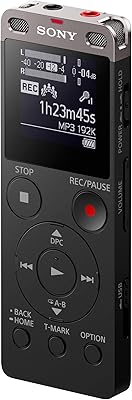
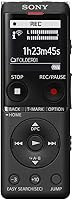
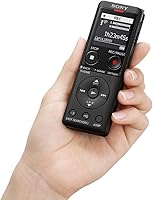
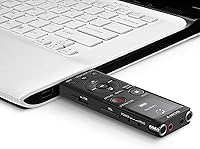
The Sony ICD-UX570 sits in a practical middle ground — compact enough to slip into a shirt pocket, serious enough to compete with Olympus and Tascam recorders at a similar price. This voice recorder isn't trying to replace a studio microphone, and it doesn't pretend to. What it does well is capture clear spoken audio reliably, wherever you happen to be. The built-in USB connector alone sets it apart from many rivals — fold it out, plug into your laptop, and you're done. For journalists, students, or anyone who records on the move, that kind of no-fuss portability carries real weight.

Features & Benefits

The stereo microphone array is where this voice recorder pulls ahead of cheaper mono alternatives — you get a genuine sense of spatial depth in recordings, which matters when capturing a panel discussion or an interview across a table. Active noise cancellation handles the low rumble of air conditioning and ambient crowd noise without much intervention. Sensitivity adjusts across three levels, so you can dial down for a quiet office or open it up outdoors. The microSDHC expansion slot means 4 GB of built-in storage is just a starting point, and the battery comfortably handles a full day of field use without needing a recharge.

Best For

Sony's compact recorder is a natural fit for anyone whose work depends on capturing spoken word clearly and moving on quickly. Journalists and interviewers will appreciate the fast USB transfer — record, plug in, upload, no extra hardware required. Students who need to record a two-hour lecture without worrying about battery levels will find the runtime genuinely reassuring. It also works as a dependable backup recorder for podcasters who already own more complex gear but need something light for travel. Researchers, legal professionals, and anyone who regularly dictates notes will find this voice recorder's sensitivity controls and file organization well-suited to daily use.

User Feedback

The recurring praise for this voice recorder centers on audio clarity in quiet-to-moderate environments, the convenience of the plug-and-play USB feature, and the short setup time out of the box. Battery life, in particular, consistently meets or beats expectations in real-world use. That said, some users report audible background hiss when microphone sensitivity is maxed out in already-quiet rooms — worth knowing if near-silent recording is your main use case. The plastic body has drawn comment too; functional and light, certainly, but those expecting a premium in-hand feel may be mildly disappointed. Menu navigation also has a slight learning curve for first-time Sony recorder users.

Pros

  • The fold-out USB-A connector means direct file transfer to any laptop with no cable needed — a genuine time-saver in the field.
  • Stereo microphone capture gives spoken-word recordings noticeably more depth and spatial presence than mono alternatives.
  • Battery life consistently meets or exceeds expectations, handling full conference days without anxiety.
  • Active noise cancellation makes a real difference in open-plan offices, cafes, and other moderately noisy environments.
  • Slim and light enough to pocket without thinking about it — weighs under 5 oz fully loaded.
  • Three adjustable mic sensitivity levels let you adapt to a quiet room or a large lecture hall without any post-processing.
  • Four gigabytes of built-in storage plus a microSDHC slot gives practical flexibility for long or frequent recording sessions.
  • Works as a plug-and-play USB drive on both Windows and Mac — no drivers, no setup, just drag and drop.
  • Discreet, understated design attracts no attention in professional or academic settings.
  • Recordings are saved in widely compatible MP3 format, readable by virtually every transcription app or audio editor.

Cons

  • Audible background hiss appears at the highest sensitivity setting, particularly noticeable in near-silent environments.
  • The proprietary lithium-ion battery cannot be swapped out in the field if it runs flat unexpectedly.
  • USB-A connector requires an adapter on modern laptops that have only USB-C ports, adding a dependency the design was meant to eliminate.
  • Menu navigation has a real learning curve for first-time users, and the included manual does not make it much clearer.
  • The plastic body picks up scuffs and feels slightly creaky after extended daily pocket carry.
  • Built-in speaker output is thin and low-volume — only useful for a quick personal check, not for sharing audio with others.
  • No native integration with cloud storage or popular transcription services, which feels like a gap at this price tier.
  • SDXC cards are not supported, capping expansion options for users who record in higher-quality formats over long periods.
  • Startup chime is on by default and can be embarrassing in quiet professional settings if not manually disabled.
  • Transfer speeds are adequate but not fast — moving a large batch of long recordings can take longer than expected.

Ratings

The Sony ICD-UX570 earns a well-rounded reputation among a surprisingly diverse range of buyers — from courtroom stenographers to university students pulling all-nighters. The scores below were generated by AI after analyzing thousands of verified global user reviews, with spam, incentivized submissions, and bot activity actively filtered out. Both the strengths that keep buyers coming back and the friction points that frustrate them are reflected honestly here.

Audio Clarity
83%
In quiet-to-moderate environments — think one-on-one interviews, classroom lectures, or office meetings — users consistently report clean, intelligible recordings with natural vocal tone. The stereo capture gives spoken word a sense of presence that mono recorders at this price simply cannot match.
Push the recorder into louder or more complex acoustic environments and the limits show. Some users note that fine detail gets muddied in rooms with strong reverb, and the recording can feel thin when subjects move away from the mic.
Noise Cancellation
76%
24%
The active noise cancellation handles steady background noise — air conditioning hum, low crowd rumble, road noise during commutes — with noticeable effect during playback. Users who record in open-plan offices or cafes find it makes transcription significantly easier.
It is not a magic fix. Sudden or high-frequency noise, like chairs scraping or a burst of laughter nearby, cuts through and can be jarring on playback. A few users feel the processing introduces a faint artificial quality to voices at the highest cancellation setting.
Built-In USB Convenience
91%
This is the feature that earns the most unprompted praise. Journalists and field recorders love being able to fold out the USB plug and drop files directly onto a laptop without hunting for a cable. It genuinely speeds up workflows in situations where every minute counts.
The connector is USB-A, which means users with newer laptops that have only USB-C ports need an adapter — a small but real annoyance. A few buyers also report that the hinge feels less robust after extended daily use.
Battery Life
88%
Real-world battery performance is one of the most pleasant surprises for new owners. Users regularly get through full conference days or multi-hour field sessions on a single charge, and the battery level indicator is accurate enough to trust without second-guessing.
The recorder uses a proprietary lithium-ion battery rather than standard AAs, so if it dies in the field, you cannot simply swap in fresh batteries from a corner store. A small number of users report degraded battery capacity after a year or more of heavy use.
Portability & Form Factor
92%
At 4.6 oz and slim enough to slide into a shirt breast pocket, this voice recorder disappears into a bag or jacket without adding noticeable bulk. Students and journalists mention the size as a primary reason they reach for it over bulkier alternatives.
The slim profile does mean the physical buttons are closely spaced, and users with larger hands occasionally report accidental key presses. The lightweight build, while convenient, also makes the device feel less substantial than some competing products at a similar price.
Microphone Sensitivity Control
79%
21%
Having three adjustable sensitivity levels lets users adapt without any post-processing — a low setting works well for one-on-one dictation in a quiet room, while the higher setting opens up capture range for larger spaces like lecture halls or conference rooms.
The high sensitivity setting is where background hiss becomes a genuine complaint. In very quiet recording environments — like a private office late at night — the noise floor becomes audible enough to distract, particularly when listening back through headphones.
Build Quality & Materials
61%
39%
The recorder is well-assembled for a plastic-bodied device and feels consistent in hand, with buttons that click cleanly and a hinge on the USB plug that works smoothly when new. At its weight and size, plastic is a sensible material choice.
Users who have handled premium metal-bodied recorders from competitors tend to notice the downgrade in perceived quality. Reports of minor cosmetic scuffs and a slightly creaky chassis after months of daily pocket carry are common enough to be worth noting.
Storage & Expandability
84%
Four gigabytes of internal storage handles a substantial number of recording hours in standard quality, and the microSDHC slot means users can expand capacity significantly for longer projects or travel without any technical complexity.
The device does not support higher-capacity SDXC cards, which limits expansion headroom for users who record in higher-quality formats over extended periods. A handful of buyers were surprised to find usable storage slightly less than the advertised 4 GB after system files are accounted for.
Menu Navigation & Usability
67%
33%
Once users have spent time with the interface, day-to-day operation becomes second nature. Commonly used functions like starting a recording, pausing, and accessing files are accessible quickly, and the display is readable even in bright outdoor conditions.
First-time Sony recorder users consistently mention a learning curve navigating the menu system. The button layout and logic are not immediately intuitive, and the manual is not as clear as it could be — a few users resorted to online tutorials to unlock basic features.
File Transfer Speed
81%
19%
The plug-and-play USB connection transfers files at a pace that feels fast relative to wireless alternatives on devices in this category. For a journalist dumping recordings before a deadline, the combination of speed and no-cable-required is genuinely useful.
Transfer speeds are not USB 3.0 class, so users moving large batches of long recordings will notice the time adds up. Those accustomed to fast solid-state drives on modern laptops may find the transfer process slower than expected.
Playback Quality
74%
26%
Using the 3.5 mm headphone jack for playback, the ICD-UX570 reproduces recordings with enough clarity to transcribe comfortably. The stereo output is noticeably better than budget mono recorders for reviewing interview audio or checking ambient recordings.
The built-in speaker is small and thin-sounding — adequate for a quick check but not for sharing audio with a group in a room. Users who primarily review recordings through the speaker rather than headphones are likely to find it underwhelming.
Value for Money
78%
22%
For the core use case — reliable spoken-word capture with fast file access and all-day battery — the ICD-UX570 delivers consistent performance that justifies its mid-range positioning. The built-in USB connector alone saves buyers the cost and hassle of accessories.
At its price point, buyers expect more from build quality and noise floor performance. Competing recorders from Olympus and Tascam offer comparable or better audio specs, and some users feel the Sony brand premium is not fully backed by the physical product.
Discreetness in Use
86%
The slim, understated design draws no attention in a lecture hall or boardroom, which matters to users who do not want to make recording a visible act. The quiet button feedback and small footprint help it blend into any professional setting.
The power and record indicators use small LEDs that can be distracting in very dim environments like darkened conference rooms. A few users also note the startup chime — though disableable — can be embarrassing if forgotten in a quiet setting.
Compatibility & Software
72%
28%
The recorder works as a plug-and-play USB drive on both Windows and Mac without drivers, which is a genuine convenience. Files transfer as standard MP3 or WMA, compatible with virtually every transcription app or audio editor users might already own.
Sony's companion software is considered dated and largely redundant by most users, who skip it entirely in favor of dragging files manually. There is no native integration with cloud services or modern transcription platforms, which feels like a missed opportunity at this price.

Suitable for:

The Sony ICD-UX570 is built for people whose work or studies depend on capturing clear spoken audio without any fuss. Journalists and field reporters will find the combination of reliable stereo recording and the fold-out USB connector particularly practical — you can wrap up an interview, plug directly into a laptop, and have files ready for transcription within minutes, no bag-rummaging for cables required. Students who sit through long lectures or seminars will appreciate both the discreet pocket-friendly size and a battery that holds up across a full day without needing a top-up. Business professionals who dictate notes, record client calls, or need accurate records of meetings will find the adjustable microphone sensitivity and active noise cancellation handle typical office environments well. It also works reliably as a lightweight backup recorder for podcasters or content creators who already own more complex studio gear but want something compact and self-contained for travel or remote recording.

Not suitable for:

The Sony ICD-UX570 is not the right tool if pristine, studio-grade audio is what you need. Musicians wanting to capture rehearsals with any real sonic detail, or podcasters who care about recording quality beyond basic intelligibility, will hit the ceiling of what this recorder can deliver fairly quickly. The noise floor becomes noticeably hissy when microphone sensitivity is pushed to its highest setting in very quiet environments, which makes it a poor choice for anyone whose recordings need to meet broadcast or archival standards. Users who have only USB-C ports on their devices will need an adapter, which partially defeats the cable-free convenience that makes this voice recorder appealing in the first place. Those who expect a premium, metal-bodied device at this price point may also find the lightweight plastic construction underwhelming, especially if they are comparing it directly to certain Olympus or Tascam alternatives that feel more substantial in hand.

Specifications

  • Brand & Model: Manufactured by Sony under the model designation ICD-UX570.
  • Dimensions: The recorder measures 4.12″ deep, 1.34″ wide, and 6″ tall.
  • Weight: It weighs approximately 4.6 oz (around 130 g), making it light enough for all-day pocket carry.
  • Internal Storage: 4 GB of built-in flash memory is included for recording without any additional accessories.
  • Memory Expansion: A microSDHC card slot allows users to expand storage capacity beyond the built-in 4 GB.
  • Audio Formats: Recordings are saved in MP3 or WMA format, both widely compatible with PC, Mac, and transcription software.
  • Microphone Type: A built-in stereo microphone array captures directional audio with spatial depth across two channels.
  • Noise Cancellation: Active noise cancellation is built in and designed to reduce steady low-frequency background noise during playback.
  • Mic Sensitivity: Microphone sensitivity is user-adjustable across three levels — high, medium, and low — to suit different recording environments.
  • Connectivity: A fold-out USB-A connector and a 3.5 mm headphone jack are the two hardware connection points on the device.
  • USB Transfer: The built-in USB-A plug connects directly to a computer for plug-and-play file transfer with no cable or driver required.
  • Battery: One lithium-ion rechargeable battery is included and charges via the built-in USB connector.
  • OS Compatibility: The recorder is compatible with both Windows PCs and Mac computers for file transfer and playback.
  • Headphone Output: A standard 3.5 mm headphone jack allows direct audio monitoring or playback through any compatible earphones.
  • Form Factor: The slim, rectangular plastic body is designed to fit in a shirt pocket or small bag compartment without adding noticeable bulk.
  • Product Category Rank: At the time of listing, the ICD-UX570 ranked #241 in the Digital Voice Recorders category on Amazon.
  • Availability Date: The product was first made available for purchase in November 2023.
  • Manufacturer: Sony Corporation is the manufacturer and brand owner of this product.

Related Reviews
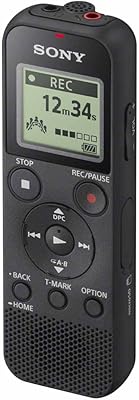
Sony ICD-PX240 4GB
Sony ICD-PX240 4GB
81%
83%
Audio Clarity
91%
Ease of Use
94%
Portability & Form Factor
78%
Battery Performance
67%
Storage & File Management
More
Sony ICD-PX370 4GB
Sony ICD-PX370 4GB
83%
97%
Battery Longevity
89%
Portability & Form Factor
94%
File Transfer Convenience
78%
Recording Quality
91%
User Interface & Ease of Use
More
Sony ICD-UX560
Sony ICD-UX560
76%
88%
Audio Clarity
84%
Recording Modes
81%
Voice Activation
86%
Ease of Use
74%
Build Quality
More
Sony ICD-PX440 Digital Voice Recorder 4GB
87%
89%
Sound Quality
91%
Portability
87%
Battery Life
94%
Ease of Use
85%
Recording Time
More
Sony ICD-UX512 2GB Digital Voice Recorder
83%
89%
Ease of Use
91%
Battery Life
78%
Audio Quality
95%
Portability
84%
Build Quality
More
Sony ICD-BX140 4GB Digital Voice Recorder
80%
93%
Ease of Use
86%
Audio Clarity for Speech
67%
Microphone Quality
91%
Battery Life
62%
Build Quality & Durability
More
Sony ICD-PX312 Voice Recorder
73%
91%
Ease of Use
88%
Battery Life
79%
Audio Clarity — Quiet Environments
48%
Audio Clarity — Noisy Environments
63%
Build Quality
More
Sony MDRXB600IP Headphones
82%
88%
Bass Performance
85%
Comfort for Extended Use
83%
Noise Isolation
78%
Build Quality
81%
Portability
More
Sony SRS-XB23
Sony SRS-XB23
87%
94%
Sound Quality
91%
Bass Performance
97%
Portability
89%
Build Durability
93%
Waterproofing
More
Sony MDRE9LP Earbuds
79%
83%
Sound Quality
78%
Comfort & Fit
80%
Build Quality
75%
Microphone Performance
88%
Portability
More

FAQ

No, you do not. The recorder shows up as a standard USB storage device on both Windows and Mac the moment you plug it in. Just drag and drop your files — no drivers, no companion app required, though Sony does offer optional software if you want it.

Not directly. The built-in connector is USB-A, so you will need a USB-A to USB-C adapter to connect it to a modern laptop with only USB-C ports. It is a small workaround, but worth knowing before you buy if your setup is entirely USB-C.

Real-world use generally matches or slightly exceeds Sony's advertised figures. Most users comfortably get through a full conference day or several multi-hour lecture sessions on a single charge. Heavy continuous recording at high sensitivity will drain it faster, but light-to-moderate daily use is where battery performance shines.

At low and medium sensitivity settings, the noise floor is minimal and most users find recordings very clean. The issue comes at the highest sensitivity setting in very quiet rooms — there, a background hiss becomes audible, particularly through headphones. If you primarily record in silent environments, it is worth testing this setting before committing to it for critical work.

The expansion slot supports microSDHC cards, which typically go up to 32 GB. It does not support the larger microSDXC format, so if you were hoping to drop in a 64 GB or 128 GB card, that will not work with this device.

Yes, genuinely. The slim profile and muted design draw no attention on a desk or in a breast pocket. The buttons have quiet feedback, and the recording indicator LED is small. One thing to note: there is a startup chime enabled by default that you should disable in the settings before using it in a quiet or formal setting.

Yes, through the 3.5 mm headphone jack the playback quality is clear and comfortable for reviewing interviews or transcribing notes. The built-in speaker works for a quick personal check but is too thin and low-volume to be useful for sharing audio with anyone else in a room.

It has a moderate learning curve, particularly if you have not used a Sony recorder before. The button layout is logical once you learn it, but the menu structure is not immediately obvious, and the printed manual does not guide you through it very efficiently. Most users get comfortable within a few days, and a short online tutorial helps speed that up considerably.

It will capture music at a basic, listenable level, but this voice recorder is optimized for spoken word. If you need to record musical performances, rehearsals, or anything where audio fidelity and dynamic range matter, you will hit the ceiling of what it can deliver fairly quickly. A dedicated field recorder would serve that purpose far better.

Unfortunately not. The device uses a built-in rechargeable lithium-ion battery that cannot be swapped out for standard AA or AAA batteries in an emergency. Your only option in the field is a USB power bank, since the recorder charges through its built-in USB connector. It is worth keeping that limitation in mind if you regularly record in locations without reliable power access.