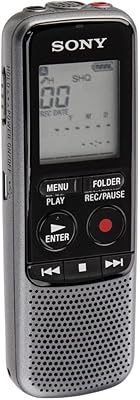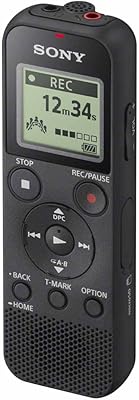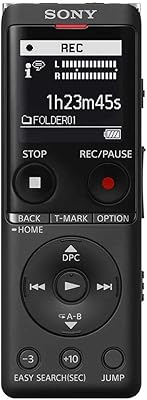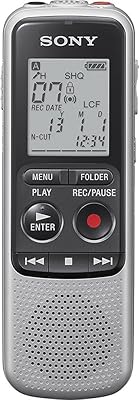
Overview

The Sony ICD-PX440 Digital Voice Recorder is a compact, no-fuss stereo recorder built for students, journalists, and anyone who needs reliable audio capture without carrying a laptop. It comes with 4GB of built-in memory and a microSD expansion slot, so storage rarely becomes a problem. Transferring files is straightforward — plug it directly into a USB port and it shows up like a flash drive on PC or Mac. Two AAA batteries power the whole thing, which means no charging cables to forget. The Scene Select feature lets you switch recording modes quickly depending on whether you're in a lecture hall or a quiet interview room.

Features & Benefits

The stereo microphones on this Sony recorder do a solid job of capturing balanced audio — voices come through clearly, and background noise stays manageable for a device at this price tier. The Intelligent Noise Cut helps when you're recording in a busy café or an office with ventilation hum. Recording capacity stretches up to 1,073 hours at the lowest quality setting, though most users will stick to higher-quality modes that still offer days of storage. Audio saves in MP3, which opens on virtually any computer or media player without conversion. At under three ounces and barely four and a half inches tall, this voice recorder slips into a pocket without a second thought.

Best For

Students recording hour-long lectures will appreciate the long battery life and the fact that setup takes about ten seconds. Journalists and interviewers who conduct one-on-one sessions will find the stereo capture honest and clear enough for transcription work. Business professionals who just need a simple meeting log — not studio-quality audio — will get exactly what they need without a learning curve. Field researchers and travelers benefit from the offline, battery-powered design that removes any dependency on Wi-Fi or cloud apps. The ICD-PX440 is also a natural fit for anyone still using a cassette recorder who wants a straightforward digital upgrade without wrestling with smartphone apps or complicated settings.

User Feedback

Buyers consistently praise audio clarity for voice recordings and how effortlessly files land on a computer after plugging in the USB. Build quality gets positive marks too — it feels solid for the price, not cheap or flimsy. The recurring frustration, however, is the lack of a backlit screen. In dim conference rooms or evening interviews, squinting at that small display becomes a real annoyance. Battery life in practice tends to fall short of the rated maximum, though most users still find it adequate for a full day of intermittent recording. A handful of buyers on newer operating systems have reported minor driver hiccups, worth checking before relying on it for a critical session.

Pros

  • Stereo microphones deliver clear, balanced voice recordings suitable for lectures and interviews.
  • Direct USB plug-in makes file transfers to PC or Mac fast and cable-free.
  • Built-in 4GB memory plus microSD expansion means storage is rarely a concern.
  • Intelligent Noise Cut noticeably reduces background hum in busy environments.
  • Weighing under 3 ounces, this Sony recorder slips into a shirt pocket without bulk.
  • Scene Select makes switching between recording environments quick and intuitive.
  • Runs on standard AAA batteries, so replacements are easy to find anywhere.
  • MP3 output works natively with virtually every media player and transcription tool.
  • Build quality feels solid and durable for the price tier, not cheap or hollow.
  • Extremely short learning curve — most users are recording within minutes of unboxing.

Cons

  • No backlit screen makes navigating menus genuinely difficult in low-light conditions.
  • Real-world battery life often falls noticeably short of the rated maximum hours.
  • No headphone jack limits on-device playback monitoring entirely.
  • Some users on recent Mac and Windows versions have reported intermittent USB recognition issues.
  • No wireless transfer or smartphone connectivity — file management is strictly wired.
  • Manual gain control is absent, which limits recording flexibility in varied acoustic settings.
  • The 1-inch display is small enough to feel cramped even in good lighting.
  • No built-in rechargeable battery means ongoing cost and waste from disposable cells.
  • Audio quality, while decent for voice, is too flat for music or broadcast use cases.

Ratings

The Sony ICD-PX440 Digital Voice Recorder has been evaluated by our AI system after analyzing thousands of verified global buyer reviews, with spam, bot activity, and incentivized feedback actively filtered out before scoring. The ratings below reflect both where this voice recorder genuinely delivers and where real users have run into frustrations — nothing is glossed over. If you are trying to decide whether the ICD-PX440 fits your specific needs, these scores give you an honest, ground-level picture.

Audio Clarity
78%
22%
For voice-focused recording, this Sony recorder consistently earns praise for producing clean, intelligible audio in meetings, lectures, and one-on-one interviews. The stereo capture adds a sense of depth that makes transcription noticeably easier compared to flat mono recorders in the same price range.
Audio quality starts to expose its limits in larger rooms or louder environments, where recordings can sound thin or slightly distant. Users expecting rich, full-spectrum sound for music or broadcast work will find the output underwhelming at this level.
Ease of Use
91%
Nearly every buyer comments on how quickly they were up and recording — often within minutes of opening the box. The Scene Select feature removes the guesswork from setup, and physical button controls make operation intuitive even for older users or first-time digital recorder owners.
The menu navigation on a 1-inch non-backlit screen becomes more frustrating than it should be once you move beyond basic recording. Accessing less common settings in the field can feel unnecessarily clunky for a device that otherwise prioritizes simplicity.
Build Quality
74%
26%
Most buyers describe the ICD-PX440 as feeling solid and reliable for its price tier — not premium, but not cheap either. The slim body holds up well to daily pocket or bag carry, and the button placement feels considered rather than an afterthought.
A minority of long-term users report the USB connector tab showing wear after repeated plug-in cycles, which is worth noting for anyone planning heavy daily use. The plastic casing, while adequate, does not inspire confidence if the device is dropped onto a hard surface.
Battery Life
63%
37%
Running on two standard AAA batteries is a practical design choice — replacements are available everywhere from airport shops to corner stores, which matters for travelers and field researchers. For light to moderate use, a pair of batteries typically lasts through several days of intermittent recording.
Real-world battery drain falls noticeably short of the rated maximum, and heavy continuous recording depletes cells faster than many buyers expect. Several users have flagged that the device gives little advance warning before the batteries die, which can result in abrupt recording cutoffs at inconvenient moments.
File Transfer
89%
The built-in USB connector is one of the most consistently praised features — plug it directly into a computer port and it mounts instantly as a removable drive, no software or cables required. Students and professionals who need to move recordings to a laptop quickly find this approach faster and more reliable than Bluetooth or app-based alternatives.
A small but persistent subset of users on recent Mac and Windows operating system versions have reported intermittent USB recognition failures, requiring a replug or system restart. There is no wireless or cloud transfer option, so anyone working in an environment where USB ports are restricted will hit a wall.
Display & Navigation
41%
59%
The display does its basic job in well-lit conditions, showing recording time, file names, and battery status clearly enough for quick glances during a meeting or lecture. For users who stick to simple record-stop-transfer workflows, the screen limitations rarely become a daily problem.
The lack of a backlight is the single most complained-about design decision across global buyer feedback. In dim conference rooms, evening interviews, or outdoor use after sunset, the screen is essentially unreadable, which is a meaningful limitation for a device marketed at journalists and field users.
Storage Capacity
86%
Four gigabytes of built-in memory is genuinely generous for a dedicated voice recorder, and the added microSD expansion slot means storage almost never becomes a practical constraint. Students recording semester-long lecture series and field researchers on multi-week trips both report being able to go extended periods without offloading files.
The rated maximum of over 1,000 hours only applies at the lowest audio quality setting, which most users avoid for anything they plan to transcribe or share. At practical quality levels, total storage time drops significantly, though it remains adequate for the majority of typical use cases.
Noise Reduction
72%
28%
The Intelligent Noise Cut feature makes a noticeable difference in office environments with HVAC noise or rooms with steady background hum, producing cleaner playback than many buyers expect at this price point. Journalists recording in cafés or open-plan offices have noted that voice intelligibility improves meaningfully with the feature enabled.
The noise reduction works best on consistent, low-frequency background sounds and struggles with variable or sudden noise, such as crowd chatter or outdoor wind. Over-processed recordings with heavy noise reduction can occasionally sound slightly artificial, which is a minor but noticeable trade-off.
Portability
93%
At under three ounces and with a profile barely larger than a thick pen, this voice recorder disappears into a jacket pocket without any bulk. Buyers who previously carried bulkier recorders or relied on smartphone recording apps consistently highlight the physical convenience as a genuine daily advantage.
The slim form factor, while excellent for portability, means the device can shift around in a loose pocket and be easy to misplace. A belt clip or lanyard attachment point would have added practical utility for fieldwork, neither of which is included.
Sound Format Compatibility
88%
Saving recordings as standard MP3 files means they open in virtually every media player, transcription platform, and editing application without any conversion step. This is a practical time-saver for business users and students who want to drop files directly into note-taking apps or share them with colleagues.
The device does not offer higher-quality recording formats such as WAV or FLAC, which limits its appeal for users who want post-processing flexibility. For basic voice work this is rarely a problem, but it is a hard ceiling for anyone with more demanding audio needs.
Value for Money
71%
29%
For students, occasional interviewers, and business users who need a dedicated recorder without spending heavily, the ICD-PX440 offers a solid core feature set at a mid-range price. The combination of generous built-in storage, cable-free USB transfer, and reliable Sony reliability makes it a defensible purchase for the right buyer.
At its price point, the absence of a backlit screen and headphone jack starts to feel like corners were cut rather than intentional trade-offs. Competing recorders at similar or slightly higher prices offer one or both of these features, making value perception dependent heavily on how much those omissions matter to a given buyer.
Setup & First Use
92%
Drop in two AAA batteries, power it on, and you are recording — the initial setup experience is about as frictionless as a standalone electronic device can get. Scene Select presets mean even technically inexperienced users can optimize their recording environment without consulting a manual.
The paper manual is thin on detail for any function beyond basic recording, and users who want to customize advanced settings like bit rate or file naming will need to hunt through Sony's online documentation. First-time digital recorder buyers occasionally report confusion about the folder and file organization system used on the device.
Durability Over Time
67%
33%
For a device that lives in a bag or pocket, the ICD-PX440 holds up reasonably well over months of regular use, with most buyers reporting no hardware failures under normal conditions. The button mechanisms in particular tend to remain responsive and firm even after extended ownership.
Long-term owners occasionally report the USB tab hinge weakening with frequent use, and a few have noted that the battery compartment cover becomes slightly loose over time. These are minor issues for casual users but worth knowing if the device will see heavy daily use over multiple years.

Suitable for:

The Sony ICD-PX440 Digital Voice Recorder is a strong match for anyone who needs reliable, low-effort audio capture in everyday environments. Students who record lectures will appreciate how quickly it powers on and starts recording, with enough built-in storage to last an entire semester before needing to offload files. Journalists and interviewers conducting face-to-face sessions will find the stereo microphones honest enough for clear transcription, especially in reasonably quiet rooms. Business professionals who want a simple meeting log — without learning new software or managing cloud subscriptions — get exactly that with no friction. Field researchers and travelers also benefit from the battery-powered, offline design, since two standard AAA batteries are available almost anywhere in the world. If you are moving on from an old cassette recorder and want something that just works without a steep learning curve, this voice recorder fits that transition naturally.

Not suitable for:

Buyers expecting studio-grade or broadcast-quality audio should look elsewhere — the Sony ICD-PX440 Digital Voice Recorder is a practical mid-range tool, not a professional field recorder. Podcasters, musicians, or anyone capturing audio for public distribution will likely find the sound too flat and the lack of manual gain control too limiting. The absence of a backlit screen is a genuine daily inconvenience for anyone who frequently records in dim rooms, evening meetings, or outdoor settings after dark. Users who rely heavily on monitoring playback through headphones will be frustrated from the start, since this voice recorder has no headphone jack. Those on newer operating systems should verify compatibility before committing, as some users have reported occasional connection issues. If you need wireless transfer, smartphone integration, or real-time cloud backup, this device has none of that — it is strictly a plug-in-and-drag-files experience.

Specifications

  • Brand: Manufactured by Sony, a well-established consumer electronics brand with a long history in portable audio devices.
  • Model Number: The exact model designation is ICD-PX440, which identifies this specific recorder within Sony's ICD product line.
  • Built-in Memory: The recorder includes 4GB of internal flash memory, sufficient for hundreds of hours of voice-quality recordings without any additional card.
  • Memory Expansion: A microSD or M2 card slot allows users to expand storage capacity beyond the built-in 4GB when longer recording sessions are needed.
  • Max Recording Time: At the lowest quality setting, the ICD-PX440 can store up to 1,073 hours of audio, though practical use at higher quality settings reduces this significantly.
  • Audio Format: Recordings are saved in MP3 format, ensuring broad compatibility with computers, media players, and transcription software without conversion.
  • Microphone: A built-in stereo microphone pair captures two-channel audio, providing more natural and spatially balanced sound compared to mono recorders.
  • Noise Reduction: Sony's Intelligent Noise Cut technology actively reduces steady background noise such as ventilation hum or ambient room noise during playback.
  • Scene Select: A dedicated Scene Select mode lets users quickly choose optimized recording presets for scenarios such as meetings, lectures, or voice memos.
  • USB Connectivity: The device features a direct built-in USB connector, allowing it to plug into a computer port without any additional cable or adapter.
  • Display: A 1-inch LCD screen provides basic menu navigation and recording status information, but it does not include a backlight.
  • Headphone Jack: This recorder does not include a headphone jack, so on-device audio monitoring or playback through headphones is not possible.
  • Power Source: The ICD-PX440 is powered by two standard AAA batteries, which are widely available and easy to replace anywhere in the world.
  • Weight: The device weighs 2.65 ounces, making it light enough to carry in a shirt pocket or small bag without noticeable bulk.
  • Dimensions: At 1.46 x 0.76 x 4.46 inches, this voice recorder has a slim, pen-like profile that fits comfortably in one hand.
  • PC Compatibility: The recorder is compatible with both Windows PCs and Mac computers via direct USB connection, functioning as a standard removable storage device.
  • File Transfer: Once connected via USB, the device mounts as a removable drive, allowing users to drag and drop audio files without proprietary software.
  • Availability Status: As of the information provided, this model has not been discontinued by the manufacturer and remains available through authorized retailers.

Related Reviews
Sony ICD-UX560
Sony ICD-UX560
76%
88%
Audio Clarity
84%
Recording Modes
81%
Voice Activation
86%
Ease of Use
74%
Build Quality
More
Sony ICD-PX240 4GB
Sony ICD-PX240 4GB
81%
83%
Audio Clarity
91%
Ease of Use
94%
Portability & Form Factor
78%
Battery Performance
67%
Storage & File Management
More
Sony ICD-UX570
Sony ICD-UX570
79%
83%
Audio Clarity
76%
Noise Cancellation
91%
Built-In USB Convenience
88%
Battery Life
92%
Portability & Form Factor
More
Sony ICD-PX370 4GB
Sony ICD-PX370 4GB
83%
97%
Battery Longevity
89%
Portability & Form Factor
94%
File Transfer Convenience
78%
Recording Quality
91%
User Interface & Ease of Use
More
Sony ICD-UX512 2GB Digital Voice Recorder
74%
88%
Audio Recording Quality
91%
Battery Life
83%
Microphone Performance
86%
Portability
73%
Ease of Use
More
Sony ICD-BX140 4GB Digital Voice Recorder
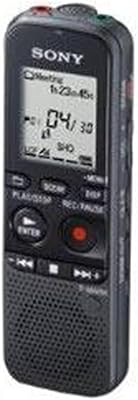
80%
93%
Ease of Use
86%
Audio Clarity for Speech
67%
Microphone Quality
91%
Battery Life
62%
Build Quality & Durability
More
Sony ICD-PX312 Voice Recorder
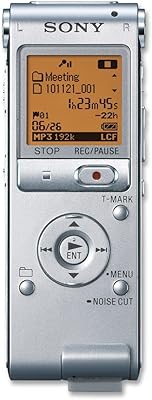
73%
91%
Ease of Use
88%
Battery Life
79%
Audio Clarity — Quiet Environments
48%
Audio Clarity — Noisy Environments
63%
Build Quality
More
OM Digital Solutions WS-500 Digital Voice Recorder
81%
94%
Battery Life
91%
Ease of Use
78%
Sound Quality
96%
Recording Time
85%
Portability
More
YOXIJAC LYB-101 8GB
YOXIJAC LYB-101 8GB
75%
91%
Ease of Use
78%
Audio Quality — Quiet Environments
47%
Audio Quality — Noisy Environments
63%
Voice Activation Accuracy
69%
Battery Life
More
Wucotc Z1 264GB Digital Voice Recorder
75%
71%
Audio Clarity
93%
Storage Capacity
84%
Battery Life
82%
Ease of Use
76%
Build Quality & Portability
More

FAQ

Yes, it does. When you plug it in via the built-in USB connector, it shows up as a removable drive on both Mac and Windows systems. That said, a small number of users on newer operating system versions have reported occasional recognition issues, so it is worth testing it with your specific setup before relying on it for something critical.

With the 4GB built-in memory, you get a very generous amount of space for voice recordings. The rated maximum of over 1,000 hours applies to the lowest quality setting, but even at higher quality modes you will likely get dozens of hours before needing to offload files. You can also pop in a microSD card if you need more room.

Unfortunately, no. This voice recorder does not have a headphone jack, so you cannot monitor playback directly on the device through headphones. You would need to transfer files to a computer or another device to listen that way.

This is one of the device's most consistently mentioned limitations. The 1-inch display has no backlight, which means in dim or dark environments it can be genuinely difficult to read. If you frequently record in low-light conditions, this is worth weighing seriously before purchasing.

Real-world battery life tends to fall short of the rated maximum, which is typical for most electronics. Practically speaking, most users find two AAA batteries last through several days of intermittent recording before needing replacement. Carrying a spare pair is a good habit, especially for travel or all-day use.

It will record music, but this voice recorder is optimized for speech, not musical performance. The built-in stereo mics and audio processing are tuned for voice clarity, so the results for instruments or singing will sound flat compared to even a basic dedicated music recorder. For transcription or casual reference, it works fine; for anything you plan to share or publish, it likely will not meet expectations.

No software is required. When you plug the ICD-PX440 into a computer using its built-in USB connector, it mounts as a standard external drive. You simply drag your MP3 files off it, just like copying files from a USB flash drive.

The expansion slot accepts microSD and M2 format cards. MicroSD is far more common and easier to find, so that is the practical choice for most users. This lets you expand storage well beyond the built-in 4GB when needed.

Yes, this is one of its genuine strengths. The controls are straightforward, and the Scene Select feature removes most of the guesswork around settings. Most people can unbox it, drop in two AAA batteries, and be recording within a couple of minutes without reading the manual.

For its price tier, the build quality is generally well-regarded by buyers. It feels solid rather than flimsy, with a slim plastic body that holds up to daily bag or pocket carry. For occasional use — a few meetings a week or periodic lecture recording — it represents reasonable value. If you need it for heavy daily professional use, you might want to consider a more rugged option.

Where to Buy