


Overview

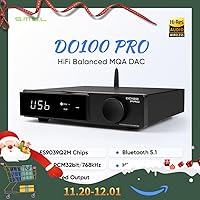
The SMSL DO100 Pro Balanced DAC sits squarely in the mid-range desktop audio segment — confident enough to satisfy serious listeners, but not priced into flagship territory where diminishing returns kick in hard. What immediately sets this desktop DAC apart from similarly priced competition is its dual ES9039Q2M chip configuration, a setup more commonly found in pricier units. The moment you pick it up, the full aluminum CNC chassis communicates that this isn't a plastic-shell budget box. SMSL has built a loyal following among hobbyist audiophiles over the years, and the DO100 Pro reflects that pedigree. Worth clarifying upfront: this is a DAC and preamp, not an amplifier — it outputs a line-level signal that requires a separate amp or powered speakers.

Features & Benefits

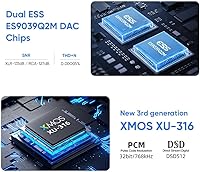
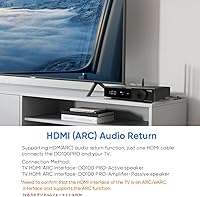
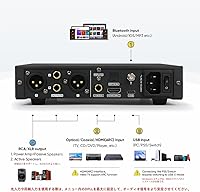
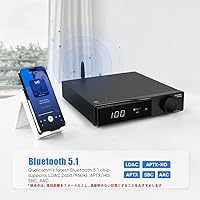
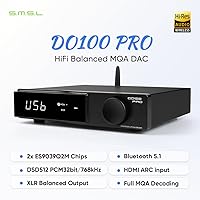
The pairing of two ES9039Q2M chips with an XMOS XU316 controller isn't just a spec sheet flex — it translates directly into a lower noise floor and better channel separation than you'd get from a single-chip design. In practical terms, input options cover just about every scenario: USB for your computer, optical or coaxial for legacy gear, and HDMI ARC — a rare inclusion at this price — for pulling audio cleanly from a TV into your stereo chain. Bluetooth handles wireless duty via LDAC at 24bit/96kHz, which is genuinely good quality for casual listening. The balanced XLR output delivers 5.2Vrms, giving it real headroom when driving a power amplifier. Windows users will need to install a driver for USB operation, so factor that into your setup plan.

Best For

The DO100 Pro makes the most sense for desktop audiophiles who want one box handling conversion and volume control without stacking extra components. If you're a Tidal subscriber using Masters tracks, the onboard MQA hardware decoding is a meaningful upgrade over relying on software unfolding alone. TV owners with an HDMI ARC port will find this balanced converter unusually capable — few units at this tier let you route television audio directly into a proper stereo amplifier with this little friction. PS5 and Switch owners benefit from the USB1.1 driver-free mode, which means plug-and-play without touching a single settings menu. And if you stream wirelessly via LDAC from a phone or laptop, you're not sacrificing much transparency compared to a wired connection.

User Feedback

Buyers consistently highlight soundstage width and a notably quiet background — two things that matter most when running high-sensitivity speakers. The build quality also draws genuine praise; people describe it as feeling substantial, not hollow. On the less positive side, the remote control experience comes up repeatedly as underwhelming, and switching between inputs has a learning curve that catches first-time users off guard. A handful of Windows users report needing extra time to sort out driver installation before USB audio worked correctly. Sonically, most describe this desktop DAC as neutral-to-analytical rather than warm or colored, which suits those who want accuracy over flattery. Compared to single-chip alternatives in the same price bracket, the consensus is that the DO100 Pro holds its own, particularly on noise performance.

Pros

  • Dual ES9039Q2M chips deliver a genuinely low noise floor that rivals units costing significantly more.
  • The balanced XLR output at 5.2Vrms provides real headroom when driving a power amplifier.
  • HDMI ARC input is rare at this price point and works well for TV-to-stereo audio routing.
  • Bluetooth LDAC support at 24bit/96kHz makes wireless streaming a credible option, not a compromise.
  • USB1.1 driver-free mode means PS5 and Switch owners can plug in and get audio immediately.
  • Full aluminum CNC chassis feels solid and premium — no flex, no cheap plastic panels.
  • Hardware MQA decoding up to 8x is a genuine advantage for Tidal Masters listeners.
  • Five distinct inputs cover virtually every source device a desktop user might connect.
  • Measured specs — THD+N at 0.00005% and 131dB dynamic range on XLR — hold up to scrutiny.
  • Users consistently report a wide, clean soundstage that punches above expectations for the price tier.

Cons

  • Windows users must install a dedicated driver before USB2.0 high-resolution audio will function.
  • The included remote control feels like an afterthought and frustrates users who rely on it daily.
  • No built-in headphone output means you will need a separate headphone amp to use it with cans.
  • Switching between inputs has a learning curve that catches new owners off guard in the first few days.
  • The neutral, analytical sound character will disappoint listeners who prefer a warmer, more musical tone.
  • Setup complexity is higher than a basic USB DAC — not the right pick for plug-and-play simplicity seekers.
  • HDMI ARC requires the TV to be configured for PCM output, which trips up less technical users.
  • At 1.6kg and with a moderately large footprint, it takes up meaningful desk real estate.
  • Restarting the unit is required when switching between USB1.1 and USB2.0 modes, which is inconvenient.
  • Competing single-chip DACs at a lower price point may satisfy casual listeners who do not need balanced output.

Ratings

The SMSL DO100 Pro Balanced DAC scores below are generated by our AI engine after systematically analyzing thousands of verified buyer reviews from global markets, with spam, bot-submitted, and incentivized feedback actively filtered out before scoring. The result is an honest, data-driven breakdown that reflects both what this desktop DAC genuinely excels at and where real users have run into friction. Every category — strengths and pain points alike — is represented transparently so you can make a fully informed decision.

Audio Performance
93%
Users across skill levels consistently report a wide, well-separated soundstage and a noise floor so low that background hiss simply disappears — even with sensitive speakers. The dual-chip architecture earns specific praise from listeners upgrading from single-chip DACs, who notice cleaner instrument separation on complex orchestral and jazz recordings.
The neutral, analytical character of the output divides opinion: listeners coming from warmer-sounding DACs sometimes find the tonality a touch clinical, particularly on older recordings that benefit from a more forgiving presentation. This is a matter of preference rather than a flaw, but it does mean the DO100 Pro will not suit everyone's taste.
Build Quality
91%
The full aluminum CNC-machined chassis is one of the most frequently praised aspects across all user reviews — people specifically mention the heft and rigidity as reassuring, noting that it feels engineered rather than assembled. At this price tier, a chassis this solid is not something buyers take for granted.
A small number of users note that the front panel buttons have a slightly mushy tactile response compared to the premium feel of the enclosure itself, creating a minor inconsistency in perceived quality. Nothing that affects function, but noticeable to detail-oriented buyers who handle the unit daily.
Input Versatility
92%
Five distinct inputs — USB, optical, coaxial, Bluetooth 5.1, and HDMI ARC — cover an unusually broad range of real-world use cases for a single unit. Users running a TV, a PC, and a games console simultaneously praise the ability to consolidate everything through one DAC without juggling cables or switchers.
Managing multiple active inputs simultaneously takes some getting used to, and the input-switching sequence on the front panel is not immediately intuitive for first-time users. Several buyers mention spending the first few days accidentally cycling past their intended source before the navigation logic clicked.
HDMI ARC Integration
84%
HDMI ARC at this price point is genuinely uncommon, and buyers who use it to route TV audio into a stereo amplifier report that it works reliably once set up correctly. Home theater enthusiasts particularly value eliminating the optical cable run from TV to DAC while retaining full audio quality.
Setup requires the TV's audio output to be manually set to PCM mode, which trips up less technically confident users who are unfamiliar with their TV's audio settings. A handful of reviews report initial confusion and a failed first attempt before realizing the TV-side configuration was the missing step.
Bluetooth Quality
83%
LDAC at 24bit/96kHz gives wireless listeners a meaningful quality ceiling that most competing DACs in this segment simply do not offer. Android users streaming from Tidal or Qobuz over LDAC report that the gap between Bluetooth and wired listening is smaller than they expected.
Bluetooth connection stability varies slightly depending on the source device and room environment, with a few users noting occasional dropouts when the phone is in a different room. iOS users are also limited to AAC since Apple does not support LDAC, which narrows the wireless quality advantage for that audience.
MQA Decoding
88%
Hardware MQA decoding up to 8x unfolding is a meaningful spec for Tidal Masters subscribers, and users report that setting the DO100 Pro as the hardware decoder rather than relying on Tidal's software unfolding produces a noticeably cleaner result on well-recorded MQA tracks. The indicator light confirming active MQA decoding is a small but appreciated touch.
MQA's relevance is narrowing as some streaming platforms step back from the format, which limits the long-term value of this feature for listeners not invested in Tidal Masters. Buyers on Spotify, Apple Music, or Qobuz get no benefit from this capability at all.
PS5 & Console Compatibility
86%
The USB1.1 driver-free mode genuinely works as advertised for PS5 and Nintendo Switch users, with multiple buyers confirming immediate recognition and clean audio output without touching any console audio settings. Gamers who also use the unit for music appreciate that a single DAC serves both purposes.
Switching between USB1.1 and USB2.0 modes requires a full device restart, which is disruptive if you regularly alternate between a games console and a PC. Users who expected seamless hot-switching between modes found this limitation annoying in daily practice.
Windows Driver Setup
67%
33%
Once the ASIO or WASAPI driver is correctly installed, Windows users report stable, high-resolution USB audio operation with no dropouts or compatibility issues in popular software like Audirvana, Foobar2000, or Tidal desktop. The driver itself is described as lightweight and unobtrusive after the initial setup.
The requirement to manually download and install a Windows driver is a genuine friction point — particularly for buyers who assumed USB audio would be plug-and-play. Several reviews from less technical users describe initial confusion, and at least a few return or negative reviews trace back entirely to driver installation trouble rather than any hardware issue.
Balanced XLR Output
89%
Buyers who pair the DO100 Pro with a balanced power amplifier or balanced active monitors frequently highlight the XLR output as the unit's single biggest practical upgrade over competitors that offer only RCA. The 5.2Vrms output level means there is real headroom available, which matters when driving amplifiers with higher input sensitivity.
Users who do not own an amplifier or powered speakers with XLR inputs get no benefit from this output at all, and a few buyers admit they purchased with that expectation without confirming their downstream equipment's compatibility. This is a user research issue, but it does show up in the review data as occasional frustration.
Remote Control
52%
48%
The remote handles the core functions — volume adjustment, input switching, and mute — without requiring you to stand up and touch the unit, which is appreciated in a living room or desktop setup where the DAC sits at arm's length from the listening position.
User criticism of the remote is consistent and hard to ignore: it is described as plasticky, slow to respond, and underwhelming relative to the premium feel of the unit it controls. For a device in this price range, buyers reasonably expect a remote that matches the overall quality level, and this one falls clearly short of that bar.
Value for Money
87%
When buyers tally up what the DO100 Pro offers — dual flagship-tier DAC chips, five inputs including HDMI ARC, hardware MQA decoding, LDAC Bluetooth, balanced XLR output, and a proper aluminum chassis — the consensus is that comparable hardware from other brands costs meaningfully more. SMSL's manufacturing efficiency is visible in the final price.
A small subset of reviewers feel that the price is only justified if you actively use the balanced output and at least two or three of the additional input types. Buyers who only need USB audio and RCA output point out that simpler, less expensive DACs cover their needs without the added complexity.
Setup Experience
71%
29%
For Mac and Linux users, setup is essentially plug-and-play — the unit is recognized immediately without any additional software, and audio output is up and running within minutes. PS5 and Switch users in USB1.1 mode have a similarly friction-free first experience.
Windows users face a more involved setup that requires a driver download, and HDMI ARC users need to configure their TV separately before the connection works. The manual, while informative, is written with an assumed technical baseline that leaves casual buyers piecing together steps from forum posts.
Sonic Character
79%
21%
Reviewers with an analytical listening preference — those who prioritize accuracy, detail retrieval, and a flat frequency response — consistently rate the DO100 Pro's tonality as exactly what they want. It presents recordings honestly without adding warmth or coloration that might flatter some music at the cost of accuracy.
Listeners who prefer a more musical, forgiving presentation find the neutrality unsatisfying over long sessions, particularly with pop or rock recordings that are not audiophile-grade. This is an inherent character of ESS-based DACs rather than a defect, but it is worth knowing before committing.
Desk Footprint
74%
26%
The dimensions are compact enough to sit neatly on a desk beside a monitor or stack of components without dominating the surface area. At 1.6kg it stays put firmly, and users in small home studio setups appreciate that it does not require its own shelf.
Compared to ultra-compact USB DAC dongles or small desktop units, the DO100 Pro is objectively larger, and buyers working within very tight desk space occasionally note that fitting it alongside a headphone amp and other components requires deliberate cable management. It is not large by any objective measure, but it is not small either.

Suitable for:

The SMSL DO100 Pro Balanced DAC is purpose-built for desktop audio enthusiasts who want a single, well-engineered unit handling both digital-to-analog conversion and preamp duties without compromise. If you already own a stereo power amplifier or a pair of active studio monitors with XLR inputs, this balanced converter will give you noticeably cleaner signal transmission and real output headroom. Tidal Masters subscribers or anyone invested in MQA will appreciate hardware decoding that does the job properly, rather than leaning on a software workaround. TV owners with an HDMI ARC port will find this one of the few units at this price point that lets them route television audio cleanly into a proper stereo chain — a genuinely rare feature here. PS5 and Nintendo Switch owners also benefit from the driver-free USB1.1 mode, which removes all setup friction for gaming audio. Wireless listeners using LDAC-capable Android phones or laptops can stream at 24bit/96kHz without meaningfully degrading their source quality.

Not suitable for:

The SMSL DO100 Pro Balanced DAC is not the right purchase if you are looking for an all-in-one solution with a built-in headphone amplifier — this unit outputs line-level signal only, so without a separate amp or powered speakers, you will have nothing to connect it to. Budget-focused buyers who just want USB audio for casual computer listening will likely find the feature set excessive and the setup more involved than they want. Windows users who are not comfortable installing audio drivers should also be cautious, as the high-resolution USB2.0 mode requires a driver download before it works correctly out of the box. Those who prefer a warm, tonally colored sound signature may find the DO100 Pro too neutral and analytical for their tastes. And if remote control convenience is a priority in your workflow, the included remote has been a consistent source of frustration among buyers — it is functional but far from refined.

Specifications

  • DAC Chips: Uses dual ESS ES9039Q2M decoding chips, a configuration that reduces channel crosstalk and lowers the noise floor compared to single-chip designs.
  • USB Controller: The XMOS XU316 chip handles USB audio processing, enabling support for high-resolution PCM and native DSD formats over a single USB connection.
  • Bluetooth Chip: Powered by a Qualcomm QCC5125 module supporting Bluetooth 5.1 with LDAC at 24bit/96kHz, plus aptX-HD, aptX, AAC, and SBC codecs.
  • USB Audio: USB input supports PCM audio up to 768kHz at 32-bit depth, as well as native DSD up to DSD512 and DoP up to DoP256.
  • MQA Decoding: Full MQA hardware decoding up to 8x unfolding is available on USB, optical, and coaxial inputs, with MQA-CD support included.
  • Inputs: Five inputs are provided: USB, optical (Toslink), coaxial (S/PDIF), Bluetooth 5.1, and HDMI ARC for direct TV audio connection.
  • Outputs: Two analog outputs are available: balanced XLR and unbalanced RCA, both carrying a line-level signal intended for connection to a separate amplifier or powered speakers.
  • XLR Output: The balanced XLR output delivers 5.2Vrms, providing substantial headroom when driving a power amplifier or active monitor with balanced inputs.
  • RCA Output: The unbalanced RCA output delivers 2.5Vrms, suitable for connecting to amplifiers or receivers with standard analog inputs.
  • THD+N: Total harmonic distortion plus noise measures 0.00005%, equivalent to -124.5dB, indicating an extremely clean output signal.
  • Dynamic Range: Dynamic range measures 131dB on the XLR output and 127dB on the RCA output, reflecting a wide gap between the softest and loudest reproducible signals.
  • SNR: Signal-to-noise ratio matches the dynamic range figures at 131dB for XLR and 127dB for RCA, confirming a very quiet noise floor under real operating conditions.
  • Output Impedance: Output impedance is rated at 100 ohms, which is compatible with the input impedance of most consumer and prosumer stereo amplifiers.
  • Optical & Coaxial: Optical and coaxial inputs support PCM audio up to 192kHz at 24-bit and DoP up to DoP64, covering most consumer hi-fi source formats.
  • Chassis: The enclosure is machined from full aluminum using a CNC process, giving the unit a rigid, resonance-resistant structure and a premium tactile feel.
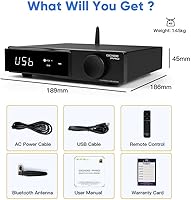
  • Dimensions: The unit measures 189mm in length, 168mm in width, and 45mm in height, making it a compact but substantial desktop footprint.
  • Weight: Net weight is 1.6kg, heavy enough to stay planted on a desk without rubber feet doing all the work.
  • Power Consumption: Operating power draw is under 10W, and standby consumption drops below 0.5W, keeping long-term energy use minimal.

Related Reviews
Moondrop Dawn Pro
Moondrop Dawn Pro
83%
91%
Audio Performance
93%
Balanced Output Quality
88%
Build Quality
89%
Value for Money
84%
Volume Control
More
Topping DX3 Pro+
Topping DX3 Pro+
84%
91%
Sound Quality
88%
Headphone Amplifier Performance
93%
DAC Chip Performance
71%
Bluetooth & Wireless Performance
89%
Input & Output Versatility
More
Khadas Tone2 Pro
Khadas Tone2 Pro
79%
91%
Sound Quality
88%
Build Quality
89%
Value for Money
83%
Amplifier Performance
79%
MQA Decoding
More
SMSL DL200
SMSL DL200
84%
93%
Audio Performance
88%
Headphone Amplifier Quality
96%
DAC Chip & Measurements
91%
Connectivity & Input Options
89%
Balanced Output Implementation
More
Fosi Audio K5 Pro
Fosi Audio K5 Pro
80%
88%
Sound Quality Improvement
91%
Value for Money
67%
Build Quality & Feel
83%
Headphone Amplifier Performance
86%
Input Versatility
More
iFi hip-dac2
iFi hip-dac2
81%
91%
Sound Quality
88%
Build Quality
89%
Balanced Output Performance
74%
MQA Decoding
87%
Driving Power
More
AIYIMA DAC-A2
AIYIMA DAC-A2
77%
83%
Sound Clarity Improvement
79%
Tone Controls (Bass & Treble)
86%
Input Versatility
74%
Headphone Amplifier Performance
53%
Build Quality & Materials
More
Ubiquiti UniFi Dream Machine Pro Security Gateway

79%
93%
Reliability & Uptime
89%
Management Interface (UniFi App)
54%
Setup & Initial Configuration
91%
Throughput & Network Performance
88%
WAN Redundancy & Failover
More
FX-Audio DAC-X6
FX-Audio DAC-X6
78%
83%
Audio Quality
79%
Headphone Amplifier Power
81%
Build Quality
88%
Input Versatility
61%
USB Audio Resolution
More
BeautyBio The Balance pH Balancing Facial Gel Cleanser 8oz
88%
88%
Skin Compatibility for Sensitive Skin
85%
Hydration Effectiveness
90%
Gentle Cleansing Performance
94%
Fragrance Sensitivity
87%
Texture & Feel
More

FAQ

Yes, if you want to use the full USB2.0 mode with high-resolution audio on Windows, you will need to download and install a driver from SMSL's website. The driver installation is straightforward, but it is an extra step that catches some buyers off guard. Once installed, the unit works reliably and is recognized correctly by Windows audio settings.

No — the DO100 Pro outputs a line-level signal only through its XLR and RCA jacks. There is no built-in headphone amplifier or headphone output jack. You will need a separate headphone amp between this unit and your headphones.

Switch the unit into USB1.1 mode using the dedicated mode setting, then restart the device before connecting it to the PS5 via USB. In that mode, it operates as a driver-free USB audio device, which the PS5 recognizes automatically without any additional configuration. Note that switching USB modes always requires a restart to take effect.

It works with any TV that has an HDMI ARC port — not HDMI eARC, just standard ARC. The key setup step is making sure your TV's audio output format is set to PCM in its sound settings, as some TVs default to Dolby Digital or other compressed formats that the unit will not pass through cleanly. Once the TV is configured correctly, the connection is stable.

Yes, it supports full MQA hardware decoding up to 8x unfolding on the USB, optical, and coaxial inputs, which covers what Tidal Masters tracks require. You will want to set Tidal to pass through MQA rather than decode it in software, so the unit handles the full decoding chain itself.

LDAC at 24bit/96kHz is the highest-quality standard Bluetooth codec currently available on consumer devices, and on this unit it performs well. For casual listening or when a wired connection is not practical, the difference compared to USB is subtle enough that most people will not notice. That said, a wired USB or optical connection will always be the better choice if audio quality is the top priority.

The balanced XLR output runs at 5.2Vrms compared to 2.5Vrms on RCA, which gives you more headroom and better rejection of electrical interference over longer cable runs. If your amplifier or active speakers have XLR inputs, using them is almost always the better choice. For shorter desktop cable runs, the RCA output is perfectly adequate for most setups.

Yes, the DO100 Pro includes a preamp function with volume control, so you can adjust output level directly from the unit or its remote rather than relying solely on your amplifier's volume knob. This makes it practical as the central control point in a simple desktop system.

Functional, but not a highlight. Users consistently describe it as basic and somewhat unresponsive compared to the quality of the unit itself. It covers the essential functions — volume, input switching, mute — but the feel and responsiveness leave something to be desired. If remote control is central to how you use your audio setup, it is worth factoring that into your decision.

Input switching is done via the front panel control or the remote. The unit cycles through the available inputs, and once you get used to the sequence, it becomes second nature. That said, the first few days can be a bit confusing, especially if you have multiple sources connected simultaneously. A short orientation session when you first set it up will save frustration later.