


Overview

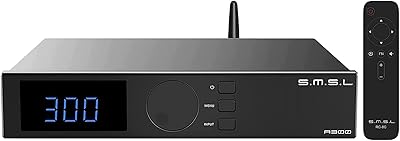
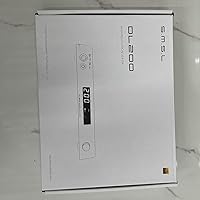
The SMSL DL200 sits in an interesting spot in the desktop audio market — it's a compact all-in-one DAC and headphone amplifier built around the ESS ES9039Q2M, a chip you'd normally expect to find in considerably more expensive hardware. The form factor is clean and unobtrusive, fitting comfortably on a desk without demanding attention. What makes this desktop unit more practical than many rivals is the inclusion of full remote control, Bluetooth 5.1 with LDAC support, and multiple output options — all in one box. It's clearly aimed at listeners who want to consolidate their setup without making obvious compromises on measured performance.

Features & Benefits

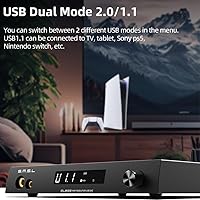
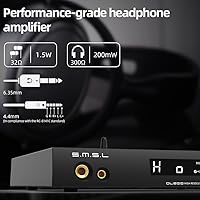
The ES9039Q2M chip isn't just a marketing detail — it translates directly into a vanishingly low noise floor that you can actually hear as a blacker background between notes. The dual USB mode setup is genuinely practical: USB2.0 handles high-resolution 768kHz/32bit files for dedicated listening, while USB1.1 lets you plug into a TV or game console with zero driver hassle. Up front, both a 6.35mm single-ended and a 4.4mm balanced headphone jack are available, and the balanced TRS line output hits 5.0Vrms — enough to properly drive active studio monitors. Seven PCM filters plus DPLL adjustment give technically inclined users real control over jitter handling.

Best For

This DAC/amp combo makes the most sense for headphone listeners who are tired of managing separate devices and want one well-measuring unit to handle everything. It's a natural step up for anyone moving on from a portable dongle or a basic desktop DAC, and the balanced output options make it relevant for small home studio setups feeding powered monitors. Gamers and TV users who want plug-and-play USB audio without hunting for drivers will appreciate the USB1.1 mode. And if you stream regularly over Bluetooth, LDAC and aptX HD support means you're not giving up much compared to a wired connection at typical streaming bitrates.

User Feedback

With around 93 ratings so far, the sample size is modest, so take these trends as directional rather than definitive. That said, the pattern is fairly consistent: buyers highlight a clean, detailed sound and appreciate that the remote control — often an afterthought on desktop DACs — actually works well in daily use. On the critical side, some Windows users found the USB2.0 driver installation process more fiddly than expected, which is worth knowing upfront before you commit. A handful of buyers also noted that the DPLL and filter menu isn't the most intuitive without reading the manual. A few reviewers directly compared it to pricier competing units and felt the measurements justified the purchase.

Pros

  • The ES9039Q2M chip delivers a noise floor low enough that sensitive IEMs stay completely silent between tracks.
  • Both 6.35mm and 4.4mm balanced headphone outputs are on the front panel — no adapters needed for daily switching.
  • LDAC and aptX HD Bluetooth support means Android users get near-lossless wireless audio at the desk.
  • USB1.1 driverless mode connects to TVs and game consoles instantly, with zero software required.
  • The full remote control, including a screen-off toggle, is a genuine convenience rarely found at this price.
  • Balanced TRS line output at 5.0Vrms is strong enough to properly drive most active studio monitors.
  • Optical, coaxial, USB, and Bluetooth inputs mean this desktop unit can serve as the hub of an entire audio setup.
  • Seven PCM filter options give technically engaged listeners real tools for tuning digital playback quality.
  • Buyers consistently report the unit competes favorably with separates costing significantly more on measurable performance.
  • Low and high gain switching makes the amp section adaptable across sensitive IEMs and harder-to-drive over-ear headphones.

Cons

  • USB2.0 driver installation on Windows is a known friction point that has tripped up multiple buyers.
  • The TRS balanced line output requires a TRS-to-XLR adapter for standard studio monitor connections — an extra purchase.
  • DPLL and PCM filter menus are not self-explanatory; without reading the manual, most users will leave them at default.
  • Apple device users are limited to AAC over Bluetooth, missing out on the higher-quality codec support available to Android.
  • No aptX Adaptive support puts the Bluetooth codec list slightly behind newer competing hardware.
  • Switching between balanced and single-ended headphone outputs at the same volume position can produce unexpected level jumps.
  • The display has no brightness adjustment — it is either fully on or fully off, which limits flexibility in dim environments.
  • The chassis finish attracts fingerprints and the volume knob feel does not quite match the quality of the internal components.
  • With around 93 ratings at the time of review, the feedback pool is still relatively small and should be treated as directional.
  • Listeners who prefer a warmer, more forgiving sound signature may find the neutral, analytical output character unsatisfying.

Ratings

The SMSL DL200 scores below are generated by AI after analyzing verified global user reviews, with spam, bot, and incentivized feedback actively filtered out. This DAC/amp combo earns strong marks in several key areas, but the analysis transparently surfaces real friction points that show up consistently across buyer accounts. Both the standout strengths and the genuine limitations are reflected in every category score.

Audio Performance
93%
Reviewers consistently describe a clean, low-noise presentation with excellent channel separation — the kind of background silence that makes detailed headphones like planars and electrostatics genuinely shine. The ES9039Q2M chip delivers measurements that rival units costing significantly more, which buyers notice in practice as a more resolved, natural-sounding output.
A small number of listeners felt the sound signature leaned slightly analytical, which may not suit those who prefer a warmer, more colored presentation. This is subjective, but worth knowing if you are coming from a tube-adjacent setup.
Headphone Amplifier Quality
88%
The built-in amp handles a wide range of headphones competently, with enough headroom on the high-gain setting for harder-to-drive planars. The near-zero output impedance is a practical advantage — sensitive in-ear monitors stay quiet and do not pick up any audible hiss.
At very high listening volumes with demanding 300-ohm dynamic drivers, a few users noted the amp section felt closer to its ceiling than a dedicated amplifier would. For most headphones it is fine, but hardcore planars with low sensitivity might leave some buyers wanting a separate amp stage.
DAC Chip & Measurements
96%
A THD+N figure of 0.00006 percent on the line output is genuinely exceptional at this price tier — buyers who cross-reference measurements on forums consistently flag this as one of the cleaner-measuring desktop units available without spending considerably more. Dynamic range of 130dB on the balanced output is a real differentiator.
For most listeners the measurement advantage over a competent competing chip is inaudible in daily use. Buyers who do not follow measurement-focused audio communities may not fully appreciate what these numbers represent in practical terms, making it a selling point that partly targets a niche audience.
Connectivity & Input Options
91%
Having USB, optical, coaxial, and Bluetooth 5.1 all on one unit means this desktop unit can anchor an entire listening setup without requiring an external switch or hub. Swapping between a laptop via USB and a TV via optical takes seconds using the remote.
The Bluetooth antenna is internal and a handful of users in larger rooms or through walls reported occasional dropouts, which is common for desktop units but still a limitation if wireless listening is your primary use case.
Balanced Output Implementation
89%
The 4.4mm balanced headphone jack and 5.0Vrms TRS balanced line output are not token additions — they perform as proper balanced outputs with a measurable reduction in noise floor compared to the single-ended alternatives on the same unit. Studio monitor users especially appreciated the balanced line stage.
The TRS balanced line output uses a 6.35mm connector rather than XLR, which requires an adapter for standard balanced studio monitor inputs. It works perfectly with the right cable, but it is an extra purchase some buyers did not anticipate.
USB Implementation & Driver Setup
71%
29%
USB1.1 driverless mode is a genuine convenience win for TV and console users — plug in, select the input, and audio just works without touching a settings menu. For casual desktop use at 96kHz/24bit, many users never needed to go beyond this mode.
USB2.0 mode, which unlocks full 768kHz/32bit capability, requires a driver installation on Windows that several buyers described as confusing or finicky on first setup. This is a real friction point, and a few users reported needing to troubleshoot before getting stable high-res playback.
Bluetooth & Codec Support
84%
LDAC and aptX HD support means Android and Sony device users can stream at near-lossless quality wirelessly, which is a meaningful practical benefit for desk listeners who do not want to be tethered while working. The Bluetooth 5.1 connection is stable at typical desktop distances.
Apple device users are limited to AAC, which is decent but not at the same quality tier as LDAC. There is no aptX Adaptive support, which is increasingly common on newer source devices and puts this unit slightly behind on the Bluetooth codec roadmap.
PCM Filter & DPLL Options
73%
27%
Having seven PCM filter options and a nine-step DPLL adjustment gives technically engaged listeners meaningful control over how the unit handles digital signals from slightly noisy sources, such as older optical outputs or budget coaxial sources. Some users found specific filter combinations genuinely improved their listening experience.
The filter and DPLL menus are not explained adequately on the device itself, and without reading the manual carefully, most buyers will navigate them by trial and error. A few reviewers explicitly said they gave up and left everything at default, which is fine but defeats the purpose of the feature.
Remote Control
87%
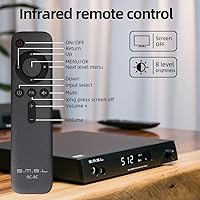
A properly functional remote on a desktop DAC at this price is less common than it should be, and buyers appreciated being able to adjust volume, switch inputs, and kill the display from across the room. The screen-off function is a small but thoughtful touch for late-night listening in dark rooms.
The remote itself is a basic infrared unit and requires line-of-sight to function reliably. A couple of users noted the response could be sluggish if the unit was positioned at an angle to the listening position, which is a minor but real usability limitation.
Build Quality & Design
82%
18%
The DL200 has a solid, no-flex chassis that feels appropriately substantial for a desktop unit at this price point. The front panel layout is intuitive, with the headphone jacks and volume knob positioned logically without any crowding.
The finish shows fingerprints easily, and a handful of buyers noted the volume knob, while smooth, had a slightly plasticky feel relative to the overall build. Nothing structurally concerning, but the tactile finish does not quite match the internal component quality.
Value for Money
92%
When you factor in the chip quality, the balanced outputs, Bluetooth codec support, and the inclusion of a remote, the DL200 represents genuinely strong value in its price bracket. Several buyers had previously owned units costing 50 to 100 dollars more and felt this matched or exceeded them on measurable performance.
The value calculation shifts slightly if you need to purchase a TRS-to-XLR adapter for balanced monitor use, or if USB2.0 driver issues cost you troubleshooting time. These are minor additions to the true cost but worth budgeting for.
Setup & Ease of Use
69%
31%
Initial setup for basic USB or optical use is fast and uncomplicated — connect a cable, select an input, and the unit works. Casual users who stay in USB1.1 mode and never touch the filter settings will find the day-to-day operation very straightforward.
Getting full performance out of the unit — installing USB2.0 drivers, configuring DPLL, choosing an appropriate PCM filter — requires patience and a willingness to read documentation. For buyers who expected a simple plug-and-play experience at all capability levels, the learning curve felt steeper than expected.
Display & Interface
78%
22%
The front display is clear and readable from a normal desk listening distance, showing input selection, volume level, and filter settings without ambiguity. The one-touch screen-off option via remote is a practical feature that audiophile-focused buyers tended to use regularly.
The display itself is functional rather than premium — a few users felt it looked slightly dated compared to competitors at a similar price. There is no brightness adjustment beyond fully on or fully off, which could be limiting in dim environments where even a dim display would be preferred.
Headphone Output Versatility
86%
Offering both 6.35mm and 4.4mm outputs simultaneously, with switchable low and high gain, means this desktop unit adapts to a wide range of headphones without adapters. Moving between a sensitive IEM and a harder-to-drive over-ear is simply a matter of switching the gain setting.
There is no independent volume memory per output, so switching from a balanced to a single-ended connection at the same volume position can produce a level jump that catches users off guard. A minor workflow annoyance rather than a technical flaw, but it comes up in reviews.

Suitable for:

The SMSL DL200 is a strong fit for the kind of listener who has outgrown a basic dongle DAC or a budget desktop unit and wants measurably better performance without buying separate components. If you spend real time at a desk with quality headphones — planars, high-impedance dynamics, or sensitive IEMs — this DAC/amp combo gives you the flexibility of both single-ended and balanced outputs in one tidy box. Home studio users who want to feed powered monitors via a balanced line output will find the 5.0Vrms TRS output more than capable. It also works well for anyone who splits their listening between a laptop, a TV, and a phone: USB, optical, coaxial, and Bluetooth 5.1 with LDAC are all covered. The driverless USB1.1 mode makes it genuinely easy to connect to game consoles or smart TVs without any software headaches. And if you care about what your hardware actually measures — THD+N, dynamic range, noise floor — this desktop unit competes with products asking considerably more money.

Not suitable for:

The SMSL DL200 is probably the wrong choice if you want a truly effortless out-of-the-box experience at every capability level. Getting full high-resolution USB2.0 playback on Windows requires a driver installation that has frustrated a meaningful subset of buyers, and if you are not comfortable troubleshooting audio drivers, that friction is real. Listeners who prefer a warm, richly colored sound signature may also find this DAC/amp combo too neutral and analytical for their taste — it is built to measure well, not to add character. If your headphone collection is dominated by very demanding low-sensitivity planar magnetic drivers, the built-in amp section may eventually feel like a ceiling rather than a foundation, and a dedicated amplifier would serve you better. Apple users who rely on Bluetooth will be limited to AAC rather than the higher-quality codecs available on Android, which narrows the wireless advantage. Finally, if desk space is a genuine constraint, the nearly 9-inch width is not enormous, but it is not a compact unit either.

Specifications

  • DAC Chip: The unit uses the ESS ES9039Q2M, a high-performance 2-channel decoder chip capable of processing up to 768kHz/32bit PCM audio.
  • THD+N: Total harmonic distortion plus noise measures 0.00006% (-123dB) on the line output and 0.00009% (-120dB) on the headphone output.
  • Dynamic Range: Dynamic range reaches 130dB on the balanced XLR output, 127dB on RCA, and 125dB on the headphone output.
  • Headphone Outputs: The front panel provides both a 6.35mm single-ended headphone jack and a 4.4mm balanced headphone jack for direct use without adapters.
  • Headphone Power: Headphone amplifier output power is rated at 3W x2 into 16Ω and 1.5W x2 into 32Ω.
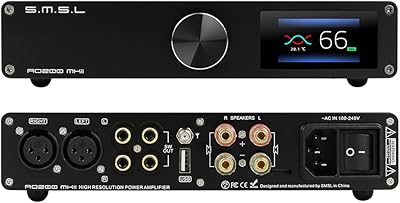
  • Line Outputs: Balanced line output uses a TRS 6.35mm connector at 5.0Vrms, while the RCA single-ended line output delivers 2.5Vrms.
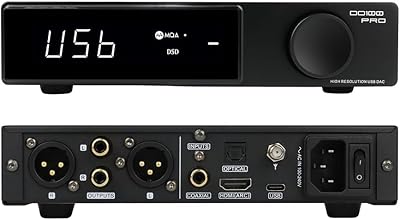
  • Inputs: Available inputs include USB, optical (TosLink), coaxial (S/PDIF), and Bluetooth 5.1.
  • USB Modes: USB2.0 asynchronous mode supports up to 768kHz/32bit and requires a driver on Windows; USB1.1 mode supports up to 96kHz/24bit and is fully driverless.
  • Bluetooth: Bluetooth 5.1 supports LDAC, aptX HD, aptX, AAC, and SBC codecs for broad compatibility with Android, iOS, and desktop source devices.
  • Headphone Gain: Two gain settings are available: low gain at 0dB and high gain at 11dB, selectable to match a wide range of headphone sensitivities.
  • PCM Filters: Seven selectable PCM filters are available alongside a DPLL adjustment range of levels 1 through 9 for managing jitter on unstable digital sources.
  • Output Impedance: Headphone output impedance is near 0Ω, making the unit compatible with sensitive in-ear monitors without audible hiss or tonal shift.
  • Dimensions: The unit measures 8.74 x 8.15 x 1.22 inches, giving it a low-profile desktop footprint that fits neatly under a monitor or beside a keyboard.
  • Weight: The DL200 weighs 3.94 pounds, reflecting a solid metal chassis construction appropriate for a stationary desktop component.
  • Remote Control: A full-function infrared remote is included, covering volume, input switching, gain, filter selection, and a one-touch screen-off toggle.
  • USB Compatibility: USB2.0 mode requires a driver on Windows 7 through 11; Android, Mac OSX 10.6 or later, and Linux operate in driverless mode natively.
  • SNR: Signal-to-noise ratio is 130dB on the balanced output, 127dB on RCA, and 125dB on the headphone output.
  • Manufacturer: The DL200 is designed and manufactured by S.M.S.L, a Chinese audio brand specializing in desktop DAC and amplifier products.

Related Reviews
SMSL PL100 CD Player
87%
95%
Audio Quality
90%
Connectivity Options
80%
Ease of Use
88%
Build Quality
75%
Remote Control Usability
More
SMSL M300SE MQA Audio Decoder
87%
94%
Audio Quality
88%
Build Quality
90%
Connectivity Options
91%
Ease of Setup
72%
Bluetooth Range
More
SMSL A300
SMSL A300
80%
88%
Sound Quality
91%
Build Quality
93%
Power Output
89%
Value for Money
82%
Bluetooth Connectivity
More
SMSL AO200 Mk II
SMSL AO200 Mk II
82%
88%
Sound Quality
91%
Power Output & Headroom
87%
Build Quality & Chassis
84%
Input Flexibility & Connectivity
93%
Noise Floor & Interference Rejection
More
SMSL DO100 PRO HiFi Balanced DAC
87%
94%
Sound Quality
91%
Build Quality
89%
Versatility of Inputs
77%
Ease of Setup
85%
Bluetooth Performance
More

FAQ

It depends on which USB mode you use. In USB1.1 mode the unit is completely driverless and works on Windows, Mac, Android, and Linux right away, but it tops out at 96kHz/24bit. If you want full 768kHz/32bit high-resolution playback on Windows, you will need to install the dedicated USB2.0 driver from SMSL. The driver installation is straightforward if you follow the manual step by step, but it has caused confusion for a few buyers who skipped the documentation.

No, the 6.35mm and 4.4mm outputs are not simultaneously active — you select which one you are using. The practical upside is that both jacks are right there on the front panel, so switching between a balanced and a single-ended headphone is just a physical swap rather than digging into a menu.

For most planar headphones with moderate sensitivity, the high-gain setting delivers enough power to reach satisfying listening volumes. That said, very low-sensitivity planar drivers — some of the harder-to-drive models from Audeze or HiFiMAN — may push the amp section close to its limits at high volumes. If your entire collection revolves around the most demanding planars, a dedicated amplifier paired with this unit used purely as a DAC might serve you better long term.

The DL200 uses Bluetooth 5.1 and supports LDAC, aptX HD, aptX, AAC, and SBC. Android users get the best experience since LDAC is available on most modern Android phones. iPhone users are limited to AAC, which is still decent quality but not the highest tier this unit can support. Pairing is standard — hold the Bluetooth input button, find the device on your phone, and connect.

The balanced line output on the back uses a TRS 6.35mm connector rather than a standard XLR, so if your powered monitors have XLR balanced inputs — which most do — you will need a TRS-to-XLR cable or adapter. These are inexpensive and widely available, but it is worth budgeting for one if you do not already own it.

Yes, and this is one of the more practical use cases for this DAC/amp combo. In USB1.1 mode it operates as a plug-and-play USB audio device, which means many smart TVs, PS4, PS5, and similar consoles will recognize it immediately without any driver installation. You can also use the optical or coaxial input if your TV has a digital audio output, which is often the cleaner connection for home theater setups.

PCM filters affect how the chip handles the digital-to-analog conversion mathematically — different filters produce slightly different frequency roll-off characteristics near the upper limits of audible range. Most listeners will not hear a dramatic difference between them in everyday use. The DPLL setting controls how aggressively the unit locks onto and corrects an incoming digital clock signal; higher values help prevent audio dropouts from unstable sources like some optical outputs. If everything sounds fine at default, there is no urgent reason to change either setting, but they are useful tools if you are troubleshooting dropouts or want to experiment.

For the majority of headphones — including most planar magnetics, high-impedance dynamics up to around 300Ω, and all sensitive IEMs — the built-in amp is genuinely capable and not a weak link in the chain. If you already own a high-end separate amplifier, you can absolutely use the balanced or RCA line outputs to feed it. But for most buyers, using this desktop unit as an all-in-one solution makes perfect sense and will not be the bottleneck in their listening setup.

The remote covers the full range of functions: volume up and down, input selection, gain switching, filter changes, and the screen-off toggle. It uses infrared, so it needs a reasonably clear line of sight to the front panel sensor. At a standard desk listening distance it works without issues; at wider angles or greater distances a few users have noted occasional sluggish responses, but this is typical of infrared remotes in general.

The main trade-off is flexibility versus convenience. A dedicated DAC paired with a dedicated amplifier gives you the option to upgrade each component independently, and a high-end standalone amplifier will generally outperform any integrated amp section in a combo unit. What this DAC/amp combo offers in return is a cleaner desk, one power cable, one remote, and a chip-level performance ceiling that genuinely competes with separates costing more. For most listeners who are not already deep into a separate-components setup, the all-in-one approach here is a smart, well-measured choice.