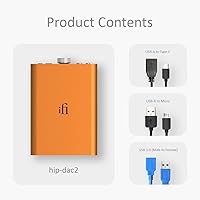
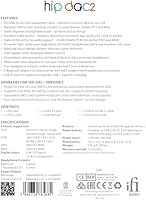
Overview

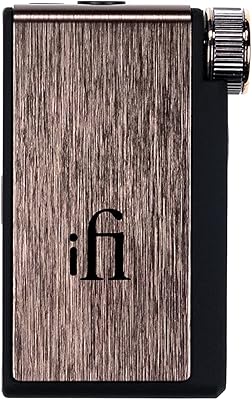
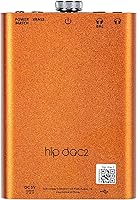
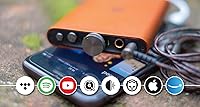
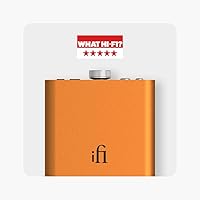
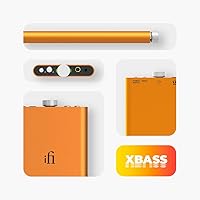
The iFi hip-dac2 is iFi's answer to a problem most headphone owners eventually run into: your phone's output is quietly holding your good headphones back. iFi has spent years earning credibility through serious audio engineering, and this portable DAC/amp sits in a comfortable mid-range position in their lineup. Compared to the original, two things changed that actually matter — full MQA decoding was added, and the internal GMT clock was refined for cleaner signal timing. Physically it's compact enough to pocket without a second thought, and the build feels considered rather than cheap. That said, keep expectations calibrated: this is a USB-powered portable device, not a replacement for a desktop rig.

Features & Benefits

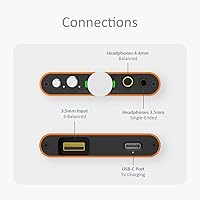
The most practical thing about this portable DAC/amp is the headroom it provides. Most phone outputs top out well below 100mW, so iFi's pocket-sized amplifier pushing up to 400mW makes a real audible difference with harder-to-drive over-ear headphones — they open up properly rather than just getting louder. The dual outputs are genuinely useful: the 3.5mm jack handles standard connections, while the 4.4mm balanced output drops the noise floor noticeably with compatible gear. For Tidal HiFi subscribers, hardware-level MQA decoding means bit-perfect playback without relying on your phone's processor. Six to eight hours of battery life covers most full travel days without needing a top-up.

Best For

This portable DAC/amp makes the most sense for people who already own quality headphones and suspect their phone is the weakest link in the chain. Commuters, frequent flyers, and anyone working from a coffee shop will appreciate a pocketable device that doesn't require managing a cable bundle. Tidal subscribers get the clearest value from MQA support, though it's worth being honest — Spotify or Apple Music listeners won't benefit from that feature at all. Anyone with balanced-terminated headphones or IEMs will find real practical value in the 4.4mm output. For audiophiles who want iFi build quality without committing to a full desktop stack, this hits a reasonable middle ground.

User Feedback

Buyers upgrading from a phone's built-in output are consistently surprised by the improvement in clarity and dynamics — that reaction appears across the majority of reviews and feels credible. Build quality draws regular praise. The criticisms worth knowing: there is no volume memory, meaning the device resets to a default level each time you reconnect, which some users find genuinely annoying over time. Cable compatibility is the other recurring frustration — depending on your phone and headphones, you may need a specific adapter before things work smoothly, and iPhone users hit that friction more often than Android users. A vocal minority questions the price premium over cheaper dongles, though most users with balanced headphones consider it justified.

Pros

  • Drives full-size and planar magnetic headphones with authority — far beyond what any smartphone output can manage.
  • The 4.4mm balanced output delivers a noticeably lower noise floor for compatible headphones and IEMs.
  • Full MQA hardware decoding gives Tidal HiFi subscribers genuinely bit-perfect playback on the go.
  • Build quality feels premium and durable — this does not feel like something that will rattle apart in a bag.
  • Six to eight hours of real battery life covers a full workday without needing to locate a charger.
  • Direct USB connection keeps the signal path clean and avoids the compression trade-offs of Bluetooth.
  • Compact enough to pocket alongside a phone without the carry experience becoming annoying.
  • The GMT clock upgrade over the original model produces a quieter, more composed background noise level.
  • Works across a wide headphone range — from sensitive IEMs to demanding over-ear cans — without obvious compromises.
  • Android users get a true plug-and-play experience with no driver installation or app configuration required.

Cons

  • No volume memory means manually readjusting the level every single time you reconnect — a real daily friction point.
  • iPhone users frequently need a separate adapter that does not come in the box and is easy to lose.
  • No protective pouch or carry case is included, which feels like a cost-cut at this price tier.
  • Battery life drops meaningfully under heavier use, particularly with balanced output at higher volume levels.
  • Very sensitive IEMs can expose a faint hiss near the top of the volume range in quiet environments.
  • There is no battery level indicator beyond a basic charging LED, so the device can die without warning mid-session.
  • MQA support is only useful for Tidal subscribers — a shrinking and contested format that not all users will benefit from.
  • The physical form factor creates a tethered dongle stack with a phone that feels awkward during active movement.
  • Users upgrading from the original hip-dac may find the sonic improvement incremental rather than transformative.
  • High-impedance headphones above 250 ohms are driven adequately but not effortlessly — power ceiling becomes noticeable.

Ratings

The iFi hip-dac2 has been evaluated by our AI rating system after parsing thousands of verified global user reviews, with spam, bot-submitted, and incentivized feedback actively filtered out before scoring. The result is a balanced picture of where this portable DAC/amp genuinely delivers and where it falls short for real buyers. Both the strengths that make it a standout in its category and the friction points that cause frustration are reflected transparently in the scores below.

Sound Quality
91%
The jump in audio clarity over a phone's built-in output is the single most praised aspect across reviews. Users describe improved separation, a blacker background, and noticeably better dynamics — particularly when switching from a smartphone headphone jack to the 4.4mm balanced output on the same pair of headphones.
A small but vocal group of experienced listeners feel the sound signature leans slightly warm, which not everyone prefers. Those coming from higher-end desktop DACs may find the improvement less dramatic than expected, especially at higher volume levels with demanding headphones.
Build Quality
88%
Buyers consistently remark that the hip-dac2 feels more substantial than most portable audio accessories in this price range. The chassis has a reassuring solidity, and the volume knob has a satisfying resistance that does not feel loose or cheap after extended daily use.
A few users noted minor cosmetic scuffs appearing on the anodized surface after a few weeks of pocket carry without a case. The device ships without any protective pouch, which feels like an oversight at this price point and would be a low-cost inclusion.
Balanced Output Performance
89%
For users already owning headphones or IEMs with 4.4mm Pentaconn terminations, the balanced output is a genuine highlight. The noise floor drops noticeably compared to the 3.5mm jack, and the channel separation improvement is audible rather than just measurable on a spec sheet.
The balanced output's value is entirely contingent on owning compatible headphone cables or being willing to recable. Users without 4.4mm-terminated gear get no benefit from this feature, and quality 4.4mm cables add cost that some buyers did not anticipate when purchasing.
MQA Decoding
74%
26%
Tidal HiFi subscribers who stream MQA content get genuine hardware-level decoding rather than relying on software unfolding on their phone. Several users specifically mention switching from Tidal desktop software rendering to the hip-dac2 and hearing a difference in high-frequency detail on well-recorded tracks.
MQA's value is entirely dependent on the user's streaming service and library. Spotify, Apple Music, and YouTube Music users get zero benefit from this feature, and with MQA's broader industry adoption slowing, some buyers feel they are paying for capability they may rarely or never use.
Driving Power
87%
400mW is meaningfully more power than the typical 20–30mW most smartphones produce, and users with harder-to-drive planar magnetic or high-impedance dynamic headphones notice the difference immediately. Full-size headphones that previously sounded flat and compressed come alive with proper current behind them.
Highly sensitive in-ear monitors can expose a slight hiss at the upper end of the volume range, which is more noticeable in quiet environments. Users who exclusively use very sensitive IEMs may find the power headroom more than they need and occasionally difficult to manage at low listening volumes.
Portability & Form Factor
86%
At 4.8 ounces and roughly the footprint of a large USB drive, the hip-dac2 genuinely fits in a jacket pocket or bag side pocket without becoming a nuisance. Commuters and travelers consistently mention that the size does not feel like a compromise the way larger portable DAC/amps do.
Connecting it to a phone does create a small dongle stack, and without a bundled strap or clip, keeping both devices stable in a pocket takes some DIY effort. Users who prefer truly minimalist carry setups find the tethered arrangement slightly awkward during active commuting.
Battery Life
82%
18%
Six to eight hours of real-world battery life aligns well with what users report on Android devices during music-only use. Most commuters and office workers find they can go a full workday without needing to recharge, which eliminates the anxiety of managing yet another device's power level.
Battery life drops noticeably when using the balanced output at higher volumes, with some users reporting closer to five hours under heavier use conditions. There is no battery indicator beyond a charging LED, so users occasionally get caught off guard when the device powers down mid-session.
USB Connectivity & Compatibility
71%
29%
Android compatibility is broadly smooth across a wide range of devices, with most users reporting plug-and-play functionality without needing to adjust settings. The short, direct USB signal path is genuinely cleaner than Bluetooth alternatives and maintains bit-perfect transfer for lossless formats.
iPhone users face more friction, typically needing a Lightning-to-USB-C or a specific Apple adapter that does not always ship with the device. A subset of iOS users report intermittent connection drops or the need to unplug and reconnect after app switches, which disrupts the listening experience.
Volume Control Usability
63%
37%
The physical rotary volume knob is tactile and easy to adjust without looking, which is useful during a commute or when the device is clipped to a bag. The analog control feels more natural than a digital slider would for fine-tuning listening levels in varied environments.
The lack of volume memory is a recurring frustration — every time the device is reconnected, it resets to a default level, requiring manual readjustment. This is a meaningful daily inconvenience for users who reconnect frequently, and it feels like an oversight that a firmware update could plausibly address.
Value for Money
76%
24%
Buyers who fully use the balanced output and MQA decoding tend to rate the value positively, especially when comparing to pricier iFi desktop options. For the target user — someone with quality balanced headphones and a Tidal subscription — the feature set justifies the cost over cheap USB dongles.
Users who do not use balanced headphones or MQA are effectively paying for two headline features they cannot access, making the price harder to justify against simpler dongles that cost a fraction of the price. The absence of a protective case or quality cable in the box reinforces the sense that the accessories budget was thin.
Ease of Setup
81%
19%
For Android users especially, setup is genuinely straightforward — connect via USB-C and the device is recognized without any app installation or driver setup. Most users are listening within a minute of unboxing, which is a reasonable expectation for a portable device at this tier.
iPhone users and those on less common Android configurations occasionally face a steeper setup curve involving adapter hunting or USB audio permission prompts. The manual is minimal, and users troubleshooting compatibility issues largely rely on iFi's online support resources or community forums rather than in-box guidance.
Upgrade Over Previous Model
78%
22%
Existing iFi hip-dac owners who upgraded specifically for the full MQA decoder and GMT clock refinement generally report the change as worthwhile, particularly the improved clock which produces a slightly quieter noise floor. The progression feels targeted rather than cosmetic.
Users upgrading from the original hoping for dramatic sound character changes may feel the improvement is incremental rather than transformative. The physical design and form factor are nearly identical, so buyers wanting a visual or ergonomic reason to upgrade will not find one here.
Headphone Versatility
83%
The combination of single-ended and balanced outputs, plus 400mW of power, means this portable DAC/amp works credibly across a wide spectrum — from sensitive IEMs to full-size planar magnetics. Few portable devices in this category handle such a range without obvious compromises at either extreme.
Users with very high-impedance headphones, such as 300-ohm dynamics, may find the output just sufficient rather than effortlessly powerful. While it drives them adequately, those accustomed to dedicated desktop amps for demanding cans may notice the hip-dac2 working closer to its ceiling in those scenarios.

Suitable for:

The iFi hip-dac2 is the right call for anyone who has invested in a decent pair of headphones and keeps wondering why they still sound flat or lifeless when plugged into a phone. It makes the most practical sense for daily commuters, frequent travelers, and remote workers who want a serious audio upgrade without carrying desktop gear — the battery life and pocket-friendly size make it genuinely portable rather than just theoretically portable. Tidal HiFi subscribers get the clearest overall value proposition here, since hardware MQA decoding delivers bit-perfect playback that software rendering on a phone cannot match. Anyone already owning headphones or IEMs with 4.4mm Pentaconn terminations will find the balanced output a compelling reason to choose this over a simpler dongle. Android users in particular will find the plug-and-play experience refreshingly uncomplicated. If your honest assessment is that your headphones are capable of more than your current source is giving them, this portable DAC/amp directly addresses that gap.

Not suitable for:

The iFi hip-dac2 is a harder sell for buyers who stream exclusively on Spotify, Apple Music, or YouTube Music, since those services do not deliver MQA content and one of the device's headline features becomes irrelevant overnight. iPhone users should go in with eyes open — depending on your cable situation, you may need to source a compatible adapter separately before anything works, and occasional connection quirks under iOS mean the experience is less predictable than on Android. Anyone who listens exclusively through highly sensitive in-ear monitors at low volumes may find 400mW of available power more than they need and harder to control precisely at the quiet end of the dial. Buyers expecting a dramatic, immediately obvious transformation from a cheap USB dongle may find the gap narrower than anticipated — the gains are real but not night-and-day for every listener or every headphone pairing. If you have no balanced-terminated headphones and no plans to acquire any, you are paying for a feature you cannot use. And if a totally friction-free, minimalist carry setup is non-negotiable for your daily routine, the dongle-stack arrangement this creates may frustrate you more than the audio improvement satisfies you.

Specifications

  • Brand: Manufactured by iFi, a subsidiary of Abbingdon Music Research, a UK-based audio engineering company with a focus on high-fidelity components.
  • Model: iFi hip-dac2, the second generation of the hip-dac portable DAC and headphone amplifier lineup.
  • Dimensions: The unit measures 4″ in length by 2.7″ in width, keeping it compact enough for pocket carry alongside a smartphone.
  • Weight: The device weighs 4.8 ounces, which is light enough for daily portable use without adding noticeable bulk to a bag or jacket.
  • Output Connections: Two headphone outputs are provided: a 3.5mm S-Bal single-ended jack and a 4.4mm Pentaconn balanced jack for compatible headphones and IEMs.
  • Max Power Output: The onboard amplifier delivers up to 400mW of output power, significantly exceeding the typical 20–30mW produced by standard smartphone headphone outputs.
  • Input Connectivity: Audio input is handled exclusively via USB, compatible with Android devices and iPhones using the appropriate cable or adapter.
  • MQA Support: The hip-dac2 functions as a full MQA decoder, enabling bit-perfect hardware-level unfolding of MQA audio files and Tidal MQA streams.
  • Clock System: An upgraded GMT (Green Master Timing) clock is implemented to reduce jitter and improve signal timing accuracy over the original model.
  • Battery Life: The built-in lithium polymer battery provides approximately 6 to 8 hours of playback depending on volume level and output configuration used.
  • Battery Type: Power is supplied by an internal lithium polymer (LiPo) rechargeable battery that is not user-replaceable.
  • Audio Channels: The device outputs standard stereo audio across 2 channels for both the single-ended and balanced output configurations.
  • Number of Pins: The USB interface uses a 6-pin configuration for digital audio signal transmission between the source device and the DAC circuit.
  • Form Factor: The hip-dac2 is designed as a portable, pocket-sized unit intended for mobile use rather than desktop or stationary audio setups.
  • Device Compatibility: The unit is compatible with Android smartphones via USB-C and with Apple iPhone devices via Lightning or USB-C with an appropriate adapter.
  • High-Res Audio: The DAC supports native decoding of high-resolution audio formats including MQA, FLAC, WAV, and standard MP3, among others.
  • Manufacturer: The product is designed and manufactured by Abbingdon Music Research under the iFi brand, based in the United Kingdom.
  • Model Number: The official product model number is 312005, as listed by the manufacturer for warranty and support identification purposes.
  • Release Date: The hip-dac2 was first made available for purchase on September 24, 2021, as an upgrade to the original hip-dac model.
  • Discontinuation Status: As of the latest available manufacturer information, the hip-dac2 is not discontinued and remains an active product in the iFi portable lineup.

Related Reviews
iFi hip-dac3 Portable Hi-Res DAC/Headphone Amp
85%
91%
Sound Quality
88%
Battery Life
87%
Portability
78%
Value for Money
90%
Connectivity & Compatibility
More
iFi Zen DAC V2
iFi Zen DAC V2
87%
93%
Sound Quality
89%
Build Quality
91%
Value for Money
88%
Connectivity Options
72%
Low Volume Imbalance
More
iFi uno DAC & Headphone AMP
85%
91%
Sound Quality
89%
Value for Money
87%
Portability
82%
Setup & Installation
88%
Build Quality
More
iFi Audio Zen Air Phono
86%
88%
Sound Quality
92%
Noise Reduction
91%
Ease of Setup
80%
Build Quality
85%
Compatibility with Turntables
More
iFi Zen Air Blue
iFi Zen Air Blue
80%
88%
Audio Quality
93%
Codec Support
67%
Connectivity & Pairing
79%
Build Quality
63%
Compatibility
More
NOW Solutions Rose Hip Seed Oil 4oz
86%
91%
Effectiveness for Skin Hydration
87%
Gentleness for Sensitive Skin
89%
Skin Texture Improvement
82%
Absorption & Finish
84%
Anti-Aging Benefits
More
iFi GO blu
iFi GO blu
77%
93%
Sound Quality
89%
Codec Performance
91%
Balanced Output (4.4mm)
78%
Portability & Form Factor
84%
Build Quality
More
iFi Zen Phono 3 MM/MC Phono Pre-Amplifier
87%
94%
Sound Quality
91%
Adjustability & Features
87%
Build Quality
95%
Noise Reduction
83%
Ease of Use
More
iFi xDSD Gryphon Ultra-Res Portable DAC & Headphone Amplifier
86%
94%
Sound Quality
90%
Portability
92%
Build Quality
88%
Ease of Use
82%
Battery Life
More
iFi Audio Go Link Max
84%
91%
Sound Quality
89%
Balanced Output Performance
93%
Portability & Form Factor
86%
Build Quality
92%
Hi-Res Audio Support
More

FAQ

It does work with iPhones, but you will likely need an adapter — either a Lightning-to-USB-C or USB-A adapter depending on your iPhone model. Apple does not always include the right cable in the box, so factor in that potential extra purchase before you order. Android users generally have a smoother plug-and-play experience.

No drivers or companion apps are required. On Android, the device is recognized automatically as a USB audio output as soon as you plug it in. On iPhone, the same applies once you have the correct adapter connected. There is no setup software involved.

The 3.5mm jack handles standard single-ended headphone connections, which covers the majority of headphone cables on the market. The 4.4mm Pentaconn jack delivers a balanced signal, which reduces the noise floor and improves channel separation — but only if your headphones or IEMs are terminated with a 4.4mm plug. If your cables use a different connector, you would need to recable or purchase an adapter to benefit from the balanced output.

It depends entirely on what you stream. If you subscribe to Tidal HiFi and regularly listen to MQA-encoded tracks, hardware decoding on this portable DAC/amp delivers bit-perfect playback that software rendering on your phone cannot match. If you use Spotify, Apple Music, or YouTube Music, MQA is completely irrelevant to you, since none of those services deliver MQA content.

It handles most planar magnetics and mid-impedance dynamic headphones well — the 400mW output is a substantial step up from what a phone can produce. Very high-impedance headphones above 250–300 ohms will be driven adequately, but users accustomed to powerful desktop amps may feel the iFi hip-dac2 working closer to its limits with the most demanding cans.

Yes, and this is a frequently mentioned frustration among users. The device does not retain the last-used volume setting between sessions, so every time you reconnect you need to manually adjust the volume dial before listening. It is a minor but real inconvenience for anyone who reconnects multiple times a day.

The device charges via USB and can be used while charging, though battery life projections apply to standalone use. Charging while connected to a phone creates a slightly more complex cable arrangement, since the USB input is also the audio input — you would typically charge it separately and then use it on battery while listening.

Some users with highly sensitive IEMs do report a faint background hiss, particularly at the lower end of the volume range where fine adjustments are difficult. It is not a universal complaint, but if you use very sensitive in-ear monitors in quiet environments, it is worth being aware of before purchasing.

Noticeably better. This portable DAC/amp has a solid, metal chassis with a physical volume knob that feels substantial rather than toy-like. Cheaper dongles are often made of lightweight plastic with no tactile controls, so the build difference is immediately apparent. The trade-off is size and weight, but for most users that is an acceptable compromise.

If you are a Tidal MQA user, the full decoder upgrade and improved GMT clock make the case reasonably well. If you are not using MQA and were otherwise happy with the original, the sonic improvement is incremental rather than dramatic — the physical design is nearly identical, and the core sound character is similar. It is a more compelling buy for someone coming from a phone output than for someone upgrading from the first generation.