Overview

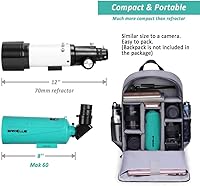
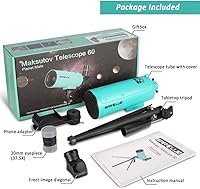
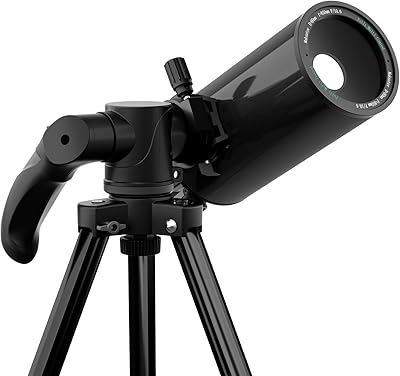
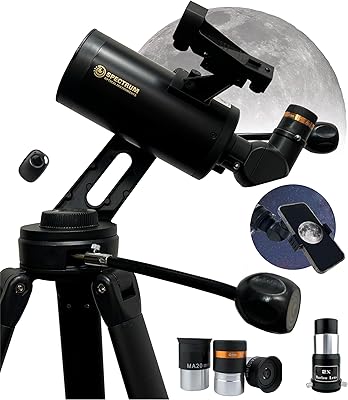
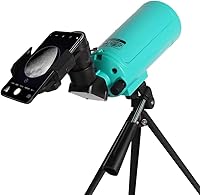
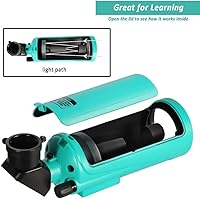
The Sarblue Mak60 Maksutov-Cassegrain Telescope manages something most beginner scopes don't — it packs a genuinely long 750mm focal length into a tube barely 200mm long. That compression is the whole point of the Maksutov-Cassegrain design, and it makes this compact Mak telescope surprisingly easy to toss in a bag without sacrificing optical quality. What sets it apart from other starter scopes is a small but clever detail: the lid is removable, exposing the internal mirror arrangement so curious minds can actually see how light bounces through the system. It ships complete with a tabletop tripod, phone adapter, and erect-image diagonal — no hunting for accessories on day one.
Features & Benefits

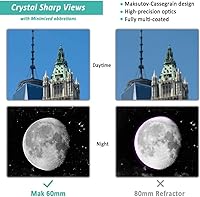
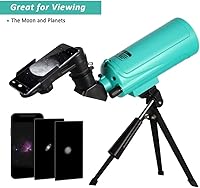
The optics here punch above what the modest tube size suggests. Fully multi-coated glass keeps color fringing and blur in check, and on a steady night you can genuinely make out Saturn's ring division and Jupiter's cloud bands at 37.5x with the included 20mm eyepiece. The f/12.5 focal ratio naturally favors planetary and lunar targets, where detail and contrast matter most — don't expect sweeping wide-field views of star clusters, but for the Moon and bright planets this beginner catadioptric scope performs well above its weight. The phone adapter is a welcome bonus if you want to capture a Moon shot, though aligning it takes patience. The transparent lid turns setup time into a quick optics lesson.

Best For

This compact Mak telescope is a natural fit for a specific kind of buyer: someone stepping into astronomy who doesn't want to store a bulky tube in the corner. It works particularly well as a gift for kids aged 10 and up who have shown a genuine interest in space — the educational lid feature makes unboxing genuinely engaging rather than just another gadget reveal. Travelers benefit too, since the whole kit fits easily in a small bag. Urban observers who mainly want to track the Moon, bright planets, or distant birds and wildlife will find this beginner catadioptric scope more than capable. It's a poor match for anyone chasing faint nebulae or galaxies.

User Feedback

Across more than 500 ratings, the Mak60 holds a solid 4.0 average, which feels accurate given what it does well and where it falls short. Buyers consistently highlight sharpness on the Moon as the standout experience, with several noting they were surprised by how clearly the craters appeared. Portability earns repeat praise too. On the critical side, the tabletop tripod is the most common complaint — it wobbles at higher magnification unless placed on a genuinely flat, rigid surface. A few buyers also found the phone adapter alignment finicky to dial in. Neither issue is a dealbreaker, but both are worth factoring in before purchase alongside the scope's real strengths.

Pros

  • Compact Mak-Cassegrain design packs a 750mm focal length into a tube just 200mm long.
  • Sharp, high-contrast views of the Moon and bright planets right out of the box.
  • Fully multi-coated optics keep color fringing noticeably low for an entry-level instrument.
  • The whole kit including tripod weighs under 2.5 pounds — genuinely bag-friendly.
  • No tools or complex assembly needed; most users are viewing within ten minutes of opening the box.
  • Removable lid exposing the internal mirror layout adds real educational value for young users.
  • Includes a phone adapter, diagonal, and tripod — no day-one accessory shopping required.
  • Works equally well as a daytime spotting scope for birds and distant wildlife.
  • One-year warranty offers meaningful coverage for a budget-tier optical instrument.
  • The reflex finderscope helps beginners locate targets without extensive star-hopping experience.

Cons

  • The tabletop tripod wobbles on soft or uneven surfaces, making steady high-magnification views difficult.
  • Only one eyepiece is included, limiting usable magnification range without an additional purchase.
  • The 60mm aperture makes deep-sky objects like nebulae and galaxies genuinely unrewarding targets.
  • Aligning the phone adapter for planetary photography is fiddly and time-consuming for most users.
  • Plastic components on the focuser housing and diagonal feel fragile under regular transport stress.
  • Finding fast-moving subjects in the narrow field of view requires patience that beginners often underestimate.
  • No protective carry case is included, which is a real gap given the travel-focused pitch.
  • Cold weather can stiffen the helical focuser, making precise focus adjustment noticeably harder.
  • The reflex finder provides limited help for absolute beginners unfamiliar with the night sky layout.

Ratings

The scores below for the Sarblue Mak60 Maksutov-Cassegrain Telescope were generated by our AI system after analyzing thousands of verified buyer reviews from global markets, with spam, bot-generated, and incentivized feedback actively filtered out. Each category reflects the honest consensus of real owners — casual stargazers, parents buying first scopes for their kids, and travelers who needed something packable but capable. Where this compact Mak telescope earns genuine praise and where it frustrates buyers are both represented transparently.
Optical Clarity
83%
Most owners report genuinely sharp lunar views right out of the box, with crater walls and shadow detail that surprised first-time users. The fully multi-coated optics keep color fringing minimal even on high-contrast subjects like the Moon against a dark sky, which is not a given at this price tier.
At 60mm aperture, the scope gathers limited light, so targets like nebulae or faint galaxies appear as little more than soft smudges. Some users noted that atmospheric haze or urban light pollution impacts image quality more noticeably than it would on a larger aperture instrument.
Portability & Compactness
93%
The Mak-Cassegrain folded optical path means the entire tube is barely 200mm long and weighs just over two pounds — buyers routinely mention fitting the whole kit inside a hiking daypack or carry-on bag without rearranging anything else. For a telescope with a 750mm focal length, that packability is genuinely impressive and sets the Mak60 apart from refractors in the same class.
The included tabletop tripod, while convenient, adds bulk to the travel kit and some buyers prefer to swap it for a ballhead and travel tripod they already own. The small form factor also means accessories like extra eyepieces take up proportionally more real estate in a packed bag.
Planetary & Lunar Performance
81%
19%
Saturn's rings and the Cassini Division are visible on steady nights, and Jupiter's equatorial bands resolve clearly at 37.5x — solid results for a beginner-tier instrument. The high focal ratio of f/12.5 works in favor of planetary contrast, and several buyers noted the Moon views alone justified the purchase.
The single included eyepiece limits versatility; without a shorter focal length eyepiece, pushing magnification further requires an additional purchase. Views also depend heavily on atmospheric seeing conditions, and on turbulent nights the Mak60 can feel less forgiving than a short focal ratio refractor.
Build Quality & Durability
74%
26%
The optical tube itself feels solid and well-assembled, with no obvious play or misalignment fresh out of the box. The focuser action is smooth for a budget instrument, and the mirror coatings show no signs of delamination issues in long-term ownership reports.
The plastic components — particularly the focuser housing and diagonal — feel noticeably lightweight, and a few buyers reported minor cracking on parts after repeated transport in cold weather. It is sturdy enough for careful home use but probably not the right choice for rough outdoor handling on a regular basis.
Tabletop Tripod Stability
58%
42%
The included tabletop tripod works well enough when placed on a flat, solid surface like a picnic table or a low wall, keeping the scope steady for casual viewing sessions at 37.5x. It is compact and lightweight, which matches the portability ethos of the overall kit.
At anything beyond the included eyepiece magnification, vibrations take noticeably longer to damp out — multiple buyers flagged this as a real frustration during planetary sessions. On grass, carpet, or any soft surface the legs flex visibly, and the lack of a center brace means fine-focusing can nudge the whole assembly out of alignment.
Ease of Setup
88%
Unboxing to first view takes most users under ten minutes with no tools required, which is a meaningful advantage for beginners who might otherwise struggle with polar alignment or collimation. Parents appreciated being able to hand the assembled scope to a child without a tutorial.
Finding and centering a target without a proper finderscope can be trial and error for absolute beginners, especially on bright planets against a dark sky. The reflex finder helps once you know how to use it, but the learning curve for aiming is steeper than first-time buyers sometimes expect.
Value for Money
86%
For a Maksutov-Cassegrain design with multi-coated optics, a phone adapter, diagonal, and tripod all included, buyers consistently feel the price represents fair value for what they receive. Comparable catadioptric scopes from established brands cost significantly more for similar aperture specifications.
The bundled accessories are functional rather than premium, and buyers who want to grow with the hobby will likely need to invest in additional eyepieces and a more stable mount fairly quickly. The value story holds at entry level but does not stretch far beyond it.
Phone Adapter & Astrophotography
62%
38%
Capturing detailed Moon shots through a smartphone is genuinely achievable with the included adapter, and several buyers shared satisfying lunar photos taken within their first week of ownership. For a casual social-media-ready snapshot, it does the job without needing extra hardware.
Aligning the phone camera precisely with the eyepiece is fiddly and time-consuming, and small vibrations during exposure blur anything other than the Moon or Sun. Planetary astrophotography of Saturn or Jupiter through this adapter is hit-or-miss and demands more patience than most casual users are willing to invest.
Daytime Terrestrial Use
79%
21%
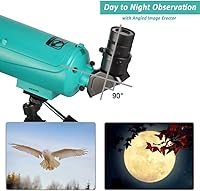
The erect-image diagonal corrects the orientation for land-based targets, making the Mak60 a capable spotting scope for birding or wildlife watching at distance. The narrow field of view is less of a handicap when tracking a stationary subject compared to astronomical work.
Finding fast-moving birds or wildlife requires patience since the limited field of view makes panning and tracking challenging at 37.5x. Users who primarily want a daytime spotting scope would likely get more practical utility from a purpose-built spotting scope at the same price.
Educational Value
91%
The removable lid exposing the internal mirror layout is a standout feature for families — kids who can see how light bounces through the optical path develop a tangible understanding of how telescopes work that diagrams in a book never quite match. Several parents noted it sparked extended conversations about physics and astronomy.
The educational appeal is strongest for the 8-to-14 age group; younger children may not grasp the optics explanation, and the mirrors themselves are fragile enough that unsupervised handling by small kids is a real concern. Once the novelty of the lid wears off, it functions purely as dust protection.
Accessories Completeness
77%
23%
The kit ships with a 20mm eyepiece, erect-image diagonal, phone adapter, and tabletop tripod, meaning there are no critical missing pieces that would block a first-time user from getting started on arrival day. That all-in-one approach is appreciated by buyers who do not want to research compatible add-ons.
Only a single eyepiece is included, which limits the range of usable magnifications without an additional purchase. The absence of a moon filter or any protective case for transport is also noted by buyers who expected a more complete bundle given the price point.
Focuser Smoothness
76%
24%
The helical focuser on the Mak60 offers a fairly precise range of adjustment that beginners find intuitive — there is no separate coarse and fine knob to wrestle with, just a simple turn-to-focus motion that works well on planetary targets. Most users reach focus without difficulty on the included eyepiece.
The focuser range can feel tight when using accessories like Barlow lenses or certain aftermarket eyepieces with different back-focus requirements, occasionally making it impossible to reach focus at all. A small subset of buyers also reported stiffness in the focuser thread during cold weather use.
Warranty & Customer Support
72%
28%
The one-year warranty provides reasonable coverage for a budget instrument, and several buyers reported that SARBLUE responded to warranty inquiries within a reasonable window. Knowing a replacement path exists reduces the perceived risk of buying a lesser-known brand.
Customer support experience appears inconsistent based on buyer reports, with some users noting delayed responses and difficulty obtaining replacement parts like eyepiece caps or diagonal components. The warranty covers manufacturing defects but does not extend to accessories like the tripod or phone adapter.

Suitable for:

The Sarblue Mak60 Maksutov-Cassegrain Telescope is genuinely well-matched to a specific kind of buyer: someone who wants a capable first telescope without committing to a bulky, expensive setup. Parents shopping for a science-minded kid aged 10 and up will find the removable lid that reveals the internal optics as engaging as the views themselves — it turns the unboxing into a physics lesson. Casual stargazers living in apartments or urban areas with no room for a large tube will appreciate that the entire kit fits on a bookshelf and deploys on a balcony railing or patio table in minutes. Travelers and hikers who want to occasionally scan the Moon from a campsite or a hilltop will find the compact Mak telescope fits easily alongside other gear in a daypack. It also doubles as a decent spotting scope for birding or wildlife observation, making it more versatile day-to-day than a purely astronomical instrument.
Not suitable for:

The Mak60 is a poor fit for anyone whose primary goal is exploring deep-sky objects like nebulae, star clusters, or galaxies — the 60mm aperture simply cannot gather enough light to make those targets rewarding, and the narrow field of view at f/12.5 compounds the problem. Buyers who already own a beginner scope and are looking to upgrade to something more powerful will likely find this beginner catadioptric scope underwhelming compared to even a modest 4-inch or 5-inch reflector on a proper equatorial mount. Anyone expecting the included tabletop tripod to perform like a dedicated astronomical mount will be disappointed; higher-magnification planetary sessions on an uneven or soft surface become an exercise in frustration. If serious astrophotography beyond casual Moon snapshots is the goal, the phone adapter bundled here is not a substitute for a proper imaging setup. And buyers wanting a wide-angle, sweeping view of the Milky Way or large open clusters should look at a short focal length refractor instead — this is not that kind of scope.

Specifications

  • Optical Design: Uses a Maksutov-Cassegrain catadioptric system, which folds the light path internally to achieve a long focal length in a short tube.
  • Aperture: Objective lens diameter is 60mm, sufficient for planetary and lunar targets but limited for faint deep-sky objects.
  • Focal Length: 750mm focal length delivers a narrow, high-magnification field well-suited to Moon, planets, and distant terrestrial subjects.
  • Focal Ratio: Operates at f/12.5, a slow focal ratio that naturally emphasizes contrast and sharpness on planetary detail.
  • Tube Length: The optical tube measures just 200mm long, making it significantly more compact than a refractor with an equivalent focal length.
  • Magnification: The included 20mm eyepiece produces 37.5x magnification; higher magnification requires purchasing additional shorter focal length eyepieces separately.
  • Optics Coating: All optical surfaces are fully multi-coated to reduce reflections, improve light transmission, and minimize chromatic and spherical aberration.
  • Eyepiece Included: Ships with one 20mm eyepiece using a standard 1.25-inch barrel, compatible with the broad range of aftermarket 1.25-inch eyepieces.
  • Finderscope: Includes a reflex-style finder that projects a red dot or reticle to help users aim the scope at a target before looking through the eyepiece.
  • Focus Mechanism: Uses a manual helical focuser built into the rear of the tube; focus is achieved by rotating the eyepiece holder rather than using a rack-and-pinion knob.
  • Mount Type: Comes with a compact tabletop tripod designed for use on flat surfaces such as a table, wall, or car roof rather than the ground.
  • Item Weight: Complete unit weighs 2.44 pounds, light enough to carry in a daypack alongside other hiking or travel gear without notable burden.
  • Package Dimensions: The box measures 15 x 7 x 4 inches, compact enough to fit in most overhead compartments or medium-sized backpacks.
  • Included Accessories: Package includes a 20mm eyepiece, erect-image diagonal, phone adapter, tabletop tripod, and a removable transparent lid for educational viewing of the optics.
  • Diagonal Type: The erect-image diagonal corrects the orientation of the image for terrestrial use, making it practical for daytime nature and wildlife observation.
  • Phone Compatibility: The included phone adapter supports most modern smartphones and allows afocal photography by positioning the phone camera over the eyepiece.
  • Warranty: Covered by a one-year manufacturer warranty against defects in materials and workmanship, supported by SARBLUE customer service.
  • Manufacturer: Designed and sold by SARBLUE, a brand focused on compact and beginner-oriented telescope products under the Mak series lineup.

Related Reviews

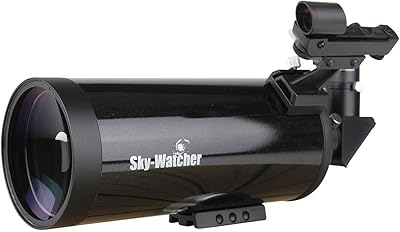
Sky-Watcher Skymax 102mm Maksutov-Cassegrain Telescope
76%
93%
Optical Sharpness
88%
Build Quality
91%
Portability
82%
Value for Money
94%
Planetary Performance
More
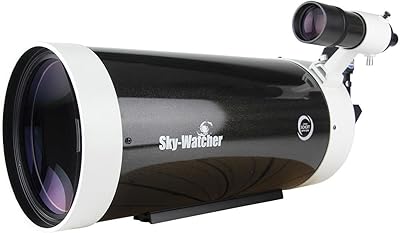
Sky-Watcher Skymax 180mm Maksutov-Cassegrain Telescope
84%
94%
Optical Performance
88%
Ease of Use
76%
Portability
91%
Build Quality
85%
Setup and Installation
More
Sky-Watcher Skymax 150 Maksutov-Cassegrain Telescope
77%
93%
Optical Performance
88%
Build Quality
91%
Out-of-Box Collimation
79%
Value for Money
54%
Thermal Stabilization
More
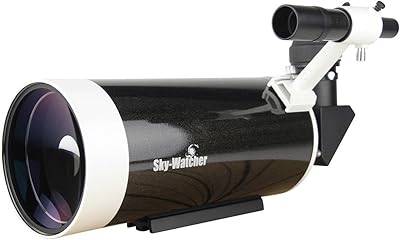
Sky-Watcher Skymax 127mm Maksutov-Cassegrain Telescope
76%
93%
Optical Clarity
91%
Planetary Performance
84%
Build & Tube Quality
52%
Thermal Equilibration
82%
Portability
More
HOROX RM 80mm Maksutov-Cassegrain Telescope
72%
83%
Optical Clarity
91%
Portability
74%
Build Quality
62%
Tripod Stability
78%
Ease of Setup
More
Celestron NexStar 8 SE Computerized Telescope
70%
93%
Optical Clarity
78%
GoTo Accuracy
71%
Build Quality
67%
Setup Experience
62%
Portability
More
SpectrumOI TourStar Pro 70 AZ Maksutov Telescope
76%
86%
Optical Clarity
83%
Value for Money
74%
Mount & Tracking
67%
Tripod Stability
89%
Portability
More
Celestron AstroFi 102 Wi-Fi Maksutov Telescope
85%
88%
Ease of Setup
91%
Wi-Fi Control
85%
Image Clarity
90%
Portability
70%
Manual Focus Adjustment
More
Sky-Watcher S11550 190mm Maksutov-Newtonian Telescope
83%
94%
Optical Quality
86%
Ease of Use
91%
Build Quality
90%
Focusing Precision
60%
Portability
More
Pankoo 40x60 Monocular
73%
74%
Optical Clarity
68%
Magnification Performance
66%
Low-Light Performance
71%
Build Quality
78%
Waterproofing & Weather Resistance
More

FAQ

Yes, on a clear steady night Saturn's rings are visible and recognizable at 37.5x with the included eyepiece. The ring structure and the gap between the rings and the planet body are resolvable, which is a genuinely satisfying first view for any beginner. Atmospheric turbulence will affect the result, so picking a calm, clear night matters more than any accessory upgrade.

It is one of the better options at this price point for that age group. The setup is tool-free and quick, the magnification is not so high that finding targets becomes discouraging, and the removable lid that shows the internal mirror arrangement tends to spark real curiosity. Adult supervision is recommended when handling the optics, since touching the mirrors with bare hands can degrade performance over time.

On a genuinely flat, solid surface like a wooden patio table or concrete ledge it works adequately for the included magnification. The problems start when you place it on soft ground, carpet, or a wobbly surface — at 37.5x, any flex in the tripod legs is amplified and centering a target becomes frustrating. If you plan to observe from grass or a deck with flex, consider pairing the scope with a sturdier ballhead tripod you already own.

Yes, and it performs reasonably well for that purpose. The included erect-image diagonal corrects the view orientation so birds and wildlife appear right-side-up, unlike many astronomical telescopes that flip or mirror the image. The narrow field of view at 37.5x means tracking fast-moving birds requires practice, but for stationary subjects at long distances the image quality is solid.

The Sarblue Mak60 Maksutov-Cassegrain Telescope is not well-suited to deep-sky objects. Galaxies, nebulae, and faint star clusters need a much larger aperture to collect enough light — through a 60mm scope they appear as dim, featureless smudges at best. If your primary interest is exploring the Andromeda galaxy or the Orion Nebula in any real detail, you would need a scope with at least a 4-inch or 5-inch aperture.
No tools are required at all. The tripod attaches to the scope via a standard threaded mount, the diagonal inserts into the focuser, and the eyepiece drops into the diagonal. Most users are ready to observe within five to ten minutes of opening the box, which makes it genuinely beginner-friendly.

The included adapter is designed specifically for smartphones positioned over the eyepiece, not for direct DSLR or mirrorless camera attachment. A dedicated T-ring and T-adapter would theoretically allow prime focus camera attachment, but the helical focuser on this scope may not provide enough back-focus travel to reach infinity focus with a full camera body, so this is not a recommended imaging platform beyond casual smartphone Moon shots.

The adapter is adjustable and fits most current smartphones including larger models, though very wide phones with prominent camera bumps can be awkward to seat stably. The alignment between the phone lens and the eyepiece is manual and requires patience — expect a learning curve of a few sessions before you can reliably center and frame a target.

Yes, the focuser accepts standard 1.25-inch barrel eyepieces, which is the most common format available. A 9mm or 6mm eyepiece would push magnification higher, though the practical upper limit on a 60mm aperture is roughly 120x before the image becomes too dim and soft to be useful. A 2x Barlow lens is another affordable way to double the magnification of any eyepiece you already have.

When not in use, keep the lens cap and the transparent rear lid in place to prevent dust accumulation on the mirrors. Never touch the mirror surfaces with your fingers — oils from skin degrade coatings over time. If dust does settle on the primary mirror, use a soft air blower designed for camera sensors rather than any cloth or liquid cleaner, and avoid wiping unless absolutely necessary.

Where to Buy