Overview

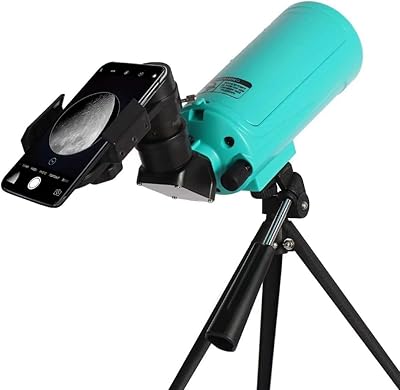
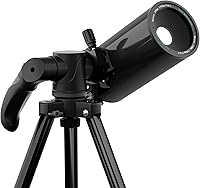
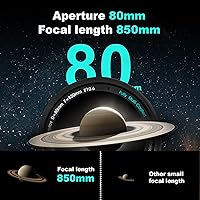
The HOROX RM 80mm Maksutov-Cassegrain Telescope is one of those rare beginner scopes that actually takes optical design seriously. HOROX launched it in late 2023 and has already earned a top-five spot in the catadioptric telescope category — a fast climb that reflects genuine buyer interest. The core appeal is straightforward: an 850mm focal length packed into a tube barely 22 centimeters long. That level of compactness is unusual for this optical class. It is not a professional instrument, and it is not pretending to be. But for someone ready to move past toy-grade scopes without committing to a bulky setup, this compact Mak-Cass sits in a genuinely interesting position.
Features & Benefits

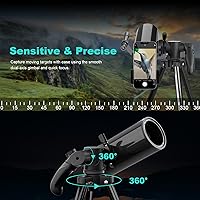
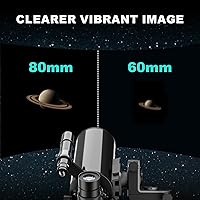
The 80mm aperture is honest work — enough to show Saturn's rings with real clarity, reveal Jupiter's cloud bands, and pick up the Andromeda galaxy as a soft smudge on a dark night. Do not expect extraordinary detail, but do expect to be genuinely impressed on a clear evening. The folded light path keeps chromatic fringing well controlled, which matters more than most beginners realize. HOROX's proprietary gimbal mount deserves credit: dual adjustment knobs and a locking handle make centering objects far less frustrating than a standard alt-az head. The Focus Indicator is a small but clever addition that helps new users hit sharp focus without endless back-and-forth. Two eyepieces — 10mm and 20mm — cover a useful magnification range right out of the box.

Best For

This catadioptric scope suits a specific type of buyer: someone who wants a genuine astronomy experience without hauling a massive tube to the backyard or across the country. Urban stargazers with limited outdoor space will appreciate how quickly it sets up and breaks down. Hikers and campers will notice the short tube actually fits in a day pack. During daylight hours it works surprisingly well as a long-reach spotting scope paired with a smartphone — wildlife observation, landscape detail — so it earns its keep on trips where space is tight. It is also a thoughtful gift option for a curious adult or teenager ready to take astronomy past a casual interest.

User Feedback

Buyers who set realistic expectations tend to be satisfied with the HOROX telescope — those who do not, often are not. Consistent praise centers on planetary image clarity and the genuinely compact form factor; people are regularly surprised by how sharp Saturn looks through a tube this small. On the critical side, a few themes recur. The tripod can develop noticeable wobble at full height in breezy conditions, which is worth knowing before your first outdoor session. New users also tend to underestimate thermal equilibration — a Mak-Cass design needs time to reach ambient temperature before delivering its sharpest views. The phone adapter fits most modern smartphones well, though compatibility with larger-format devices can vary.

Pros

  • Saturn's rings and Jupiter's cloud bands are genuinely visible and sharp on a clear night — a real thrill for first-time users.
  • The short tube body makes this compact Mak-Cass far easier to carry on hikes or pack for travel than any equivalent refractor.
  • The proprietary gimbal mount with locking handle makes centering objects noticeably smoother than a standard alt-az head.
  • The patented Focus Indicator removes much of the frustration beginners face when trying to dial in a sharp image.
  • Two eyepieces included out of the box give you immediate flexibility in magnification without extra purchases.
  • The phone adapter works well for casual astrophotography and doubles the scope as a daytime telephoto tool.
  • Setup time is short enough that spontaneous stargazing sessions are actually realistic on a weeknight.
  • Build quality feels appropriately solid for the price tier — this does not feel like a cheap, flimsy kit.
  • The folded optical path keeps chromatic aberration well controlled, producing clean, color-accurate views.

Cons

  • Thermal equilibration is required before peak performance — plan to wait 20 to 30 minutes outdoors before serious viewing.
  • The tripod develops noticeable wobble at full height, especially in any wind, making high-magnification views harder to hold steady.
  • At 80mm aperture, faint deep-sky objects like nebulae remain largely out of reach — this is a planetary scope first.
  • No motorized tracking means objects drift out of view quickly at higher magnifications, requiring constant manual adjustment.
  • The phone adapter fit can be inconsistent with larger or unusually shaped smartphone models.
  • Collimation, while rarely needed, is unfamiliar territory for most beginners and not well-documented in the included materials.
  • At just over nine pounds total with the tripod, it is not ultralight — every gram matters on longer hikes.
  • No carrying case is included, which is a real gap for a scope marketed partly on portability.
  • The reflex finderscope is functional but minimal — locating faint targets quickly still takes practice and patience.

Ratings

Our AI-generated scores for the HOROX RM 80mm Maksutov-Cassegrain Telescope were produced by analyzing verified buyer reviews from multiple global markets, with spam, incentivized, and bot-flagged submissions actively filtered out before scoring. Each category reflects the honest distribution of real user sentiment — including the frustrations — so you get a clear picture of where this compact Mak-Cass genuinely delivers and where it falls short. Strengths and pain points are weighted equally, giving you a scorecard you can actually trust when making your decision.
Optical Clarity
83%
Buyers consistently single out planetary views as the standout experience — Saturn's rings and Jupiter's banding come through with satisfying sharpness on steady nights. The folded optical path keeps chromatic fringing well controlled, which is a real advantage over similarly priced refractors where color fringing can be distracting.
At 80mm aperture, faint deep-sky objects remain soft and unconvincing, which disappoints users who expected more from a scope marketed as capable of galaxy viewing. Image quality is also noticeably dependent on thermal equilibration — those who skip the warm-up period frequently report blurry, shimmery views and blame the optics unfairly.
Portability
91%
The short 22cm tube is genuinely backpack-friendly in a way that very few 850mm focal-length scopes can claim, and campers and hikers repeatedly mention fitting it into a standard daypack without issue. Urban users appreciate being able to carry it to a rooftop or park without drawing attention or requiring a vehicle.
At just over nine pounds total, it is not truly ultralight — after a longer hike, the weight becomes noticeable, especially without a dedicated carry case. The absence of an included case is a recurring complaint, since the scope has no protective solution for field transport beyond careful packing.
Build Quality
74%
26%
The optical tube feels solid and well-assembled, and the reinforced aluminum alloy tripod inspires more confidence than the plastic-legged tripods bundled with entry-level scopes. Most users report no issues with the core mechanical components after months of regular use.
Fit and finish on some units is inconsistent — a handful of buyers note minor play in the focuser or imprecise threads on the eyepiece barrel. The tripod head connection point feels less robust than the legs themselves, which causes some concern when transporting a fully assembled rig.
Tripod Stability
62%
38%
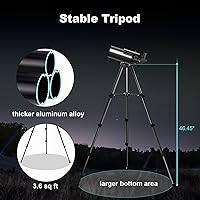
At mid-range extension on firm, flat ground, the tripod provides a stable enough platform for relaxed planetary viewing, and the wide base coverage of 3.6 square feet helps on slightly uneven terrain like grass or gravel.
At full height in any noticeable breeze, wobble becomes a genuine problem — high-magnification views vibrate enough to make sustained observation frustrating. Multiple reviewers note that even footsteps nearby or touching the focuser sends the image shaking for several seconds, which is a meaningful limitation during real observing sessions.
Ease of Setup
78%
22%
Most buyers report being up and running within 15 to 20 minutes on their first attempt, which is faster than average for a catadioptric scope in this class. The gimbal mount design is intuitive enough that beginners rarely feel overwhelmed during initial assembly.
The included instruction manual is thin and occasionally unclear, particularly around aligning the finderscope and understanding the Focus Indicator — two steps that are critical for a productive first session. A few users needed to supplement with online tutorials before feeling confident.
Gimbal Mount & Targeting
81%
19%
The proprietary gimbal with dual adjustment knobs stands out in buyer feedback as a genuinely useful upgrade over basic alt-az heads — panning smoothly across the sky without fighting a stiff or jerky mechanism makes a real difference during casual stargazing. The locking handle is a practical touch that holds the scope in position between adjustments.
At higher magnifications, the precision of the knobs becomes limiting — fine adjustments to track a drifting planet are possible but require a careful, practiced touch that beginners take time to develop. A few users found the locking mechanism slightly fiddly to engage without accidentally bumping the scope off target.
Focus System
79%
21%
The patented Focus Indicator is one of the more genuinely useful beginner-facing features on this scope — it gives users a physical reference point for sharp focus rather than relying entirely on eye judgment, which meaningfully shortens the learning curve during early sessions.
The focuser travel range is somewhat limited, which can make fine-tuning at the extremes of its range feel imprecise. Users who switch between the two included eyepieces frequently need to re-focus substantially each time, which interrupts the flow of an observing session.
Included Accessories
72%
28%
Getting two eyepieces — 20mm and 10mm — and a phone adapter straight out of the box is a genuinely complete starter kit, removing the need for immediate additional purchases that typically hit buyers of entry-level scopes.
The eyepiece quality is functional but not impressive — experienced users quickly note they are the weakest link in the optical chain and a limiting factor at higher magnifications. The reflex finderscope is usable but basic, offering little help when trying to locate faint targets in a light-polluted sky.
Smartphone Compatibility
67%
33%
For standard-sized smartphones, the included adapter clips on securely enough to capture satisfying lunar and planetary snapshots, and casual astrophotographers find it a fun bonus that works better than expected for social media sharing.
Compatibility drops off noticeably with larger flagship phones or devices in thick protective cases, where the adapter struggles to maintain a centered, secure hold. Video capture through the adapter is usable but prone to vibration blur, limiting it to still images in practice.
Value for Money
77%
23%
Relative to what most buyers spend on entry-level refractors in this price range, the optical performance of this compact Mak-Cass represents a meaningful step up — you get a longer effective focal length, better chromatic correction, and a more thoughtful mount design for a comparable investment.
The absence of a carry case, a mediocre finderscope, and a tripod that wobbles at full height collectively leave some buyers feeling the kit is slightly underspecified for its price point. Competing options from established astronomy brands occasionally offer more refined accessories at a similar spend.
Daytime Versatility
76%
24%
As a daytime spotting scope paired with a smartphone, this catadioptric scope genuinely earns its keep on outdoor trips — wildlife, distant landscapes, and architectural detail all benefit from the tight, high-contrast field of view the 850mm focal length provides.
The mirror-image orientation the Mak-Cass design produces is disorienting for new users tracking moving daytime subjects and requires a mental adjustment period. Without a diagonal that corrects image orientation, terrestrial use stays in the casual rather than practical category.
Learning Curve
58%
42%
For buyers who invest the time to understand thermal equilibration, finderscope alignment, and basic star-hopping, the rewards are real — user satisfaction in this group is noticeably higher than among those who expect instant out-of-box results.
The learning demands of a Mak-Cass design are higher than most beginners anticipate, and HOROX's documentation does not fully bridge that gap. Users who pick it up expecting the same immediacy as a point-and-shoot camera frequently leave disappointed, and this expectation mismatch drives a meaningful share of the negative reviews.
Thermal Performance
54%
46%
Once fully cooled to ambient temperature, the optics deliver the sharpness the design promises, and users who build the equilibration wait into their routine report consistently satisfying sessions.
The 20-to-30-minute mandatory warm-up window before peak performance is a genuine friction point that discourages spontaneous late-night sessions. Buyers in colder climates report the equilibration period extending even longer, which is rarely mentioned in the product description and comes as an unwelcome surprise.
Astrophotography Capability
61%
39%
For casual lunar photography and planetary snapshots shared on social media, the scope delivers results that regularly impress friends and family — the Moon in particular photographs beautifully through the phone adapter at this focal length.
Without any form of motorized tracking, long-exposure deep-sky imaging is simply not viable, and even short planetary video clips require constant manual correction. Serious astrophotographers will quickly outgrow this scope, as the platform lacks the mechanical foundation that imaging demands.

Suitable for:

The HOROX RM 80mm Maksutov-Cassegrain Telescope is genuinely well-matched to adult beginners and casual hobbyists who want a real optical experience without the bulk or complexity of a traditional long-tube setup. If you live in a city or suburb where hauling a large telescope to a dark-sky site is impractical, this compact Mak-Cass solves a real problem — it sets up in minutes and packs away just as fast. Campers and hikers will find the short tube refreshingly backpack-friendly for its focal length class, and the included phone adapter means it doubles as a capable daytime spotting tool without any additional investment. It also makes a strong gift for a curious adult or older teenager who is serious enough about the hobby to want a proper optical system, but not yet ready to navigate the complexity or expense of a more advanced setup. For anyone whose primary goals are clear planetary views on occasional clear nights and easy portability between locations, this scope punches meaningfully above what most people expect at this price tier.
Not suitable for:

Experienced amateur astronomers or anyone with serious deep-sky ambitions will likely find the HOROX RM 80mm Maksutov-Cassegrain Telescope underwhelming for their needs. An 80mm aperture, while honest and capable, simply cannot gather enough light to reveal faint nebulae, distant galaxies, or fine planetary surface detail the way a larger instrument can — and no amount of clever optical folding changes that physical reality. Mak-Cass designs also require thermal equilibration, meaning you need to let this catadioptric scope sit outside for 20 to 30 minutes before it reaches peak sharpness; buyers expecting instant, perfect views straight out of the bag will be frustrated. The tripod, while stable at moderate heights, can wobble noticeably in the wind or at full extension, which makes precise tracking at high magnification more difficult than it should be. If your primary goal is astrophotography beyond casual smartphone snaps — tracked long exposures, deep-sky imaging — this scope lacks the motorized mount and structural rigidity that serious imaging demands.
Specifications

  • Optical Design: This telescope uses a Maksutov-Cassegrain catadioptric system, which folds the light path internally to achieve a long focal length in a compact tube.
  • Aperture: The objective lens measures 80mm in diameter, allowing meaningful light collection for planetary and select deep-sky observation.
  • Focal Length: The optical system delivers an 850mm focal length, yielding an f/10.6 focal ratio well suited to high-contrast planetary views.
  • Tube Length: The physical optical tube measures approximately 22cm long, dramatically shorter than a refractor with an equivalent focal length.
  • Eyepieces: Two eyepieces are included — a 20mm for wider, lower-magnification views and a 10mm for closer, higher-magnification observation.
  • Mount Type: The scope ships with an altazimuth mount featuring a proprietary gimbal design, dual adjustment knobs, and a handle lock for stable positioning.
  • Focus System: Focusing is manual and assisted by a patented Focus Indicator, a mechanical aid designed to help users identify and return to the sharpest focal point.
  • Finderscope: A reflex-style finderscope is included to help users roughly align the telescope toward a target before fine-tuning through the eyepiece.
  • Tripod Material: The tripod is constructed from reinforced aluminum alloy, balancing durability and weight for field and travel use.
  • Tripod Height: The tripod extends to a maximum height of 46.45 inches, accommodating a range of viewing postures for seated or standing observers.
  • Tripod Footprint: At full extension, the tripod legs spread to cover a base area of up to 3.6 square feet, providing a stable support platform on uneven ground.
  • Smartphone Adapter: A phone adapter is included in the kit, enabling users to attach most smartphones directly to the eyepiece for casual astrophotography or daytime photography.
  • Total Weight: The complete kit weighs approximately 9.31 pounds, which includes the optical tube, mount, and tripod assembly.
  • Packed Dimensions: The overall product footprint when assembled measures 17.6 x 14 x 5.28 inches, sized to fit most medium-to-large backpacks for transport.
  • Viewing Use: This scope supports both celestial observation — planets, the Moon, select deep-sky objects — and terrestrial daytime viewing such as wildlife or landscapes.
  • Manufacturer: The telescope is designed and sold by HOROX, a brand that entered the consumer astronomy market in late 2023.

Related Reviews

Sarblue Mak60 Maksutov-Cassegrain Telescope
78%
83%
Optical Clarity
93%
Portability & Compactness
81%
Planetary & Lunar Performance
74%
Build Quality & Durability
58%
Tabletop Tripod Stability
More
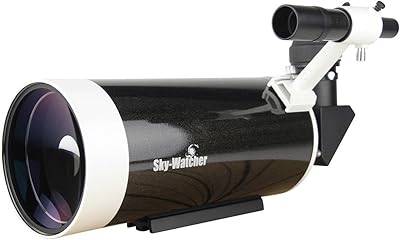
Sky-Watcher Skymax 127mm Maksutov-Cassegrain Telescope
76%
93%
Optical Clarity
91%
Planetary Performance
84%
Build & Tube Quality
52%
Thermal Equilibration
82%
Portability
More
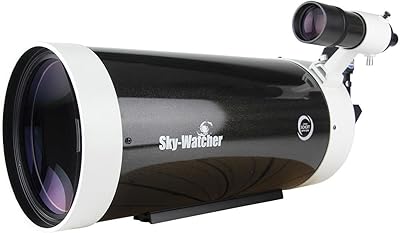
Sky-Watcher Skymax 150 Maksutov-Cassegrain Telescope
77%
93%
Optical Performance
88%
Build Quality
91%
Out-of-Box Collimation
79%
Value for Money
54%
Thermal Stabilization
More
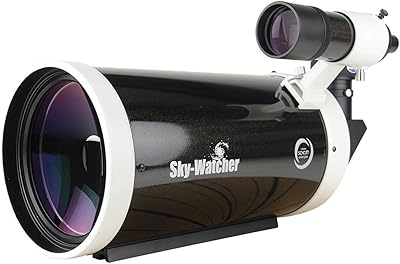
Sky-Watcher Skymax 102mm Maksutov-Cassegrain Telescope
76%
93%
Optical Sharpness
88%
Build Quality
91%
Portability
82%
Value for Money
94%
Planetary Performance
More
Sky-Watcher Skymax 180mm Maksutov-Cassegrain Telescope
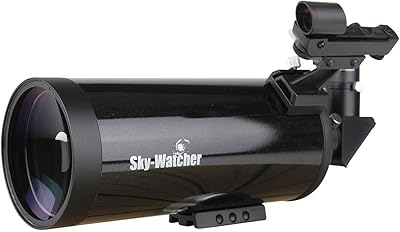
84%
94%
Optical Performance
88%
Ease of Use
76%
Portability
91%
Build Quality
85%
Setup and Installation
More
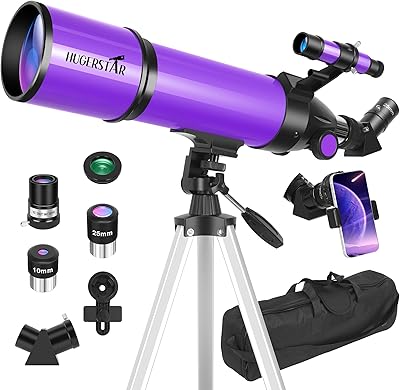
HUGERSTAR 80600 Refractor Telescope
70%
78%
Optical Clarity
88%
Ease of Setup
61%
Tripod Stability
83%
Value for Money
84%
Portability
More
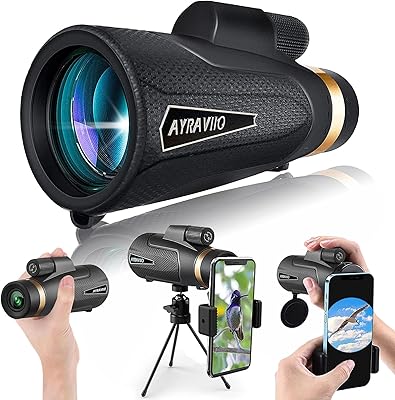
AYRAVIIO RM 12x60 Monocular Telescope
79%
78%
Optical Clarity
71%
Low-Light Performance
74%
Build Quality
66%
Focus Mechanism
88%
Bundle Value
More
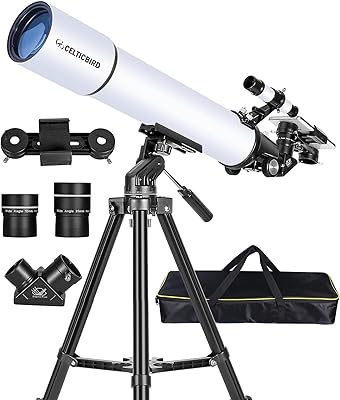
Celticbird 80mm 800mm Refractor Telescope
75%
83%
Optical Clarity
91%
Ease of Assembly
78%
Mount Usability
61%
Tripod Stability
58%
Included Eyepiece Quality
More
Celestron AstroFi 102 Wi-Fi Maksutov Telescope
85%
88%
Ease of Setup
91%
Wi-Fi Control
85%
Image Clarity
90%
Portability
70%
Manual Focus Adjustment
More
Celestron NexStar 8 SE Computerized Telescope
70%
93%
Optical Clarity
78%
GoTo Accuracy
71%
Build Quality
67%
Setup Experience
62%
Portability
More

FAQ

Realistically, the Moon is going to look spectacular — craters, ridges, the works. Saturn's rings are clearly visible and genuinely exciting the first time you see them. Jupiter shows its main cloud bands and the four Galilean moons as distinct points of light. For deep-sky objects, you can pick up the Andromeda galaxy as a faint smudge and a handful of bright star clusters. Faint nebulae and distant galaxies are mostly out of reach at 80mm, so set your expectations around the solar system and nearby showpieces.

No prior experience is necessary, but plan for a learning curve of an hour or two during your first session. The mount and tripod assembly is fairly intuitive, and the Focus Indicator genuinely helps beginners find sharp focus without endless guesswork. The trickier part is learning to use the finderscope to locate objects — that takes a little patience but becomes second nature quickly.

This is one of the most important things new Mak-Cass owners miss: the scope needs time to cool down to the ambient outdoor temperature before the optics settle and deliver their sharpest images. Plan on leaving it outside, capped, for about 20 to 30 minutes before your first serious look. Skipping this step often leads to shimmery, soft views that people mistakenly blame on the optics.

At moderate heights it is solid enough for most casual use. At full extension — particularly on grass or soft ground, or in any noticeable breeze — you will notice some wobble, especially at higher magnifications where even minor vibration is amplified. Keeping the tripod legs at about two-thirds extension rather than fully deployed helps considerably if stability is a concern.

It works reliably with most standard-sized smartphones. Users with larger flagship phones or unusually thick phone cases have occasionally reported a less secure fit, so if you have a particularly wide device it is worth checking compatibility. For casual lunar or planetary snapshots, it performs well enough that most people are pleasantly surprised by the results.

Yes, and it works better than you might expect for daytime use. The long focal length gives you a tight, detailed view of distant subjects, making it useful for wildlife, landscape detail, or even boat-spotting near water. Just keep in mind that a Mak-Cass produces a mirror-image view rather than a correct-orientation image, which can take a little getting used to when tracking moving subjects.

Mak-Cass designs are generally more collimation-stable than reflectors and most users never need to touch it. However, if the scope is dropped or transported roughly, alignment can shift. Collimating a Mak-Cass is a more involved process than a Newtonian reflector and the included documentation does not cover it in great depth, so be prepared to consult online astronomy forums or video guides if it ever becomes necessary.

It is a genuinely good fit for a teenager who has shown real curiosity about astronomy rather than a passing interest. It looks and feels like a serious instrument, the results through the eyepiece are rewarding enough to hold attention, and it is not so complex that it becomes discouraging. For a younger child or a casual observer who just wants to glance at the Moon occasionally, a simpler and less expensive scope might be a better match.

The optical tube can be separated from the included mount, and it has a standard dovetail or mounting interface that is compatible with many third-party alt-az and equatorial mounts. If you plan to do more serious planetary observation or want better tracking capability, upgrading the mount down the line is a reasonable path without having to replace the optical tube itself.

A moon filter is an inexpensive and highly recommended addition — the full Moon through an 80mm scope is bright enough to be uncomfortable without one. A Barlow lens, which doubles or triples the magnification of your existing eyepieces, can extend the usefulness of the two included eyepieces significantly. A red-light flashlight helps you read star charts without ruining your night vision. Beyond that, a basic planisphere or a free smartphone sky-map app will make finding objects much less frustrating in the early stages.