Overview

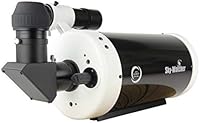
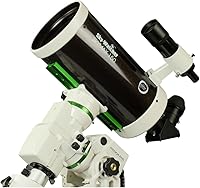
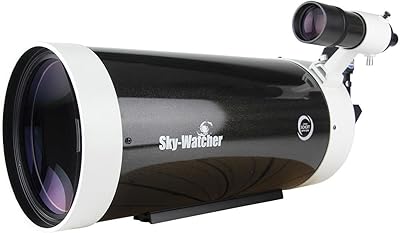
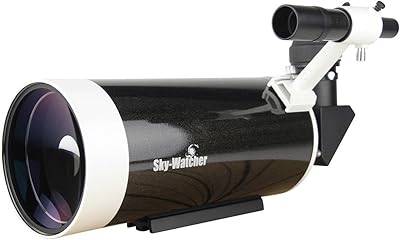
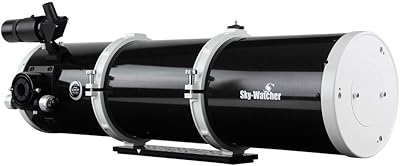
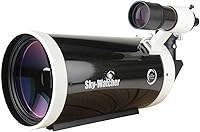
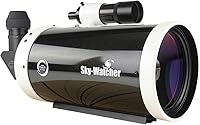
The Sky-Watcher Skymax 150 Maksutov-Cassegrain Telescope occupies a sweet spot in the amateur astronomy market — serious enough for experienced observers, yet compact enough to actually take outside on a weeknight. Unlike a Newtonian of comparable aperture, which demands a bulky truss tube and careful collimation, this 150mm Maksutov-Cassegrain folds its long optical path into a sealed, manageable tube that fits in a car trunk. It sits at the top of Sky-Watcher's well-regarded Skymax family, a lineage built on consistent optical quality. One important note before buying: no mount is included. This is an optical tube assembly only, and mount choice will make or break your experience with it.
Features & Benefits

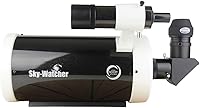
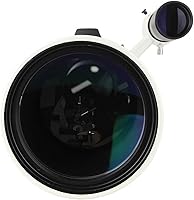
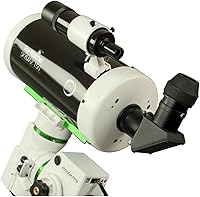
The optical heart of the Skymax 150 is a borosilicate primary mirror coated with aluminum and a quartz overcoat, reaching 94% reflectivity — a figure that translates directly into brighter, crisper images and noticeably darker sky backgrounds. Paired with matched secondary optics and a multi-coated corrector plate, the result is the kind of contrast that makes Saturn's Cassini Division snap into view. The fully baffled tube keeps stray light out, which matters especially if you observe from a suburban backyard. At roughly 1800mm focal length and f/12, native magnification is high, making it a natural for the Moon, planets, and tight double stars. The included 28mm eyepiece, 2-inch star diagonal, and 9x50 finderscope give you a solid starting kit.

Best For

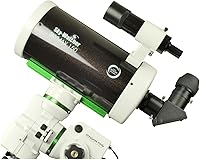
This Sky-Watcher Mak is built for observers who want high-contrast planetary detail above all else. If you are upgrading from a 90mm or 102mm refractor and want a meaningful jump in resolution — think resolving cloud bands on Jupiter or counting craters along the lunar terminator — this is where 150mm of aperture genuinely pays off. Suburban observers benefit from the sealed tube design, which resists dust and thermal currents that plague open Newtonians. It is also a strong choice for planetary astrophotographers willing to pair it with a solid equatorial or GoTo mount. If your priority is wide-field views of large nebulae, though, this long focal ratio scope is not the right tool.

User Feedback

Owners consistently praise the out-of-box collimation — unlike many reflectors, this 150mm Maksutov-Cassegrain typically arrives ready to observe, which is a genuine relief. Build quality draws frequent compliments too. The most common criticism involves thermal cool-down: expect to wait 45 to 90 minutes after bringing it outside before the optics stabilize and you see peak sharpness. The stock finderscope can be tricky to align, and some users find the included eyepiece a reasonable but not exceptional starting point. Comparisons with the Celestron C6 SCT often come up — the Skymax 150 generally wins on contrast, while the C6 offers broader accessory ecosystem support. Critically, mount choice matters enormously; buyers who struggled usually paired it with an undersized or poorly tracking mount rather than facing any optical flaw.

Pros

  • Exceptional planetary contrast — Saturn's rings and Jupiter's cloud bands resolve with striking clarity.
  • Arrives with optics already well-collimated straight out of the box, saving setup frustration.
  • The sealed tube design keeps dust and air currents out, a real advantage for suburban or urban observers.
  • 94% mirror reflectivity means noticeably brighter, crisper images compared to lower-grade coatings.
  • At 14 pounds, the Skymax 150 is far more portable than a Newtonian offering similar aperture.
  • Vixen-style dovetail works with a wide range of popular mounts many buyers already own.
  • Included 9x50 finderscope is a genuinely useful accessory for locating targets quickly.
  • The long focal length makes high-magnification observing feel natural without relying on short, expensive eyepieces.
  • Build quality is consistently praised — this is a scope that feels like it will last years of regular use.
  • Strong value proposition compared to premium apochromatic refractors delivering similar planetary performance.

Cons

  • No mount is included, and buying a quality one adds significant cost that first-time buyers often underestimate.
  • Thermal cool-down of 45 to 90 minutes is required before peak sharpness — spontaneous quick sessions are harder to pull off.
  • The included finderscope can be frustrating to align accurately and may need adjustment out of the box.
  • The stock 28mm eyepiece is adequate but not exceptional; most users will want to invest in additional eyepieces fairly quickly.
  • Not a deep-sky scope — faint galaxies and large nebulae are beyond its practical strengths at f/12.
  • The long focal length makes tracking drift more noticeable, putting extra pressure on mount quality and polar alignment.
  • Dew can form on the corrector plate during humid nights, requiring a dew shield or heater for extended sessions.
  • At this aperture and focal length, even moderate atmospheric turbulence can significantly limit usable magnification.

Ratings

The scores below reflect AI-driven analysis of verified global user reviews for the Sky-Watcher Skymax 150 Maksutov-Cassegrain Telescope, with spam, bot-generated, and incentivized feedback actively filtered out before any score was calculated. Real buyer experiences — both glowing and critical — shaped every number you see here, so you can trust that the pain points are just as visible as the strengths. This is an honest, balanced snapshot of what owners actually encounter once the box is open and the scope is outside.

Optical Performance
93%
Owners consistently describe the views of Saturn's rings and Jupiter's equatorial bands as some of the sharpest they have seen at this aperture level. The matched mirror set and multi-coated corrector plate produce a noticeably dark, high-contrast background that makes planetary detail pop even from light-polluted backyards.
Peak optical performance is only accessible after a 45 to 90 minute cool-down period outdoors, which catches many new owners off guard on their first night out. On evenings with poor atmospheric seeing, the long focal length amplifies turbulence and the views can deteriorate quickly regardless of optics quality.
Build Quality
88%
The tube feels solid and purposeful, with a weight and finish that signals durability rather than cost-cutting. Users report that the focuser moves smoothly and that the overall construction inspires confidence for regular transport to dark sites or star parties.
A handful of buyers noted minor cosmetic inconsistencies in the finish around the focuser housing, and the finderscope bracket feels slightly less robust than the main tube. These are aesthetic concerns rather than functional ones, but noticeable at this price tier.
Out-of-Box Collimation
91%
Unlike Newtonian reflectors that frequently need collimation adjustments on arrival, this Sky-Watcher Mak typically ships with optics that are ready to observe almost immediately. This is a genuine time-saver for intermediate users who want to observe rather than tinker on their first session.
While the factory collimation is reliable for most units, a small percentage of buyers received scopes requiring minor adjustment after shipping. The collimation process for a Maksutov-Cassegrain is less intuitive than for a Newtonian, and documentation on how to perform it is limited in the box.
Value for Money
79%
21%
When judged purely on optical return for the investment, the Skymax 150 holds its own against significantly more expensive apochromatic refractors for planetary work. Buyers upgrading from smaller Maks or entry-level refractors frequently describe it as the most meaningful optical improvement they have made.
The total cost of ownership is higher than the purchase price suggests because a quality mount — essential for a satisfying experience — adds considerable expense on top. Buyers who did not factor in mount cost often feel the setup is overpriced once they add everything together.
Thermal Stabilization
54%
46%
Once fully thermally equilibrated, the optics perform exceptionally and the sealed tube helps maintain stable air inside, reducing internal convection currents that plague open-tube designs. Observers who plan their sessions around the cool-down window consistently report rewarding results.
The 45 to 90 minute wait before peak sharpness is the single most complained-about characteristic across verified reviews. For anyone who wants to step outside for a quick 20-minute look at Saturn on a clear night, this scope requires more planning and patience than many buyers anticipate.
Portability
83%
At 14 pounds and roughly 25 inches long, the sealed tube fits easily into a large backpack or car boot, making transport to dark sites far less stressful than managing a comparably sized open Newtonian. Several owners specifically mention that the compact form factor was the deciding factor in choosing a Mak over a reflector.
While the tube itself is manageable, the overall kit — including a suitable mount and tripod — can become heavy and bulky. Buyers hoping for a truly grab-and-go setup may find the total system weight and setup time more involved than expected.
Included Accessories
66%
34%
The 9x50 finderscope is a genuinely useful tool for locating targets, and the 2-inch star diagonal is a quality inclusion that buyers would otherwise need to purchase separately. The 28mm eyepiece provides a workable starting point for initial orientation sessions.
The stock eyepiece selection leaves a gap at higher magnifications where this scope really shines, and most users purchase additional eyepieces within their first month. The finderscope alignment process frustrated a notable number of buyers, with several reporting difficulty getting it to hold a consistent zero after initial setup.
Finderscope Quality
61%
39%
A 9x50 straight-through finderscope offers meaningful light-gathering ability and makes star-hopping to targets much easier than a red-dot finder alone would allow. Observers who took the time to align it properly found it a reliable and practical tool for regular sessions.
The straight-through design can require uncomfortable viewing angles depending on where the tube is pointed, and many users ultimately replace it with a right-angle unit or add a red-dot finder alongside it. Alignment stability is a recurring complaint, with some owners reporting it drifts after transport.
Mount Compatibility
84%
The Vixen-style dovetail standard is one of the most universally adopted in amateur astronomy, meaning most buyers who already own a compatible mount can attach this tube immediately without adapters. Compatibility with popular platforms from Sky-Watcher, Celestron, and iOptron is a practical advantage.
Because no mount is included, first-time buyers face the added complexity and cost of selecting an appropriate one. Owners who underestimated the required payload capacity of their mount reported noticeably degraded tracking and vibration, creating frustration that was ultimately the mount's fault rather than the optics.
Deep-Sky Capability
57%
43%
Brighter showpiece objects — the Orion Nebula, the Andromeda Galaxy's core, and prominent globular clusters like M13 — are visible and enjoyable through the Skymax 150. Observers who supplement high-power planetary sessions with occasional deep-sky targets report satisfying views of the most accessible objects.
The f/12 focal ratio makes wide-field, low-power viewing difficult to achieve, and faint extended nebulae look dim and uninspiring compared to what a fast Newtonian or rich-field refractor would show. Buyers expecting versatile deep-sky performance alongside planetary excellence will be disappointed.
Planetary & Lunar Detail
94%
This is where the Skymax 150 genuinely excels — users describe seeing the Cassini Division in Saturn's rings, multiple cloud belts on Jupiter, and fine crater and rille detail along the lunar terminator with regularity. For observers focused on the solar system, the contrast and resolution on offer are outstanding for the aperture.
Achieving the best planetary views requires not just good optics but steady atmospheric seeing, a properly thermally equilibrated tube, and a tracking mount — variables that do not always align. On nights with turbulent air, the high magnification needed for planetary detail also amplifies the wobble, making results inconsistent.
Astrophotography Suitability
72%
28%
Paired with a planetary camera and a solid tracking mount, the Skymax 150 can produce detailed, sharp images of the Moon and planets that compare favorably to results from more expensive dedicated imaging setups. Several astrophotographers in verified reviews highlighted Saturn and Jupiter captures they were genuinely proud of.
Long-exposure deep-sky imaging is impractical without an exceptionally precise, high-payload equatorial mount, putting that use case out of reach for most buyers. The long focal length also narrows the margin for error in polar alignment and tracking, making the learning curve steeper for imaging newcomers.
Ease of Setup
74%
26%
With factory collimation already dialed in and the Vixen dovetail ready to drop onto a compatible mount, initial setup is straightforward for anyone with basic astronomy experience. Most intermediate observers report being ready to observe within 15 to 20 minutes of unpacking, excluding cool-down time.
Absolute beginners may find the lack of included mount guidance and the finderscope alignment process more confusing than anticipated. The cool-down requirement also adds an invisible setup step that is not clearly communicated in the product documentation, which has frustrated several first-time owners.
Tube Sealing & Durability
86%
The fully sealed tube is a significant practical advantage — dust and moisture cannot reach the internal optics during transport or storage, reducing long-term maintenance concerns considerably. Observers who transport the scope regularly in cars or carry it to remote sites appreciate not having to baby the optical surfaces.
The sealed design means dew forming on the exterior corrector plate during humid nights can degrade views, and a dew shield or heating strip becomes a near-essential accessory in wetter climates. Unlike open tubes where internal surfaces can be cleaned more freely, any contamination on the corrector requires careful attention to avoid damage.

Suitable for:

The Sky-Watcher Skymax 150 Maksutov-Cassegrain Telescope is an excellent match for intermediate to advanced amateur astronomers who have outgrown smaller refractors or entry-level scopes and are ready for a serious optical upgrade. If your primary targets are the Moon, planets, and tight double stars — the kind of observing where contrast and fine resolution matter more than a wide field of view — this 150mm Mak delivers the goods in a surprisingly compact package. Suburban observers will appreciate how the sealed, baffled tube handles light-polluted skies far better than an open-tube Newtonian would. Planetary astrophotographers chasing sharp images of Jupiter, Saturn, or the lunar surface will also find the long focal length and stable optical design well-suited to that work, provided they pair the tube with a capable equatorial or GoTo mount. It is equally appealing to anyone who wants meaningful aperture without hauling a large truss-tube telescope to a dark site.
Not suitable for:

Buyers expecting a ready-to-observe complete setup should know upfront that the Sky-Watcher Skymax 150 Maksutov-Cassegrain Telescope is sold as an optical tube assembly only — no mount is included, and an inadequate or wobbly mount will ruin the experience regardless of how good the optics are. True beginners who have never owned a telescope may find the learning curve steep, particularly around understanding focal ratios, magnification limits, and the patience required during thermal cool-down. Wide-field enthusiasts who want sweeping views of large nebulae like the Orion Nebula or open star clusters will be disappointed; at roughly f/12, this is a high-magnification specialist, not a visual deep-sky explorer. Observers who want to grab their scope and be imaging within minutes will also need to adjust expectations — the optics need 45 to 90 minutes outside to thermally stabilize before they perform at their best. If portability in the most extreme sense is your priority, lighter and shorter Maks in the same family may serve you better.
Specifications

  • Optical Design: Maksutov-Cassegrain, a catadioptric design that uses a combination of mirrors and a meniscus corrector lens to fold a long focal path into a compact sealed tube.
  • Aperture: 150mm primary mirror diameter, providing sufficient light-gathering ability for detailed views of planets, the Moon, and brighter deep-sky objects.
  • Focal Length: Approximately 1800mm, yielding high native magnification that makes this optical tube well-suited to planetary and lunar observation without requiring extreme eyepiece choices.
  • Focal Ratio: f/12, a long focal ratio that produces high contrast and works best with mid-to-high power eyepieces rather than ultra-wide field designs.
  • Mirror Coating: Aluminum coating with a quartz overcoat on the borosilicate primary mirror, achieving a 94% reflectivity rating for strong light transmission and contrast.
  • Corrector Plate: Multi-coated meniscus corrector lens matched to the primary and secondary mirrors to minimize aberrations and maintain edge-to-edge sharpness across the field.
  • Tube Design: Fully baffled and sealed optical tube that prevents stray light intrusion and protects internal optics from dust, moisture, and air currents.
  • Dovetail Standard: Vixen-style dovetail bar is factory-fitted, making this tube directly compatible with a wide range of popular equatorial and alt-az mounts from Sky-Watcher, Celestron, iOptron, and others.
  • Included Eyepiece: One 28mm 2-inch eyepiece is included, providing a practical starting magnification for initial orientation and lower-power observing sessions.
  • Star Diagonal: A 2-inch 90-degree star diagonal is included, allowing comfortable viewing angles when the tube is pointed at high elevations.
  • Finderscope: A 9x50 straight-through finderscope is included for locating targets before switching to higher magnification with the main tube.
  • OTA Dimensions: The optical tube measures 25″ in length by 10″ in both width and height, making it notably compact relative to its aperture class.
  • OTA Weight: 14 pounds for the optical tube assembly alone, not including any mount, rings, or additional accessories.
  • Primary Mirror Material: Borosilicate glass, chosen for its low thermal expansion coefficient, which helps the mirror maintain its shape more consistently as temperatures change during a session.
  • Mount Included: No mount is included; the tube ships as a standalone optical tube assembly requiring a separately purchased Vixen-compatible equatorial or alt-az mount.
  • Focuser Size: 2-inch focuser accepting standard 2-inch and 1.25-inch barrel accessories via a step-down adapter, offering broad compatibility with aftermarket eyepieces and cameras.
  • Manufacturer: Sky-Watcher, a globally recognized telescope manufacturer known for consistent optical quality across its Skymax Maksutov-Cassegrain product family.

Related Reviews

Sky-Watcher Skymax 127mm Maksutov-Cassegrain Telescope
76%
93%
Optical Clarity
91%
Planetary Performance
84%
Build & Tube Quality
52%
Thermal Equilibration
82%
Portability
More
Sky-Watcher Skymax 180mm Maksutov-Cassegrain Telescope
84%
94%
Optical Performance
88%
Ease of Use
76%
Portability
91%
Build Quality
85%
Setup and Installation
More
Sky-Watcher Skymax 102mm Maksutov-Cassegrain Telescope
76%
93%
Optical Sharpness
88%
Build Quality
91%
Portability
82%
Value for Money
94%
Planetary Performance
More
Sky-Watcher S11550 190mm Maksutov-Newtonian Telescope
83%
94%
Optical Quality
86%
Ease of Use
91%
Build Quality
90%
Focusing Precision
60%
Portability
More
Sarblue Mak60 Maksutov-Cassegrain Telescope
78%
83%
Optical Clarity
93%
Portability & Compactness
81%
Planetary & Lunar Performance
74%
Build Quality & Durability
58%
Tabletop Tripod Stability
More
Sky-Watcher Heritage 130mm Tabletop Dobsonian Telescope
82%
88%
Optical Performance
91%
Value for Money
89%
Ease of Use
86%
Portability & Storage
79%
Build Quality
More
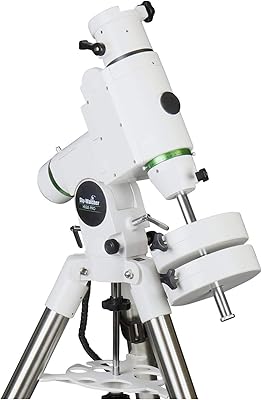
Sky-Watcher HEQ5 Computerized Equatorial Telescope Mount
85%
94%
Tracking Precision
91%
Build Quality
87%
Ease of Setup
65%
Portability
89%
Payload Capacity
More
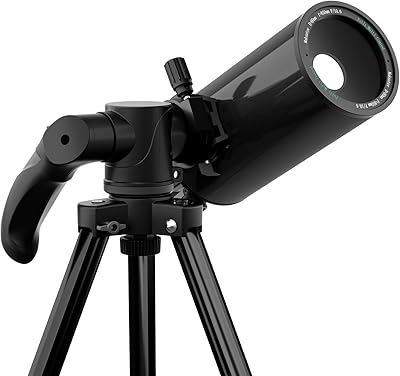
HOROX RM 80mm Maksutov-Cassegrain Telescope
72%
83%
Optical Clarity
91%
Portability
74%
Build Quality
62%
Tripod Stability
78%
Ease of Setup
More
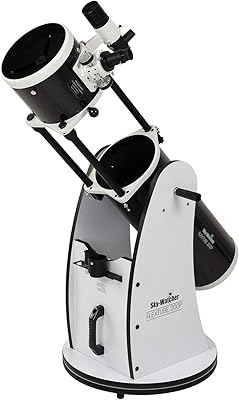
Sky-Watcher Flextube 250 10-inch Dobsonian Telescope
70%
91%
Optical Performance
74%
GoTo Accuracy
77%
Portability & Transport
83%
Build Quality
66%
SynScan Software & Interface
More
Sky-Watcher EQ6-R German Equatorial Mount
76%
88%
Tracking Accuracy
84%
Build Quality
91%
Motor & Drive System
79%
GoTo Accuracy
62%
SynScan Hand Controller
More

FAQ

It comes as an optical tube assembly only — no mount is included. You will need to purchase a compatible mount separately. The Vixen-style dovetail fits a wide range of popular mounts, including the Sky-Watcher EQ5, HEQ5, AZ-GTi, and Celestron Advanced VX, among others. Budget for a quality mount upfront; it has a bigger impact on your viewing experience than almost any other accessory.

Plan on at least 45 to 90 minutes for the optics to reach the same temperature as the outdoor air — a process called thermal equilibration. If you skip this step, you will likely see blurry, heat-shimmer images even on a calm night. Set it outside while you have dinner, then come back when it has had time to cool down. It is one of the most commonly overlooked steps with any Maksutov-Cassegrain of this size.

It can work for a motivated beginner, but it is really designed for intermediate to advanced observers. You will need to understand concepts like focal ratio, magnification limits, polar alignment, and how atmospheric seeing affects high-power views. If you are brand new to astronomy, a simpler setup with a smaller scope and included mount might give you a better first experience while you learn the basics.

It is capable of both, but the type of astrophotography it suits best is high-resolution planetary and lunar imaging. Paired with a planetary camera and a solid tracking mount, the Skymax 150 can produce excellent detail on Jupiter, Saturn, and the Moon. Long-exposure deep-sky photography is more challenging at this focal length and generally requires a very precise, high-payload mount to avoid trailing.

Both are capable 6-inch catadioptric scopes, but they have different optical formulas. The Skymax 150 Mak tends to offer slightly better contrast and a darker background due to its smaller central obstruction and the meniscus corrector design. The Celestron C6, being an SCT, has a broader accessory ecosystem and cools down a little faster. Which is better depends on your priorities — the Mak edges ahead on pure planetary contrast, while the C6 offers more flexibility.

The included 28mm eyepiece is a reasonable starting point for initial views, but most users do invest in additional eyepieces fairly quickly. A quality 6mm to 9mm eyepiece for high-power planetary work and a 2x Barlow lens are popular early additions. The stock eyepiece is fine for getting acquainted with the scope, but you will likely want more magnification range within a few sessions.

The sealed Maksutov-Cassegrain design holds collimation very well and most users find it arrives ready to use straight out of the box. Unlike a Newtonian reflector, you are unlikely to need frequent adjustments. That said, if the scope takes a hard knock or significant impact during transport, it is worth checking collimation before your next session. Sky-Watcher provides guidance on the adjustment process if it ever becomes necessary.

The 9x50 finderscope is a solid accessory for its class — at 50mm aperture, it gathers enough light to show stars clearly and make target acquisition straightforward. That said, a number of users report that aligning it to the main tube takes some patience out of the box. Set aside time during your first session to get the alignment right under daylight on a distant landmark before you head out at night.

You can see brighter deep-sky objects like the Orion Nebula, the Andromeda Galaxy, and globular clusters like M13. However, the long focal ratio of f/12 means wide-field, low-power views are harder to achieve, and faint extended objects like large diffuse nebulae can look disappointing compared to a wider, faster scope. Think of this as a planetary specialist that can also handle brighter deep-sky targets — not the other way around.

For a 150mm aperture telescope, the Skymax 150 is genuinely portable. At 14 pounds and measuring about 25 inches long, the optical tube fits comfortably in most car trunks. The sealed design also means you do not need to worry about dust contaminating the mirrors during transit. You will still need to transport your mount and tripod separately, but the optical tube itself is far less cumbersome than a Newtonian of comparable aperture.

Where to Buy