Overview

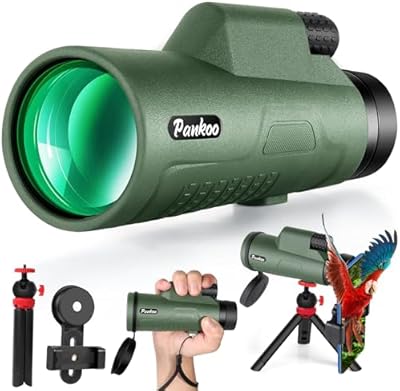
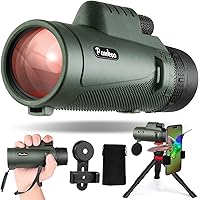
The Pankoo 40x60 Monocular is a compact, accessory-rich optic built for casual outdoor use without the bulk or expense of a full spotting scope. The 40x60 designation tells you two things: the magnification power and the width of the front lens, which together determine how much detail you can pull in and how bright that image will be. What sets this scope apart at its price point is the included bundle — a smartphone holder and an adjustable tripod come in the box, not as paid extras. Optically, it uses BAK4 prism glass and a fully multi-coated lens, both legitimate quality markers, though buyers should calibrate expectations accordingly for this tier.
Features & Benefits

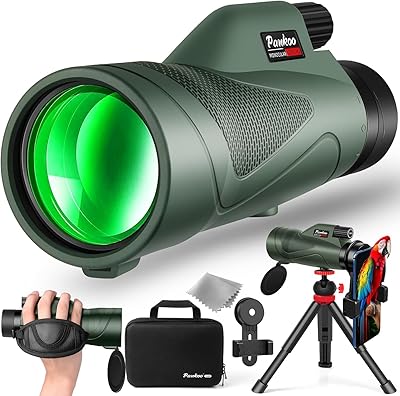
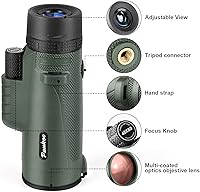
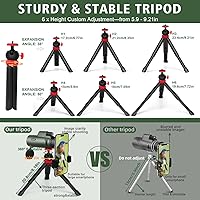
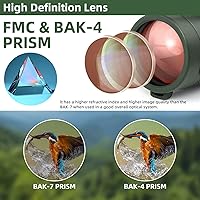
The 60mm front lens is the optical backbone here — a wider objective means more light reaches your eye, which matters when scanning a treeline at dusk or catching detail in overcast conditions. The BAK4 prism paired with full multi-coating helps maximize that light rather than scatter it, producing images noticeably cleaner than bare-glass alternatives at this price. The body is waterproof and fog-proof, so a drizzly hike or humid morning won't sideline it. The included tripod adjusts across three height settings and two tilt angles — handy for stationary watching sessions. The smartphone adapter clips on intuitively for digiscoping, and the padded carry case keeps everything organized in the field.

Best For

This compact optic hits a sweet spot for a fairly specific type of buyer. Birdwatchers who want something more pocketable than a spotting scope but don't need precision optics will find it a practical trail companion. Hikers and campers benefit from the lightweight single-tube design — at just over a pound, it won't weigh down a pack. Concert-goers or sports fans who occasionally want a closer look at the action are another natural fit. It also works well as a gift for beginners — the case, tripod, and phone holder make for a complete, well-presented package. It's less ideal for serious birders or wildlife photographers who need consistent edge-to-edge sharpness.

User Feedback

With around 45 ratings and a 4.0 average, the feedback picture is positive but still relatively thin, so individual experiences carry more weight here than usual. Several buyers highlighted how bright and clear the central image looks, especially given the price. That said, a handful of users mentioned chromatic fringing and some softness toward the edges of the view — not unusual for this category, but worth knowing going in. The tripod earns a practical nod as a welcome inclusion, though a few noted it feels less rigid at full height. The phone holder works reliably with most mid-sized smartphones but can feel awkward with larger models. The carry case earned consistent praise for its build and presentation.

Pros

  • The wide front lens pulls in solid brightness for daytime and dawn birdwatching sessions.
  • BAK4 prism glass delivers noticeably cleaner images than bare-glass alternatives at this price.
  • Waterproof and fog-proof sealing makes the Pankoo scope reliable in drizzle and humid trail conditions.
  • The included tripod and smartphone holder add genuine utility without requiring a separate purchase.
  • Weighing just over a pound, this compact optic is easy to carry on all-day hikes without fatigue.
  • The padded carry case keeps the full kit organized and protected during transport.
  • Setup is intuitive enough for first-time monocular users to start using it within minutes.
  • As a gift, the complete bundled kit makes a strong impression right out of the box.
  • The manual focus mechanism is straightforward and requires no batteries or charging.

Cons

  • Chromatic fringing and edge softness are noticeable, especially when viewing against bright or high-contrast backgrounds.
  • At full magnification, handheld stability is very difficult — a tripod becomes almost necessary for comfortable use.
  • The tripod wobbles at full height extension, reducing its usefulness for precise or sustained viewing sessions.
  • The smartphone holder struggles with larger phone models and requires patience to align properly.
  • Real-world usable magnification feels more modest than the headline spec implies — a common issue in this category.
  • The focus wheel can feel stiff or inconsistent on some units, slowing down field adjustments.
  • Tracking fast-moving subjects like birds in flight is genuinely difficult given the narrow field of view at high power.
  • With fewer than 50 reviews, long-term durability data is limited and hard to assess with confidence.
  • No diopter adjustment is available, which limits comfort for users with unequal vision between eyes.

Ratings

The Pankoo 40x60 Monocular has been evaluated by our AI rating system after analyzing verified purchaser reviews from global marketplaces, with spam, bot-generated, and incentivized submissions actively filtered out before scoring. The results reflect a candid picture of what real buyers experience in the field — from early morning birdwatching sessions to stadium concerts — covering both what this compact optic does well and where it falls short of expectations.
Optical Clarity
74%
26%
For casual daytime use, several buyers were genuinely impressed by how sharp and bright the central image appears, especially when focused on stationary subjects like perched birds or distant landmarks. The BAK4 prism and multi-coated glass do their job well enough at the price point to satisfy most recreational users.
Edge softness and mild chromatic fringing — color halos around high-contrast subjects — surface fairly often in buyer accounts, particularly when viewing against bright skies. These are expected trade-offs at this tier, but users upgrading from premium binoculars will notice the difference immediately.
Magnification Performance
68%
32%
The scope pulls in distant subjects with enough power to make bird identification or reading stadium scoreboards genuinely practical. Buyers headed to outdoor concerts or sporting events found the reach satisfying for the price, particularly when the optic was mounted on the included tripod for stability.
At maximum magnification, any hand tremor becomes exaggerated, making handheld use at full power difficult for sustained viewing. Several users noted that the practical, comfortable magnification in real-world conditions feels more modest than the spec suggests — a common reality with high-magnification budget scopes.
Low-Light Performance
66%
34%
The wide 60mm front lens pulls in a respectable amount of light for dawn and dusk sessions, and buyers who used it during golden-hour hikes or early morning birdwatching noted the image stayed reasonably bright longer than expected for the category.
Once light drops significantly — think deep shade or post-sunset — the image degrades noticeably, with contrast and sharpness both taking a hit. Users hoping to use this monocular for any low-light wildlife activity like tracking nocturnal animals will find it comes up short.
Build Quality
71%
29%
The body feels solid in hand for its weight class, with a rubberized grip that holds up well in damp conditions. Several buyers mentioned it survived rough handling during hiking trips without any visible damage or deterioration in optical alignment.
The focus wheel on some units feels slightly stiff or inconsistent, which can be frustrating when quick adjustments are needed in the field. A few buyers noted the rubber armor around the barrel showed minor peeling after extended outdoor use.
Waterproofing & Weather Resistance
78%
22%
Buyers who used the Pankoo scope during rainy coastal hikes or foggy mountain mornings reported that the sealed body held up without fogging internally or letting moisture compromise the optics. For casual outdoor use in unpredictable weather, this is a dependable feature.
The waterproofing appears to be adequate for light rain and humidity rather than full submersion or sustained heavy downpours. It is marketed for adverse weather but should not be treated as a dive-rated instrument — a distinction worth keeping in mind for more extreme outdoor conditions.
Tripod Quality & Stability
61%
39%
The tripod is a genuinely useful inclusion rather than a throwaway accessory, offering three height adjustments and two tilt angles that make hands-free viewing sessions at parks or birdwatching spots much more comfortable. Buyers appreciated that it comes ready to use out of the box.
At full extension, the tripod wobbles enough to be noticeable, particularly on uneven ground or in windy conditions. It functions well on flat, stable surfaces but does not deliver the rigidity that serious digiscopers or long-session watchers would expect from a dedicated tripod.
Smartphone Holder Usability
63%
37%
For users with standard to mid-sized smartphones, the holder clips on quickly and aligns with the eyepiece well enough to capture decent photos and short video clips. Several buyers were pleased to get shareable wildlife shots without purchasing a separate adapter.
Larger phones — particularly those with wide camera bump housings — can feel unstable or require extra fiddling to center properly. Lens alignment between phone and eyepiece is manual and imprecise, which means getting a clean, vignette-free shot takes patience and some trial and error.
Portability & Size
83%
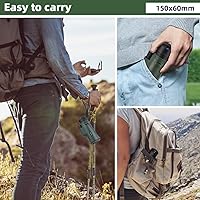
At just over a pound and compact enough to fit in a jacket pocket or day-pack side pouch, this compact optic travels well. Hikers and travelers specifically praised how little space it takes up compared to carrying a set of binoculars on longer excursions.
The carry case, while padded and well-built, adds a bit of bulk to what would otherwise be an ultra-packable setup. Users who wanted to slip the monocular into a shirt pocket found the included case was really the minimum protective option rather than a pocketable one.
Ease of Use
81%
19%
The manual focus mechanism is straightforward enough for first-time monocular users to get comfortable with quickly, and the single-tube form factor is far less intimidating than a spotting scope setup. Gift recipients with no prior optics experience reported getting usable images within minutes.
Fine focus control at high magnification requires a patient touch — overshoot the focus point and you can spend a few frustrating seconds hunting back for the sweet spot. There is no diopter adjustment for users with significant differences in vision between eyes, which limits comfort for some.
Carry Case & Packaging
84%
The padded hard-shell case is one of the most consistently praised elements across buyer reviews, with many noting it makes the product feel premium at unboxing. It holds the monocular, tripod, and accessories together neatly, which is practical for storing and transporting the full kit.
The case latch mechanism on some units feels plasticky and not especially confidence-inspiring for long-term durability. A few buyers who put the case through repeated rough use noted the hinge or closure started to loosen over time, though it remains functional.
Value for Money
76%
24%
When the full bundle is taken into account — scope, tripod, smartphone holder, and carry case — the overall package represents strong value for a casual user or beginner. Buyers who compared it against similarly priced bare-scope alternatives felt the accessory inclusion tipped the scales noticeably in its favor.
Buyers who prioritize optical quality above all else may find that the money is better spent on a simpler scope with better glass rather than this accessory-laden bundle. The accessories add perceived value but do not compensate for the optical limitations if sharp, aberration-free images are the primary goal.
Gift Suitability
87%
The presentation — a complete kit in a tidy carry case — makes this one of the more giftable optics at this price range. Buyers purchasing for birthdays, graduations, or outdoor-enthusiast family members reported the unboxing experience landed very well, giving the item a premium feel.
As a gift for someone with genuine birding or photography ambitions, it may underperform expectations once they develop beyond the beginner stage. Recipients who already own even modestly better optics may find the optical quality does not match the strong first impression the packaging creates.
Field of View
67%
33%
For tracking slow-moving subjects like perched birds or distant mountain ridgelines, the field of view is workable and buyers found subject acquisition reasonably intuitive once accustomed to the magnification level. Landscape viewing in particular was cited as a pleasant experience.
The narrow field of view that comes with high magnification makes tracking fast-moving subjects — flying birds, athletes in motion — genuinely difficult. Buyers hoping to follow action sports or mobile wildlife will find themselves frequently losing the subject and having to relocate from scratch.
Durability Over Time
62%
38%
Most buyers who used the scope across a single season of hiking or birdwatching reported no significant degradation in image quality or mechanical function. For light, occasional use, the build appears to hold together adequately over a reasonable period.
There are enough accounts of focus mechanisms stiffening, rubber grip peeling, or accessories loosening after several months of regular use to suggest this is not a buy-it-for-life tool. Heavy or daily use will likely surface durability limitations faster than the occasional weekend outing would.

Suitable for:

The Pankoo 40x60 Monocular is a strong match for anyone stepping into outdoor optics for the first time and wanting a complete, ready-to-use kit without spending heavily. Casual birdwatchers who head out on weekend nature trails will find the magnification and light-gathering capable enough to identify common species at a comfortable distance. Hikers and backpackers who want to shed the weight and bulk of binoculars without losing useful reach will appreciate the single-tube form factor and the padded case that keeps everything protected in a pack. It also works well for travelers who want one compact tool for everything from scanning landscapes to reading distant trail markers. Concert-goers or sports fans who just want occasional close-up views from the stands will find it more than adequate for that purpose. Gift buyers will find the full bundle — scope, tripod, phone holder, and carry case — makes for a well-presented, thoughtful package that punches above its price in terms of perceived value.
Not suitable for:

The Pankoo 40x60 Monocular is not the right choice for buyers who prioritize optical precision above all else. Serious birders who need clean, edge-to-edge sharpness to identify fast-moving or distant species will quickly run into the chromatic fringing and edge softness that are honest limitations of the optics at this price tier. Wildlife photographers or digiscopers hoping to capture consistently sharp, frame-ready images through the smartphone holder will find the manual alignment process too imprecise for reliable results. Anyone expecting the included tripod to perform like a dedicated photographic head will be disappointed — it is a functional bonus, not a precision instrument, and wobble at full extension is a real issue for long observation sessions. Users who already own mid-range or premium optics, even older ones, are unlikely to find a meaningful upgrade here. And if durability under heavy daily use is a priority — for field researchers, guides, or frequent travelers in punishing conditions — the long-term build quality may not hold up to that level of demand.
Specifications

  • Magnification: This monocular provides 40x magnification power, bringing distant subjects significantly closer for detailed observation.
  • Objective Lens: The 60mm objective lens diameter allows a generous amount of light to enter the optic, supporting brighter and more detailed images in varied lighting conditions.
  • Prism Type: BAK4 borosilicate crown glass prisms are used internally, a quality-tier glass choice that reduces internal light scatter compared to lower-grade BK7 alternatives.
  • Lens Coating: All optical surfaces feature fully multi-coated (FMC) treatment to maximize light transmission and minimize reflections across the visible spectrum.
  • Focus System: Focus is achieved via a manual focus wheel; no autofocus or electronic components are involved.
  • Weather Sealing: The body is waterproof and fog-proof, making it suitable for use in light rain, mist, and high-humidity outdoor environments.
  • Dimensions: The scope measures approximately 3.7″ deep by 3.7″ wide by 7.3″ tall in its standard storage orientation.
  • Weight: The monocular body weighs 1.1 pounds, keeping the overall kit manageable for day hikes and travel.
  • Tripod: An adjustable tabletop tripod is included, offering two tilt angle positions and three height settings for hands-free stationary viewing.
  • Smartphone Holder: A universal clip-style smartphone adapter is included for attaching a phone over the eyepiece to capture photos or video through the optic.
  • Carry Case: A padded hard-shell carry case is included to protect the monocular and all accessories during storage and transport.
  • Power Source: No batteries, charging, or external power source of any kind is required for operation.
  • Model Number: The official manufacturer model number for this variant is PANKOO4060-II.
  • Eye Relief: The eyepiece is designed with standard eye relief suitable for naked-eye users; eyeglass wearers may experience a reduced effective field of view.
  • Body Material: The outer body is constructed with a rubberized armor finish over a rigid internal chassis, providing grip and basic impact resistance.
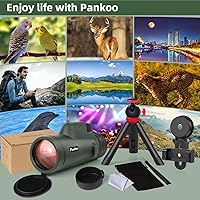
  • Included Accessories: In addition to the monocular itself, the box includes the adjustable tripod, universal smartphone holder, padded carry case, lens cleaning cloth, and lens caps.

Related Reviews

Pankoo 16x52 Monocular
74%
74%
Optical Clarity
71%
Magnification Performance
52%
Low-Light Performance
77%
Build Quality & Durability
81%
Waterproofing & Fog Resistance
More
Pankoo 12x60 Monocular
78%
83%
Optical Clarity
79%
Magnification Performance
72%
Build Quality
61%
Included Accessories
57%
Smartphone Adapter Usability
More
Pankoo 12x50 HD Monocular Telescope
84%
89%
Image Clarity
78%
Portability & Weight
85%
Build Quality
92%
Ease of Use
80%
Field of View
More
Starscope 10x42 Monocular
85%
88%
Optical Quality
91%
Ease of Use
94%
Portability & Weight
85%
Build Durability
70%
Smartphone Compatibility
More
Astromania 12X50 BAK4 Monocular
86%
88%
Image Clarity
92%
Build Quality
94%
Waterproof Performance
90%
Portability
85%
Ease of Use
More
Astromania 8X42 BAK4 Monocular
85%
88%
Visual Clarity
91%
Durability (Waterproof, Shockproof, Fogproof)
85%
Ease of Use (One-Handed Design)
80%
Field of View
87%
Portability & Size
More
Brunton Echo Monocular 7x18
82%
93%
Portability
90%
Ease of Use
85%
Optical Performance
87%
Build Quality
65%
Magnification Power
More
URBANCOAST 15x54 Monocular
77%
83%
Optical Clarity
81%
Build Quality
74%
Waterproofing & Weather Resistance
79%
Comfort & Ergonomics
77%
Magnification Performance
More
Celestron Nature 10x25 Monocular
85%
93%
Portability
88%
Optical Clarity
90%
Build Quality
85%
Ease of Use
91%
Waterproof & Fogproof Performance
More
PhysioPhyx 80x100 Monocular Telescope
84%
88%
Value for Money
91%
Optical Clarity
93%
Portability/Weight
80%
Smartphone Compatibility
85%
Build Quality
More

FAQ

It is a fair thing to question. The Pankoo 40x60 Monocular does advertise 40x magnification, and that figure technically reflects the optical design. That said, at maximum power any hand tremor becomes very exaggerated, so handheld use at full magnification can be frustrating in practice. Mounting it on the included tripod makes a noticeable difference and gets you much closer to usable, shake-free viewing at that level.

You can use it in light to moderate rain without worry — the body is sealed against moisture ingress and treated to prevent internal fogging. It is not rated for submersion, so you would not want to drop it in a stream, but a drizzly hike or a humid morning at a marsh is well within its design intent.

It is compatible with most smartphones, but larger models with wide frames or thick protective cases can be tricky to center and secure properly. The clip mechanism has a finite range of expansion, and several buyers with oversized handsets noted it felt less stable than with standard-sized phones. If you have a large flagship, budget a few extra minutes for fiddling with alignment before you get a clean, vignette-free shot.

The tripod is a practical bonus rather than a precision instrument. On flat, stable ground it works well enough to hold the scope steady for relaxed viewing. At full height extension, though, a bit of wobble is noticeable — particularly if there is any wind or if the surface is uneven. For casual sessions it gets the job done, but do not expect the rigidity of a dedicated photographic tripod.

It can be used with glasses, but the effective field of view will be somewhat reduced because eyeglass wearers naturally hold the eyepiece further from the eye. If you have mild vision correction you may be fine, but users with strong prescriptions or thick frames often find the viewing experience less comfortable compared to using it without glasses.

The wide objective lens genuinely helps here — it gathers more light than narrower budget scopes, so images stay reasonably bright into the golden hour. However, once ambient light drops significantly, the image quality degrades noticeably. This is a daytime and civil-twilight optic, not one designed for low-light or nocturnal wildlife observation.

Honestly, some chromatic aberration — color halos around high-contrast edges — and mild softness toward the periphery of the field of view are present. These are genuine trade-offs at this price tier and affect most budget monoculars to varying degrees. The central image is where the optic performs best, and for casual use most buyers find it acceptable.

Yes, that is what the included smartphone holder is designed for. You clip your phone over the eyepiece, align the camera lens with the eyepiece center, and shoot. Results work well for casual sharing — landscapes, distant birds, travel snapshots — but the alignment is manual and imprecise, so consistently sharp or perfectly framed shots take patience. Do not expect results comparable to a proper digiscoping rig.

The full kit includes the monocular, the adjustable tabletop tripod, the universal smartphone holder, a padded hard-shell carry case, a lens cleaning cloth, and protective lens caps for both the objective and eyepiece ends. Everything needed to start using it in the field arrives together, which is part of the appeal for buyers new to monoculars.

It is actually a pretty solid pick for both scenarios. The operation is simple — manual focus with no electronics or complex adjustments — and the complete bundled kit means there is nothing extra to buy. The carry case and packaging also make for a strong presentation if you are giving it as a gift. Just set realistic expectations: it is an entry-level optic, and the person receiving it should treat it as a starter scope rather than a long-term precision instrument.