
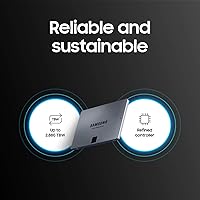
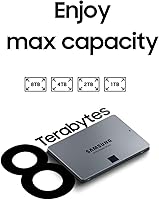
Overview

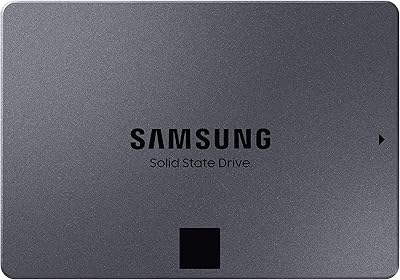
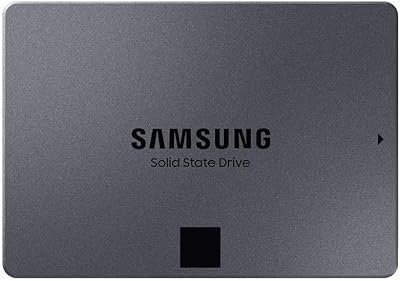
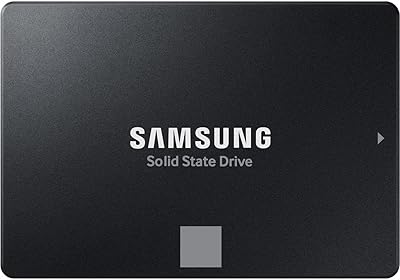
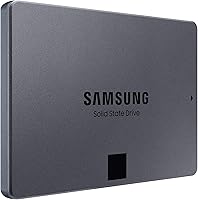
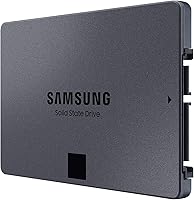
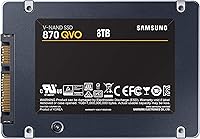
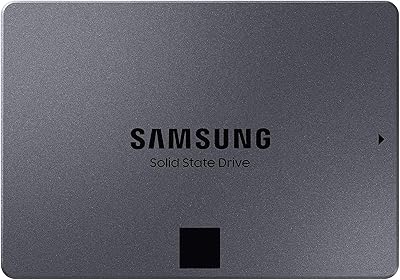
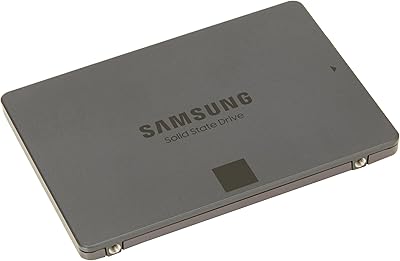
The Samsung 870 QVO 2TB Internal SSD is Samsung's second-generation QLC NAND drive, built squarely for users who need generous storage without paying a premium for cutting-edge NVMe speeds. It fits the standard 2.5-inch SATA form factor, making it a straightforward drop-in replacement for a spinning hard drive or an aging first-gen SSD. The 2TB capacity hits a practical sweet spot — enough for a Windows installation, a sizable game library, and a media collection without constantly juggling files. This SATA drive has been on the market since mid-2020 and remains one of the more consistently recommended options in its segment, which says something about how well it has held up against newer competition.

Features & Benefits

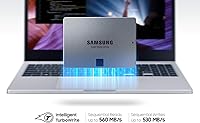
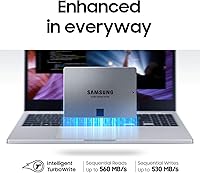
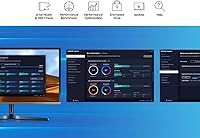
The 870 QVO 2TB pushes close to what SATA III can realistically deliver, with sequential speeds of 560/530 MB/s for reads and writes respectively. That headroom translates into noticeably snappier game launches and file transfers compared to any spinning drive. Samsung builds both the DRAM cache and NAND flash in-house, giving them tighter control over component quality than brands that source parts externally. One honest caveat: the QLC NAND architecture means sustained write speeds taper off once the TurboWrite cache fills — worth knowing if you regularly move multi-gigabyte video files. Samsung Magician handles health monitoring and firmware updates reasonably well, though some users report occasional glitches on specific system configurations.

Best For

The ideal buyer for this Samsung SSD is someone upgrading from a mechanical hard drive in an older laptop or desktop that lacks an M.2 slot. The improvements — faster boot times, quicker app launches, snappier file access — are dramatic compared to what they're replacing. It also suits home users building out a media or gaming library where raw capacity matters more than peak throughput. IT teams managing older hardware fleets often find the 870 QVO 2TB a cost-effective bulk deployment option. If your machine already supports NVMe, this drive has nothing extra to offer — it's purpose-built for users whose systems are tied to SATA.

User Feedback

Across a large pool of reviews, people upgrading from hard drives consistently describe this SATA drive as a genuine revelation in day-to-day responsiveness — boot times, game loads, and file access all improve noticeably and immediately. Installation is routinely described as painless, particularly when using Samsung's Data Migration tool. On the downside, power users have flagged that sustained write speeds drop during prolonged large transfers, which is a real QLC NAND limitation rather than a defect. The three-year warranty is shorter than what a few competitors offer, so longevity-focused buyers should factor that in. Long-term reliability looks solid overall, with very few early failure reports given the sheer volume of units in the field.

Pros

  • Boot times and application launch speeds improve dramatically compared to any mechanical hard drive.
  • The 2TB capacity offers plenty of room for a full OS install, games, and a media library simultaneously.
  • Near-SATA-ceiling speeds of 560/530 MB/s mean you are not leaving performance on the table within the interface.
  • Samsung builds both the NAND and DRAM cache in-house, resulting in more consistent component quality.
  • Installation is straightforward, and Samsung's Data Migration tool makes cloning an existing drive painless.
  • Samsung Magician provides useful drive health monitoring and firmware management in one place.
  • The 870 QVO 2TB has a strong long-term reliability track record based on a very large user base.
  • Backward compatibility with SATA 3 Gbps and 1.5 Gbps interfaces makes it usable in a wide range of older systems.
  • The slim 2.5-inch form factor fits virtually every laptop and desktop that accepts standard SATA storage.

Cons

  • Sustained write speeds drop significantly once the TurboWrite cache fills, affecting large file transfer workloads.
  • QLC NAND is inherently less write-endurance-efficient than TLC or MLC alternatives at the same capacity.
  • The 3-year limited warranty falls short of the 5-year coverage offered by several competing drives.
  • Samsung Magician software can be unreliable on certain system configurations, with occasional bugs reported.
  • This SATA drive offers no upgrade path for users who later switch to a system that only supports M.2 NVMe.
  • Random read and write performance, while adequate, trails behind even budget NVMe drives in benchmark comparisons.
  • The value proposition weakens at the higher-capacity tiers, where NVMe alternatives become more price-competitive.
  • No included mounting bracket or adapter, which can be an added cost for users with 3.5-inch drive bays.

Ratings

Our AI rating engine analyzed thousands of verified global reviews for the Samsung 870 QVO 2TB Internal SSD, actively filtering out incentivized, duplicate, and bot-generated submissions to surface what real buyers actually experience. The scores below reflect a balanced synthesis of genuine praise and recurring frustrations — nothing is glossed over. Whether this SATA drive earns a place in your system or falls short of your needs, the data tells the full story.

Everyday Performance
88%
For the overwhelming majority of users upgrading from a hard drive, the day-to-day speed improvement is immediately obvious — Windows boots in under 15 seconds, games load without the usual wait, and general file access feels responsive. Buyers consistently describe it as transformative for aging desktops and laptops.
Users who already own a mid-range NVMe SSD will notice no meaningful improvement, and the 870 QVO 2TB cannot close that gap. It hits the ceiling of what SATA allows, which is solid but not exciting in a world increasingly dominated by PCIe storage.
Sustained Write Speed
61%
39%
For short to medium bursts — copying a folder of photos, installing a game, or moving a few gigabytes of documents — the TurboWrite cache keeps things moving at full SATA speed without any noticeable slowdown. Casual users rarely push past this threshold in normal use.
Once the write cache is exhausted during large sustained transfers — think copying a 50GB video project or doing a full system backup — speeds drop noticeably to native QLC rates. Power users transferring multi-gigabyte files regularly will find this frustrating and it is the most cited technical complaint across reviews.
Installation Ease
94%
Buyers across all skill levels describe the physical installation as genuinely painless — it is a standard SATA connector with no special tools or adapters required for most 2.5-inch bays. Samsung's Data Migration software makes cloning an existing drive straightforward, even for first-timers.
A small number of users in desktop towers ran into fitment issues because no 3.5-inch adapter bracket is included in the box, requiring a separate purchase. The migration software also occasionally struggles with systems that have unusual partition layouts or third-party encryption active.
Reliability & Longevity
87%
Across a very large installed base, early failure rates are impressively low and long-term reliability reports are consistently positive. Samsung's in-house NAND and DRAM manufacturing gives the 870 QVO 2TB a quality consistency advantage that many third-party-component drives cannot match.
The QLC NAND architecture carries a lower per-cell write endurance than TLC or MLC alternatives, which is a theoretical concern for write-heavy workloads over many years. The 720 TBW rating is adequate for home users but below what competing TLC drives offer at the same capacity tier.
Value for Money
83%
The 870 QVO 2TB consistently delivers a strong cost-per-gigabyte ratio within the SATA segment, and the performance uplift over a hard drive is dramatic enough that most buyers feel the purchase is clearly justified. For systems locked to SATA, there are few better options at this capacity.
As NVMe pricing has continued to fall, the value case for this SATA drive has softened for buyers with M.2-capable systems who could spend a similar amount and get significantly faster storage. At the 4TB and 8TB tiers especially, competing products occasionally undercut it on price.
Random Access Speed
78%
22%
Random read and write performance is considerably better than any spinning hard drive, which translates directly into snappier application launches, faster boot times, and more responsive multitasking on older systems. For the intended audience, it more than gets the job done.
Against NVMe competitors, random IOPS figures are modest — the SATA interface bottleneck is unavoidable here. Users running databases, virtual machines, or other IOPS-intensive workloads will find the ceiling relatively low compared to what modern PCIe drives deliver.
Software (Samsung Magician)
71%
29%
When it works well, Samsung Magician provides genuinely useful visibility into drive health, remaining lifespan estimates, and firmware update notifications — all in one tidy interface. IT administrators managing multiple machines in particular appreciate having a structured monitoring tool available.
A meaningful portion of users report Magician behaving erratically on certain hardware configurations — crashing on launch, showing incorrect health readings, or conflicting with security software. It is a nice-to-have rather than essential, but the inconsistency is a recurring theme in negative feedback.
Compatibility
92%
The standard 2.5-inch SATA form factor and backward compatibility with older interface speeds make this one of the most universally compatible internal drives available. It works in virtually every laptop, desktop, and external enclosure that accepts a SATA drive, regardless of age.
Compatibility is a non-issue for SATA systems, but the drive is entirely useless in machines that have moved to M.2-only configurations. A small number of ultra-thin laptops also use proprietary connectors that prevent any standard 2.5-inch SSD from fitting.
Heat & Noise
91%
As a solid-state drive, the 870 QVO 2TB produces no mechanical noise whatsoever and runs noticeably cooler than the hard drives it typically replaces. Laptop users in particular appreciate the reduction in heat output during extended use sessions.
Under sustained heavy write loads — the same scenario that triggers the cache slowdown — drive temperature can climb more than under typical conditions, though it remains within safe operating ranges in virtually all reported cases. Thermal throttling is not a documented concern for typical use.
Warranty & Support
69%
31%
Samsung's brand reputation and established support infrastructure give buyers reasonable confidence that warranty claims will be handled professionally. The warranty registration and claim process is generally described as straightforward compared to lesser-known SSD brands.
The 3-year limited warranty is a genuine weak point when several competitors — including Western Digital and Crucial — offer 5-year coverage at comparable price points and capacity tiers. For buyers planning to keep a system for five or more years, this is a tangible consideration.
Build & Form Factor
89%
The slim, lightweight 2.5-inch chassis feels solid and well-finished, consistent with Samsung's broader hardware standards. At just over 3 ounces, it adds negligible weight to a laptop and installs cleanly into desktop bays without any flex or fitment concerns.
No mounting bracket or adapter is included for users with 3.5-inch bays, which is a minor but recurring frustration for desktop upgraders. The drive also lacks any external heat spreader, which is standard for the form factor but worth noting for custom builds in tight, poorly ventilated cases.
Sequential Read Speed
86%
At up to 560 MB/s, this SATA drive reaches close to the theoretical maximum of the SATA III interface — meaning buyers are not leaving performance on the table relative to what the connection standard can physically deliver. Large file reads, game streaming from disk, and OS loading all benefit.
The 560 MB/s ceiling is inherently fixed by the SATA interface, not the drive itself, so there is no firmware or configuration path to exceed it. Buyers who later upgrade to an NVMe-capable system will almost certainly want a different drive to take full advantage of the new hardware.
Capacity Options
82%
18%
The availability of 1TB, 2TB, 4TB, and 8TB variants under the same product line makes it easy for buyers to right-size their purchase. The 2TB variant in particular hits a sweet spot that covers a full OS installation alongside a large game library or media collection without constantly managing space.
Per-terabyte pricing at the higher capacity tiers becomes less competitive as QLC NAND costs have not dropped as fast as the broader SSD market. Buyers looking at the 4TB or 8TB versions should compare current pricing carefully against alternatives before committing.

Suitable for:

The Samsung 870 QVO 2TB Internal SSD is an excellent fit for anyone upgrading a desktop or laptop that still relies on a spinning hard drive and has a standard 2.5-inch SATA bay. If your machine lacks an M.2 slot — which is common in systems built before 2018 — this SATA drive is essentially the fastest storage upgrade available to you without replacing the motherboard. Home users who store large media libraries, game collections, or local backups will appreciate the generous 2TB capacity without constantly managing disk space. IT professionals maintaining a fleet of older business machines will find the 870 QVO 2TB a practical, manageable option that pairs well with Samsung Magician for remote health monitoring. For anyone currently tolerating five-minute boot times and sluggish application launches, the jump to this Samsung SSD is immediate and dramatic in everyday use.

Not suitable for:

If your system already supports NVMe storage via an M.2 slot, the Samsung 870 QVO 2TB Internal SSD simply cannot compete on throughput — NVMe drives can deliver three to five times the sequential speeds over the PCIe interface, and the price gap has narrowed significantly in recent years. Power users who regularly move large batches of high-resolution video, RAW photo archives, or multi-gigabyte files in sustained bursts will run into the QLC NAND cache ceiling, where write speeds drop noticeably once the TurboWrite buffer is exhausted. This SATA drive is also not the right choice for anyone building a new system from scratch, since modern motherboards offer faster alternatives at comparable price points. Buyers prioritizing long-term warranty coverage may want to weigh the 3-year limited warranty against competitors who offer 5-year coverage at similar capacity tiers. If maximum endurance is a priority — say, for a write-intensive workstation or a NAS array — the QLC architecture and 720 TBW rating put it below what purpose-built endurance drives offer.

Specifications

  • Capacity: The drive offers 2TB of usable storage space for operating systems, applications, games, and media files.
  • Form Factor: Standard 2.5-inch design fits any desktop or laptop with a compatible SATA drive bay.
  • Interface: Uses the SATA III (6 Gbps) interface and is backward compatible with SATA 3 Gbps and 1.5 Gbps connections.
  • Read Speed: Sequential read performance reaches up to 560 MB/s, near the practical ceiling of the SATA III interface.
  • Write Speed: Sequential write performance reaches up to 530 MB/s under cached burst conditions via TurboWrite technology.
  • NAND Type: Built on QLC (Quad-Level Cell) NAND flash memory, optimized for high-capacity storage at a mainstream price point.
  • DRAM Cache: Includes an onboard Samsung LPDDR4 DRAM cache to improve random access speeds and overall responsiveness.
  • Endurance: Rated for 720 TBW (Terabytes Written), representing the total data volume the drive is warranted to sustain over its lifetime.
  • Warranty: Covered by a 3-year limited warranty provided directly by Samsung.
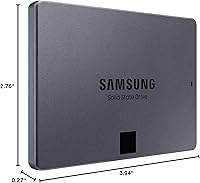
  • Dimensions: Measures 3.94 x 2.76 x 0.27 inches, conforming to the standard 2.5-inch SSD footprint.
  • Weight: Weighs 3.04 ounces, making it light enough for both portable laptop upgrades and desktop installations.
  • Compatible Devices: Designed for use in desktop PCs and laptops that support a 2.5-inch internal SATA storage bay.
  • Manufacturer: All key components, including NAND flash and DRAM cache, are designed and produced in-house by Samsung.
  • Software: Compatible with Samsung Magician, a free utility for drive health monitoring, performance benchmarking, and firmware updates.
  • Encryption: Supports AES 256-bit hardware encryption for data security at the drive level.
  • Operating Temp: Rated for operation between 0°C and 70°C (32°F to 158°F) under standard use conditions.
  • Power Draw: Consumes approximately 2.5W under active load and as little as 50mW in device sleep mode.
  • MTBF: Samsung rates the mean time between failures at 1.5 million hours, reflecting the drive's expected long-term reliability.

Related Reviews
Samsung 870 QVO 1TB 2.5″ Internal SSD
85%
88%
Real-World Read Performance
67%
Sustained Write Performance
94%
Installation Experience
86%
Value for Money
79%
Long-Term Reliability
More
Samsung 870 QVO 8TB SATA SSD
85%
85%
Performance
91%
Ease of Installation
96%
Storage Capacity
88%
Energy Efficiency
83%
Durability/Build Quality
More
Samsung 870 QVO 4TB Internal SSD
84%
88%
Everyday Performance
61%
Sustained Write Speed
93%
Storage Capacity Value
94%
Installation Experience
86%
Long-Term Reliability
More
SanDisk SSD Plus 2TB Internal SSD
82%
88%
Read Speed Performance
74%
Write Speed Performance
94%
Installation & Compatibility
91%
Value for Money
86%
Long-Term Durability & Reliability
More
Samsung 970 EVO 2TB M.2 NVMe SSD
86%
93%
Read Speed Performance
88%
Write Speed Consistency
91%
Reliability & Longevity
74%
Thermal Management
86%
Software & Ecosystem
More
Samsung 860 PRO 2TB Internal SSD
85%
88%
Read Performance
93%
Write Endurance
94%
Long-Term Reliability
58%
Value for Money
91%
Data Security Features
More
Samsung X5 2TB Thunderbolt 3 Portable SSD
79%
94%
Transfer Speed
91%
Build Quality
88%
Portability
83%
Drop & Shock Resistance
71%
Thermal Management
More
Patriot P210 2TB Internal SATA SSD
80%
93%
Value for Money
76%
Read & Write Speed
91%
Installation Ease
78%
Compatibility
67%
Long-term Reliability
More
Samsung T7 2TB Portable SSD
79%
88%
Transfer Speed
92%
Build Quality
94%
Portability
74%
Value for Money
86%
Long-Term Reliability
More
Samsung 860 EVO 2TB Internal SSD
84%
78%
Sequential Read/Write Performance
89%
Everyday Responsiveness
91%
Reliability & Longevity
86%
Build Quality & Durability
88%
Warranty & Support
More

FAQ

Yes, that is exactly the scenario this drive is built for. The 870 QVO 2TB uses a standard 2.5-inch SATA connector and is backward compatible with older SATA 3 Gbps and 1.5 Gbps interfaces, so even if your laptop predates SATA III, it will still work — just at slightly lower speeds.

The difference is dramatic. Windows boot times typically drop from over a minute to under 15 seconds, and applications launch almost instantly compared to a spinning hard drive. For everyday use — browsing, loading documents, launching games — the improvement is one of the most impactful hardware upgrades you can make to an older system.

QLC NAND uses a TurboWrite cache to handle fast bursts of data, but once that cache fills, sustained write speeds drop to native QLC rates — roughly 80 to 160 MB/s. For most everyday users this never becomes an issue, since typical tasks never push that much data continuously. If you regularly transfer multi-gigabyte video files or back up large archives in one go, you will notice the slowdown partway through the transfer.

Samsung offers a free Data Migration tool that clones your current drive directly to the Samsung 870 QVO 2TB Internal SSD, preserving your OS, settings, and files. You will need a USB-to-SATA adapter or a SATA docking station to connect the new drive externally while your old one is still running. The process is straightforward and well-documented on Samsung's support site.

It works equally well in both roles. Many users install it as a secondary drive dedicated to game storage, a media library, or local backups, while keeping their OS on a faster NVMe drive. There is no technical limitation preventing either use case.

For typical home and office workloads, the real-world difference is minimal — both drives feel fast in daily use. The 860 EVO uses TLC NAND, which offers better sustained write performance and slightly higher endurance per terabyte, while the 870 QVO trades some of that for a lower cost per gigabyte at higher capacities. If raw endurance or heavy write workloads matter, the 860 EVO has an edge; if you want more storage for the money, the 870 QVO makes more sense.

No, the drive works perfectly without it. Samsung Magician is optional software that adds useful features like health monitoring, over-provisioning settings, and firmware updates, but the drive will operate normally without it installed.

The 870 QVO 2TB is a 2.5-inch drive, so you will need a 2.5-inch to 3.5-inch mounting bracket adapter to fit it in a standard desktop bay. These adapters are widely available and inexpensive. Some cases also include tool-free trays that accept 2.5-inch drives directly, so check your case manual first.

For most home users, 720 TBW is more than sufficient. A typical home PC might write 20 to 40 GB per day, which means the drive would take decades to reach its rated write limit under normal use. The endurance rating becomes more relevant for workstations doing constant video editing, database work, or large daily backups.

Yes, the 870 QVO 2TB supports AES 256-bit hardware encryption. To use it, you generally need to enable it through your system BIOS or a compatible security management tool. Samsung Magician can also help configure encryption settings if your system supports it.