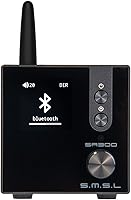
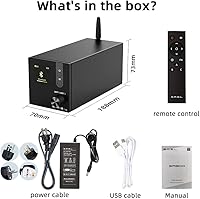
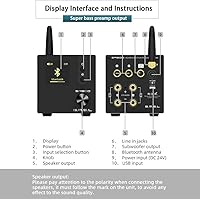
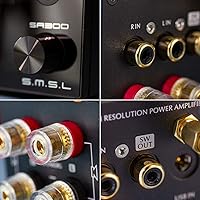
Overview

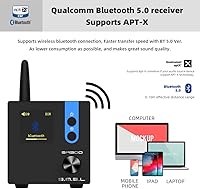
The S.M.S.L SA300 Class D Stereo Amplifier is one of those rare small-box audio devices that makes you question why you ever needed anything bigger. Built around Infineon's MA12070 chip, it delivers genuinely low-distortion amplification without the bulk or heat associated with older amplifier topologies. The CNC-machined aluminum enclosure feels more expensive than the price suggests — pick it up and the weight and finish immediately signal that corners weren't cut on the outside, at least. It ships as a complete package with a 24V adapter and remote, so there's nothing extra to source. In a crowded space that includes Fosi Audio and Lepai options, this desktop amp stands apart with built-in Bluetooth 5.0 and onboard EQ tuning.

Features & Benefits

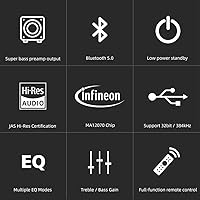
The SA300 puts out enough power to drive most bookshelf speakers to satisfying volumes in a typical bedroom or desktop setup — not concert-hall levels, but clean and controlled, which matters far more at close range. Distortion stays impressively low across the frequency range, and the signal-to-noise ratio is strong enough that background hiss is essentially absent. Qualcomm aptX Bluetooth is a genuine step up from basic wireless implementations; music stays detailed and relatively stable, though it's still a compressed codec, not a wired feed. Three physical inputs — USB, RCA, and Bluetooth — mean you can connect a computer, a turntable, and a TV without an external DAC. Eight onboard EQ presets plus manual treble and bass trim let you shape the sound without launching any software, and the damped volume knob adds a satisfying tactile finish to the whole experience.

Best For

This compact stereo amplifier is an obvious fit for anyone building a desktop speaker setup around a PC or laptop — plug in over USB, connect a pair of passive bookshelves, and you're done. It also works well for bedroom systems where space rules out a full-size receiver. If you're coming from a Bluetooth speaker or a cheap powered desktop set, this desktop amp paired with even entry-level passive speakers represents a noticeable step up in sound quality. That said, speaker matching is important: this amp isn't a power monster, so efficiency matters. It's equally well suited to Bluetooth-first listeners who still want an RCA input for a turntable or television. Beginners nervous about passive speakers will appreciate that everything — including the remote — is in the box.

User Feedback

Across well over a thousand reviews, the SA300 earns a strong overall rating, and the feedback patterns are telling. Build quality and knob feel come up repeatedly as pleasant surprises — people aren't expecting a metal chassis at this price, and it clearly resonates. Bluetooth range and aptX stability also draw consistent praise. On the other side, the eight EQ presets lack any real documentation, so most users figure them out by ear, which some find frustrating. The bundled power adapter raises occasional eyebrows, with a few buyers upgrading to an aftermarket 24V supply. A small number mention minor low-volume channel imbalance, a known behavior with some Class D implementations rather than a defect. Overall, the criticism is minor and the satisfaction rate looks healthy.

Pros

  • The CNC-machined aluminum enclosure feels noticeably premium and well-built for this price bracket.
  • Bluetooth aptX support delivers stable, detail-preserving wireless streaming over typical home distances.
  • Three inputs — USB, RCA, and Bluetooth — cover most real-world source combinations without extra hardware.
  • Eight onboard EQ presets plus manual treble and bass controls let you tune the sound without a computer.
  • Clean, low-distortion output keeps background noise essentially inaudible during quiet listening passages.
  • The volume knob has a satisfying weighted feel that budget amps in this category rarely match.
  • Includes a remote control, which adds genuine convenience for shelf or cabinet placement.
  • Arrives as a complete package with power adapter included — no extra sourcing required out of the box.
  • Over a thousand real-world ratings back up the SA300's reputation for consistent performance and build quality.

Cons

  • The eight EQ presets come with no meaningful documentation, leaving users to guess their way through settings.
  • The bundled power adapter quality has raised concern among experienced users, and an aftermarket upgrade may be advisable.
  • A noticeable channel imbalance at very low volume levels has been reported by a subset of users.
  • Speaker matching is critical — pair this amp with inefficient or low-impedance speakers and results will disappoint.
  • No headphone output, which limits versatility for mixed speaker-and-headphone listening setups.
  • Bluetooth, while better than average, is still a lossy codec and not a true substitute for wired sources.
  • No balanced or optical digital inputs, which may frustrate buyers wanting to grow into a more capable system later.
  • The EQ preset names give little hint of their actual effect, making initial setup more tedious than it needs to be.

Ratings

The S.M.S.L SA300 Class D Stereo Amplifier has been scored by our AI rating engine after processing verified purchase reviews from buyers worldwide, with spam, bot-generated, and incentivized feedback actively filtered out. Scores reflect the full spectrum of real owner experiences — from what this compact desktop amp genuinely gets right to the friction points that came up repeatedly across independent reviews. Both strengths and honest shortcomings are weighted into every category below.

Build Quality
88%
The aluminum alloy CNC-machined enclosure consistently earns genuine surprise from buyers who weren't expecting a chassis this solid at this price point. The anodized finish resists fingerprints well, and the overall rigidity feels closer to a boutique audio product than a budget import.
A small number of users noted minor cosmetic inconsistencies on unit edges and corners, suggesting quality control isn't perfectly uniform across production batches. It looks and feels premium in most cases, but it isn't flawless.
Sound Quality
83%
For a Class D desktop amp in this segment, the audio output is impressively clean and controlled — background noise is effectively absent during typical listening, and the stereo imaging holds up well with well-matched bookshelf speakers. Buyers upgrading from powered computer speakers consistently report a clear and welcome improvement.
At very low volumes, some users detect a slight softness or tonal unevenness that becomes less apparent once the level rises. It also won't satisfy listeners with revealing, high-impedance speakers that demand more current than this amplifier comfortably delivers.
Bluetooth Performance
79%
21%
The aptX over Bluetooth 5.0 implementation is stable and noticeably better than the SBC connections found in cheaper alternatives. Range across a typical living room or bedroom is reliable, and dropouts are uncommon under normal conditions.
aptX is still a compressed wireless codec — not a lossless transmission — and critical listeners will hear a difference versus a wired USB or RCA source. The amp also only supports one Bluetooth device at a time, so switching between a phone and laptop requires manual re-pairing.
Value for Money
86%
When you factor in the aluminum build, aptX Bluetooth, three inputs, onboard EQ, and remote control arriving as a single package, the SA300 represents strong value in its market tier. Comparable competitors either lack the build quality or the connectivity flexibility at a similar price.
The bundled power adapter quality undermines the overall value proposition somewhat — a portion of buyers feel it is the weakest link in the package and factor in the cost of a third-party 24V upgrade. That hidden extra cost softens what would otherwise be an easy recommendation.
Input Versatility
84%
Three distinct inputs — USB for computers, RCA for turntables or TVs, and Bluetooth for mobile devices — cover the vast majority of real desktop and small-room setups without requiring any additional switching hardware. Switching between them is straightforward and handled cleanly by the front knob.
There is no optical or coaxial digital input, which limits integration with TVs or game consoles that output digital audio only. Users hoping to connect more than three sources simultaneously will also need an external selector switch.
EQ & Tone Controls
67%
33%
Having eight preset EQ modes plus independent treble and bass adjustment built directly into the amplifier is a genuine convenience — particularly for users who want a quick tonal shift between music genres without reaching for software. The manual controls respond smoothly and predictably.
The eight presets are poorly documented with no clear labeling of what each mode targets sonically, forcing users into a trial-and-error process that can be frustrating. Without any accompanying guide or app, the EQ system feels like a feature that was added without being fully finished.
Power Output
74%
26%
Output is generous enough to drive most popular bookshelf speakers — including models from Klipsch and Polk — to satisfying levels in bedroom and desktop environments without running out of headroom. The low distortion rating means the power it does deliver stays clean rather than harsh.
Speaker matching is critical and the amp is unforgiving with low-sensitivity or low-impedance loads. Users who pair it with larger floor-standing speakers or power-hungry drivers will hit the ceiling quickly, and the output is simply not in the same league as integrated amps in higher price tiers.
Remote Control
73%
27%
The included remote covers all core functions — volume, input selection, and EQ switching — which is a meaningful convenience when the unit lives on a shelf or media stand across the room. Most buyers appreciate having it included rather than sold separately.
The remote itself feels lightweight and plasticky relative to the premium feel of the main unit, and the button layout takes some getting used to. Range and responsiveness are acceptable but not exceptional, and the remote requires a direct line of sight to function reliably.
Setup & Ease of Use
81%
19%
Plugging in and getting sound out of this amp is straightforward for most connection types — USB in particular is plug-and-play on both Windows and macOS without driver installation in typical scenarios. The single knob interface keeps the learning curve minimal for new passive speaker users.
The EQ preset system adds a layer of confusion for first-time users, and the manual is thin on practical guidance. Turntable users who don't already know they need a phono preamp may also be caught off guard by the absence of one.
Thermal Performance
82%
18%
Class D efficiency means the SA300 runs noticeably cooler than an equivalent Class A/B amplifier, which matters in small desktop environments where heat buildup can become uncomfortable. Extended listening sessions don't cause any worrying warmth through the chassis.
The unit does get warm to the touch after an hour or more of use, particularly at higher volume levels, and should not be placed in a fully enclosed cabinet without ventilation. It is not a problem under normal use, but it is worth noting for buyers planning rack or furniture integration.
Knob & Control Feel
89%
The volume knob is one of the most commented-on physical details in user reviews — it has a weighted, high-damping feel that conveys quality in a way that photos don't capture. Buyers who care about the tactile experience of using their equipment regularly mention it as a highlight.
The knob is the only physical control, which means all functions share a single interface point and some operations require multiple presses or turns to reach. Users coming from amplifiers with dedicated input selector switches may find this approach mildly inconvenient at first.
Wireless Range
76%
24%
Bluetooth 5.0 gives the SA300 a range advantage over older implementations, and most users report clean, uninterrupted streaming from a typical bedroom or home office distance without needing line-of-sight between device and amp.
Range degrades meaningfully through walls, and users in open-plan spaces or those streaming from an adjacent room report occasional instability. The Bluetooth antenna is not user-adjustable, so placement of the unit relative to the source matters more than it should.
Packaging & Unboxing
71%
29%
The unit arrives well-protected and the included accessories — adapter, remote, and basic documentation — are present and accounted for. For a mid-range product, the presentation is adequate and the amp itself shows no transit damage in the vast majority of reported cases.
The power adapter packaging and documentation quality feel noticeably below the standard set by the amplifier hardware itself, which creates an uneven first impression. The included manual is minimal and does little to help users get the most out of the EQ system.
Long-Term Reliability
72%
28%
With over a thousand reviews accumulated over several years on the market, the SA300 has a track record long enough to assess durability reasonably well. Most owners who use it as intended — desktop or small-room duty with appropriately matched speakers — report no hardware failures.
A subset of longer-term owners mention the power adapter as a potential weak point over time, and S.M.S.L's customer service responsiveness has drawn mixed feedback internationally. The 365-day support window is reassuring in principle but the experience of actually using it varies.

Suitable for:

The S.M.S.L SA300 Class D Stereo Amplifier is a strong fit for anyone building a compact desktop audio system around passive bookshelf speakers — particularly those pairing it with a PC, laptop, or small media setup where space is genuinely limited. If you're currently using powered computer speakers or an aging receiver hand-me-down and want a meaningful upgrade without dedicating half your desk to equipment, this desktop amp makes a compelling case. It also works well for Bluetooth-first listeners who still need a clean wired fallback: the combination of aptX wireless, USB, and RCA inputs means a phone, a computer, and a turntable can all coexist without a separate DAC or switcher. Bedroom and small-room setups are a natural home for it, and the included remote adds real day-to-day convenience when the unit is tucked away on a shelf. Beginners nervous about passive speakers will appreciate that the whole package — adapter, remote, onboard EQ — arrives in one box with no additional purchases required to get started.

Not suitable for:

The S.M.S.L SA300 Class D Stereo Amplifier is not the right tool if your speakers are power-hungry, low-efficiency floor-standers or demanding planar designs — its output is well-suited to sensitive bookshelves in small rooms, but it is not a high-current workhorse that can drive difficult loads cleanly at volume. Dedicated audiophiles expecting XLR balanced inputs, a high-quality headphone output, or a fully discrete analog signal path will also find the feature set too limited for their needs. If you rely heavily on Bluetooth as your only source, keep in mind that aptX is a step up from basic wireless but is still a lossy codec, not a substitute for a wired or optical digital connection. The bundled power adapter has drawn enough skepticism from experienced users that anyone planning a long-term high-fidelity setup may want to factor in the cost of a quality aftermarket 24V supply. And if you frequently listen at very low volumes in a quiet room, the minor channel imbalance some users report at the bottom of the dial could be a genuine irritant rather than an occasional curiosity.

Specifications

  • Amplifier Chip: Powered by the Infineon MA12070, a Class D amplifier IC known for efficient, low-heat operation and low distortion at real listening volumes.
  • Output Power: Delivers 80W per channel into 4-ohm loads and 40W per channel into 8-ohm loads, making it well-suited to sensitive bookshelf speakers in small to medium rooms.
  • THD+N: Total harmonic distortion plus noise is rated at 0.005%, indicating a clean signal output with minimal audible coloration under typical use conditions.
  • Signal-to-Noise Ratio: SNR is rated at 103dB, which in practice means background hiss is effectively inaudible during normal listening sessions.
  • Channel Separation: Channel separation is specified at 88dB, providing a clear stereo image with minimal crosstalk between left and right audio channels.
  • Bluetooth: Uses Qualcomm Bluetooth 5.0 with aptX codec support, offering improved wireless range and better audio detail retention compared to standard SBC streaming.
  • Inputs: Accepts audio from three sources: USB (for direct computer connection), stereo RCA (for turntables, TVs, or other line-level devices), and Bluetooth.
  • Power Supply: Operates from an included 24V DC adapter that accepts AC input between 100V and 240V, making it compatible with mains power in most countries.
  • EQ Modes: Includes eight selectable preset EQ modes plus independent manual treble and bass adjustment controls, all accessible via the front knob or remote.
  • Remote Control: Ships with a dedicated remote control that replicates all primary functions, including input selection, volume, and EQ mode switching.
  • Enclosure Material: The chassis is CNC-machined from a single aluminum alloy block with an anodized finish and chamfered edges, giving it a solid, premium feel.
  • Dimensions: The unit measures approximately 9.84″ long by 7.24″ wide by 4.53″ tall, fitting comfortably on a standard desk or small shelf.
  • Weight: Weighs 1.7 pounds, light enough to reposition easily but solid enough to stay put during normal use.
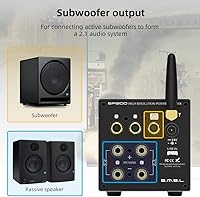
  • Channels: A stereo two-channel design intended exclusively for use with passive speakers; it does not support powered or active speaker connections.
  • Warranty Support: S.M.S.L offers a 365-day customer service guarantee, committing to respond to product issues raised within one year of purchase.
  • Model Number: The official model designation is SA300, manufactured by Shenzhen Shuangmusanlin Electronic Co., Ltd under the S.M.S.L brand.

Related Reviews
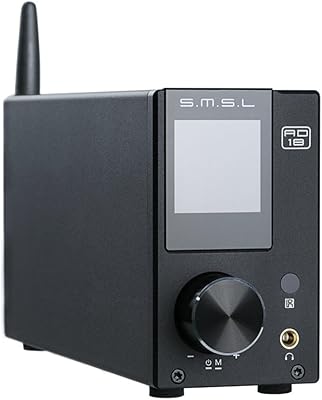
SMSL AD18 Digital Stereo Amplifier
79%
86%
Sound Quality
93%
Input Versatility
88%
Bluetooth Performance
81%
Build Quality
52%
Remote Control
More
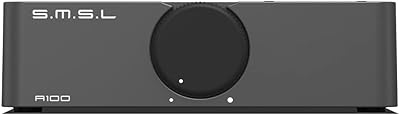
SMSL A100 Stereo Class D Amplifier
78%
83%
Sound Quality
79%
Bluetooth Performance
86%
Input Versatility
71%
USB Audio Reliability
63%
Build Quality
More
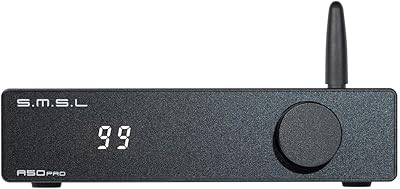
SMSL A50 Pro 2.1-Channel Power Amplifier
81%
88%
Sound Quality
91%
Crossover Flexibility
86%
Subwoofer Integration
89%
Connectivity Range
71%
Bluetooth Performance
More
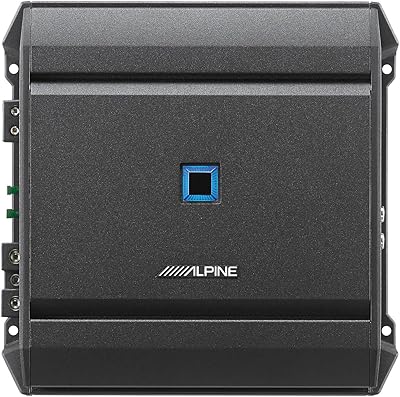
Alpine S-A60M
Alpine S-A60M
82%
91%
Power Accuracy & Honesty
88%
Thermal Performance
87%
Ease of Installation
79%
Signal-to-Noise Ratio
74%
Bass Boost Quality
More
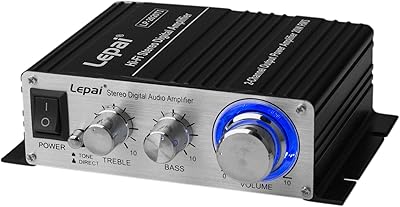
Lepai LP-2020TI Stereo Amplifier
75%
83%
Sound Quality
91%
Value for Money
89%
Ease of Setup
61%
Build Quality
67%
Reliability & Longevity
More
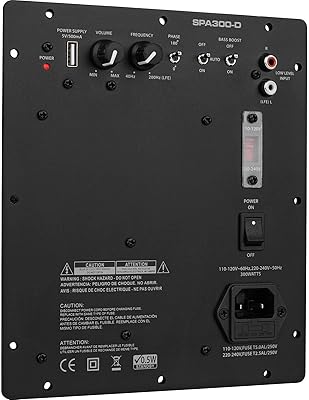
Dayton Audio SPA300-D
80%
88%
Power Output & Headroom
83%
Bass Quality & Low-End Extension
86%
Signal Clarity & Noise Floor
79%
Build Quality & Durability
91%
Ease of Installation
More
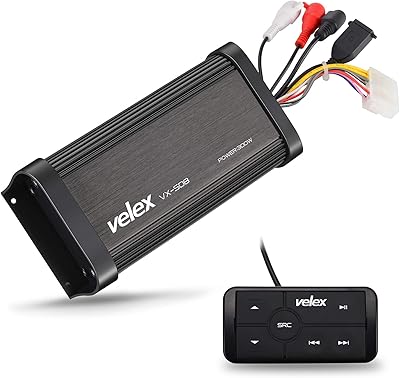
Velex VX508 Class-D Marine Amplifier
75%
83%
Sound Quality
79%
Build Quality
76%
Waterproofing
58%
Installation Experience
86%
Bluetooth Performance
More
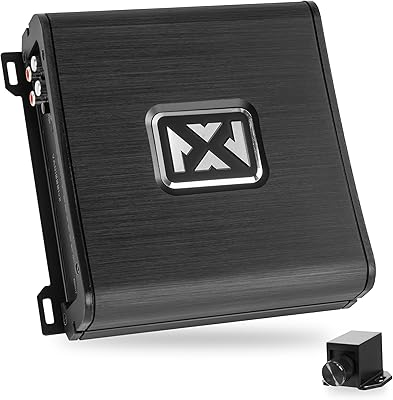
NVX VADM1v2 Monoblock Amplifier
82%
88%
Power Output
93%
Compact Form Factor
71%
Thermal Management
86%
Tuning Controls
74%
High-Level Input Usability
More
NVX VAD10001 v2 Monoblock Class D Amplifier
88%
91%
Sound Quality
93%
Build Quality
85%
Ease of Installation
88%
Bass Control Flexibility
89%
Heat Management
More
Audiobank P8001 Monoblock Car Amplifier
63%
74%
Value for Money
31%
Power Accuracy
81%
Ease of Installation
57%
Build Quality
53%
Thermal Management
More

FAQ

Yes, the SA300 handles both 4-ohm and 8-ohm loads. Power output drops roughly in half at 8 ohms compared to 4 ohms, but for most bookshelf speakers in a small to medium room that is still more than adequate. The key variable is speaker sensitivity — more efficient speakers will sound louder and cleaner at lower power levels.

Yes, the USB input lets you connect a PC or Mac directly and use the amp as a USB audio device. No separate DAC or sound card is required. Your computer should recognize it automatically in most cases, though you may need to select it as your default audio output in your system settings.

The S.M.S.L SA300 Class D Stereo Amplifier uses Qualcomm aptX over Bluetooth 5.0, which is a genuine step up from basic Bluetooth audio. Range is solid across a typical room with no walls in between. That said, aptX is still a lossy compressed codec — it sounds noticeably better than standard SBC, but it is not identical to a wired connection if you are listening critically.

The presets do make an audible difference, shifting the tonal balance in ways that range from subtle to quite obvious depending on the mode. The honest downside is that the presets are not well documented, so most users cycle through them by ear until something clicks. Think of it as a useful tuning tool rather than a precision equalizer.

You can connect a turntable via the RCA input, but only if your turntable already has a built-in phono preamp or if you have a separate phono stage in the chain. The SA300 itself does not include a phono preamp, so plugging a raw cartridge signal directly into the RCA input will produce a very quiet, thin sound.

The bundled adapter works fine for most users out of the box. That said, a vocal subset of experienced buyers have reported that switching to a quality aftermarket 24V DC supply produced a slight improvement in noise floor and stability. It is not a necessary upgrade to enjoy the amp, but if you are chasing the last bit of performance, it is worth looking into.

Probably not — this is a known characteristic of certain Class D amplifier implementations and is related to how the volume control circuit behaves at the extreme low end of its range. It typically disappears once the volume is turned up even slightly. If the imbalance persists across normal listening levels, that would be worth flagging to S.M.S.L support.

All three occupy a similar price and use-case territory, but the SA300 differentiates itself with a more substantial aluminum chassis, aptX Bluetooth, and onboard EQ presets. The Fosi BT20A is a solid, simpler option, while the SA300 offers more input flexibility and a noticeably more premium physical build. Which is better depends on whether those extras matter to your specific setup.

Class D amplifiers are significantly more efficient than Class A or A/B designs, and the SA300 reflects that — it runs warm during extended sessions but not uncomfortably hot. Normal ventilation around the unit is sufficient; you do not need to leave large gaps around it, though avoiding enclosed spaces with no airflow is always sensible practice.

Efficient bookshelf speakers in the 85dB sensitivity range or higher tend to work best — models like the Klipsch R-51M, Polk Audio T15, or similar entry-to-mid-level bookshelves are popular pairings. Avoid pairing it with large floor-standing speakers or anything that needs high current to come alive, as the SA300 is optimized for near-field and small-room listening rather than filling large spaces.