Overview

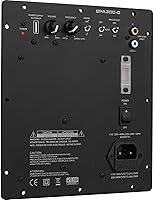
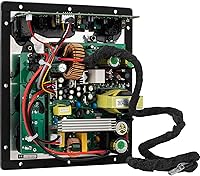
The Dayton Audio SPA300-D is a plate-style subwoofer amplifier built for DIY speaker builders and home theater enthusiasts who want dependable performance without stretching into audiophile pricing. It has been around long enough to build a genuine reputation, and you will find it recommended regularly in the Parts Express community and across DIY audio forums. The plate format mounts flush into the rear wall of a subwoofer enclosure, keeping the build clean and self-contained. What makes it worth considering at this tier is a Class-D output stage that runs efficiently, generates manageable heat, and delivers 300 watts RMS without the bulk or running costs of older Class-AB designs.
Features & Benefits

The SPA300-D pushes 300 watts RMS into a 4-ohm load, with a 600-watt peak that provides real headroom when bass transients hit hard. The switchable 6dB boost at 30Hz adds low-end weight when you want it — useful for film content, less ideal for accurate music reproduction, so it is smart that it can be turned off entirely. Variable gain and phase controls let you integrate the sub into your room without sourcing additional components. Both manual and auto on/off modes are included, which covers a wide range of system configurations. Internationally, the switchable 115–230V input is a practical addition that removes a common compatibility headache for builders outside North America.

Best For

This plate amplifier fits two situations particularly well: building a custom subwoofer enclosure from scratch, or swapping out a failed OEM amp in an existing cabinet. If you have done basic panel work before, the installation is straightforward — the 7″ H x 6″ W cutout spec is standard, and the onboard controls reduce how much extra hardware you need. It is a strong match for 4-ohm driver builds, and the feature set covers what most home theater setups actually require. Budget-conscious builders get a competitive package here. Those running dual-voltage environments, whether internationally or in mixed-standard installations, will also find the switchable voltage input a genuine convenience rather than a marketing footnote.

User Feedback

Across retailer reviews and forum discussions, the recurring theme is that this subwoofer amp installs without drama and holds up reliably over time. Long-term durability gets consistent praise, and most users report satisfying bass output for both film and music use. The criticism that comes up most often involves the auto-on circuit — some find it slow to trigger from weak input signals or inconsistent with certain preamp outputs. Heat buildup during extended high-volume sessions is another flag, particularly in sealed or cramped enclosures. A handful of buyers have noted QC variance and occasional shipping damage, so a close inspection on arrival is worth the extra minute. Overall sentiment leans positive, with caveats.

Pros

  • 300 watts RMS delivers more than enough clean output for most home theater subwoofer builds.
  • Class-D design runs efficiently with far less heat than older plate amp technologies.
  • Variable phase control allows precise subwoofer integration without buying a separate crossover.
  • Switchable 30Hz bass boost is a handy option for film content — and easy to leave off for music.
  • The SPA300-D has a proven long-term reliability record backed by years of DIY community use.
  • Standard cutout dimensions make enclosure installation straightforward for experienced builders.
  • Dual-voltage support covers international use without adapters or external converters.
  • Both manual and auto on/off modes provide real flexibility across different system configurations.
  • Noise floor is impressively low for the price tier, keeping the background clean at normal gain settings.
  • Strong value relative to competing plate amps at this wattage and feature level.

Cons

  • Auto-on circuit can be unreliable with weak or low-voltage signals from budget receivers.
  • No variable low-pass crossover onboard — precision frequency tuning depends on your receiver or external DSP.
  • Packaging has been flagged repeatedly for not adequately protecting the unit during rough courier handling.
  • Unit-to-unit QC variance means a small but notable number of buyers receive imperfect examples.
  • The 30Hz bass boost is broad and not adjustable, making it too blunt for critical music listening.
  • Sustained high-volume use in tightly sealed, poorly ventilated enclosures can push operating temperatures uncomfortably high.
  • No detents or precise markings on the gain and phase controls make repeatable settings difficult to restore.
  • Input headroom can be insufficient when paired with high-output preamps, risking distortion before reaching target volume.
  • The manual does not adequately address troubleshooting for atypical source or receiver pairings.
  • Faceplate and control feel is functional but clearly cost-engineered — not a premium tactile experience.

Ratings

The Dayton Audio SPA300-D has earned a well-worn spot in the DIY audio community, and these scores reflect what real buyers across verified global reviews actually experienced — after filtering out incentivized, bot-generated, and outlier feedback. Our AI analysis weighted patterns from thousands of hands-on accounts to surface both the genuine strengths and the friction points that show up repeatedly. The result is a transparent picture of where this subwoofer amp earns its reputation and where it leaves some users wanting more.
Power Output & Headroom
88%
Most builders running 4-ohm drivers in medium to large enclosures report that 300 watts RMS is more than sufficient for home theater use, with clean transient response during demanding film scenes. The 600-watt peak headroom means the amp rarely feels strained at realistic listening levels.
In very large rooms or with less-efficient drivers, some users felt the output ceiling was limiting compared to higher-wattage competitors. Those chasing reference-level SPL in bigger spaces may eventually outgrow it.
Bass Quality & Low-End Extension
83%
Users consistently describe the low-end as tight and controlled for the price tier, particularly in sealed enclosures tuned around 25–35Hz. The switchable 30Hz boost adds noticeable weight for film content without muddying the mid-bass when used carefully.
The bass boost is a broad-strokes tool — not surgical — and a few listeners found it too blunt for music-critical applications. Without an external DSP, those chasing room-corrected accuracy have limited fine-tuning options beyond gain and phase.
Signal Clarity & Noise Floor
86%
For a plate amp at this price, the noise floor is impressively low in typical listening environments. Builders integrating it into home theater systems report a clean background even at higher gain settings, which speaks well to the 101dB SNR spec translating into real-world use.
A small subset of users reported a faint hiss when the amp was idle in very quiet rooms or near-field setups. This was not universal, but it points to some unit-to-unit variance that can affect sensitive listening environments.
Build Quality & Durability
79%
21%
Long-term reliability is one of the most praised aspects across DIY forums. Many users report units running without issues for three to five years of regular use, which is meaningful for a component permanently installed inside a sealed cabinet.
The chassis and faceplate feel functional rather than premium — no complaints for a hidden plate amp, but a few buyers noted that the controls feel slightly plasticky. QC variance exists, with occasional reports of units arriving with cosmetic or minor functional issues.
Ease of Installation
91%
The standard 7-inch by 6-inch cutout dimensions align with common router templates, and the wiring layout is logical enough that builders with moderate DIY experience can complete the install in under an hour. Onboard controls reduce the need for external components, which streamlines the whole build.
Absolute beginners without prior speaker building or basic electrical experience may find the install less intuitive. The manual, while adequate, does not go deep on troubleshooting edge cases like mismatched sensitivity levels from certain preamp outputs.
Auto On/Off Reliability
62%
38%
When paired with a preamp or AV receiver outputting a reasonably strong signal, the auto-on circuit wakes up reliably and quickly. Users in straightforward two-channel or 5.1 setups generally find it works without intervention.
This is the most consistently flagged frustration in user reviews. Weak or low-voltage trigger signals — common with some budget receivers — cause delayed or missed activation. Several users ultimately switched to manual mode as a permanent workaround, which defeats the convenience.
Thermal Management
71%
29%
Class-D topology keeps heat generation meaningfully lower than older AB-class plate amps, and most users report the unit running warm but never uncomfortably hot during standard listening sessions of two to three hours.
Extended high-volume use — particularly in tight, sealed enclosures with limited ventilation — can push temperatures to the point where some users expressed concern. A few reported thermal throttling behavior, though outright failures attributed to heat were rare.
Phase & Gain Controls
81%
19%
The variable phase control is a genuine differentiator at this price point, letting users dial in subwoofer integration without a separate crossover or DSP unit. Builders consistently praise how much flexibility this adds to the tuning process, especially in asymmetrical rooms.
The controls are functional but not precision instruments — there are no detents or markings precise enough for repeatable settings if you ever need to reset after a change. Fine-tuning by ear is required, which is not a problem for experienced builders but can frustrate newcomers.
Value for Money
87%
Within the DIY plate amp segment, the SPA300-D consistently ranks as one of the better-value options for the feature set delivered. The combination of power output, onboard controls, and dual-voltage support at this price tier is difficult to match from competing brands.
The value equation weakens slightly if you factor in the auto-on inconsistency, which may require additional workarounds. Buyers who encounter QC issues and need to manage a return or replacement feel the value proposition takes a hit.
Dual-Voltage Compatibility
89%
International buyers specifically highlight the 115–230V switchable input as a practical advantage, particularly in markets where sourcing a well-specified plate amp locally is difficult or expensive. It removes a step that would otherwise require a separate voltage converter.
The voltage selector switch requires a deliberate manual change before powering on in a different region — there is no auto-sensing. Users who travel with or ship their builds internationally need to remember to check this, as incorrect settings could cause damage.
Crossover Flexibility
74%
26%
The built-in low-pass crossover handles the fundamental task of rolling off upper frequencies cleanly, and most home theater users find the range adequate for standard subwoofer integration with a full-range main system.
Audiophiles wanting precise crossover frequency adjustment will find the onboard options limited. Without a variable low-pass control or built-in parametric EQ, the amp relies on your receiver or preamp to handle crossover duties if you need tighter control.
Shipping & Packaging
67%
33%
The majority of buyers receive the unit intact and functional straight out of the box. For a relatively compact and lightweight component, most standard shipping scenarios cause no issues.
A recurring thread in negative reviews involves inadequate packaging for a component with exposed controls and connectors. Dented faceplates and bent connectors appear often enough in one-star reviews to suggest the packaging does not consistently absorb rough courier handling.
Input Sensitivity & Compatibility
76%
24%
The 200mV input sensitivity works well with most standard line-level outputs from AV receivers and preamps, and users generally report no issues matching levels without maxing out the gain control.
A minority of users with high-output preamps found the amp could be driven into noticeable distortion before achieving the desired volume, suggesting the input stage has a relatively low headroom ceiling. Matching with atypical source components requires more careful setup.

Suitable for:

The Dayton Audio SPA300-D is built for a specific kind of buyer, and it serves that buyer well. If you are constructing a custom subwoofer enclosure from scratch — whether it is a ported bass reflex cabinet for movies or a sealed box for tighter music reproduction — this plate amplifier fits the job without requiring a separate external amp, crossover, or power management unit. Home theater enthusiasts who have an older subwoofer cabinet with a dead or underpowered OEM amp will find the standard cutout dimensions and onboard controls make it a practical drop-in replacement. The dual-voltage input is genuinely useful for international buyers or anyone purchasing for installation in a dual-standard environment, removing a compatibility step that other plate amps at this tier skip entirely. Budget-conscious builders who want a unit that has earned trust across the Parts Express and AVS Forum communities — rather than an unknown brand — will feel confident in the long-term reliability track record this subwoofer amp has accumulated over years of real-world use.
Not suitable for:

If you are expecting a plug-and-play solution with no technical involvement, the Dayton Audio SPA300-D will likely frustrate you — it is a component for builders, not a finished product for casual buyers. Listeners who rely heavily on the auto-on function and use a receiver with a low-output trigger signal may find the activation circuit unreliable enough to become a persistent annoyance. Those chasing genuinely room-corrected bass response will hit the limits of the onboard controls fairly quickly; without a variable low-pass filter or any DSP capability, you are dependent on your receiver or a separate processor to handle precision crossover duties. Anyone building for a large room, high-SPL environment, or using a low-sensitivity driver should also think carefully — at 300 watts RMS, this subwoofer amp is well-matched to typical home theater use but is not the right tool for demanding installations that routinely push boundaries. And if you are an audiophile prioritizing absolute sonic accuracy over practicality and value, there are higher-specification options worth the additional investment.

Specifications

  • RMS Output: Delivers 300 watts RMS into a 4-ohm load, providing sufficient continuous power for most home theater subwoofer enclosures.
  • Peak Output: Rated at 600 watts peak, offering headroom to handle dynamic bass transients without clipping under normal listening conditions.
  • Amplifier Class: Class-D output stage operates with high switching efficiency, generating significantly less heat than equivalent Class-AB designs.
  • Frequency Response: Covers 20Hz to 200Hz, spanning the full subwoofer range from deep infrasonic content up to the standard low-pass crossover region.
  • Bass Boost: Includes a switchable 6dB boost centered at 30Hz, which can be enabled or disabled depending on content type and listener preference.
  • Signal-to-Noise Ratio: Achieves 101dB SNR (A-weighted), indicating a low noise floor that keeps background hiss inaudible during typical home listening sessions.
  • Total Harmonic Distortion: THD is rated at under 1.5%, reflecting clean output with minimal audible coloration across the operating power range.
  • Input Sensitivity: Accepts line-level signals with 200mV input sensitivity, compatible with standard preamp and AV receiver subwoofer output connections.
  • Input Voltage: Features a manually switchable 115–230V AC input, allowing use in both North American and international electrical environments.
  • Channels: Single-channel (mono) design, purpose-built for driving one subwoofer driver per unit as intended in plate amplifier applications.
  • On/Off Modes: Supports both manual power switching and an auto-sensing mode that activates the amplifier when an input signal is detected.
  • Controls: Onboard variable gain and variable phase controls allow the user to optimize subwoofer output level and timing integration relative to main speakers.
  • Plate Dimensions: The amplifier plate measures 8-1/16″ high by 7-1/16″ wide, determining the external footprint visible on the rear of the enclosure.
  • Cutout Dimensions: Requires a panel cutout of 7″ high by 6″ wide for flush mounting into a subwoofer cabinet rear baffle.
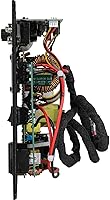
  • Depth: Protrudes 2-1/8″ into the enclosure interior, a dimension that must be accounted for when calculating usable internal cabinet volume.
  • Weight: The unit weighs 2.2 lbs, making it lightweight enough to mount securely in a thin MDF or plywood rear panel without structural reinforcement.
  • Inputs: Provides one line-level input connection for integration with a subwoofer output or LFE channel from a preamplifier or AV receiver.
  • Power Consumption: Draws up to 300 watts from the mains supply at full rated output, consistent with the Class-D efficiency profile of the amplifier stage.

Related Reviews
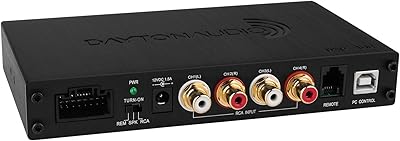
Dayton Audio DSP-408
85%
94%
Value for Money
88%
Software Interface & GUI
92%
Audio Routing Flexibility
87%
Compactness & Form Factor
61%
Out-of-the-Box Connectivity
More
Dayton Audio Classic B40
77%
88%
Sound Clarity
91%
Treble Performance
54%
Bass Extension
83%
Build Quality
93%
Value for Money
More
Dayton Audio Wave-Link WLS System
86%
89%
Wireless Performance
91%
Ease of Setup
87%
Multi-room Compatibility
84%
Sound Quality
65%
Latency
More
Dayton Audio APA150
Dayton Audio APA150
81%
88%
Sound Quality
83%
Build Quality
91%
Value for Money
89%
Noise Floor & Fan Operation
61%
Crossover Precision
More
Dayton Audio Classic B65
78%
83%
Sound Quality
71%
Bass Performance
86%
Treble Clarity
78%
Build Quality
91%
Value for Money
More
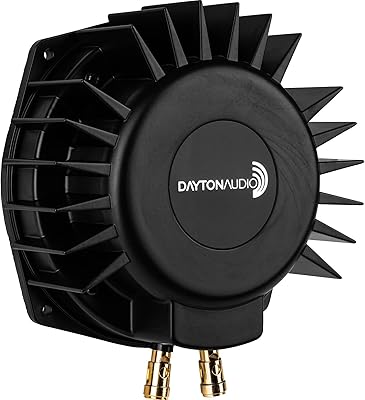
Dayton Audio BST-300EX Bass Shaker
84%
88%
Bass Performance
91%
Build Quality
85%
Ease of Setup
90%
Value for Money
87%
Durability
More
Dayton Audio Classic T65 Tower Speakers
86%
91%
Sound Quality
87%
Bass Performance
88%
Treble Clarity
85%
Power Handling
92%
Build Quality
More
Dayton Audio CCS-33B Center Channel Speaker
90%
94%
Sound Clarity
96%
Dialogue Intelligibility
87%
Bass Performance
91%
Build Quality
90%
Ease of Installation
More
Dayton Audio SUB-1000 10″ Powered Subwoofer
84%
92%
Value for Money
88%
Bass Performance
93%
Compactness/Size
85%
Setup & Integration
89%
Sound Clarity
More
Dayton Audio SD215A-88 8″ DVC Subwoofer
85%
92%
Sound Quality
89%
Bass Response
85%
Ease of Installation
90%
Durability
87%
Value for Money
More

FAQ

You need a rectangular cutout measuring 7 inches high by 6 inches wide. The full plate is slightly larger at 8-1/16″ by 7-1/16″, so that outer lip overlaps the panel and covers the edges of your cut. Most builders use a router with a straight bit and a simple jig to get clean results.

It can drive an 8-ohm driver, but the rated 300 watts RMS is specified at 4 ohms — into 8 ohms you will get roughly half that power output. If your driver is 8 ohms, the amp will still function and sound fine, but you will not be extracting its full potential. For best results, pair it with a 4-ohm driver as intended.

This is a known pain point for a subset of users, particularly those with receivers that output a relatively weak subwoofer signal. The auto-sensing circuit needs a strong enough signal to trigger consistently. If your receiver has a subwoofer level adjustment, try bumping it up. If the problem persists, simply switching to manual mode and using your system's master power sequencing is a practical and widely used workaround.

Not necessarily. The boost adds 6dB at 30Hz, which sounds great for action films and content with deep LFE tracks, but it can make music reproduction feel heavy or one-note depending on your enclosure tuning. A good approach is to leave it off as your default and switch it on for dedicated movie sessions if you want that extra low-end impact.

Yes, as long as you manually switch the voltage selector to the 230V position before connecting it to mains power. The amp supports 115–230V AC, so it is electrically compatible with European and UK outlets — just do not forget to set the switch first, as leaving it on 115V and plugging into 230V mains will damage the unit.

The amplifier body protrudes 2-1/8 inches into the enclosure once mounted. This is not a large intrusion, but it is worth factoring into your internal volume calculations, especially if you are working with a compact sealed box where every liter counts.

For a typical home theater room up to around 3,000 to 4,000 cubic feet, 300 watts RMS into a well-matched 4-ohm driver in a properly tuned enclosure is generally more than adequate. In very large or open-plan spaces, or if you are building for genuinely high SPL levels, you may eventually want something with more headroom. For most living room setups, it will perform without limitations.

Under normal use, the Class-D design keeps heat manageable — warm to the touch but not concerning. The issue arises during extended high-volume sessions in a very tight, sealed enclosure with no ventilation path. If your cabinet is on the smaller side and you listen loud for long periods, it is worth drilling a small ventilation port near the amp plate or ensuring the cabinet is not in a fully enclosed furniture bay.

You can, provided your TV has a variable line-level audio output or a dedicated subwoofer output. Many modern TVs only have optical or HDMI ARC outputs, which are digital and not directly compatible with this amp's analog line-level input. In that case, you would need a DAC or AV receiver in the chain. Check your TV's audio output options before assuming a direct connection will work.

Packaging quality has been flagged by some buyers as inconsistent, so a thorough inspection on arrival is worth the time. Check the faceplate for dents or cracks, verify that all controls turn smoothly without feeling loose or gritty, and inspect the input and speaker terminals for any bent or misaligned connectors. If anything looks off, document it with photos immediately before doing any installation work — it will make a warranty or return claim much easier to process.