Overview

The SMSL A50 Pro 2.1-Channel Power Amplifier is one of those compact units that quietly overdelivers for what it costs — a practical choice for anyone building a real 2.1 speaker system without raiding their savings. At its core is Infineon's MA12070P chip, which is worth calling out because it's the reason this little box runs cool, draws only 36 watts under load, and keeps distortion impressively low. SMSL has carved out a respectable niche in budget HiFi, and this compact 2.1 amplifier fits squarely within that tradition. Just keep expectations calibrated: this is an amplifier for passive speakers and a passive subwoofer, not a full AV receiver with room correction or processing.
Features & Benefits

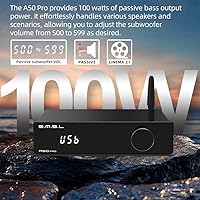
The A50 Pro delivers 70 watts per channel into 4-ohm loads for the main speakers and a dedicated 100-watt channel for a passive subwoofer — that's enough grunt for a satisfying desktop or small-room setup. What really stands out, though, is the adjustable crossover: you get ten selectable frequency points for both the high-pass and low-pass filters, which lets you dial in exactly where your subwoofer takes over from your main speakers. That's a level of tuning control that usually costs significantly more. The subwoofer volume is independently adjustable across a wide range, so blending bass with your mains is straightforward. Add Bluetooth 5.0, driver-free USB-C, HDMI ARC, optical, and AUX inputs, and this SMSL unit connects to nearly everything.

Best For

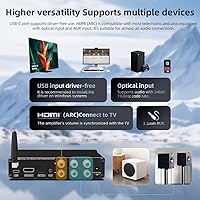
This compact 2.1 amplifier is an especially strong fit for desktop listeners pairing bookshelf speakers with a passive subwoofer — think a dedicated music corner or a home office setup where you actually want to hear what your speakers can do. TV owners will appreciate the HDMI ARC input, which connects directly to most modern televisions without needing an optical adapter or splitter box. PC users benefit from the driver-free USB-C connection, making audio setup genuinely plug-and-play. One honest caveat: this unit works best in small to medium rooms. It doesn't include room correction, and its output levels, while capable, aren't engineered for large open spaces or serious home theater installations.

User Feedback

Across buyer communities and forum discussions, the A50 Pro earns consistent praise for its clean, quiet output — users frequently note the near-silent noise floor during quiet passages, which reflects those solid distortion and signal-to-noise figures in real-world listening. The independent subwoofer volume control also gets regular mentions as something people find genuinely useful on a day-to-day basis. On the flip side, some users have flagged occasional Bluetooth pairing hiccups, particularly when switching between devices, and a handful find the remote control range underwhelming in larger rooms. Build quality impressions are mixed — the unit feels lightweight, which some find reassuring for desk space, while others would prefer something more substantial. Overall, the consensus leans positive for the price category.

Pros

  • Adjustable crossover with ten frequency points each for high-pass and low-pass — rare at this price tier.
  • Independent subwoofer volume control makes daily bass adjustments quick and intuitive.
  • HDMI ARC input connects directly to most modern TVs without adapters or extra cables.
  • USB-C audio works without installing any drivers, making PC setup genuinely plug-and-play.
  • THD+N of 0.013% means the audio signal stays clean even at higher listening volumes.
  • Bluetooth 5.0 handles wireless streaming from phones or tablets without noticeable lag.
  • The Infineon MA12070P chip keeps the unit running cool and energy-efficient under sustained use.
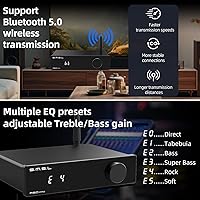
  • Multiple EQ presets and tone controls let you adapt the sound for different music genres.
  • At 0.3Kg, this compact 2.1 amplifier takes up almost no desk or shelf space.
  • A 12-month warranty offers reasonable peace of mind for an entry-level HiFi investment.

Cons

  • Bluetooth pairing can be inconsistent when switching between two or more source devices.
  • The remote control range feels limited, which matters if the unit is placed further from your seat.
  • No room correction or automatic equalization means acoustic tuning is entirely manual.
  • Passive subwoofer compatibility depends on impedance matching — buyers need to check their sub specs before purchasing.
  • The display can be difficult to read at a glance, particularly in bright ambient lighting conditions.
  • Build quality feels noticeably lightweight, which may affect long-term durability confidence.
  • No analog preamp output limits integration options if you want to expand the system later.
  • The subwoofer channel is rated at 2Ω, which narrows the range of compatible passive subs on the market.

Ratings

Our AI rating engine analyzed verified buyer feedback for the SMSL A50 Pro 2.1-Channel Power Amplifier from communities and retailers worldwide, actively filtering out incentivized, bot-generated, and suspiciously timed reviews to surface genuine user sentiment. The scores below reflect a balanced picture — where this compact 2.1 amplifier consistently earns trust, and where real buyers have run into friction. Both the standout strengths and the recurring frustrations are represented honestly.
Sound Quality
88%
Users consistently describe the audio output as clean and composed, with a notably quiet noise floor that becomes obvious when switching from cheaper Class D alternatives. The Infineon MA12070P chip earns real praise here — listeners picking up on the lack of harshness at moderate-to-high volumes, even during extended evening sessions.
A portion of experienced listeners feel the default tuning leans slightly thin in the midrange, requiring EQ adjustments to feel fully balanced. Without those corrections, some find the A50 Pro sounds a touch clinical compared to warmer-voiced amplifiers in the same price bracket.
Crossover Flexibility
91%
The ten-point adjustable crossover for both high-pass and low-pass filters is the feature that keeps coming up in community discussions, and for good reason — it lets buyers actually match this amp to their existing speakers rather than compromising. Users who have tried pairing it with multiple subwoofer and bookshelf combinations report finding a workable balance in under an hour.
The crossover interface, navigated via front panel controls and a small display, takes some patience to learn. A few users found the process unintuitive without reading the manual, and the display's limited size makes confirming the exact frequency point less straightforward than it should be.
Subwoofer Integration
86%
The independently adjustable subwoofer volume — separate from the main output level — is something buyers genuinely appreciate in daily use. Switching from music to TV audio often requires a quick bass adjustment, and having a dedicated control for that makes the habit easy to build without disrupting the main speaker balance.
The subwoofer output is rated at 2Ω, which limits compatible passive subwoofers to a narrower selection than many buyers anticipate. Users who already own a 4Ω or 8Ω passive sub have sometimes discovered the mismatch only after purchase, which generates noticeable frustration in feedback threads.
Connectivity Range
89%
Five distinct input types — Bluetooth, USB-C, HDMI ARC, optical, and AUX — cover an unusually wide range of source devices for this price tier. TV owners in particular highlight the HDMI ARC connection as a genuine convenience, letting them route television audio through real speakers without adding a DAC or optical splitter to the chain.
While the input list is broad, there is no input memory or auto-switching — each source change requires a manual selection step. Users running multiple devices simultaneously, like a TV and a desktop PC, find this adds a small but repeated friction point to their daily routine.
Bluetooth Performance
71%
29%
Bluetooth 5.0 handles stable streaming from a single paired device well, and the connection latency is low enough for casual video and music playback. Users who keep it linked to one phone or tablet throughout the day report a generally reliable wireless experience within the same room.
Switching between two paired Bluetooth devices — say, a work laptop and a personal phone — is the most consistently cited frustration with this SMSL unit. Re-pairing is sometimes required rather than seamless device-hopping, and occasional dropouts have been reported in environments with significant wireless interference.
HDMI ARC Compatibility
83%
For TV users, the HDMI ARC input is a meaningful upgrade path that avoids the cost and complexity of a dedicated DAC or AV receiver. Most modern televisions recognize the connection without any manual configuration, and the ability to use the TV remote for volume in some setups is a practical bonus.
Compatibility is not universal — a small percentage of users report their specific TV models require manual audio output settings adjustments, and a handful find ARC handshaking unreliable enough to default back to optical. HDMI cable quality also appears to influence stability, which is not always obvious at first.
USB-C Audio
92%
Driver-free USB-C operation is one of the most friction-free features on the A50 Pro for PC and Mac users. Plug it in, select it as the audio output, and it simply works — no software downloads, no compatibility warnings, no audio engine conflicts. Users building a clean desktop setup cite this as a significant quality-of-life advantage.
The USB-C input is audio-only and does not carry power or data, which occasionally surprises buyers expecting more from a USB-C port. It also lacks support for high-resolution audio formats beyond standard PCM, which is a meaningful limitation for users coming from dedicated DAC setups.
EQ & Tone Controls
78%
22%
Having both EQ presets and manual bass and treble controls gives casual listeners a meaningful degree of sound shaping without needing external software. Users who listen across multiple genres — jazz in the morning, bass-heavy electronic at night — appreciate being able to switch presets rather than readjusting individual sliders each time.
The ±9-level bass and treble adjustment, while functional, is fairly coarse compared to a parametric EQ. Audiophiles who want precise frequency-band control will find the system limiting, and the preset options do not cover every musical scenario users might want to address.
Build Quality
66%
34%
The chassis is compact and tidy, and the external finish looks clean enough for a desktop or media shelf without drawing negative attention. For buyers who prioritize a small footprint and are not attached to the weight of traditional amplifier construction, the form factor feels purposeful rather than cheap.
At 0.3Kg, the unit feels noticeably light — light enough that some users question its long-term durability, especially when physically swapping cables between inputs regularly. The plastic-adjacent feel of the enclosure generates mixed reactions, and a segment of buyers expected something more substantial given the feature set.
Display & Interface
63%
37%
The front-panel display provides basic feedback on input selection, volume level, and active settings, which is sufficient for routine adjustments. Users who set up their preferred configuration and rarely change it tend to find the interface perfectly adequate for daily use.
The display is small and can be genuinely difficult to read in bright ambient lighting — a recurring complaint among users who have the unit positioned near a window. Navigating crossover settings or EQ presets requires multiple button presses with limited on-screen guidance, which makes initial configuration more tedious than it needs to be.
Remote Control
67%
33%
The included remote handles the basics — volume, mute, input switching — which covers most common daily interactions without needing to approach the unit. For desk setups where the amp sits within a few feet, it functions without issue and feels like a thoughtful inclusion at this price point.
Remote range is a recurring complaint, particularly from users who have the amplifier positioned further than three or four meters away — such as on a TV unit across a living room. The remote also lacks backlighting and the button layout is not always intuitive for new users.
Setup & Ease of Use
82%
18%
The initial hardware setup is genuinely straightforward — connect speakers, connect a source, and the unit produces sound quickly. PC and TV users in particular find the USB-C and HDMI ARC paths nearly plug-and-play, and the input switching is simple enough that non-technical household members can operate it without guidance.
Getting the crossover and subwoofer volume dialed in correctly takes more time and requires reading the manual, which some users find poorly translated in parts. Buyers who expect everything to sound immediately well-balanced out of the box may go several weeks before discovering how much the crossover settings affect their listening experience.
Power Efficiency
93%
At 36W operating draw and under 0.5W in standby, the A50 Pro runs genuinely cool and costs very little to leave on all day. Users who run it for eight or more hours daily on a desktop setup appreciate that the chassis never gets more than slightly warm, which also builds confidence in long-term reliability.
There are no meaningful complaints about power efficiency — this is one of the cleaner scores in the category. The only minor note is that the unit lacks an auto-standby timer, so users who forget to switch it off manually contribute to slightly more idle consumption than necessary.
Value for Money
87%
The combination of adjustable crossover, multiple inputs, independent subwoofer control, and a capable amplifier chip at this price tier is difficult to match with competing products. Buyers who have previously priced out separate DAC, preamp, and amplifier components to achieve similar functionality consistently call the A50 Pro a strong deal.
The value equation weakens somewhat for buyers who discover post-purchase that their existing passive subwoofer is impedance-incompatible, or who were expecting active sub support. In those cases, the cost of additional components — or replacing the sub — narrows the perceived savings significantly.

Suitable for:

The SMSL A50 Pro 2.1-Channel Power Amplifier was built for a fairly specific type of listener, and it genuinely delivers for them. If you have a pair of passive bookshelf speakers and a passive subwoofer sitting on a desk or in a small living room, this compact 2.1 amplifier gives you the controls to actually tune how they work together — something most budget amps skip entirely. TV owners who want better sound than their built-in speakers without the complexity or cost of a full AV receiver will find the HDMI ARC input a practical, low-friction solution. PC users benefit too, since the driver-free USB-C connection means no software installs, no compatibility headaches — just plug in and listen. Entry-level HiFi hobbyists who want to experiment with crossover frequencies and subwoofer blending, without spending heavily on separate components, will find the A50 Pro's tuning options genuinely educational and rewarding.
Not suitable for:

The SMSL A50 Pro 2.1-Channel Power Amplifier is not the right tool for every situation, and being clear about that matters. If you are outfitting a large room or building a dedicated home theater, the output levels here are not going to satisfy — this unit is sized and powered for small to medium spaces, and it has no room correction or acoustic processing to compensate for challenging environments. Anyone expecting active subwoofer support should know upfront that this SMSL unit is designed specifically for passive subwoofers; plugging in an active sub with its own amp is not the intended use case. Buyers who prioritize a heavy, premium-feeling chassis may also be disappointed, as the lightweight build reflects the price tier. And if Bluetooth reliability is critical to your workflow — say, constantly switching between a phone and a laptop — the occasional pairing inconsistencies reported by users could become a real friction point over time.
Specifications

  • Channels: The amplifier operates in a 2.1-channel configuration, driving two main speakers and one passive subwoofer simultaneously.
  • Main Output: Each main channel delivers 70W into a 4Ω load, providing sufficient headroom for most bookshelf and small floor-standing speakers.
  • Sub Output: The dedicated subwoofer channel outputs 100W into a 2Ω load, designed exclusively for passive subwoofer use.
  • Amplifier Chip: Audio amplification is handled by Infineon's MA12070P, a Class D chip known for high efficiency and low thermal output.
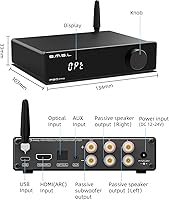
  • Inputs: Supported inputs include Bluetooth 5.0, USB-C, HDMI ARC, optical (Toslink), and a 3.5mm AUX line-in.
  • Frequency Response: The unit covers a full 20Hz–20kHz frequency range, spanning the entire audible spectrum.
  • Distortion (THD+N): Total harmonic distortion plus noise measures 0.013%, indicating a very clean signal with minimal coloration at normal listening levels.
  • Signal-to-Noise: The signal-to-noise ratio is rated at 102dB, which translates to a near-silent noise floor during quiet passages.
  • Crossover Control: Both the high-pass and low-pass filters offer 10 selectable frequency points each, allowing precise crossover tuning between mains and subwoofer.
  • Sub Volume Range: Subwoofer output level is independently adjustable across a wide S00–S99 range, separate from the main volume control.
  • Tone Controls: Bass and treble can each be adjusted across a ±9-level range, and several EQ presets are available for different listening preferences.
  • USB-C Audio: The USB-C input operates in driver-free mode, meaning no software installation is required for plug-and-play audio on Windows or macOS.
  • Power Draw: Operating power consumption is 36W, and standby draw is kept below 0.5W for energy efficiency when not in active use.
  • Power Supply: The unit operates on a 24V DC input, supplied via the included external power adapter.
  • Dimensions: The chassis measures 12.68 × 7.8 × 2.87 inches, making it compact enough for most desktops and media shelves.
  • Weight: The unit weighs 0.3Kg, reflecting its lightweight, all-in-one integrated design rather than a traditional heavy-chassis amplifier.
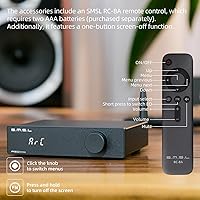
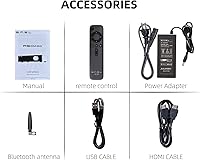
  • Remote Control: A remote control is included in the box for adjusting volume, input selection, and other functions from a distance.
  • Channel Separation: Channel separation is rated at -94dB at 1kHz, meaning left and right audio channels remain well-isolated from each other.
  • Mounting Type: The amplifier is designed for surface mounting on a desk, shelf, or media unit — no rack mounting hardware is included.
  • Warranty: SMSL covers this unit with a 12-month manufacturer warranty, with options for return or replacement in the event of a defect.

Related Reviews
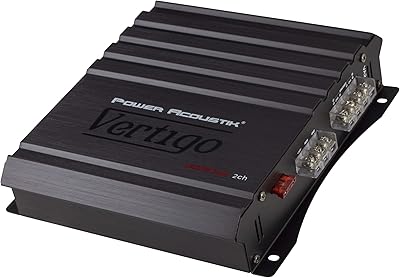
Power Acoustik VA2-1400D Vertigo Series 1,400-Watt 2-Channel Amplifier
83%
91%
Value for Money
88%
Power Output
85%
Ease of Installation
92%
Size and Portability
81%
Build Quality
More
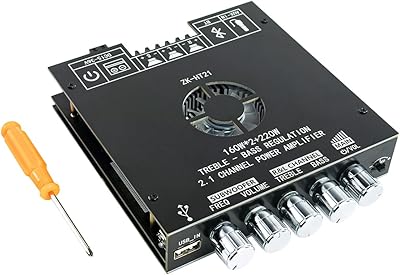
Hosyond TDA7498E 2.1 Channel Bluetooth Amplifier Board 160W×2+220W
73%
88%
Value for Money
76%
Power Output & Headroom
83%
Bluetooth Connectivity
79%
Build & Component Quality
62%
Thermal Management
More
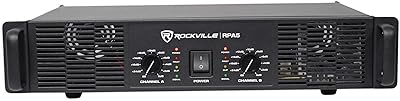
Rockville RPA5 2-Channel Power Amplifier
78%
88%
Value for Money
76%
Power Output & Headroom
67%
Build Quality & Construction
79%
Cooling & Thermal Management
91%
Connectivity & I/O Flexibility
More
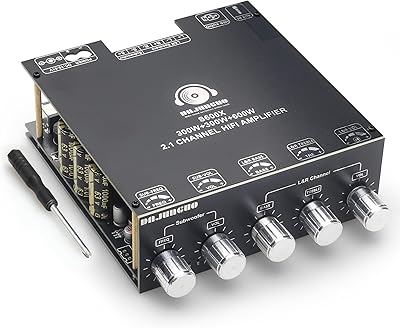
DAJUNGUO S600X
DAJUNGUO S600X
75%
78%
Power Output
74%
Audio Quality
83%
Bluetooth Connectivity
88%
Input Versatility
86%
Value for Money
More
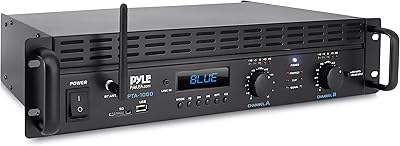
Pyle PTA1000BT 2-Channel Bluetooth Power Amplifier
73%
82%
Value for Money
51%
Power Output Accuracy
58%
Build Quality
89%
Ease of Setup
71%
Bluetooth Performance
More
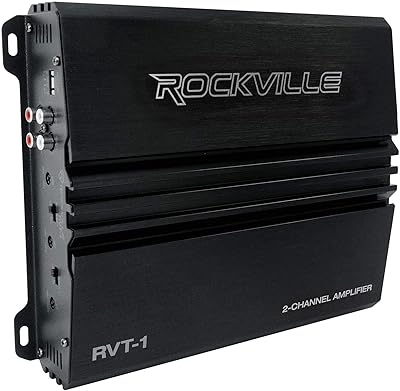
Rockville RVT-1 2-Channel Car Amplifier
68%
83%
Value for Money
67%
Power Output
58%
Build Quality
61%
Thermal Management
72%
Audio Clarity
More
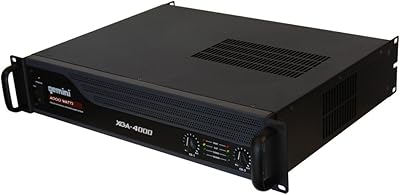
Gemini XGA-4000 4000W 2-Channel Power Amplifier
85%
94%
Power Output
88%
Build Quality
91%
Cooling Performance
85%
Setup & Installation
87%
Connectivity & Compatibility
More
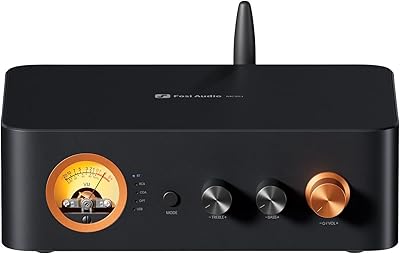
Fosi Audio MC351
Fosi Audio MC351
81%
83%
Sound Quality
91%
Build Quality
88%
VU Meter
86%
Connectivity & Inputs
71%
Bluetooth Performance
More
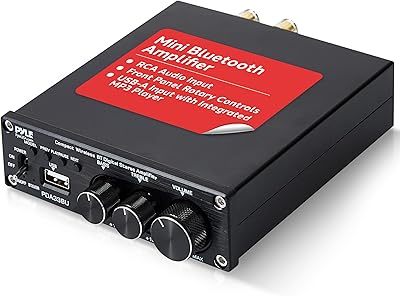
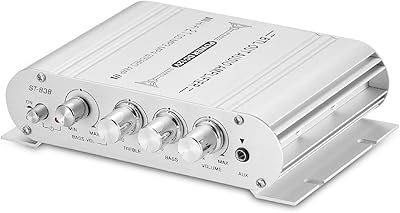
Pyle PDA33BU 2.1 CH Wireless Stereo Power Amplifier
81%
82%
Sound Quality
88%
Ease of Setup
75%
Bluetooth Connectivity
67%
Bass Performance
92%
Value for Money
More
Douk Audio OK013 Mini 2.1 Channel HiFi Stereo Amplifier
75%
83%
Value for Money
71%
Sound Output & Power
77%
Build Quality
88%
Ease of Installation
58%
Thermal Management
More

FAQ

Not in the way most people expect. The subwoofer output on the A50 Pro is a speaker-level output designed for passive subwoofers — ones with no built-in amplifier. If you connect an active subwoofer directly to that terminal, you risk damaging the sub's internal amp. Some active subs have a speaker-level input specifically for this kind of connection, but you should verify that with your subwoofer's manual before attempting it.

It will work with 8-ohm speakers, but the output power drops compared to the rated 70W at 4Ω — expect roughly half that figure into 8Ω loads. That is still plenty for bookshelf speakers in a typical room, but if you are running less-sensitive speakers and want serious volume, 4Ω-rated speakers will get more out of this unit.

You connect a standard HDMI cable from the ARC port on your TV to the HDMI ARC input on this SMSL unit. Once your TV's audio output is set to ARC in the settings menu, your TV's sound will route through the amplifier and out to your speakers. It works with most modern televisions and means you can use your TV remote to control the volume in many cases.

Yes, in most cases. The USB-C audio input uses a driver-free implementation, which means both Windows and macOS should recognize it as a standard audio device without any software installation. Just plug it in, select it as your output device in your system sound settings, and you are ready to go.

The crossover frequency is the point at which your main speakers stop reproducing bass and your subwoofer takes over. Setting it correctly means you avoid bass frequencies overlapping or leaving a gap. A good starting point is to match it to the lower frequency limit of your bookshelf speakers — for example, if your mains roll off around 80Hz, set the low-pass filter near that point and the high-pass filter similarly. You can then fine-tune by ear.

The SMSL A50 Pro 2.1-Channel Power Amplifier, like most amps in its class, is a single-input-at-a-time device — you select one source and it plays through the speakers. You cannot mix two sources simultaneously. Switching between inputs is straightforward via the front panel or remote, but blending a Bluetooth stream and a wired source at once is not supported.

Bluetooth 5.0 offers a solid range in open conditions, but real-world performance depends heavily on walls, interference, and your specific phone. Most users find it reliable within the same room or an adjacent one with a clear line of sight. Switching between two paired devices — like going from your phone to a laptop — can sometimes require manually re-pairing, which is the most commonly reported Bluetooth annoyance with this unit.

For most typical living rooms in the 150–250 square foot range, the A50 Pro has more than enough headroom with appropriately sensitive speakers. If your room is larger or you listen at very high volumes regularly, you may start pushing the limits. This unit is not engineered for large, open-plan spaces or for use as a party amplifier — it excels in focused, near-to-mid-field listening environments.

Based on how this class of SMSL amplifier typically operates, the unit retains the last-used input and volume level on power-up. However, detailed EQ presets and crossover settings may need to be confirmed after a full power cycle, so it is worth running through your preferred setup once and noting the values you land on.

SMSL offers a 12-month manufacturer warranty covering defects in materials and workmanship. Within that window, you are entitled to a replacement or return if the unit develops a fault. As with most electronics warranties, physical damage or issues from incorrect wiring are typically excluded, so it is worth double-checking your speaker impedance and connections before first use.