Overview

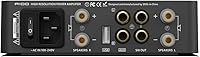
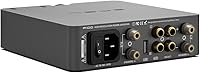
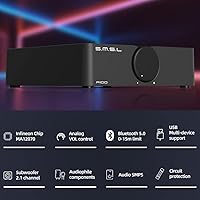
The SMSL A100 Stereo Class D Amplifier is a compact desktop unit aimed at budget-conscious listeners who want more than a generic chip driving their speakers. What sets it apart at this price point is its use of the Infineon MA12070 chip, a component enthusiast buyers actually search for by name — it's a meaningful spec rather than marketing noise. The A100 arrives in a small, dense chassis that feels reasonably solid for the category, and setup is straightforward. Whether you're pairing it with bookshelf speakers on a desk or building a modest 2.1 home system, this mini Class D amp covers the basics without demanding much space or effort.

Features & Benefits

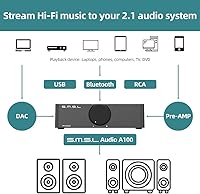
The A100 packs three inputs — USB, Bluetooth 5.0, and RCA line-in — which is genuinely useful when your sources change depending on the day. Driver-free USB audio is the kind of practical feature that gets overlooked in spec sheets but matters the moment you plug in a PC and it just works. Bluetooth 5.0 holds a stable connection at reasonable distances without the dropout issues that plagued older BT standards. Two subwoofer pre-outputs let you run a 2.1 or even 2.2 setup without buying a separate crossover. The built-in switching supply handling AC 100–240V also removes one common weak link that cheaper external adapters tend to introduce.

Best For

This desktop amplifier makes the most sense for desktop PC listeners who are tired of their motherboard's audio output and want a real amp in the chain without sacrificing desk space. It's also a smart step for anyone moving away from an aging AV receiver toward a leaner, purpose-built stereo setup. The dual sub pre-outs make it genuinely useful for 2.1 builds, a configuration many first-time hi-fi buyers land on naturally. Wireless users benefit from the stable Bluetooth connection, though analog purists may prefer something without digital conversion in the path. At this tier, it's one of the more spec-credible entry points into dedicated amplification.

User Feedback

Across a relatively small pool of verified reviews, the A100 holds a 4.1 out of 5 rating — enough to suggest general satisfaction, though the sample size means individual trends carry less weight than usual. Buyers consistently praise sound clarity at volume and how painless Bluetooth pairing tends to be. On the downside, a handful report subtle channel imbalance at very low volume settings, a known quirk with some Class D designs at minimum gain. A few users also flag the USB input behaving inconsistently with certain PC setups. Against similarly priced rivals, most seem to find this mini Class D amp at least competitive, if not slightly preferable on raw specs.

Pros

  • The Infineon MA12070 chip is a meaningful spec that puts the A100 ahead of many generic mini amps in this price range.
  • Three input options — USB, Bluetooth 5.0, and RCA — cover most common source combinations without needing an external switcher.
  • Driver-free USB audio works out of the box with most PCs, no software installation required.
  • Dual subwoofer pre-outputs let you build a 2.1 or 2.2 system without buying additional crossover hardware.
  • Bluetooth 5.0 holds a stable connection at a practical distance and pairs quickly with phones and laptops.
  • The built-in switching power supply handles AC 100–240V, making it usable internationally without a converter.
  • Thermal and overcurrent protection circuits make it safe to leave running on a desk for extended periods.
  • At just over two pounds, this desktop amplifier is easy to reposition or pack for travel.
  • Gold-plated input and output terminals are a small but appreciated build detail at this price point.
  • A 12-month warranty provides a basic safety net that many competing budget amps do not include.

Cons

  • Some users report a subtle channel imbalance at very low volume settings, which is frustrating for quiet late-night listening.
  • USB input compatibility is inconsistent across certain PC configurations, requiring troubleshooting for a small number of buyers.
  • No optical or coaxial digital input limits connectivity with TVs, game consoles, and standalone DACs.
  • The physical build feels utilitarian rather than premium, which may underwhelm buyers used to heavier metal-chassis competitors.
  • With only 57 reviews at the time of writing, long-term reliability patterns are harder to assess than for more established models.
  • No dedicated tone controls or EQ adjustment means the sound is what it is — unsuitable if you like to tune the output.
  • The volume knob on some units has been noted as feeling loose or imprecise compared to pricier alternatives.
  • Rated wattage figures reflect 4-ohm peak conditions; real-world output driving typical 8-ohm bookshelf speakers is notably lower.

Ratings

The scores below were generated by AI after analyzing verified buyer reviews for the SMSL A100 Stereo Class D Amplifier from multiple global sources, with spam, bot-submitted, and incentivized feedback actively filtered out. The sample size is relatively modest at around 57 reviews, so these ratings reflect meaningful patterns rather than statistically overwhelming consensus. Both the genuine strengths and the recurring frustrations are represented transparently — no category has been inflated to paint a rosier picture than buyers actually report.

Sound Quality
83%
For a desktop amp in this price range, the A100 consistently earns praise for delivering a clean, unfatiguing sound with good clarity at moderate to high volumes. Buyers pairing it with efficient bookshelf speakers report a noticeably more defined stereo image than what integrated motherboard audio can produce.
A handful of listeners feel the sound lacks the warmth or dimensionality that more expensive Class A or AB amplifiers provide. Those coming from higher-tier equipment may find the presentation slightly clinical, particularly on complex orchestral or acoustic recordings.
Bluetooth Performance
79%
21%
Bluetooth 5.0 pairs quickly and holds a stable connection at typical desktop distances, with very few reports of dropout during casual listening sessions. Users switching between a phone and laptop throughout the day find the reconnection process faster and less frustrating than with older BT implementations.
Audiophiles who compare wired and wireless inputs directly often notice a subtle loss in detail over Bluetooth, which is expected but worth noting. A few users also report that the amp does not always reconnect automatically to the last paired device after being powered off and on again.
Input Versatility
86%
Having USB, Bluetooth, and RCA line-in available on a single compact unit is genuinely practical for a mixed-source desktop setup. Users who feed audio from a PC via USB during the day and switch to a phone via Bluetooth in the evening find the input switching straightforward and reliable.
The lack of an optical or coaxial digital input is a real gap for anyone wanting to connect a TV, gaming console, or external DAC with only digital outputs. There is also no remote control for input switching, which means getting up or leaning over to change sources manually every time.
USB Audio Reliability
71%
29%
Most users on Windows and macOS report that the USB audio input is recognized instantly without any driver installation, which makes initial setup refreshingly simple. For straightforward PC-to-amp connections, it works exactly as advertised the majority of the time.
A recurring thread in negative reviews involves USB audio failing to be detected consistently on certain motherboard configurations or after system sleep cycles. The workaround — unplugging and replugging the USB cable — is not a dealbreaker but is annoying enough that it shows up repeatedly in user complaints.
Build Quality
63%
37%
The chassis feels adequately solid for a budget desktop unit, and the gold-plated terminals are a nice touch that suggest a degree of care in component selection. At its physical size and weight, the A100 sits stably on a desk without sliding around during use.
Several buyers describe the overall fit and finish as underwhelming compared to competitors in a similar price bracket, particularly around the volume knob, which can feel loose or imprecise. The enclosure material does not inspire confidence about long-term durability if the unit is handled or moved frequently.
Value for Money
81%
19%
Considering the MA12070 chip, the number of inputs, dual subwoofer pre-outputs, and a built-in power supply all in one compact box, buyers generally feel the A100 delivers solid value relative to what it costs. First-time hi-fi buyers especially appreciate getting a spec-credible amp without paying for features they do not need yet.
A small number of reviewers who compared it head-to-head with similarly priced Fosi or AIYIMA models feel the value edge is narrower than expected, particularly if build quality matters to them. If you only ever use one input and have no interest in subwoofer output, the pricing feels slightly less justified.
Low-Volume Behavior
57%
43%
At moderate and higher volume levels, the stereo image is well-balanced and the channel matching holds up reliably. Users who do most of their listening at medium volume report no noticeable issues with left-right balance.
Channel imbalance at very low volume settings is a documented and recurring complaint among buyers who prefer quiet background listening, such as late-night use. This is a common limitation of budget potentiometers and is not unique to this amp, but it is a real frustration for users who regularly listen at whisper levels.
Subwoofer Integration
84%
Having two dedicated subwoofer pre-outputs is a standout practical feature that lets buyers build a 2.1 or 2.2 system without purchasing additional hardware. Users who pair the A100 with a compact active sub report that the pre-out signal is clean and the bass integration with their main speakers is smooth.
There is no onboard crossover frequency adjustment, so the sub cutoff point is determined entirely by the active subwoofer itself. Buyers who want more precise control over how the low-end blends with their main speakers may find this limiting without an external DSP or crossover.
Setup & Ease of Use
88%
Out of the box, the A100 is one of the less fussy amps to get running — connect speakers, plug in a source, and it works. The driver-free USB operation and instant Bluetooth pairing mean most users are up and running within minutes of unboxing.
The manual included in the box is sparse and not particularly helpful for less experienced buyers navigating input selection or subwoofer wiring for the first time. Without a remote or any app control, adjusting volume or switching inputs requires physical access to the unit every time.
Power Supply Quality
78%
22%
The built-in switching power supply handling AC 100–240V removes one common point of failure found in budget amps that rely on cheap external adapters. Users traveling internationally or relocating between countries appreciate not needing a separate voltage converter.
A small number of users report a faint electrical hum audible at the speakers when the unit is idle, which may originate from the power supply design. This is only noticeable in very quiet environments and at close proximity to sensitive speakers, but it can be bothersome for users running high-efficiency drivers.
Thermal Management
82%
18%
The onboard thermal and overcurrent protection circuits make the A100 reasonable to leave running during long work-from-home sessions without anxiety about overheating. Users report the unit runs warm but not hot during extended use, which is typical and expected for a Class D design at this output level.
There is no fan, and the chassis has no visible venting slots on some sides, so placement in a tightly enclosed space or directly against a wall could limit passive heat dissipation over time. Long-term reliability data is limited given the relatively small review pool.
Compact Footprint
91%
At just over two pounds and with a small tabletop footprint, the A100 fits naturally on crowded desks without dominating the space. Users who previously avoided dedicated amplification because of size concerns find this desktop amplifier easy to integrate into tight setups alongside monitors, keyboards, and other gear.
The compact size does mean the speaker binding posts are closely spaced, which can make attaching thicker gauge speaker wire slightly awkward. There is also no rack-mount option, so it is purely a tabletop unit with no flexibility for alternative installations.
Long-Term Reliability
67%
33%
The 12-month warranty provides a basic safety net, and the majority of buyers report no hardware failures during the review period. Protection circuits for overheating and overcurrent suggest the design accounts for common failure scenarios in always-on desktop environments.
With only around 57 reviews in total, it is genuinely difficult to assess long-term durability with confidence — patterns that appear in larger datasets simply are not visible yet. A few users mention quality control inconsistencies between units, such as varying volume knob feel, which hints at some variability in the manufacturing process.

Suitable for:

The SMSL A100 Stereo Class D Amplifier is a strong fit for desktop PC users who want a dedicated amp without giving up desk real estate or wiring up a full receiver. If your current setup involves a PC, a pair of passive bookshelf speakers, and a mix of wired and wireless sources, this desktop amplifier covers that use case efficiently and without unnecessary complexity. It also makes good sense for someone building their first 2.1 system on a budget, since the dual subwoofer pre-outputs remove the need to buy additional hardware just to add a sub. Bluetooth 5.0 makes it genuinely practical for wireless listeners who switch between a phone and a laptop throughout the day. First-time hi-fi buyers who want a spec-credible starting point — rather than a toy amp with inflated wattage claims — will find the A100 a reasonable and honest entry into dedicated amplification.

Not suitable for:

The SMSL A100 Stereo Class D Amplifier is not the right call for audiophiles who prioritize a fully analog signal path, since the digital conversion involved in Bluetooth and USB audio adds steps that purists tend to avoid. If you plan to drive large floor-standing speakers in a medium or large room, the rated output — while listed at 80W×2 into 4 ohms — reflects peak rather than typical listening conditions, and real-world headroom may disappoint at higher volumes. This mini Class D amp also lacks optical or coaxial digital inputs, which rules it out for anyone feeding audio from a TV, game console, or dedicated DAC with only those outputs available. Buyers expecting a heavily built, premium-feeling chassis may find the physical construction underwhelming relative to more expensive competitors. If you already own a quality integrated amplifier or AV receiver, the A100 offers little reason to switch.

Specifications

  • Amplifier Chip: Powered by the Infineon MA12070, a Class D chip known for efficient power delivery and low distortion at this price tier.
  • Output Power: Rated at 80W×2 into 4Ω and 40W×2 into 8Ω, reflecting peak conditions rather than continuous typical listening output.
  • Bluetooth: Bluetooth 5.0 provides improved connection stability and range compared to earlier BT standards used in competing budget amps.
  • Inputs: Three input options are available: USB audio, Bluetooth 5.0, and RCA line-in, covering the most common source types for a desktop setup.
  • Subwoofer Outputs: Includes two dedicated subwoofer pre-outputs, enabling 2.1 or 2.2 speaker configurations without requiring additional crossover hardware.
  • THD+N: Total harmonic distortion plus noise is rated at 0.005%, indicating a clean audio signal with very low audible coloration under normal conditions.
  • SNR: Signal-to-noise ratio is rated at 103dB, meaning background noise should remain inaudible during typical listening at moderate to high volumes.
  • Channel Separation: Channel separation is specified at 88dB, providing a reasonably distinct stereo image between left and right channels.
  • Power Supply: Features a built-in switching power supply compatible with AC 100–240V, making it suitable for use across different regional mains voltages.
  • USB Audio: USB audio input operates without drivers on most operating systems, allowing plug-and-play connectivity with Windows and macOS computers.
  • Terminals: All input and output terminals are gold-plated, which helps resist oxidation and maintain consistent signal contact over time.
  • Protection Circuits: Onboard protection covers overheating and overcurrent scenarios, reducing the risk of damage during extended desktop use.
  • Dimensions: The unit measures 10.79 × 8.07 × 3.23 inches, making it compact enough to sit comfortably on a typical desk alongside a monitor.
  • Weight: At 2.14 pounds, the A100 is lightweight enough to reposition easily but has enough mass to stay stable during normal use.
  • Mounting Type: Designed for tabletop placement and is not intended for rack mounting or wall installation.
  • Number of Channels: Two-channel stereo output supports standard left and right speaker configurations for desktop or small-room listening.
  • Warranty: Covered by a 12-month manufacturer warranty that allows for replacement or return if a defect is confirmed within the coverage period.

Related Reviews
Lepai LP-2020TI Stereo Amplifier
75%
83%
Sound Quality
91%
Value for Money
89%
Ease of Setup
61%
Build Quality
67%
Reliability & Longevity
More
Dayton Audio SPA300-D
80%
88%
Power Output & Headroom
83%
Bass Quality & Low-End Extension
86%
Signal Clarity & Noise Floor
79%
Build Quality & Durability
91%
Ease of Installation
More
Velex VX508 Class-D Marine Amplifier
75%
83%
Sound Quality
79%
Build Quality
76%
Waterproofing
58%
Installation Experience
86%
Bluetooth Performance
More
Topping PA3s
Topping PA3s
82%
91%
Sound Cleanliness
88%
Channel Separation
79%
Power & Headroom
86%
Input Flexibility
67%
Build Quality
More
NVX VAD10001 v2 Monoblock Class D Amplifier
88%
91%
Sound Quality
93%
Build Quality
85%
Ease of Installation
88%
Bass Control Flexibility
89%
Heat Management
More
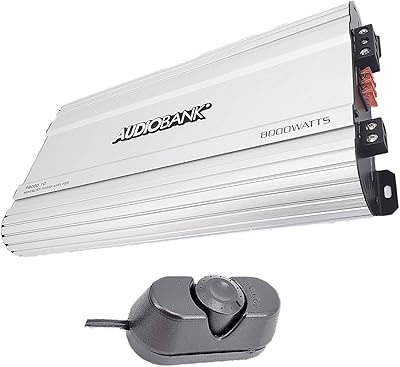
Audiobank P8001 Monoblock Car Amplifier
63%
74%
Value for Money
31%
Power Accuracy
81%
Ease of Installation
57%
Build Quality
53%
Thermal Management
More
NVX VADM1v2 Monoblock Amplifier

82%
88%
Power Output
93%
Compact Form Factor
71%
Thermal Management
86%
Tuning Controls
74%
High-Level Input Usability
More
Taramp's TL 500 2-Channel Car Amplifier
74%
88%
Value for Money
91%
Ease of Installation
74%
Sound Quality
62%
Power Output
67%
Build Quality
More
Pioneer GM-D9701 Mono Class D Car Amplifier
83%
93%
Bass Output Quality
88%
Power Delivery Consistency
84%
Installation Experience
91%
1-Ohm Stability
86%
Thermal Management
More
Audiobank P6001 Monoblock Car Amplifier
61%
74%
Value for Money
38%
Power Accuracy
56%
Build Quality
52%
Thermal Management
78%
Installation Ease
More
NVX VADM4 v2 4-Channel Amplifier
84%
93%
Power Accuracy
91%
Compact Form Factor
89%
Marine & Weather Durability
88%
Thermal Management
84%
Crossover Flexibility
More

FAQ

Yes, as long as your speakers are passive — meaning they have no built-in amplification and require an external amp to drive them. The A100 connects to passive speakers via its speaker binding posts. Just make sure your speakers are rated for 4Ω or 8Ω impedance, which covers the vast majority of bookshelf models on the market.

For most users, yes. The USB audio input is designed to operate as a class-compliant audio device, which Windows and macOS recognize automatically. That said, a small number of buyers have reported inconsistencies with certain PC configurations, so if it does not show up immediately, checking your system sound settings or trying a different USB port usually resolves it.

You can absolutely add a subwoofer. The A100 includes two dedicated subwoofer pre-outputs, so you can build a 2.1 or even 2.2 setup by connecting an active subwoofer directly to one of those outputs. No separate crossover or additional hardware is needed, which is a genuinely useful feature at this price point.

Bluetooth 5.0 performs reliably within a standard room, typically around 10 meters with no obstructions. In practice, most desktop users are sitting within two or three feet of the unit anyway, so range is rarely an issue. Connection stability is noticeably better than older Bluetooth versions, and pairing is generally fast and straightforward.

That figure represents peak output into a 4Ω load, not what you would draw during a typical listening session. In real use, you will likely tap only a fraction of that headroom, which is normal for any amplifier. For a desktop or small-room setup with efficient bookshelf speakers, the actual usable power is more than adequate.

Yes. The built-in switching power supply is rated for AC 100–240V, covering the full range of residential mains voltages used globally. You may need a plug adapter depending on your region, but a voltage converter is not required.

A small number of users have reported a subtle channel imbalance at very low volume settings, which is a known characteristic of certain potentiometer designs in this price range. It is generally only noticeable at the lowest end of the volume dial and becomes balanced as you turn it up. If you do a lot of very quiet listening, it is worth being aware of.

No, there are no onboard tone controls, bass or treble adjustments, or EQ settings. The signal path is kept relatively direct, which some listeners prefer for accuracy, but it does mean you cannot tune the sound from the amp itself. If you need tonal adjustment, you would have to do it at the source or add an external EQ.

The A100 includes built-in protection circuits for overheating and overcurrent, which makes it reasonably safe for extended desktop use. Like any amplifier, it will run warm during playback, but the thermal protection is designed to prevent damage under normal conditions. Just make sure the ventilation around the unit is not blocked.

All three brands occupy the same entry-level desktop amp space, and the differences are fairly small at this tier. The A100 is often noted for its cleaner aesthetic and the use of the MA12070 chip, which has a good reputation among budget audiophiles. Fosi and AIYIMA models sometimes offer more input variety or remote controls depending on the specific model, so it comes down to which features matter most to your particular setup.

Where to Buy