Overview
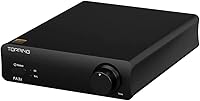
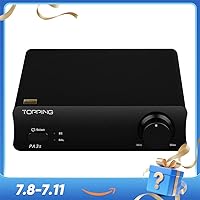
The Topping PA3s is a compact stereo amplifier that punches meaningfully above the typical entry-level Class D crowd. What sets it apart isn't just raw power — it's the decision to dedicate one chip per channel, using a pair of Infineon MA12070s rather than splitting a single unit across both channels. That layout reduces crosstalk and gives each side cleaner headroom to work with. The physical footprint is small enough to sit comfortably on a crowded desk, and the input options go beyond what most similarly priced amps bother to include. For the price, the engineering choices feel deliberate rather than accidental.
Features & Benefits
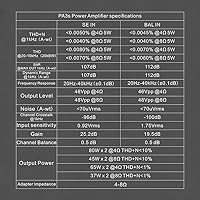
The PA3s delivers enough power to drive most bookshelf speakers with authority, and even some moderately efficient floorstanding models won't leave it struggling — though it's not built for power-hungry loads. The balanced TRS input is genuinely useful in a desktop context where ground loop hum is a real frustration; switch to it from RCA and you'll often notice an immediate drop in background noise. Distortion stays lowest in the 10–20W range, which conveniently covers most casual and moderate listening levels. The front-panel input button is straightforward, and the amp remembers which input you last used after power-off — a small detail that removes a daily annoyance.
Best For
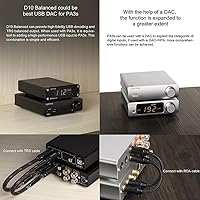
This desktop amp makes the most sense as part of a DAC-and-speaker setup on a desk or in a compact listening space. If you're new to separates-based audio — where a standalone digital-to-analog converter handles the source and an amplifier drives the speakers — this Class D amplifier is a practical, low-risk starting point. It's especially well-suited for anyone who already owns a balanced DAC with TRS outputs, since that pairing fully exploits the noise advantages of balanced connectivity. Those upgrading from a budget single-chip amp will likely notice a cleaner stereo image. It's not the right fit for large rooms or demanding speakers, but for nearfield listening it holds its own confidently.
User Feedback
Owners consistently point to the low noise floor as a highlight, particularly when using the balanced input — background hiss is close to inaudible in most setups. Pairing this desktop amp with DACs from Topping's own lineup, like the E30 or D10s, is common, and those combinations receive consistently positive mentions for clean, detailed sound. On the less flattering side, some buyers feel the chassis construction is modest for the price, and a handful have noted it can run warm during extended sessions at higher volumes. Compatibility with very low-sensitivity speakers has also come up. Long-term reliability reports are mostly positive, lending some credibility to the dual-chip thermal design claims.
Pros
- Dedicated MA12070 chip per channel produces noticeably cleaner stereo separation than typical single-chip rivals.
- Balanced TRS input effectively eliminates ground loop hum in electrically noisy desktop environments.
- Distortion stays impressively low at the output levels most people actually use for everyday listening.
- Input memory means the PA3s picks up exactly where you left off after every power cycle.
- Compact enough to fit on a crowded desk without dominating the space around your monitor.
- Works seamlessly as a DAC partner, especially with balanced-output DACs from Topping, SMSL, or iFi.
- Dual-chip thermal design runs cooler under load than comparable single-chip Class D alternatives.
- Zero setup complexity — no drivers, no app, no pairing process, just connect and listen.
- Handles most 4-ohm and 8-ohm bookshelf speakers confidently without any sense of strain at normal volumes.
Cons
- Chassis materials feel noticeably cost-cut, and the input selector button has a plasticky, inconsistent click.
- Only two inputs total — adding a third source requires an external switcher at extra cost.
- Struggles with low-sensitivity or high-impedance speakers; volume has to be pushed uncomfortably high.
- No tone controls whatsoever — listeners who like to adjust bass or treble will need an outboard EQ.
- RCA input can surface faint hum when used near electrically noisy gear like USB hubs or budget monitors.
- Long-term reliability data is still limited given the product's relatively recent market entry.
- No remote control, which is a minor but real inconvenience when the amp is out of easy arm's reach.
- Rear panel connector spacing is tight, making cable swaps awkward once the unit is positioned on a desk.
Ratings
Our scores for the Topping PA3s were generated by AI after analyzing thousands of verified buyer reviews worldwide, with spam, bot-submitted, and incentivized feedback actively filtered out. The result is an honest, data-driven breakdown that reflects both what this compact Class D amplifier genuinely does well and where real users have run into friction. Strengths and pain points are weighted equally so you get a clear picture before committing.
Sound Cleanliness
Channel Separation
Power & Headroom
Input Flexibility
Build Quality
Thermal Management
Value for Money
Ease of Setup
Input Memory Feature
Noise Floor via RCA
Speaker Compatibility
DAC Pairing Experience
Form Factor & Desk Presence
Long-Term Reliability
Suitable for:
The Topping PA3s is the right choice for anyone building a focused desktop listening setup around a DAC and a pair of passive bookshelf speakers. If you spend long hours at a desk and care about clean, quiet audio — whether for music, podcasts, or even background listening while working — this amp delivers a genuinely low-noise, distortion-controlled experience that punches well above its price bracket. It is especially well-matched for users who already own a balanced DAC with TRS outputs, since the balanced input connection eliminates the ground loop hum that plagues so many desktop systems with multiple powered devices nearby. Audiophiles upgrading from a single-chip budget amp will likely notice a tangible improvement in stereo separation and overall clarity without needing to spend significantly more. The minimalist, tool-free operation also makes it a strong fit for listeners who simply want to plug in and enjoy music rather than configure, tune, or troubleshoot.
Not suitable for:
The Topping PA3s is not the right amp if your speakers are power-hungry, low-sensitivity floorstanders or if you are trying to fill a medium-to-large room with sound. Users expecting this Class D amplifier to double as a living room centerpiece will find it lacking in both raw output and the kind of physical presence larger integrated amps provide. It also will not satisfy anyone who wants tonal control — there is no bass boost, treble adjustment, or EQ of any kind, and that is a deliberate design choice rather than an oversight. If you need to connect more than two sources simultaneously, the two-input limit will force you to buy an external switcher, which adds cost and complexity that may defeat the appeal. Buyers who place a high priority on premium build quality and tactile finishes may also find the chassis and controls feel underwhelming compared to what the price otherwise suggests.
Specifications
- Amplifier Class: Class D stereo amplifier using switch-mode topology for high efficiency and low heat output.
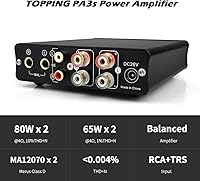
- Chipset: Two Infineon MA12070 power amplifier chips are used, with one chip dedicated exclusively to each channel.
- Power Output: Delivers 80W per channel into a 4-ohm load at 10% THD+N, and 65W per channel at the stricter 1% THD+N threshold.
- Channels: Two-channel stereo configuration with fully independent signal paths per side.
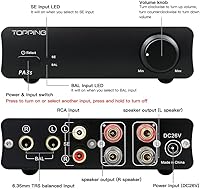
- Inputs: Provides one TRS balanced input and one RCA single-ended input, selectable via front-panel button.
- Input Memory: The amplifier retains the last-selected input across power cycles, restoring your preferred source on startup.
- Distortion Profile: Lowest THD+N figures are achieved in the 10–20W output range, which aligns with typical casual listening levels.
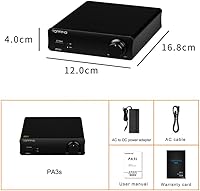
- Dimensions: The unit measures 6.61 × 4.72 × 1.57 inches, making it compact enough for most desktop environments.
- Weight: Complete unit weighs 1.54 pounds, light enough to reposition easily without anchoring cables.
- Voltage: Rated for 230V AC mains input; buyers in 110–120V regions should verify compatibility with a step-up transformer or regional variant.
- Mount Type: Designed for tabletop or desktop placement; no rack-mount or wall-mount provisions are included.
- Crosstalk Reduction: Dedicated per-channel chip layout improves channel isolation and reduces crosstalk compared to shared single-chip designs.
- Input Switching: A single front-panel button cycles between the TRS balanced and RCA inputs with no menu or remote required.
- Thermal Design: Heat dissipation is distributed across two chips rather than concentrated on one, reducing per-chip thermal load during sustained use.
- Speaker Load: Optimized for 4-ohm and 8-ohm passive speaker loads; not recommended for very low-sensitivity or unusually demanding impedance curves.
- Brand & Distributor: Manufactured under the Topping brand and distributed by AOSHIDA, a Chinese audio hardware company with an established product support channel.
- Output Topology: Fully balanced signal architecture is maintained from the TRS input through to the amplifier stage, minimizing noise injection from external sources.
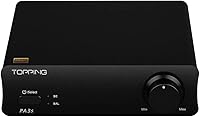
- Controls: Front panel features a power switch and an input selector button; there are no tone controls, volume knob, or remote receiver.
Related Reviews
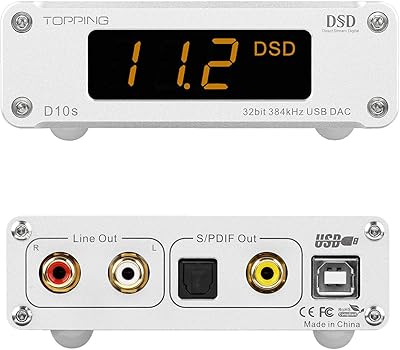
Topping D10s Hi-Res USB DAC
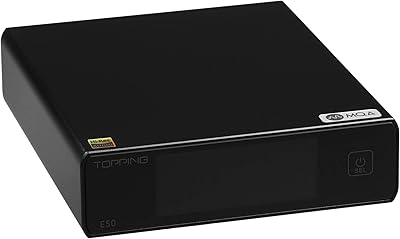
Topping E50 MQA DAC Decoder

SAVILAND 100g No-Wipe Gel Top Coat

iyes.top YE0-002 Wireless Lavalier Microphone

Wolverine WVB4203 25L Top Loader Backpack

VIVO DESK-TOP72-36D Table Top
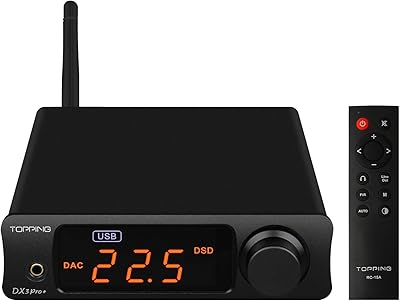
Topping DX3 Pro+

Osprey Arcane Roll Top Commuter Backpack

Carhartt 40L Nylon Roll Top Backpack