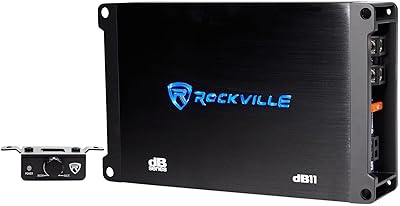
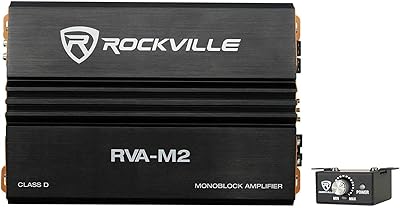
Overview

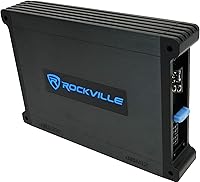
The Rockville DBM12 Mono Marine Amplifier is a purpose-built Class-D mono amp designed to drive a subwoofer on the water without draining your battery or your wallet. Rated at 500W RMS at 2 ohms, it sits in a practical middle ground — enough muscle for real bass presence, but not so over-specified that you're paying for headroom you'll never use. The 2000W peak figure is marketing math; focus on the RMS number. It launched in 2018 and remains actively sold, which says something about its staying power in a crowded marine audio market. The IPX6 waterproof rating and conformal-coated PCB are genuine selling points, addressing the salt air and splash exposure that kills lesser electronics quickly.
Features & Benefits

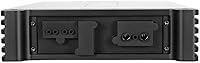
Class-D amplification is the right call for marine use — it runs cool and pulls less current, which matters when your audio system is sharing a battery with navigation and safety gear. The DBM12 gives you real tuning control with an adjustable low-pass filter spanning 50 to 250Hz and a subsonic filter that rolls off below 55Hz, protecting your sub from frequencies it cannot reproduce cleanly. The dashboard bass remote is genuinely useful; most installs hide the amp under a seat or in a hatch, and reaching back to adjust levels mid-ride is impractical. RCA in and out with 8V preamp support keeps the signal clean if you are chaining components.

Best For

This marine mono amp is a practical fit for anyone adding a dedicated subwoofer channel to a pontoon, wake boat, or fishing rig without committing to a full multi-channel install. Surface mounting is straightforward, wiring is uncomplicated, and the 2-ohm and 4-ohm compatibility means you have real flexibility when choosing a sub. It is not the right pick if you are chasing audiophile-grade bass reproduction — the specs and build quality honestly reflect the accessible price point. But for a boater who wants noticeably better low-end than the factory setup provides and needs an amp that can handle real-world marine conditions, this Rockville unit lands in a very reasonable spot.

User Feedback

Owners of the DBM12 generally report that installation is straightforward and that the amp delivers solid bass output for the price — common praise from boaters upgrading from a receiver's built-in power. The criticism that surfaces most often is around power figures: buyers expecting near-2000W performance are sometimes disappointed once they understand that 500W RMS is the working number. A few users mention the bass remote feeling budget in build, though it functions as intended. Long-term durability feedback is mixed — most report no issues after a full season, but a handful note concerns about component reliability over multiple years of continuous marine exposure.

Pros

  • Class-D design runs efficiently and cool, reducing strain on your boat battery during extended use.
  • 500W RMS at 2 ohms delivers genuine, audible bass improvement over any factory marine receiver output.
  • IPX6 splash resistance and conformal-coated PCB offer real protection against the marine environment.
  • The dashboard bass remote is a practical inclusion that makes level adjustments easy without reaching for the amp.
  • Compatible with both 2-ohm and 4-ohm subwoofers, giving you flexibility when pairing with existing or new gear.
  • Low-pass and subsonic filters let you tune the bass response tightly rather than just turning up the volume.
  • Surface-mount design and included hardware make installation accessible for a confident DIYer.
  • RCA input and output with 8V preamp support keeps the signal path clean if you expand your system later.
  • Has remained in active production since 2018, which means parts, support, and user knowledge are findable.
  • Priced accessibly for a dedicated marine subwoofer amp with weather-resistant construction included.

Cons

  • The 2000W peak rating is heavily inflated relative to the 500W RMS figure that reflects actual sustained output.
  • The included bass remote feels lightweight and plasticky, and a few owners report reliability concerns over time.
  • IPX6 covers spray and splash only — installs exposed to pooling water or submersion risk are not protected.
  • Long-term durability beyond one or two boating seasons is inconsistent based on owner feedback.
  • No built-in Bluetooth or wireless control; all signal routing relies on physical RCA connections.
  • At 9.37 pounds and over 17 inches in length, finding a clean mounting location on smaller boats can be a challenge.
  • Customer support experiences with the brand are mixed, which matters if you encounter a defect post-purchase.
  • The DBM12 is mono only, so it cannot double as a stereo amp if your setup needs evolve down the line.
  • No signal-to-noise ratio specification is published, making it harder to assess audio cleanliness against competitors.
  • Value-tier internal components may not hold up as well as pricier marine-specific brands under sustained high-volume use.

Ratings

The ratings below for the Rockville DBM12 Mono Marine Amplifier were generated by our AI system after analyzing verified purchaser reviews from multiple global sources, with spam, bot submissions, and incentivized feedback actively filtered out before scoring. Each category reflects the honest distribution of real buyer sentiment — strong points and recurring frustrations alike — so you get a transparent picture of what ownership actually looks like across different boats, climates, and use cases.
Value for Money
83%
Most buyers feel the DBM12 punches above its price bracket when judged purely on bass output delivered per dollar spent. For boaters upgrading from a head unit's internal amplification, the improvement is immediately noticeable without requiring a significant financial commitment.
A portion of buyers feel misled by the 2000W peak marketing and, once they understand the 500W RMS reality, recalibrate their satisfaction downward. Those who compare it directly to premium marine amp brands at higher price points find the gap in component quality more apparent than expected.
Power Accuracy
54%
46%
Users who researched RMS ratings before purchasing report that the 500W RMS figure holds up reasonably well in real-world use, and the amp drives compatible marine subs to satisfying volume levels during casual to moderate boating sessions.
The 2000W peak claim is a consistent source of frustration in buyer reviews — many feel it sets unrealistic expectations and borders on misleading. Buyers who purchased expecting near-2000W output and later learned the peak vs. RMS distinction tend to leave notably lower ratings regardless of actual performance.
Marine Durability
74%
26%
The conformal-coated PCB and rustproof aluminum heatsink do appear to perform their intended function across a single boating season for the majority of owners, with relatively few reports of early corrosion or moisture-related failure in splash and spray environments.
Multi-season reliability is where confidence drops — a meaningful share of long-term owners report degraded performance or failure after two or more years of regular saltwater exposure. The unit holds up well initially, but it does not seem engineered for the kind of decade-long service life some premium marine brands offer.
Ease of Installation
88%
Installation consistently earns high marks from DIY installers — the surface-mount format, clearly labeled terminals, and standard RCA connectivity make the process approachable even for boaters without a professional audio background. Most report getting the unit wired and running within a couple of hours.
No wiring kit is included in the box, which catches some buyers off guard when they realize they need to source power cable, ground wire, and a fuse holder separately. First-time amp installers occasionally struggle with setting the gain and crossover filters without a reference guide tailored to this unit.
Bass Performance
79%
21%
For a mono subwoofer amp at this price tier, the low-end output is genuinely punchy and satisfying on the water, particularly when the low-pass and subsonic filters are dialed in thoughtfully. Pontoon and fishing boat owners frequently note that it transforms an otherwise flat factory audio system.
Audiophiles or buyers upgrading from higher-end systems will likely find the bass texture less refined than what pricier Class-D competitors deliver. At maximum output the amp can sound slightly compressed, and tight, articulate bass at high volume is not its strongest suit.
Waterproof Protection
71%
29%
The IPX6 rating and silicone terminal covers give the unit a genuine advantage over non-rated amplifiers in spray-heavy environments like open bow boats or vessels exposed to rain and wake. Most owners using it in standard above-deck or under-seat locations report no moisture-related issues through a full season.
IPX6 is splash resistance, not submersion protection, and some buyers discover this distinction only after an installation in a lower storage compartment that accumulates water. A handful of reviews describe corrosion or failure in environments with high sustained humidity rather than direct splash exposure.
Bass Remote Quality
58%
42%
The concept of including a wired dash-mount remote is well-received — having real-time subwoofer level control at the helm without reaching into a storage hatch is a practical convenience that owners genuinely appreciate once they experience it on the water.
The remote's physical build quality is a recurring complaint, described by multiple reviewers as feeling cheap and fragile relative to the amplifier itself. A subset of owners report intermittent connectivity or complete remote failure within one to two seasons, suggesting it is a weak point in the overall package.
Thermal Management
81%
19%
The Class-D topology combined with the aluminum heatsink keeps operating temperatures in check during normal use, and thermal shutoff events are rarely reported by owners who mount the unit with adequate airflow clearance. It handles extended listening sessions on the water better than older Class-AB designs would at this power level.
Units installed in tightly enclosed spaces with poor ventilation do occasionally trigger thermal protection during sustained high-volume use on hot days. Rockville's installation guidance on minimum clearance requirements is limited, leaving some buyers to troubleshoot unexpected shutdowns before identifying airflow as the cause.
Signal Clarity
69%
31%
The 8V preamp output and RCA pass-through provide a reasonably clean signal path for the price, and buyers running the amp as part of a larger system with a dedicated head unit generally report satisfying audio quality without obvious noise floor issues at moderate volume.
Some users detect a faint background hiss or ground loop noise, particularly in systems where the head unit is lower quality or grounding is imperfect. The signal-to-noise ratio is not published by the manufacturer, which makes it harder to evaluate against competing products before purchase.
Build Quality
67%
33%
The amplifier chassis feels solid and purposeful, and the heatsink construction in particular gives a first impression of durability that reassures buyers on unboxing. The overall fit and finish is competitive for the accessible price point.
Internal component quality does not match the external impression for all buyers — reports of early failure from a visible minority suggest some unit-to-unit inconsistency in manufacturing. The gap between the premium-feeling exterior and the value-tier internals becomes apparent when comparing long-term reliability to more expensive alternatives.
Filter & Tuning Options
82%
18%
The combination of an adjustable low-pass filter, a subsonic filter, and a bass EQ gives users a meaningful degree of control over their subwoofer output that is not always available at this price tier. Experienced installers appreciate the ability to protect their sub from harmful ultra-low frequencies using the subsonic control.
The filter controls have no detents or clear reference markings, making precise and repeatable tuning difficult without measurement tools. Buyers new to amplifier setup sometimes report spending significant time guessing at optimal settings without clear documentation to guide them.
Subwoofer Compatibility
84%
Stable operation at both 2 and 4 ohms gives this marine mono amp practical flexibility when pairing with a wide range of available marine subwoofers, removing a common compatibility headache for buyers who already own a sub or plan to buy separately.
The mono single-channel design means it cannot be repurposed for full-range stereo use if a buyer's needs evolve, which limits its long-term versatility compared to a multi-channel amp of similar cost. There is also no bridgeable output for those who might want to increase power delivery to a high-demand subwoofer later.
Customer Support
56%
44%
Some buyers report positive warranty replacement experiences with Rockville, and the brand's relatively broad market presence means community knowledge and third-party troubleshooting resources are available online for common issues.
Customer support responsiveness receives mixed to poor marks across a notable share of reviews, with complaints about slow responses and difficult return processes. Buyers who experienced product defects within the warranty period describe the resolution process as more frustrating than expected for a brand of Rockville's size.
Packaging & Accessories
62%
38%
The unit arrives well-protected in its shipping box and the inclusion of mounting hardware and a bass remote adds immediate out-of-box utility that some competing products omit at a similar price point.
The absence of any wiring accessories — no power cable, no speaker wire, no fuse — means additional purchases are required before installation, which frustrates buyers who expected a more complete kit. Documentation is minimal, and the included instructions offer limited guidance for first-time installers.

Suitable for:

The Rockville DBM12 Mono Marine Amplifier is a strong match for recreational boaters who want a meaningful upgrade from their factory audio without diving into a complex, expensive multi-channel install. If you own a pontoon, fishing boat, or wake boat and simply want one dedicated subwoofer channel pushing real bass on the water, this unit covers that job efficiently. DIY installers will appreciate the surface-mount design and straightforward wiring — there is nothing here that requires a professional to sort out. The Class-D topology is also a practical advantage for anyone conscious of battery draw, since running audio gear off a marine battery demands efficiency that older amp designs cannot match. Boaters who spend time in spray-heavy environments will find the IPX6 splash resistance and silicone terminal covers genuinely useful, even if the protection is not unlimited.
Not suitable for:

Buyers expecting true 2000W performance should look elsewhere — the Rockville DBM12 Mono Marine Amplifier delivers 500W RMS at 2 ohms in real-world use, and the peak figure is largely a marketing number that does not reflect sustained output. If you are building a high-output, audiophile-grade marine system with exacting sound quality standards, the component tolerances and build materials at this price tier will likely leave you wanting more. The IPX6 rating means splash and spray resistance, not submersion tolerance — if your install location is prone to standing water or flooding, this unit is not built for that. Those running a complex multi-source setup with high-powered full-range speakers alongside a sub may also find a single-channel mono amp limiting, and would be better served by a multi-channel solution from the start. Buyers who have had poor experiences with value-tier audio brands and need rock-solid long-term reliability over multiple heavy-use seasons may want to invest in a more established marine audio nameplate.
Specifications

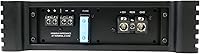
  • Output Power: Delivers 500W RMS at 2 ohms and 300W RMS at 4 ohms for sustained subwoofer drive.
  • Peak Power: Rated at 2000W peak at 2 ohms and 1200W peak at 4 ohms, reflecting momentary burst capacity only.
  • Channels: Single-channel mono design dedicated to subwoofer output, not suitable for full-range stereo use.
  • Amplifier Class: Class-D topology provides high power efficiency and low heat output, well-suited to battery-powered marine systems.
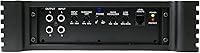
  • Low-Pass Filter: Adjustable low-pass filter spans 50Hz to 250Hz with a 12dB per octave slope for precise bass frequency control.
  • Subsonic Filter: Built-in subsonic filter sweeps from 15Hz to 55Hz to block inaudible low-frequency content that can damage subwoofers.
  • Waterproof Rating: IPX6 certified, meaning the unit withstands powerful water jets and spray but is not rated for submersion.
  • PCB Protection: Conformal coating applied to the printed circuit board provides resistance against moisture, salt air, and corrosion.
  • Heatsink: Rustproof aluminum heatsink dissipates thermal load efficiently while resisting oxidation in marine environments.
  • Terminal Covers: Waterproof silicone covers protect all input and output terminals from moisture ingress and salt spray.
  • Connectivity: Equipped with RCA input and RCA output, supporting signal pass-through and system expansion with an 8V preamp output.
  • Impedance: Stable at both 2-ohm and 4-ohm loads, compatible with the majority of marine subwoofers on the market.
  • Bass Remote: Includes a dashboard-mounted wired bass level remote for convenient subwoofer output adjustment from the helm.
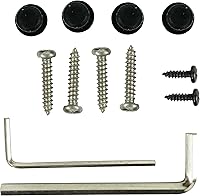
  • Mounting Type: Designed for surface mounting with included hardware; no rack or enclosure required for installation.
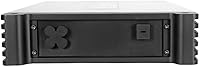
  • Dimensions: Unit measures 17.09 x 11.65 x 5.47 inches, requiring adequate clearance for heatsink ventilation during installation.
  • Weight: Weighs 9.37 pounds, which should be accounted for when selecting and reinforcing the mounting surface.
  • Certifications: Meets CE, FCC, and IPX6 standards, confirming compliance with electromagnetic and waterproof protection requirements.
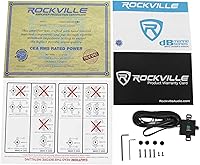
  • In the Box: Package includes the amplifier unit, a dashboard bass remote, and mounting screws; no wiring kit or fuse is included.
  • Availability: First made available in October 2018 and remains an active, non-discontinued product in the Rockville lineup.
  • Phase Control: Features a phase control switch allowing the user to align subwoofer output phase with the main speaker signal.

Related Reviews

Rockville DBM25 Marine Amplifier
75%
88%
Value for Money
83%
Marine Durability
79%
Power Accuracy
74%
Audio Quality
82%
Crossover Flexibility
More
Rockville dB14 Mono Class-D Car Amplifier
74%
83%
Value for Money
78%
Power Accuracy
67%
Build Quality
54%
Long-Term Reliability
86%
Ease of Installation
More
Rockville dB15 Mono Car Amplifier
73%
83%
Value for Money
78%
Bass Output
86%
Ease of Installation
61%
Thermal Management
58%
Power Accuracy
More
Rockville RXM-T1 2-Channel Marine Amplifier
69%
84%
Ease of Installation
61%
Power Output
77%
Marine Durability
67%
Sound Quality
54%
Heat Management
More
Rockville RVA600.1 Mono Car Amplifier
74%
83%
Value for Money
74%
Sound Quality
88%
Ease of Installation
52%
Power Accuracy
67%
Build Quality
More
Rockville DBM65 6-Channel Marine Amplifier
73%
88%
Value for Money
83%
Power Output
71%
Waterproofing & Weather Resistance
91%
Channel Flexibility
67%
Build Quality
More
Rockville dBcomp4 3000W Mono Car Amplifier
85%
94%
Power Output
91%
Bass Performance
87%
Ease of Installation
89%
Build Quality
67%
Thermal Management
More
Rockville dB16 Mono Car Amplifier
73%
83%
Bass Output
78%
Value for Money
81%
Ease of Installation
59%
Thermal Management
62%
Power Accuracy
More
Rockville dB11 Mono Class-D Car Amplifier
82%
91%
Value for Money
86%
Bass Output
88%
Ease of Installation
83%
Signal Clarity & THD
67%
Build Quality
More
Rockville dBcomp5 Mono Car Amplifier
75%
88%
Verified Power Output
82%
Build Quality
91%
Onboard Tuning Flexibility
87%
1-Ohm Stability
79%
Remote Sub Control
More

FAQ

The honest answer is no, not in any practical sense. The 2000W figure is a peak rating measured under ideal burst conditions, while the working number you should plan around is 500W RMS at 2 ohms. That is the sustained output the amp delivers during normal use, and it is a perfectly respectable figure for a dedicated marine subwoofer channel at this price point.

It works with both. The DBM12 is stable at 2 ohms and 4 ohms, so you have flexibility when pairing it with a sub. At 4 ohms you will get 300W RMS rather than 500W, which is still plenty for most recreational boat audio setups.

Water-resistant is the more accurate description. The IPX6 rating means it can handle powerful water spray and splashing from any direction, which covers most real marine conditions like rain, wake spray, and hose-down cleaning. It is not rated for submersion, so if your install location is prone to standing water or flooding, you will want to reconsider placement.

Most owners with basic car or boat audio experience find it manageable. The surface-mount design is straightforward, the terminals are clearly labeled, and the RCA connectivity is standard. You will need to supply your own power and ground wiring, fuse holder, and speaker wire — none of that comes in the box. If you have installed a car amp before, this is a similar process.

It functions as intended and is genuinely useful for adjusting subwoofer levels without reaching back to the amp. That said, the remote itself feels lightweight in hand and a few owners have noted it feels less durable than the amp unit. It works fine for most users, but it is not a premium component.

For a typical marine subwoofer setup, starting the low-pass filter around 80 to 120Hz keeps the sub focused on bass duties and avoids overlap with your main speakers. The subsonic filter is worth enabling around 30 to 35Hz — it blocks ultra-low frequencies your sub cannot reproduce cleanly and reduces unnecessary cone excursion, which protects the driver over time.

The Rockville DBM12 Mono Marine Amplifier is designed with salt air exposure in mind — the conformal-coated PCB and rustproof aluminum heatsink are genuine protective measures, not just marketing claims. Most owners report no issues after a single season. Feedback on multi-season durability is more mixed, so rinsing terminals, keeping the unit covered when not in use, and avoiding direct sustained water exposure will all help extend its service life.
Yes, if you wire them correctly. Two 4-ohm subs wired in parallel will present a 2-ohm load, which is within the amp's stable range. Two 8-ohm subs in parallel will give you 4 ohms. Just make sure the combined impedance stays at 2 ohms or above — running below 2 ohms will overstress the unit.

Yes, you should always fuse the power wire close to the battery when installing any amplifier. At 500W RMS the DBM12 will draw roughly 50 to 60 amps at full load, so a 60A to 80A fuse on the power lead is a reasonable starting point. Check your specific wiring gauge as well and match the fuse to what the wire can safely carry.

Any marine-rated subwoofer presenting a 2-ohm or 4-ohm impedance is a compatible match in terms of electrical specs. Brands like Polk Audio, JL Audio, and Kicker all make marine subs in those impedance ratings that work well with this Rockville unit. The more important pairing consideration is power handling — look for a sub rated to handle at least 250W to 500W RMS so it is not underdriven or overpowered.

Where to Buy