Overview

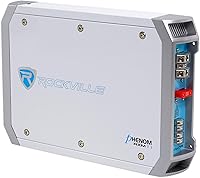
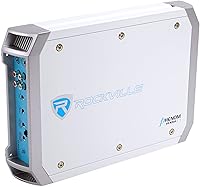
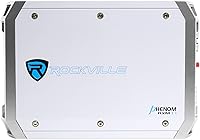
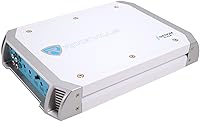
The Rockville RXM-T1 2-Channel Marine Amplifier sits in an interesting spot — enough real-world power to satisfy most recreational boaters, priced well below where the serious marine audio brands start competing. What helps it stand out from similarly priced options is its Class A/B circuitry with simulated Class G efficiency, which translates to cleaner sound and less heat buildup than pure Class D designs at this tier. Running two channels or bridging down to mono gives you flexibility depending on your speaker setup. The auto-start turn-on feature senses an audio signal rather than requiring a remote wire — a genuinely useful convenience. Just don't expect audiophile-grade transparency; this is an honest performer within clearly defined limits.

Features & Benefits

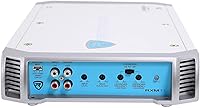
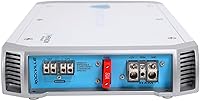
The number that jumps out on the spec sheet is 1500W peak, but the figure that actually matters is 370W RMS — that's the continuous, real-world power delivery you can count on. Configured as two channels, you're looking at 185W per side at 2 ohms, or the full 370W bridged into 4 ohms for a subwoofer. The MOSFET power supply keeps voltage stable and temperatures manageable during long afternoon runs on the water. Crossover adjustment spans 50Hz to 250Hz on both low and high pass settings, with a 12dB bass EQ layered on top — plenty of tuning range for most speaker combinations. High-level inputs let you tap directly from speaker wire if your head unit lacks RCA outputs.

Best For

This marine amp is a natural fit for smaller vessels — pontoon boats, fishing rigs, day cruisers — where you're powering a pair of marine speakers or bridging to run a single sub. DIY installers will appreciate how little drama is involved in getting it running, especially when working with an older boat stereo that outputs speaker-level signal rather than RCA. Coastal and salt-air environments are where the conformal coating earns its keep; it isn't a marketing claim — it genuinely extends the board's life when moisture is a daily reality. Where this two-channel amplifier falls short is in complex, multi-zone audio builds or for listeners with demanding expectations around sound staging and fine detail.

User Feedback

With a 3.7-star average across over 200 ratings, the Rockville RXM-T1 tells a familiar story: buyers who sized it correctly for their setup tend to come away satisfied, while those chasing the headline peak wattage walk away underwhelmed. Installation ease and the reliable auto-sensing turn-on draw consistent praise — those features genuinely reduce headaches during setup. On the other side, some owners report heat buildup during extended high-volume sessions, and a handful flagged inconsistency in build quality between units, suggesting some variance in manufacturing tolerances. The overall picture is fair value for a recreational boater, but if you need all-day reliability at full output, manage your expectations going in.

Pros

  • Auto-sensing turn-on works reliably without needing a remote wire, saving real headaches during installation.
  • High-level inputs let you plug directly into an existing head unit without additional wiring adapters.
  • Conformal-coated PCB provides genuine moisture and salt resistance, not just a marketing label.
  • Class A/B circuitry with simulated Class G efficiency runs cooler and cleaner than comparable Class D units at this price.
  • Bridgeable to mono, so you can redirect full power to a subwoofer when your setup calls for it.
  • MOSFET power supply keeps voltage delivery stable even as demand fluctuates during a long day on the water.
  • Adjustable crossover with 12dB bass EQ gives you meaningful control over how your speakers are tuned.
  • Stainless steel screws resist rust and corrosion in salt-air conditions better than standard hardware.
  • Compact footprint at under 17 inches long makes it easier to find a mount location on tighter installations.
  • Strong value for casual recreational use where the goal is louder, cleaner sound without a big budget.

Cons

  • The 1500W peak figure is misleading — real continuous output is 370W RMS, which is a significant gap.
  • Heat buildup during extended high-volume sessions has been reported by multiple owners, which can throttle performance.
  • Build quality consistency appears uneven, with some buyers receiving units that feel less solid than others.
  • Only two channels limits its usefulness for anyone wanting to run a full speaker and sub system simultaneously.
  • The efficiency rating of 65–70% is lower than modern Class D amps, which can matter on boats with smaller battery banks.
  • No dedicated gain control indicator makes setting input sensitivity a guessing game without a multimeter or test tone.
  • Sound quality lacks the clarity and detail that more expensive marine-specific amplifiers deliver at higher volume.
  • Customer support and warranty experience from Rockville has drawn mixed reviews, which is worth factoring in.
  • Cooling performance in direct sun or enclosed mounting spaces may fall short during peak summer conditions.

Ratings

The scores below for the Rockville RXM-T1 2-Channel Marine Amplifier were generated by our AI engine after analyzing verified owner reviews across global marketplaces, with spam, bot activity, and incentivized feedback actively filtered out. We've weighted both the enthusiastic praise and the recurring frustrations equally, so what you see reflects the full picture — not just the highlights. Strengths and genuine pain points are represented transparently to help you make a confident, informed decision.

Ease of Installation
84%
The auto-sensing turn-on and high-level inputs are the two features owners mention most when describing how painless the install was. Boaters with older factory stereos — no RCA outputs, no remote wire — found they could have this amp running in an afternoon without calling in a professional.
A handful of users noted that the manual is sparse when it comes to crossover and gain setup, leaving some guessing during calibration. Those new to car or marine audio may hit a wall once the physical install is done and the tuning begins.
Power Output
61%
39%
For casual weekend use — background music on a pontoon, a bit of extra volume on a fishing boat — the 370W RMS output is genuinely adequate and noticeably better than running speakers off a factory head unit alone.
The 1500W peak headline sets expectations the amp simply cannot sustain, and more than a few buyers felt misled once they heard it side-by-side with higher-rated units. Real-world output at high volumes falls short of what the spec sheet implies, which is the single most common frustration across reviews.
Marine Durability
77%
23%
The conformal-coated PCB genuinely extends the life of the board in salt air and high-humidity conditions, and owners running this amp on coastal boats report it holding up through multiple seasons without corrosion issues on the electronics side.
The stainless screws are a nice touch, but some users noted that other external hardware and the chassis finish show wear faster than expected in aggressive saltwater environments. It's marine-rated, not marine-proof, and sustained direct spray exposure is likely to cause issues over time.
Sound Quality
67%
33%
At moderate listening volumes, the Class A/B circuitry delivers cleaner, warmer audio than you'd expect from a budget-tier amp — definitely a step up from running speakers off a head unit, and adequate for most casual boating scenarios.
Push the volume past 70–75% and the clarity starts to soften, with some users describing a flatness or slight harshness at higher output levels. Audiophiles or anyone accustomed to higher-end marine audio will find the sound ceiling unsatisfying.
Heat Management
54%
46%
The MOSFET power supply and Class G-inspired efficiency do help keep temperatures down compared to older Class A/B designs, and in typical recreational use with music at social volumes, the amp runs without any thermal concerns.
Extended high-volume sessions — especially in warm climates or enclosed mounting spaces — push the amp into noticeable heat territory, and some owners report thermal protection kicking in and cutting output. If you're planning all-day listening at full tilt, this is a real limitation to factor in.
Value for Money
73%
27%
For boaters who understand what they're buying — a capable recreational amp at an accessible price — the Rockville RXM-T1 delivers a reasonable return. Features like the auto-start turn-on and conformal coating are genuine value-adds that competitors in the same range often skip.
Those who bought based on the peak power claim and expected performance comparable to more expensive marine amps felt the value proposition fall apart quickly. The gap between marketing and real-world delivery makes the perceived value heavily dependent on how well-informed the buyer was at the point of purchase.
Build Consistency
58%
42%
The majority of units arrive functional and ready to install, and owners who receive a well-built sample tend to report solid day-to-day reliability during normal seasonal use on the water.
A notable portion of negative reviews describe units that failed early, arrived with loose connections, or felt noticeably flimsier than expected for the size. The unit-to-unit variance suggests quality control is inconsistent, which introduces some risk, particularly for buyers without an easy return window.
Crossover & EQ Controls
71%
29%
The adjustable crossover range — covering 50Hz to 250Hz on low pass and 15Hz to 250Hz on high pass — gives you meaningful flexibility for matching the amp to different speaker configurations without needing a separate processor.
The controls themselves are small and unlabeled beyond basic markings, making fine-tuning by ear a somewhat imprecise exercise. Users without audio tuning experience often set these by guesswork and leave a fair amount of potential sound quality on the table as a result.
Channel Flexibility
76%
24%
The ability to switch between stereo and bridged mono mode covers the two most common recreational boat audio configurations — a pair of speakers or a single subwoofer — without requiring a second amp or an external crossover.
Two channels is the ceiling, so anyone wanting to run a full four-speaker layout plus a sub from a single unit will need to look elsewhere. For growing audio setups, this two-channel amplifier quickly becomes the bottleneck rather than the solution.
Input Compatibility
82%
18%
Supporting both RCA and high-level speaker-wire inputs means this amp integrates cleanly with almost any head unit on the market, from a modern marine stereo with full RCA outputs to a basic factory unit with speaker terminals only.
There is no dedicated input sensitivity indicator, so setting the gain correctly requires either a multimeter and test tone or a fair amount of trial and error. Getting this wrong is one of the more common reasons users report distortion or underwhelming volume.
Physical Footprint
69%
31%
At 7 pounds and a footprint of roughly 17 by 10.6 inches, the amp is manageable for one person to position and secure, and it fits reasonably well under bench seats or along transom walls on mid-size recreational boats.
It's not a compact unit by any measure, and on smaller vessels — jon boats, small fishing skiffs — finding a clean mounting location that also allows for airflow can be a genuine puzzle. The size also limits mounting orientation options in tight compartments.
Auto Turn-On Reliability
81%
19%
Signal-sensing auto-start is consistently one of the most praised aspects across owner reviews, with the vast majority reporting that the amp powers on and off cleanly and reliably without any manual intervention or wiring complexity.
A small number of users report the auto-start occasionally triggering from low-level signal noise, keeping the amp powered on even when no music is playing — a minor but real concern for battery drain during extended time at the dock.
Documentation & Support
47%
53%
The included manual covers the basic installation steps and gives enough information for someone with existing audio experience to get up and running without needing outside help.
For anyone without a background in car or marine audio, the manual falls well short of what's needed for confident setup and tuning. Customer support experiences from Rockville draw mixed reviews, with some buyers describing slow or unhelpful responses when issues arose post-purchase.

Suitable for:

The Rockville RXM-T1 2-Channel Marine Amplifier is a practical choice for recreational boaters who want a meaningful audio upgrade without diving into the deep end of marine audio pricing. It fits best on smaller vessels — pontoons, fishing boats, center consoles, and day cruisers — where you're driving one or two pairs of marine speakers, or bridging the amp to power a single subwoofer. DIY installers will find the high-level inputs especially useful, since they let you connect directly from an existing head unit's speaker outputs, eliminating the need to run a remote turn-on wire or swap out your stereo. Boaters in coastal or high-humidity environments get genuine value from the conformal-coated circuit board, which provides real protection against the salt air and moisture that quietly kill conventional electronics over time. If your goal is solid, reliable sound for weekend trips on the water without overcomplicating the install, this marine amp delivers a sensible return.

Not suitable for:

The Rockville RXM-T1 2-Channel Marine Amplifier is not the right tool if you're building a serious, multi-zone audio system across a larger vessel — two channels simply won't cover that kind of setup. Buyers chasing the 1500W peak number on the box will be disappointed once they understand that the continuous RMS output is 370W, which is respectable but a long way from the headline figure. Listeners with a trained ear who care about soundstage precision, low-noise floors, and fine audio detail will find the performance ceiling frustrating compared to purpose-built marine audio brands at higher price points. If your boat sees punishing, all-day high-volume use in direct sun — think an offshore fishing tournament or a full day on a sandbar — heat management may become a real concern, and a more thermally robust amplifier would serve you better. Anyone who needs four or more channels for a complete speaker and sub configuration should look elsewhere from the start.

Specifications

  • Brand & Model: Manufactured by Rockville under the model designation RXM-T1.
  • Peak Power: Rated at 1500W peak, which represents momentary maximum output under ideal conditions.
  • RMS Power: Continuous RMS output is 370W total — 185W per channel at 2 ohms, or 370W bridged into 4 ohms.
  • Channels: Two-channel design with bridgeable mono mode for flexible speaker and subwoofer configurations.
  • Circuitry Class: Class A/B design with simulated Class G efficiency, running at approximately 65–70% efficiency.
  • Power Supply: MOSFET-based internal power supply for stable voltage delivery and reduced heat generation during use.
  • Crossover Range: 12dB-per-octave adjustable crossover covering 50Hz–250Hz on the low-pass filter and 15Hz–250Hz on the high-pass filter.
  • Bass EQ: Built-in bass equalizer with up to 12dB of boost or cut for tuning low-frequency output.
  • Input Types: Accepts both RCA line-level inputs and high-level speaker wire inputs for compatibility with virtually any head unit.
  • Turn-On Method: Auto-start signal-sensing technology activates the amp when audio signal is detected, requiring no remote turn-on wire.
  • Marine Protection: Circuit board is treated with a conformal coating to resist moisture, salt, and corrosion; hardware uses stainless steel screws.
  • Dimensions: Measures 16.9″ long by 10.6″ wide by 4.1″ tall, sized for typical under-seat or transom mounting positions.
  • Weight: Unit weighs 7 pounds, making it manageable for a single-person installation without assistance.
  • Operating Voltage: Designed to operate on a standard 12V DC marine or automotive electrical system.
  • Mounting Type: Intended for boat mount installation on marine vessels including yachts, pontoons, and fishing boats.
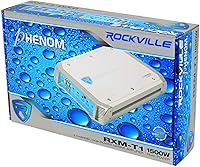
  • In the Box: Package includes the amplifier unit, a user manual, mounting screws, and basic wiring hardware.

Related Reviews
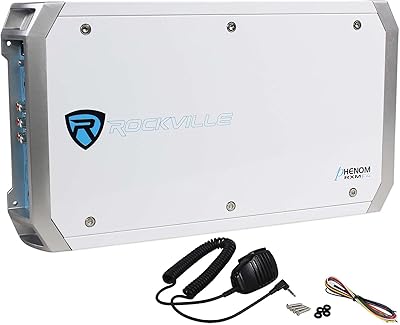
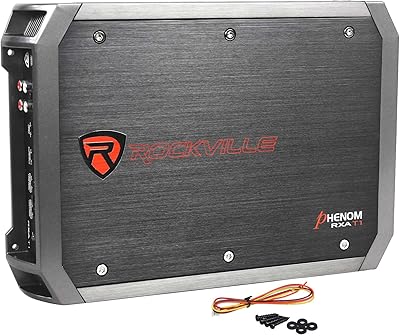
Rockville RXA-T1 1500W 2-Channel Car Amplifier
85%
88%
Audio Performance
92%
Bass Response
85%
Build Quality
89%
Compactness/Size
80%
Ease of Installation
More
Rockville RXM-F4 2400W Marine 4-Channel Amplifier
87%
89%
Sound Performance
94%
Durability & Weather Resistance
84%
Ease of Installation
91%
Build Quality
92%
Power Output
More
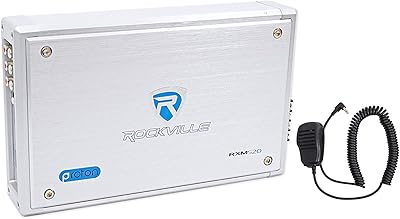
Rockville RXM-S20 4-Channel Marine Amplifier
72%
83%
Value for Money
88%
Installation Ease
71%
Sound Quality
62%
Power Accuracy
67%
Water Resistance
More
Rockville DBM65 6-Channel Marine Amplifier
73%
88%
Value for Money
83%
Power Output
71%
Waterproofing & Weather Resistance
91%
Channel Flexibility
67%
Build Quality
More
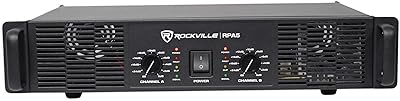
Rockville RPA5 2-Channel Power Amplifier
78%
88%
Value for Money
76%
Power Output & Headroom
67%
Build Quality & Construction
79%
Cooling & Thermal Management
91%
Connectivity & I/O Flexibility
More
Rockville DBM45 4-Channel Marine Amplifier
71%
78%
Sound Quality
74%
Build Quality
71%
Waterproofing
69%
Power Delivery
57%
Thermal Management
More
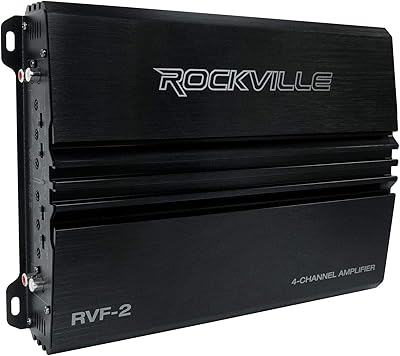
Rockville RVF-2 4-Channel Car Amplifier
84%
88%
Audio Quality
91%
Power Output
85%
Build Quality
72%
Thermals (Heat Management)
80%
Installation Ease
More
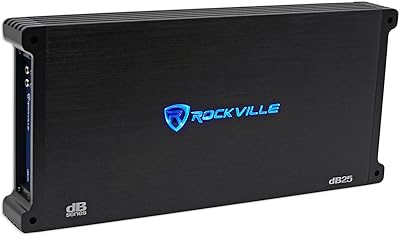
Rockville dB25 2800W 2-Channel Car Amplifier
86%
94%
Power Output
89%
Sound Quality
85%
Ease of Installation
91%
Bass Control
82%
Durability
More
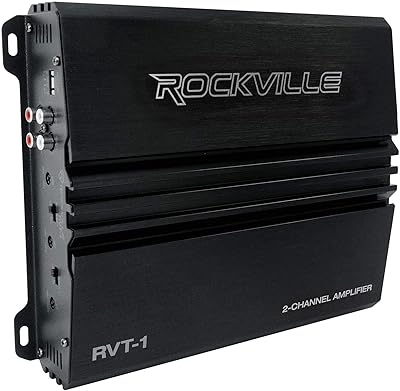
Rockville RVT-1 2-Channel Car Amplifier
68%
83%
Value for Money
67%
Power Output
58%
Build Quality
61%
Thermal Management
72%
Audio Clarity
More
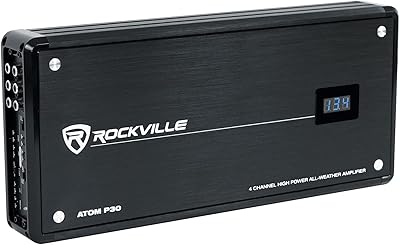
Rockville ATOM P30 2400W 4-Channel Marine Amplifier
84%
94%
Power Output
90%
Build Quality
88%
Waterproof Performance
80%
Ease of Installation
85%
Sound Quality
More

FAQ

No, and that is one of the more practical things about this marine amp. The auto-start feature senses when your head unit sends an audio signal and powers the amp on automatically. It also shuts off when the signal stops, so you don't have to worry about draining your battery.

Yes, the high-level inputs handle exactly that situation. You tap directly into the speaker wire coming out of your head unit, and the amp converts that signal internally. It's a common setup on older boats or factory stereos that lack RCA outputs, and it works without any additional adapters.

The 1500W figure is peak power — essentially the maximum the unit can handle in a very brief burst under perfect conditions. The number that reflects everyday listening is the RMS rating, which is 370W total. That's 185W into each channel at 2 ohms, or the full 370W if you bridge it to mono for a subwoofer.

The conformal coating on the circuit board is a legitimate protective measure, not just a label. It seals the electronics against moisture, salt air, and humidity that would corrode an unprotected board over time. That said, this amp is water-resistant rather than submersible — you wouldn't want it taking direct wave splash repeatedly, but for typical marine humidity and spray, it holds up well.

Yes. Bridge the two channels together and you get 370W of continuous power into a 4-ohm subwoofer — a solid amount for a single sub on a smaller vessel. Just make sure your sub's impedance matches the bridged 4-ohm requirement to avoid stressing the amplifier.

The unit measures 16.9″ long by 10.6″ wide by 4.1″ tall and weighs 7 pounds. That's a mid-size footprint — workable for most under-seat compartments, transom areas, or enclosed storage spaces on pontoons and day cruisers. It's worth measuring your intended mount location before ordering, since this isn't a compact install amp.

Heat management is worth paying attention to with this unit. At moderate volumes it runs fine, but some owners report thermal buildup during extended high-volume sessions. Make sure you're mounting it somewhere with reasonable airflow — avoid completely sealed, unventilated spaces. If you plan to push it hard all day in direct sun, a more thermally robust amplifier might be a safer bet.

Yes, it's compatible with 4-ohm speakers in stereo mode, though its per-channel RMS output is rated at 2 ohms. Running 4-ohm speakers will result in a bit less output power per channel, which is entirely normal — you'll still get solid volume for a typical recreational setup.

It's straightforward enough for a confident DIYer with basic wiring experience. The high-level inputs remove the need for RCA cables or a remote wire, and the signal-sensing auto-turn-on simplifies the electrical side considerably. The manual covers the basics, though some users find supplementing it with online tutorials helpful for the crossover and gain settings.

At its price point, the Rockville RXM-T1 competes mostly on features and protection spec rather than pure sound quality. The conformal coating, MOSFET power supply, and auto-sensing turn-on are genuine advantages over bare-bones competitors. Where dedicated marine audio brands like JL Audio or Wet Sounds pull ahead is in thermal management, build consistency, and audio fidelity — but those come at a significantly higher cost.

Where to Buy