Overview

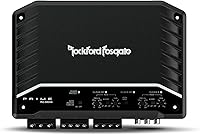
The Rockford Fosgate R2-500X4 4-Channel Car Amplifier sits comfortably in the Prime series lineup — Rockford's mid-tier range aimed at enthusiasts who want real performance without paying flagship prices. At just 6.8 by 10.1 inches and under two inches tall, it punches well above its physical weight, delivering 500 watts RMS across four channels. Its Class D topology is the headline engineering choice here, keeping power draw on your vehicle's electrical system relatively modest compared to older Class A/B designs. Whether you're running 4-ohm or 2-ohm loads, the impedance flexibility gives installers real options without forcing compromises.
Features & Benefits

One of the more practical things about this Rockford Fosgate amp is the C.L.E.A.N. circuitry, which takes the anxiety out of gain matching. Instead of relying on guesswork or ear-burning trial and error, you get a signal-sensing tool that tells you when you've hit optimal gain — less distortion, cleaner output. The Punch EQ adds a welcome bass lift of up to three times normal output, which goes a long way in vehicles that naturally absorb low frequencies. Butterworth crossovers are fully adjustable in both high and low pass modes, and the RCA pass-through outputs mean you can chain additional amplifiers without extra signal splitters. The P.O.W.E.R. Supply ramps up as battery voltage climbs, keeping headroom consistent during demanding playback.

Best For

This 4-channel amplifier makes the most sense for someone doing a meaningful upgrade to a factory system, particularly when keeping the stock head unit. High-level inputs handle that situation cleanly, so there's no need to pull the dash apart just to add a proper amplifier. It's also a natural fit for space-conscious installs — the slim profile slides under most front seats without drama. Builders looking to run four speakers and a bridged subwoofer channel will find the power distribution genuinely practical. And for daily drivers, the Class D efficiency matters more than people realize; it puts less strain on your alternator over time. Those stepping up from a budget amp but not yet ready for a multi-thousand-dollar build will find the R2-500X4 hits a sweet spot.

User Feedback

Owners generally come away satisfied, with the most common praise centered on how straightforward the initial setup is — labeled terminals and logical layout make the wiring process less intimidating for first-time installers. Sound clarity at moderate to high volumes earns consistent compliments too. On the other side, a handful of buyers have noted that the amp runs warm in tight enclosures without adequate airflow, which is worth factoring into your mounting plan. A few mention the 1-year warranty feeling short given what competing brands offer at similar price points. Long-term reliability reports are mostly positive, but the sample size is still relatively modest. Overall, this Rockford Fosgate amp lands well with buyers who did their homework on installation requirements beforehand.

Pros

  • C.L.E.A.N. circuitry takes the guesswork out of gain setup, reducing distortion risk significantly during initial install.
  • Punch EQ delivers a noticeable bass boost that genuinely compensates for the acoustic limitations of most car cabins.
  • High-level inputs make this 4-channel amplifier easy to pair with a stock head unit, no adapter required.
  • The slim 1.9-inch profile fits cleanly under most front seats, solving real space problems in compact cars.
  • RCA pass-through outputs allow a second amplifier to be added later without buying a signal splitter.
  • Class D topology keeps power consumption low, putting less long-term strain on your vehicle's charging system.
  • Butterworth crossovers are fully adjustable, giving installers genuine flexibility for both full-range and component speaker setups.
  • Rockford Fosgate's reputation for build quality holds up here — fit and finish feel solid for the price tier.
  • Top-mounted controls are accessible without pulling the amp out of a tight install location.
  • The bridged mono output of 250 watts at 4 ohms gives you a workable subwoofer channel without a dedicated mono block.

Cons

  • The 1-year warranty is shorter than what several direct competitors offer at a comparable price point.
  • Thermal management in poorly ventilated installs is a real concern — plan airflow carefully before committing to a location.
  • Power output at 4 ohms per channel is modest; buyers expecting room-filling loudness from four speakers may feel underwhelmed.
  • The Punch EQ, while useful, is not a substitute for a dedicated bass processor in more demanding listening setups.
  • No built-in bass remote output means controlling sub level from the driver seat requires an additional accessory.
  • Some buyers report that the gain setup process, despite C.L.E.A.N. circuitry, still has a learning curve for true beginners.
  • At five pounds and with a fairly standard mounting footprint, the amp offers no unique physical installation advantage beyond its slim height.
  • The P.O.W.E.R. Supply benefit is most noticeable at higher voltage, which means budget electrical systems see less of that advantage.

Ratings

The Rockford Fosgate R2-500X4 4-Channel Car Amplifier has been scored by our AI system after analyzing verified buyer reviews from multiple global markets, with spam, bot submissions, and incentivized feedback actively filtered out before any scoring took place. The results reflect a balanced picture — real strengths that repeat consistently across thousands of installs, and genuine frustrations that a fair review cannot ignore. Whether this amp earns a place in your build or sends you shopping elsewhere, the scores below tell the full story.
Sound Quality
86%
Buyers consistently report that the R2-500X4 produces clean, well-defined audio at everyday listening volumes, with minimal harshness through door speakers. The Punch EQ adds low-end body that most factory-speaker setups desperately need, and the balanced differential inputs help keep noise out of the signal chain on longer cable runs.
At very high volumes, a small but vocal segment of users notice the amp beginning to compress the dynamics, particularly on bass-heavy tracks. It is not a distortion problem so much as a headroom limitation that becomes apparent when the amp is pushed close to its ceiling.
Power Output
78%
22%
For a 4-channel amp in this size class, the power figures are genuinely useful — especially the 155 watts per channel at 2 ohms, which gives more sensitive speaker builds a real boost. Daily drivers running a set of aftermarket component speakers and a modest subwoofer find the output more than adequate for street listening.
Buyers expecting concert-level output from all four channels simultaneously will run into the amp's limits faster than the spec sheet implies. Real-world power delivery under sustained load falls short of what the peak numbers suggest, which is common at this tier but still worth managing expectations around.
Installation Ease
88%
The top-mounted controls and clearly labeled terminals make the wiring process far less intimidating than competing amps at this price level. Several first-time installers specifically called out how intuitive the layout is, noting that the high-level inputs eliminated the need to modify their factory wiring harness.
The C.L.E.A.N. gain tool helps, but the process still requires patience and a basic understanding of signal levels — buyers who skipped the manual and went by ear reported problems with distortion or under-powered output. A quick-start diagram inside the box would reduce setup errors considerably.
Build Quality
83%
The chassis feels solid for a mid-range amplifier, and the heatsink construction holds up well in typical installs where airflow is adequate. Long-term owners who have had the R2-500X4 through multiple seasons report no degradation in the housing, connectors, or control knobs.
The unit does not quite match the fit and finish of upper-tier amplifiers from the same brand, and a handful of buyers noted that the RCA connectors feel slightly less robust than expected. Nothing that causes functional problems in most installs, but it is noticeable if you are comparing it side by side with a premium unit.
Thermal Management
67%
33%
In open or semi-open install locations — like a ported amp rack in a hatchback or on a carpeted board in the trunk — the Class D design keeps the unit running at comfortable temperatures even during extended listening sessions. The heatsink does its job when it has room to breathe.
Under-seat installs with limited clearance regularly trigger thermal protection shutdowns during summer months or long highway drives at high volume. This is the single most repeated complaint across user reviews, and it points to a real limitation: the amp needs airflow, and the slim form factor that makes it easy to hide also makes ventilation harder to achieve.
Value for Money
81%
19%
Stacked against competitors in the same power and feature bracket, the R2-500X4 offers a reputable brand name, a solid feature set, and reliable day-to-day performance at a price that does not require a painful compromise elsewhere in the build budget. The C.L.E.A.N. circuitry and pass-through outputs alone justify the premium over bare-bones alternatives.
The 1-year warranty undercuts the value argument somewhat, particularly when several rivals at or near the same price point cover buyers for two to three years. If you factor in the cost of professional reinstallation if something fails just outside the warranty window, the value calculation gets less comfortable.
Gain Setup & Calibration
74%
26%
The C.L.E.A.N. circuitry is a practical tool that genuinely reduces the trial-and-error frustration of gain setting, and experienced installers appreciate how quickly it lets them dial in a clean signal. When used correctly, it produces noticeably lower distortion at moderate to high volumes compared to amps without any calibration assistance.
Users who are new to amplifier installation still find the gain process confusing despite the circuitry's guidance, and a few reported setting gains incorrectly and blowing tweeters before understanding what C.L.E.A.N. was actually indicating. Better documentation in the box would prevent a lot of these avoidable mistakes.
Compatibility
91%
The combination of high-level inputs, balanced RCA inputs, and a defeatable auto turn-on circuit means this 4-channel amplifier works cleanly with an unusually wide range of source units — from basic factory radios to aftermarket head units with preamp outputs. That flexibility is a genuine differentiator in this class.
While compatibility is broad, pairing this amp with certain DSP processors or aftermarket signal processors occasionally causes ground loop noise that takes additional troubleshooting to resolve. It is not a design flaw per se, but it requires some electrical knowledge to sort out cleanly.
Compact Form Factor
89%
At under two inches tall and roughly the footprint of a hardcover book, this Rockford Fosgate amp slides under most front seats without modification, which is a practical advantage in vehicles where trunk space is either unavailable or earmarked for a subwoofer enclosure. Installers building clean, hidden setups consistently praise the dimensions.
The slim height that makes it easy to hide also limits the surface area of the heatsink, which feeds directly into the thermal concerns mentioned by users in tight, unventilated spots. The form factor is a clear design trade-off, not a flaw, but buyers should understand what they are exchanging for that low profile.
Crossover Flexibility
82%
18%
Having fully adjustable 12 dB/octave high-pass and low-pass crossovers on board removes the need for an external crossover in most common speaker configurations. Installers running component front speakers and coaxials in the rear can tune each channel pair independently, which is a feature often missing from similarly priced competitors.
The crossover adjustment points are tight and offer limited resolution, making very precise tuning difficult without additional measuring tools. Buyers building a more exacting audio system will likely outgrow the onboard crossovers and reach for an external processor, but for everyday builds they are more than sufficient.
Electrical Efficiency
87%
Class D topology keeps idle and operating current draw low enough that most vehicles with a stock alternator handle the amp without any electrical upgrades, which is a real-world benefit for daily drivers who are not interested in adding a secondary battery or a high-output alternator to their build.
At sustained high output — particularly when running 2-ohm loads on all four channels — current draw climbs noticeably and can cause voltage sag in older vehicles with weaker charging systems. The P.O.W.E.R. Supply helps maintain performance as voltage rises, but it cannot compensate for a fundamentally underpowered electrical system.
Warranty Coverage
53%
47%
Rockford Fosgate backs the amp with a 1-year limited warranty, and the brand's customer support reputation is generally positive among the car audio community. For buyers who install the amp correctly and keep it from overheating, the unit typically outlasts the covered period without issues.
One year of coverage is simply below average for this product category, and it stands out as a weak point when competitors routinely offer two or three years at similar or slightly lower prices. Buyers who discover a manufacturing defect in month 14 have no recourse, which is a meaningful risk on a product of this cost.
Multi-Amp Scalability
79%
21%
The RCA pass-through outputs make it straightforward to add a dedicated mono subwoofer amplifier later without purchasing a separate signal splitter or line output converter. That expandability is genuinely useful for buyers who want to build their system incrementally rather than all at once.
The pass-through outputs carry the same signal as the input, so any noise or coloration introduced upstream will be passed along to the next amplifier in the chain. In electrically noisy vehicles, this can mean troubleshooting problems across two amplifiers rather than one.

Suitable for:

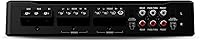
The Rockford Fosgate R2-500X4 4-Channel Car Amplifier is a strong match for anyone who wants a meaningful audio upgrade without ripping their entire dashboard apart. It's especially well-suited to drivers keeping their factory head unit, since the high-level inputs handle that connection cleanly and the defeatable auto turn-on circuit removes the need for a dedicated remote wire. Enthusiasts planning a four-speaker setup — or those who want to run three channels for speakers and bridge the fourth for a subwoofer — will find the power distribution genuinely practical. The compact footprint makes under-seat installation realistic in most vehicles, which matters a lot if trunk space is off the table. Daily drivers who want better sound without putting unnecessary strain on their alternator will also appreciate the Class D efficiency at work here.
Not suitable for:

Buyers chasing serious competition-level output or planning a high-powered multi-amplifier system should look past the Rockford Fosgate R2-500X4 4-Channel Car Amplifier and invest in a higher-tier solution. The 1-year warranty is a genuine drawback compared to several competitors in this price bracket that offer two or three years of coverage, so buyers with long ownership horizons should factor that in. Anyone mounting this amp in a sealed, poorly ventilated space should be cautious — Class D runs cooler than older topologies, but it still generates heat, and a cramped install without airflow will cause thermal shutdowns over time. If your build demands more than 155 watts per channel at 2 ohms on all four channels simultaneously, the R2-500X4 may leave you wanting more headroom. It is also not the right fit for audiophiles prioritizing ultra-low noise floors and laboratory-grade signal purity, where higher-end amps with more sophisticated power supplies would be expected.
Specifications

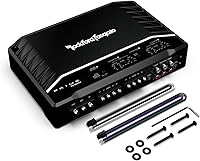
  • Total RMS Power: The amplifier delivers 500 watts of continuous RMS power across all four channels combined.
  • Power at 4 Ohms: Each channel produces 75 watts RMS when driving a 4-ohm load, suitable for most standard aftermarket speakers.
  • Power at 2 Ohms: Each channel steps up to 155 watts RMS when driving a 2-ohm load, useful for higher-sensitivity speaker configurations.
  • Bridged Power: In bridged mode, pairs of channels each deliver 250 watts RMS into a 4-ohm load, making it viable for a subwoofer channel.
  • Circuit Topology: Class D amplification is used throughout, prioritizing electrical efficiency over the heat output typical of older Class A/B designs.
  • Dimensions: The unit measures 6.8″ in width, 10.1″ in length, and 1.9″ in height, allowing under-seat installation in most vehicles.
  • Weight: The amplifier weighs 5 pounds, making single-person installation straightforward without specialized mounting equipment.
  • Max Supply Voltage: The amplifier accepts up to 16 volts DC, covering standard 12-volt automotive electrical systems with headroom for voltage spikes.
  • Crossover Type: Fully adjustable 12 dB/octave Butterworth high-pass and low-pass crossovers are included and configurable for each channel pair.
  • Gain Circuitry: C.L.E.A.N. (Clip Level Evaluation and Audio Noise) circuitry assists in setting accurate gain levels to minimize distortion during setup.
  • Bass EQ: An integrated Punch EQ provides up to 3x bass enhancement, designed to compensate for the acoustic limitations of enclosed vehicle cabins.
  • Signal Inputs: Balanced differential RCA inputs are included, reducing susceptibility to electrical noise from the vehicle's wiring harness.
  • Signal Outputs: RCA pass-through outputs allow the signal to be looped to an additional amplifier without requiring an external signal splitter.
  • High-Level Input: High-level speaker wire inputs are built in, enabling direct connection to the speaker outputs of a factory or OEM head unit.
  • Auto Turn-On: A defeatable auto turn-on circuit detects an incoming signal and powers the amplifier on without requiring a dedicated remote wire.
  • Control Placement: All user-accessible controls, including gain, crossover frequency, and EQ settings, are located on the top face of the unit.
  • Power Supply: The internal P.O.W.E.R. Supply design scales output capacity as supply voltage increases, maintaining consistent headroom during demanding playback.
  • Warranty: Rockford Fosgate provides a 1-year limited manufacturer warranty covering defects in materials and workmanship from the date of purchase.

Related Reviews
Rockford Fosgate R2-300X4 Prime 300-Watt 4-Channel Amplifier
86%
89%
Sound Quality
91%
Power Output
84%
Ease of Installation
87%
Bass Performance
82%
Build Quality
More
Rockford Fosgate Power T400-4 400-Watt 4-Channel Amplifier
87%
91%
Performance
89%
Sound Quality
94%
Ease of Installation
88%
Durability
90%
Build Quality
More
Rockford Fosgate R300X4 Prime 4-Channel Amplifier
87%
88%
Performance
91%
Ease of Installation
85%
Build Quality
87%
Thermal Management
84%
Sound Output
More
Rockford Fosgate PBR400X4D 4-Channel Car Amplifier
80%
96%
Size & Form Factor
81%
Power Output
78%
Installation Experience
83%
Sound Quality
89%
Heat Management
More
Rockford Fosgate Punch P600X4 4-Channel Amplifier
87%
93%
Sound Clarity
91%
Build Quality
88%
Power Output
89%
Installation Experience
71%
Value for Money
More
Rockford Fosgate PBR300X4 Punch 300-Watt 4-Channel Amplifier
87%
88%
Power Output
91%
Installation Ease
84%
Sound Quality
92%
Compact Design
87%
Energy Efficiency
More
Rockford Fosgate P400X4 Punch 400-Watt 4-Channel Amplifier
85%
89%
Power Output
91%
Bass Enhancement (Punch EQ)
88%
Installation Ease
85%
Sound Clarity and Performance
87%
Build Quality
More
Rockford Fosgate TM400X4ad Marine 4-Channel Amplifier
81%
91%
Build Quality
78%
Weather & Corrosion Resistance
88%
Sound Quality
86%
Power Output & Accuracy
72%
Heat Management
More
Rockford Fosgate R2-750X5 Prime 750-Watt 5-Channel Amplifier
85%
91%
Sound Quality
88%
Power Delivery
82%
Installation Ease
89%
Bass Performance
87%
Build Quality
More
Planet Audio PL1600.4 4-Channel Car Amplifier
72%
88%
Value for Money
84%
Ease of Installation
74%
Sound Quality
58%
Power Output (Real-World)
61%
Build Quality
More

FAQ

You can keep your stock head unit. The R2-500X4 includes high-level inputs that connect directly to your factory speaker wires, so there is no need to swap out the head unit just to add amplification. The defeatable auto turn-on circuit also means you do not need to hunt for a remote wire.

It is more approachable than most thanks to the C.L.E.A.N. circuitry, which uses indicator lights to signal when you have hit the right gain level. That said, if you have never set amp gain before, spending 20 minutes reading the manual before touching the knobs will save you a lot of frustration. It is not plug-and-play, but it is manageable for a careful first-timer.

Class D runs cooler than older designs, but it still generates heat — especially when pushed hard. If you are mounting it under a seat with limited airflow, make sure there is at least an inch or two of clearance on all sides. In a sealed enclosure with no ventilation, thermal shutdowns are a real possibility during extended high-volume listening.

You can run four speakers on the four channels and then bridge two of those channels to drive a subwoofer, but that means your front or rear speakers would lose their dedicated channels. To run four full-range speakers and a sub simultaneously, you would typically need a separate mono amp for the subwoofer alongside this 4-channel unit.

Rockford Fosgate recommends a 60-amp fuse for this amplifier. For the power wire, 4-gauge is the standard recommendation at typical run lengths under 15 feet from the battery. Using undersized wire will limit the amp's performance and can create a safety risk.

Yes, each channel is rated at 155 watts into a 2-ohm load, so running 2-ohm speakers or wiring dual-voice-coil woofers to 2 ohms is fully supported. Just make sure your speaker wiring is clean and your gains are set conservatively at first, since higher current draws at 2 ohms put more demand on the amp.

No, this amplifier does not include a bass remote output. If you want the ability to adjust bass level from the driver seat without reaching under the seat, you would need to add an external bass remote controller, which this amp does not natively support.

The Punch EQ is a fixed-frequency bass boost centered around 45 Hz, and it can add significant low-end energy — up to 3 times the baseline bass output. It is handy for compensating for vehicles that absorb bass naturally, but it is easy to overdo it. Start with it at minimum and raise gradually, or you risk muddying the low end rather than tightening it.

No. Bridged operation is only stable at 4 ohms minimum per bridged channel pair. Bridging into a 2-ohm load risks damaging the amplifier and is not supported by Rockford Fosgate. If your subwoofer presents a 2-ohm load, keep it on a single channel or rewire it to achieve a 4-ohm bridged-compatible impedance.

It is worth noting honestly. Several competing amplifiers at similar price points offer 2- or even 3-year warranties, so Rockford Fosgate's 1-year coverage is on the shorter side. For most buyers who install the amp correctly and keep it from overheating, it should outlast the warranty period by a wide margin. But if long warranty coverage is a priority for you, it is a fair reason to compare alternatives before deciding.

Where to Buy