Overview

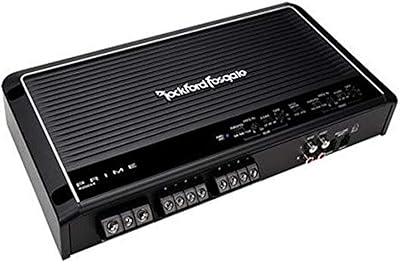
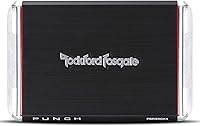
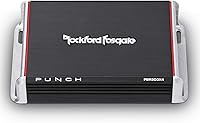
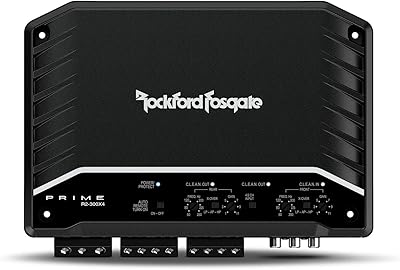
The Rockford Fosgate PBR300X4 4-Channel Car Amplifier has been a quiet staple in the car audio world since its debut in 2011, and its continued relevance says a lot. What sets it apart isn't raw wattage bragging rights — it's the Class BR Boosted Rail technology, a patented design that keeps current draw low while holding a power reserve for dynamic peaks. Sitting at a mid-range price, this compact 4-channel amp occupies a smart spot between throwaway budget units and overkill high-end hardware. If you need reliable, space-conscious amplification without chasing headline numbers, this is worth a serious look.
Features & Benefits

The dimensions alone tell most of the story: at just 1.53″ x 4.25″ x 6.75″, the PBR300X4 is genuinely small enough to tuck behind a kick panel or under a seat without creative engineering. Its 75W x 4 RMS output, measured to the CEA-2006 standard, reflects actual usable power — not inflated peak figures that evaporate under real listening conditions. The Boosted Rail circuit sips from your electrical system under steady loads but draws on stored reserves when the music demands it. High-level inputs mean connecting directly to a factory head unit is straightforward, and the built-in 12dB/octave Butterworth crossover handles basic frequency management without needing an external processor.

Best For

This Rockford Fosgate unit makes the most sense for builders where real estate is scarce. Motorcycle and powersports audio systems are an obvious fit — the low weight and minimal footprint work well strapped behind a fairing or under a seat. It's equally practical for stealth car installs, where the amp disappears behind a panel entirely. RV and UTV owners benefit from its low current draw, which matters when running off a limited electrical system for extended periods. Anyone swapping out a stock head unit without upgrading to aftermarket will also appreciate the high-level inputs, which remove one wiring headache from the job.

User Feedback

Across a wide pool of buyers, a few consistent themes emerge. The compact size draws near-universal appreciation — people who bought the PBR300X4 specifically for tight installs consistently report it fits exactly where planned. Sound quality relative to its footprint earns strong marks too, with many noting it punches noticeably above what the dimensions suggest. The main practical caveat is the 4-ohm-only impedance requirement, which rules out certain speaker pairings and catches buyers off guard if compatibility isn't checked beforehand. A smaller number of users mention the chassis can run warm at high volumes during extended sessions, though thermal protection keeps it from becoming a real issue. Long-term reliability is well-regarded.

Pros

  • The ultra-compact dimensions make it one of the few amplifiers that genuinely disappears into a motorcycle or powersports build.
  • CEA-2006 compliant power rating means 75W x 4 RMS is real, usable output — not a marketing fiction.
  • Boosted Rail technology keeps current draw low under normal listening, protecting your vehicle's electrical system.
  • High-level inputs let you connect directly to a factory head unit without buying extra adapters.
  • The aluminum chassis and MOSFET output stage handle heat efficiently, even during longer listening sessions.
  • A built-in Butterworth crossover covers basic frequency shaping without needing an external component.
  • Installation is consistently rated as straightforward, with a logical wiring layout that saves time on the job.
  • Long-term owners report consistent, dependable performance across multiple years of real-world use.
  • At its price tier, the Rockford Fosgate brand reputation adds genuine peace of mind that budget alternatives cannot match.
  • The 1-year parts and labor warranty from authorized resellers provides a meaningful safety net after purchase.

Cons

  • Strictly 4-ohm only — no flexibility for 2-ohm speaker loads, which limits compatible speaker selection significantly.
  • No subwoofer output or mono bridging option means you cannot drive a sub and four speakers from this unit alone.
  • Onboard crossover is basic; serious tuning will require an external processor or DSP to go further.
  • The chassis can run noticeably warm during sustained high-volume use, which needs consideration in enclosed install locations.
  • Only a 1-year warranty, which is shorter than what some competitors offer at a similar price point.
  • No built-in bass boost or gain overlap controls, leaving less room for fine-tuning the output character.
  • The 4-ohm-only restriction is easy to overlook during purchase research and has caught multiple buyers off guard after the fact.

Ratings

Our AI rating system analyzed thousands of verified owner reviews for the Rockford Fosgate PBR300X4 4-Channel Car Amplifier sourced from buyers worldwide, applying filters to exclude incentivized, duplicate, and bot-generated submissions before calculating each score. The category ratings below reflect a candid synthesis of what real installers, motorcycle builders, and everyday drivers actually experienced — with recurring strengths and genuine pain points given equal weight, so you can make a fully informed decision.
Sound Quality
84%
For an amplifier this physically small, the audio output consistently impresses buyers who expected less. Listeners running mid-range car speakers report noticeably cleaner highs and more controlled bass compared to relying on a factory head unit alone. The honest CEA-2006 power rating translates into real, usable headroom rather than distorted loudness at high volume.
At very high listening levels, some buyers notice the sound starts to compress slightly before thermal protection engages, which limits how hard you can push it in warmer environments. It also will not satisfy listeners chasing audiophile-grade clarity; at this price and power tier, there is a ceiling to what the output stage can resolve.
Form Factor and Size
93%
This is the category where this compact 4-channel amp simply has no close rivals at its price tier. People building motorcycle audio rigs specifically name the footprint as the deciding factor, and reports of fitting it inside spaces that seemed impossible for any amplifier are common. The physical dimensions live up to every claim made about them.
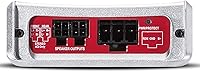
The trade-off for the tiny chassis is that wiring terminals are packed in closely, making cable management fiddly — especially with thicker gauge wire in a very confined space. Patience during the wiring phase pays off, but first-time builders may find the tight connector layout more time-consuming than anticipated.
Installation Ease
87%
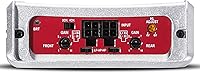
Clear labeling on the input and output terminals, combined with the high-level input option, makes this one of the easier amplifiers to install even for someone doing their first upgrade. Multiple buyers with no professional experience report completing clean installs in an afternoon without needing specialist help or a wiring diagram beyond the included documentation.
The DC offset turn-on control requires some initial adjustment to get right, and a small number of users have found it sensitive to the signal level from certain head units, requiring trial and error to eliminate turn-on or turn-off thumps. Experienced installers resolve this quickly, but it can be a stumbling block for beginners.
Power Delivery
76%
24%
The Boosted Rail technology makes the 75W x 4 RMS rating feel more dynamic than the numbers alone suggest, storing reserves for musical peaks rather than draining the vehicle's electrical system constantly. Buyers who understand CEA-2006 ratings appreciate that what is printed on the spec sheet is what they actually receive under real listening conditions.
For buyers expecting competition-level output or the ability to fill a large vehicle cabin at high volume, the PBR300X4 will fall short of those expectations. The 4-ohm-only restriction also means you cannot extract more power by dropping impedance — an option some competing amplifiers do allow.
Value for Money
82%
18%
The step up in build consistency, honest power ratings, and brand reliability over budget alternatives is tangible and meaningful for buyers who plan to keep their system for several years. Long-term owners regularly cite this Rockford Fosgate unit as one of the better spending decisions in their overall audio build.
Compared to some competing mid-range amplifiers that offer 2-ohm compatibility or more advanced onboard signal processing at a similar price, the value proposition narrows for buyers who need those features. If your build requires bridging flexibility or broader speaker pairing options, the cost-per-feature ratio shifts against it.
Electrical Efficiency
89%
The Boosted Rail design genuinely delivers on its promise of lower idle current draw, which matters most for motorcycle riders and RV owners where the electrical system has limited headroom. Buyers running this amp on a stock alternator consistently report no noticeable drain on battery voltage or impact on other electrical accessories.
Under sustained high-volume use, the efficiency advantage narrows as the amp draws more aggressively from its stored power reserves. Buyers running a full accessory load — heated grips, driving lights, and USB charging devices simultaneously — should still verify total draw against their alternator's rated output to avoid surprises on longer rides.
Build Quality
88%
The aluminum chassis feels noticeably solid for an amp at this price point, and long-term owners consistently report no physical degradation — no cracked housing, no loose connectors — even after years of use in vibration-heavy environments like motorcycles and powersports vehicles. Rockford Fosgate's manufacturing consistency earns genuine trust here.
A few buyers noted that the wiring terminals, while functional, do not feel as robustly constructed as the rest of the chassis. For high-vibration installs, adding thread-locking compound to mounting screws is a sensible precaution, and the supplied mounting hardware is minimal enough that some buyers sourced their own alternatives.
Speaker Compatibility
57%
43%
For buyers running standard 4-ohm coaxial or component speakers — which covers the majority of the aftermarket speaker market — compatibility is completely straightforward. Connecting a typical 4-ohm front component set alongside a 4-ohm rear coaxial pair requires no special configuration or additional components.
The 4-ohm-only rating is a hard wall, not a soft recommendation, and it catches a meaningful number of buyers off guard after purchase. Any speaker load below 4 ohms, any bridged-load scenario outside the rated spec, or pairings involving 2-ohm drivers are simply incompatible, which significantly narrows the universe of speakers this amp can support.
Thermal Management
67%
33%
For typical daily listening at moderate to high volumes, the aluminum chassis manages heat adequately without triggering thermal protection shutdowns. Most buyers in standard car installs report the amp running warm but stable throughout normal use, and the MOSFET output stage helps the unit recover quickly between dynamic musical peaks.
Sustained high-volume sessions in poorly ventilated or enclosed mounting locations push the chassis temperature noticeably higher, and a portion of users in warm climates report occasional thermal limiting during extended listening. The amp has no cooling fan, so adequate airflow around the unit is entirely the installer's responsibility to engineer.
Crossover and Tuning
63%
37%
Having a built-in crossover removes one external component from the signal chain for straightforward full-range speaker builds. For buyers running a simple front and rear setup without a subwoofer, the onboard Butterworth filter is sufficient to protect speakers from unwanted low-frequency stress and works cleanly within its design scope.
The 12dB/octave slope and limited adjustability make the onboard crossover inadequate for more complex audio builds, and serious tuners will want an external DSP regardless. There are no bass boost, phase adjustment, or parametric EQ controls, meaning the amp's sound-shaping capability stops well short of what dedicated outboard processors can offer.
Input Versatility
83%
The combination of RCA low-level and high-level speaker inputs makes this amp compatible with nearly any head unit configuration, factory or aftermarket, without requiring additional interface hardware. Buyers who retained a stock head unit while upgrading their speakers particularly value the high-level input for keeping the installation straightforward and cost-effective.
There is no balanced or differential input option for buyers with higher-end source units who want to take full advantage of their head unit's output quality. The RCA inputs also lack any form of differential noise rejection, which can occasionally introduce ground loop noise in vehicles with more complex electrical architectures.
Long-term Reliability
91%
Multi-year ownership reports are consistently positive, with buyers across motorcycle, car, and RV installations noting that the amp continues performing without issue well beyond the warranty window. The model's continuous production run since 2011 adds genuine credibility to reliability claims that newer, unproven designs simply cannot match yet.
A small percentage of units show issues within the first year — typically related to turn-on circuit sensitivity or connection quality — though these are covered under warranty when purchased from authorized resellers. Units bought through gray-market channels have no such protection, and their handling and storage history is impossible to verify.
Warranty and Support
72%
28%
Rockford Fosgate's 1-year parts and labor warranty provides a meaningful safety net compared to budget brands offering little or no post-purchase support. The brand's long presence in the car audio market means replacement parts and service infrastructure genuinely exist, which is a real advantage for buyers who keep equipment for the long haul.
One year of coverage is on the shorter end compared to competitors now offering two or three years at similar price points. The requirement to purchase from an authorized reseller to maintain warranty validity adds friction that catches online shoppers off guard, particularly when third-party marketplace listings do not make reseller status clear upfront.

Suitable for:

The Rockford Fosgate PBR300X4 4-Channel Car Amplifier is purpose-built for anyone who needs real amplification in a space where a full-size unit simply won't fit. Motorcycle and powersports enthusiasts will find it particularly well-matched — the sub-3-lb weight and genuinely tiny footprint make tucking it behind a fairing or under bodywork a realistic proposition rather than a compromise. It's also an excellent pick for car owners who want a stealth install, where the amp lives out of sight behind a door panel or under a seat without requiring custom fabrication. Drivers keeping their factory head unit will appreciate the high-level inputs, which let this compact 4-channel amp connect directly without requiring an additional line output converter. RV and UTV owners running off limited electrical systems benefit from the Boosted Rail technology's current efficiency, and anyone who values long-term reliability from a proven brand will find the track record here genuinely reassuring.
Not suitable for:

The Rockford Fosgate PBR300X4 4-Channel Car Amplifier is not the right tool if your speakers are rated at 2-ohm impedance — this unit is strictly 4-ohm only, and pairing it incorrectly isn't a workaround situation, it's a compatibility wall. Buyers chasing big, room-filling sound levels for large vehicles or outdoor audio setups will likely find the power output underwhelming for those demands. If your build calls for bridging channels to drive a subwoofer alongside full-range speakers, the PBR300X4's architecture isn't designed with that flexibility in mind. Audiophiles who want granular signal processing — parametric EQ, adjustable crossover slopes, bass boost controls — will need to add an external processor, since the onboard crossover is functional but basic. Finally, anyone shopping purely on wattage figures rather than real-world CEA-2006-rated output may feel misled if they aren't familiar with how honest power ratings compare to inflated marketing specs common at lower price points.
Specifications

  • Model Number: The official model identifier for this amplifier is PBR300X4, as designated by Rockford Fosgate.
  • Dimensions: The amplifier measures 1.53″ x 4.25″ x 6.75″, placing it among the most compact full-range 4-channel units in its class.
  • Weight: At 2.53 lbs, the unit is light enough to mount in locations where heavier amplifiers would be impractical.
  • Channels: This is a 4-channel amplifier, designed to power a full stereo front and rear speaker arrangement simultaneously.
  • RMS Power: Rated output is 75 watts per channel at 4 ohms, verified to the CEA-2006 standard for honest, consistent power measurement.
  • Amplifier Class: It uses Rockford Fosgate's proprietary Class BR (Boosted Rail) topology, which balances low idle current draw with dynamic power reserves for transient peaks.
  • Impedance: The amplifier supports 4-ohm speaker loads only; 2-ohm operation is not within its rated design parameters.
  • Input Type: Both RCA low-level and high-level speaker-wire inputs are supported, allowing direct connection to factory or aftermarket head units.
  • Crossover: A built-in 12dB/octave Butterworth crossover provides basic high-pass and low-pass frequency filtering without requiring an external signal processor.
  • Output Stage: The MOSFET output stage contributes to thermal stability and power efficiency during extended listening sessions.
  • Operating Voltage: The unit operates within a 9V to 16V DC range, accommodating standard 12V vehicle electrical systems including normal fluctuations.
  • Material: The chassis is constructed from aluminum, which aids heat dissipation while keeping the overall weight minimal.
  • Certification: This amplifier meets CEA-2006 and CE certification standards, confirming that published power ratings are independently verified rather than marketing estimates.
  • Warranty: A 1-year parts and labor warranty is included when the unit is purchased through an authorized Rockford Fosgate reseller.
  • Mounting Type: The unit is designed for railing mount installation, providing versatile placement options in confined or unconventional spaces.

Related Reviews
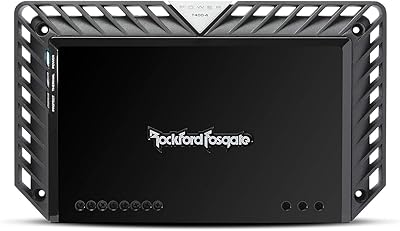
Rockford Fosgate Power T400-4 400-Watt 4-Channel Amplifier
87%
91%
Performance
89%
Sound Quality
94%
Ease of Installation
88%
Durability
90%
Build Quality
More
Rockford Fosgate R300X4 Prime 4-Channel Amplifier
87%
88%
Performance
91%
Ease of Installation
85%
Build Quality
87%
Thermal Management
84%
Sound Output
More
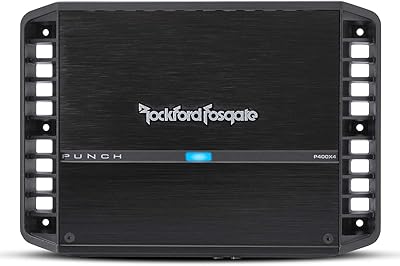
Rockford Fosgate P400X4 Punch 4-Channel Amplifier
83%
88%
Sound Quality
91%
Value for Money
83%
Ease of Installation
86%
Build Quality
67%
Thermal Management
More
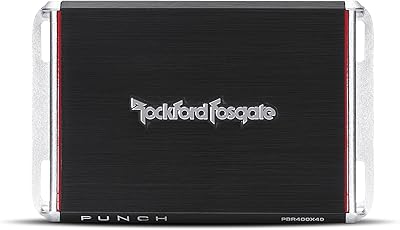
Rockford Fosgate PBR400X4D 4-Channel Car Amplifier
80%
96%
Size & Form Factor
81%
Power Output
78%
Installation Experience
83%
Sound Quality
89%
Heat Management
More
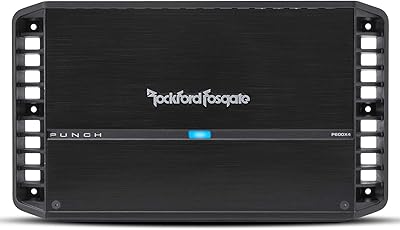
Rockford Fosgate Punch P600X4 4-Channel Amplifier
87%
93%
Sound Clarity
91%
Build Quality
88%
Power Output
89%
Installation Experience
71%
Value for Money
More
Rockford Fosgate TM400X4ad Marine 4-Channel Amplifier
81%
91%
Build Quality
78%
Weather & Corrosion Resistance
88%
Sound Quality
86%
Power Output & Accuracy
72%
Heat Management
More
Rockford Fosgate R2-500X4 4-Channel Car Amplifier
80%
86%
Sound Quality
78%
Power Output
88%
Installation Ease
83%
Build Quality
67%
Thermal Management
More
Rockford Fosgate R2-300X4 4-Channel Amplifier
82%
86%
Sound Quality
83%
Build Quality
79%
Power Output
91%
Ease of Installation
62%
Thermal Management
More
Recoil REA600.4 4-Channel Car Audio Amplifier
84%
89%
Audio Performance
91%
Ease of Installation
85%
Sound Quality at High Volumes
62%
Heat Management
90%
Power Output
More
Recoil DI550.4 4-Channel Car Audio Amplifier
74%
91%
Value for Money
78%
Power Output
86%
Ease of Installation
74%
Sound Quality
67%
Build Quality
More

FAQ

Yes, the high-level inputs let you run speaker wire directly from your factory head unit into the amp — no converter needed. The built-in DC offset voltage detection also handles the turn-on signal from those same speaker outputs, which simplifies the wiring considerably for stock stereo upgrades.

No, and this is one of the most important things to confirm before buying. The amp is rated for 4-ohm loads only, and connecting 2-ohm speakers risks overloading the output stage. Check your speaker impedance specs carefully; if yours are 2-ohm, you'll need a different unit.

It is genuinely small — roughly the footprint of a thick paperback book and less than two inches tall. At 1.53″ x 4.25″ x 6.75″, it tucks behind motorcycle fairings, under car seats, and inside side panels without much trouble. Most people who handle it say the photos don't fully capture how small it actually is.

Under normal listening conditions, the aluminum chassis stays warm but not alarmingly so. At sustained high volumes it does get noticeably hotter, which is expected behavior for an amp this size. If you are mounting it in a sealed or low-airflow space, leave a little breathing room around it to help manage heat buildup over long sessions.

The PBR300X4 is not designed to bridge channels in a way that conveniently supports a subwoofer alongside four full-range speakers from the same unit. If your build requires both a sub and front/rear speakers, you will likely need a separate mono amplifier for the subwoofer or a unit with more flexible channel routing.

Not necessarily. The variable high-level DC offset voltage input turn-on control can detect a signal from your factory speaker outputs, meaning a dedicated remote wire is optional when using high-level inputs. If you are using an aftermarket head unit that has a proper remote turn-on output, wiring that in directly is still the cleaner approach.

8-gauge wiring is generally the right choice for the power and ground runs on an amp at this output level. Going thinner than that risks voltage drop that can affect performance and reliability. Use quality wire rated for automotive use and keep the ground connection as short as possible to a solid bare-metal point on the chassis.

It is not rated as waterproof or weatherproof, so it needs to live in a protected location on a motorcycle — behind a fairing, inside a sealed compartment, or otherwise shielded from direct rain and spray. Installing it in an exposed location where it regularly contacts moisture will shorten its lifespan significantly, regardless of how well it is otherwise built.

For a standard front and rear full-range speaker build, starting the high-pass filter around 80Hz is a reasonable baseline. From there, adjust based on how your speakers handle lower frequencies — smaller speakers generally benefit from filtering out more bass. If you need finer control than the onboard crossover offers, an external DSP or active processor will give you more granular tuning options.

It covers parts and labor for one year, but only when purchased from an authorized Rockford Fosgate reseller — buying through an unauthorized third-party seller can void coverage entirely, so verify the seller's status before purchasing. Rockford Fosgate has a generally solid support reputation, and buyers who hold onto their purchase documentation typically find the claims process manageable if an issue does come up.