Overview

The Rockford Fosgate TM400X4ad Marine 4-Channel Amplifier sits at the serious end of the marine audio market — built not just for sound quality, but for survival in genuinely punishing environments. Rockford Fosgate has been a trusted name in mobile audio for decades, and this marine amplifier carries that reputation into saltwater territory. What sets it apart from typical boat amps is the proprietary Class-AD technology, which sits somewhere between the warmth of Class-A/B and the efficiency of Class-D — you get less heat buildup without sacrificing the sonic character audiophiles care about. The Element Ready construction handles UV, dust, and corrosion, though it bears noting upfront: resistant is not the same as waterproof.
Features & Benefits

One of the more practical touches on this Rockford Fosgate unit is the high-level auto turn-on — if you're connecting to a factory head unit without a dedicated remote wire, the amp detects signal and powers itself on, saving real installation headaches. Power-wise, the Constant Power design keeps output honest across both 4-ohm and 2-ohm speaker loads, which matters when mixing speaker types. The built-in Punch EQ and Butterworth crossover let you dial in bass response and frequency filtering right on the amp body, skipping the need for additional signal processors. The CLEAN circuit also monitors for clipping in real time, protecting your speakers before distortion becomes an actual problem.

Best For

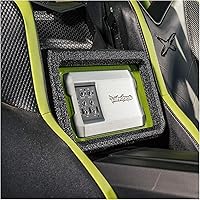
This marine amplifier is a natural fit for boat owners frustrated by stock audio that sounds flat and thin over engine noise and open water. It's equally at home in powersports and off-road builds — UTVs, jet skis, custom rigs — anywhere that sees real exposure to the elements. Running four full-range marine speakers is the most straightforward use case, but bridging two channels to drive a subwoofer alongside a stereo pair is where the flexibility really shows. Buyers stepping up from budget marine amps will notice the difference in build confidence and CEA-verified power. This is for people who want long-term reliability over short-term savings.

User Feedback

Owners consistently praise how compact the TM400X4ad is for what it delivers — fitting it into tight bilge compartments or under seats is less of a struggle than with bulkier competitors. Heat management draws mixed remarks during long, high-volume days on the water; most note it runs warm but within reasonable limits, with the common advice being to ensure adequate airflow around the unit. Long-term saltwater exposure concerns come up occasionally, though most buyers report satisfaction after several seasons. Warranty service from Rockford Fosgate earns mostly positive feedback. The recurring criticism is straightforward: the price is a real commitment compared to offshore alternatives, and some buyers feel that sting more than others.

Pros

  • CEA-2006 certified power ratings mean the watt figures on the box are what you actually get — no inflated claims.
  • Class-AD technology runs cooler than Class-A/B designs without the clinical sound character that sometimes comes with pure Class-D amps.
  • The compact footprint fits into tight bilge compartments and under-seat spaces where larger amps simply will not go.
  • High-level auto turn-on is a genuine time-saver for anyone connecting to a factory head unit without a remote wire.
  • Built-in Butterworth crossover and bass EQ eliminate the need for an additional signal processor in straightforward 4-speaker setups.
  • Element Ready construction holds up reliably through multiple boating seasons of spray, humidity, and direct sun exposure.
  • Bridging capability lets you run a subwoofer off two channels while the other two handle full-range speakers — one amp, complete system.
  • The CLEAN clip detection circuit actively protects speakers during high-volume use, reducing the risk of driver damage.
  • Rockford Fosgate's two-year parts and labor warranty backs a brand with a long track record of honoring it.
  • Long-term owners consistently report the TM400X4ad still performing reliably after three or more seasons of regular use.

Cons

  • The price is a significant commitment that is difficult to justify for casual listeners who just want background music on the water.
  • Terminal access becomes genuinely awkward once the amp is mounted in a recessed or enclosed space — plan your cable routing before you bolt it down.
  • Thermal protection can trip during extended high-volume sessions in poorly ventilated mounting locations, cutting audio at the worst moments.
  • Saltwater users should treat the terminals with additional corrosion protection — the factory coating alone is not enough for prolonged high-salinity exposure.
  • Outdoor open-air acoustics mean perceived loudness can feel modest relative to the rated output, especially without high-sensitivity marine speakers paired to it.
  • The owner's manual lacks the depth needed for first-time installers to confidently configure gain structure and crossover settings without outside research.
  • International buyers may face complications with warranty service that North American customers do not encounter.
  • The on-board EQ offers only a single fixed bass boost frequency, which limits fine-tuning options for more demanding listeners.

Ratings

The scores below reflect an AI-driven analysis of verified global user reviews for the Rockford Fosgate TM400X4ad Marine 4-Channel Amplifier, with spam, bot-generated, and incentivized feedback actively filtered out before scoring. Buyers from saltwater fishing boats, pontoon setups, and powersports builds all contributed to these results, giving a genuinely broad cross-section of real-world use. Both the standout strengths and the honest frustrations are represented here — nothing has been smoothed over.

Build Quality
91%
Owners routinely comment on how solid this Rockford Fosgate unit feels compared to similarly priced competitors. The housing resists flexing, the terminals feel robust under repeated wiring and re-wiring, and the overall fit and finish communicates that this is not a disposable purchase. Long-term owners in particular note it still looks and performs like new after multiple seasons.
A handful of users noted that the mounting feet could be sturdier for high-vibration off-road applications, with some reporting minor loosening over time. The unit is also heavier than pure Class-D alternatives of comparable power, which can be a factor in weight-sensitive builds.
Weather & Corrosion Resistance
78%
22%
The Element Ready protection holds up well against the kind of incidental splash, spray, and humidity that comes with everyday boating. Users running this marine amplifier on center consoles and pontoons through full summer seasons generally report no corrosion or moisture ingress issues when the unit is installed in a reasonably sheltered location.
It is not waterproof, and buyers who expected submersion-level protection were disappointed. A few saltwater users reported early oxidation around terminals after a year or two, suggesting that supplemental terminal protection is wise in high-salinity environments. Element Ready is resistance, not immunity.
Sound Quality
88%
The Class-AD design produces noticeably cleaner audio than typical marine Class-D amps at comparable volumes. Owners upgrading from stock marine systems describe an immediate improvement in clarity and midrange definition, especially at higher output levels where cheaper amps tend to smear or compress the sound.
In wide-open outdoor environments — large pontoons or offshore boats with significant wind noise — the sonic refinement becomes harder to appreciate without also upgrading speakers. A few critical listeners noted the on-board EQ adds useful bass punch but can sound slightly one-dimensional compared to a dedicated external processor.
Power Output & Accuracy
86%
CEA-2006 compliance is a meaningful differentiator here. The rated power figures are what you actually get, which is a refreshing contrast to the inflated claims common in budget marine audio. Users running four full-range speakers report headroom to spare for typical on-water listening levels, even with engine noise as a baseline.
In open-air environments, perceived loudness can feel slightly underwhelming relative to the watt figures, simply because outdoor acoustics demand more than enclosed spaces. Buyers expecting car-audio-level impact without also investing in high-sensitivity marine speakers may feel the output does not punch as hard as expected.
Heat Management
72%
28%
For normal listening sessions — a few hours of moderate-to-loud music on the water — thermal performance is unproblematic. The Class-AD design runs cooler than equivalent Class-A/B amps, which users in enclosed mounting spaces genuinely appreciate during warm summer days.
Extended high-volume sessions on hot days push this marine amplifier toward the warm side of comfortable. Several users recommend ensuring at least a few inches of airflow clearance around the unit, and those who mounted it in very tight, sealed compartments reported occasional thermal protection shutdowns during peak use.
Installation Experience
83%
The compact footprint makes fitting this Rockford Fosgate unit into tight bilge areas, under helm panels, or beneath seats far more manageable than with larger amplifiers. The high-level auto turn-on is a particularly welcome feature for DIY installers connecting to a factory head unit, eliminating the need to run a separate remote-turn-on wire.
Terminal labeling, while present, is not as clearly laid out as some competing units, and a few first-time installers reported confusion during initial setup. The manual could also be more detailed for users unfamiliar with crossover configuration and gain-setting procedures.
On-Board EQ & Crossover
81%
19%
Having a bass boost and a functional crossover built directly into the amp simplifies installations considerably, especially for users who want a cleaner wiring setup without an additional signal processor in the chain. The Butterworth crossover cuts cleanly enough for most four-speaker or speaker-plus-sub configurations without introducing audible artifacts.
The EQ options are limited to what is on the board — there is no parametric control or additional adjustment bands. Buyers building a more complex or precisely tuned system will likely outgrow the on-board controls and reach for an external DSP, at which point this feature becomes redundant rather than useful.
Clipping Protection
84%
The CLEAN circuit earns genuine appreciation from users who have blown speakers on cheaper amps with no protection logic. Knowing the amplifier actively monitors for distortion at both input and output stages gives installers — especially those running expensive marine speakers — a meaningful layer of confidence during high-volume use.
Some more technically experienced users noted that clip detection is reactive rather than preventive, meaning brief transient clipping events can still occur before the circuit intervenes. It is a useful safeguard, but not a substitute for proper gain structure during initial setup.
Value for Money
66%
34%
For buyers who want professional-grade marine audio with a reputable warranty, verified power ratings, and genuine weather resistance, the TM400X4ad represents a defensible investment. Owners who have owned it for three or more seasons consistently say the durability justifies the price relative to replacing cheaper units more frequently.
The asking price is a significant barrier, and it is the single most common complaint across user reviews. Budget-conscious buyers point to competing 4-channel marine amps at a fraction of the cost that perform adequately for casual use, making the premium feel steep unless longevity and audio quality are genuinely top priorities.
Compact Form Factor
89%
Weighing just over two pounds and with a footprint that fits comfortably where larger amps simply cannot go, this marine amplifier is a practical choice for space-constrained builds. Pontoon owners and small-boat installers repeatedly cite the size as a deciding factor when comparing it against bulkier alternatives.
The compact size does come with some trade-offs in terms of terminal access — routing multiple speaker cables in a tight install can become fiddly, particularly when the amp is already mounted in a recessed or enclosed space. A slightly wider terminal block would have helped.
Warranty & Brand Support
79%
21%
Rockford Fosgate's two-year parts and labor warranty is backed by a company with decades of industry presence and an established service network. Users who have needed warranty support generally report a straightforward process, with the brand's reputation providing reassurance that support will actually be available.
A minority of users reported slower-than-expected turnaround on warranty claims, particularly during peak boating season when service demand spikes. International buyers also flagged complications with cross-border warranty support, which is worth factoring in for buyers outside North America.
Long-Term Durability
82%
18%
A meaningful number of reviews come from owners who have run this Rockford Fosgate unit for three or more years without hardware failures. That kind of sustained reliability feedback — particularly from saltwater environments — is genuinely harder to find among competing marine amplifiers in this category.
Long-term performance in consistently high-humidity or high-salinity environments does show some variance. A subset of owners operating in tropical or coastal climates report gradual connector degradation over time, pointing again to the importance of treating exposed terminals rather than relying solely on the factory protection.
Multi-Configuration Flexibility
77%
23%
The ability to run four independent channels or bridge down to two channels driving a subwoofer alongside a stereo pair gives installers genuine options without buying a second amplifier. Users building modest but complete marine systems — full-range speakers plus a sub — find this flexibility avoids additional hardware cost and wiring complexity.
Bridged mode reduces the available impedance headroom, and users pushing low-impedance subwoofers in bridged configuration have occasionally reported instability or thermal issues. The flexibility is real, but it requires careful speaker matching to stay within safe operating parameters.

Suitable for:

The Rockford Fosgate TM400X4ad Marine 4-Channel Amplifier is the right call for boat owners who have grown frustrated with stock audio that gets swallowed by engine noise, wind, and open water acoustics. If you are running a pontoon, center console, or bowrider and want to power four full-range marine speakers — or three speakers plus a bridged subwoofer channel — this Rockford Fosgate unit is built precisely around that use case. It is equally well-suited for powersports builds: UTVs, jet skis, and off-road rigs where dust, vibration, and UV exposure are daily realities rather than occasional concerns. DIY installers who want to connect directly to a factory head unit without rewiring the whole dash will appreciate the high-level auto turn-on, which removes one of the more tedious steps in a marine audio upgrade. Buyers who have been burned by budget amps with inflated watt ratings will find the CEA-verified power figures a meaningful reassurance. If audio quality and long-term reliability matter more to you than minimizing upfront cost, this marine amplifier makes a compelling case for itself.
Not suitable for:

The Rockford Fosgate TM400X4ad Marine 4-Channel Amplifier is a harder sell for buyers who are working with a tight budget and need amplification purely for casual background listening on the water — there are cheaper 4-channel marine options that cover that use case without the premium outlay. Buyers expecting full waterproofing should also recalibrate: Element Ready protection handles spray and humidity well, but this is not a submersion-rated unit, and mounting it in a truly exposed location without any overhead protection is asking for trouble over time. If you are building a high-complexity audio system with precise multi-band tuning needs, the on-board EQ and crossover will eventually feel limiting and you will likely end up adding an external DSP anyway, making some of the built-in features redundant. Anyone prioritizing the absolute lightest or most compact amplifier for a weight-sensitive or ultra-minimal install may also find better-suited alternatives among dedicated Class-D marine amps. And if you are outside North America, it is worth researching regional warranty support before committing, as cross-border service has been a friction point for some international buyers.

Specifications

  • Brand: Manufactured by Rockford Fosgate, a long-established American brand specializing in mobile and marine audio equipment.
  • Model Number: The unit's official model designation is TM400X4ad, part of the Power Marine amplifier line.
  • Amplifier Class: Built on Rockford Fosgate's proprietary Class-AD topology, which blends the tonal character of Class-A/B with the thermal efficiency of Class-D.
  • Output Power: Rated at 400W total system power, configurable as 100W x 4 channels at 4-ohm or 2-ohm loads, or 200W x 2 channels in bridged mode at 4-ohm.
  • Channels: Four independent amplifier channels, with bridging capability allowing pairs to be combined for higher output to a single speaker or subwoofer.
  • Power Compliance: CEA-2006 certified, meaning published power figures are independently verified and not subject to manufacturer inflation.
  • Dimensions: The amplifier body measures 13.4 x 6.5 x 11.3 inches, making it genuinely compact relative to its power output category.
  • Weight: At 2.2 pounds, this Rockford Fosgate unit is lightweight enough for flexible mounting locations without structural reinforcement concerns.
  • Operating Voltage: Designed to operate on a standard 12V DC vehicle or marine electrical system.
  • Weather Protection: Element Ready construction provides resistance to UV radiation, airborne dust, and corrosion, though it is not rated for submersion or direct continuous water exposure.
  • Crossover: Equipped with a 12dB/octave Butterworth crossover for clean, accurate high- and low-pass frequency filtering across multi-speaker configurations.
  • Equalizer: On-board Punch EQ delivers up to +18dB of bass boost centered at 45Hz, allowing low-frequency reinforcement without an external processor.
  • Auto Turn-On: High-level input auto turn-on circuitry detects speaker-level signal from a factory head unit and powers the amplifier on and off automatically.
  • Clip Detection: The CLEAN circuit monitors both input and output signals in real time, alerting users to clipping conditions that could damage connected speakers.
  • Mounting Type: Designed for boat mount installation, with a footprint optimized for under-seat, bilge, and helm-area placement on marine vessels.
  • Warranty: Covered by a two-year parts and labor warranty backed directly by Rockford Fosgate.
  • First Available: This model has been commercially available since March 2015, with a sustained sales history indicating long-term market viability.
  • Power Configuration: Constant Power design maintains rated output consistently across both 2-ohm and 4-ohm impedance loads without meaningful performance degradation.

Related Reviews
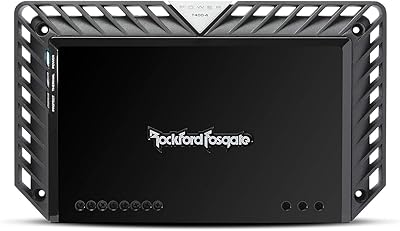
Rockford Fosgate Power T400-4 400-Watt 4-Channel Amplifier
87%
91%
Performance
89%
Sound Quality
94%
Ease of Installation
88%
Durability
90%
Build Quality
More
Rockford Fosgate R300X4 Prime 4-Channel Amplifier
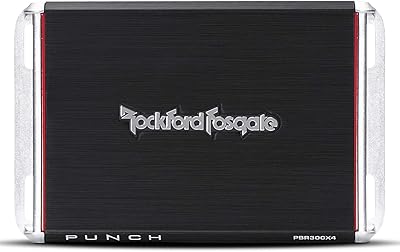
87%
88%
Performance
91%
Ease of Installation
85%
Build Quality
87%
Thermal Management
84%
Sound Output
More
Rockford Fosgate PBR300X4 Punch 300-Watt 4-Channel Amplifier
87%
88%
Power Output
91%
Installation Ease
84%
Sound Quality
92%
Compact Design
87%
Energy Efficiency
More
Rockford Fosgate Punch P600X4 4-Channel Amplifier
87%
93%
Sound Clarity
91%
Build Quality
88%
Power Output
89%
Installation Experience
71%
Value for Money
More
Rockford Fosgate PBR400X4D 4-Channel Car Amplifier
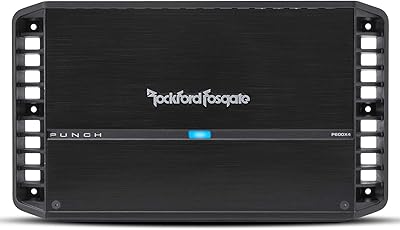
80%
96%
Size & Form Factor
81%
Power Output
78%
Installation Experience
83%
Sound Quality
89%
Heat Management
More
Rockford Fosgate P400X4 Punch 400-Watt 4-Channel Amplifier
85%
89%
Power Output
91%
Bass Enhancement (Punch EQ)
88%
Installation Ease
85%
Sound Clarity and Performance
87%
Build Quality
More
Rockford Fosgate R2-500X4 4-Channel Car Amplifier
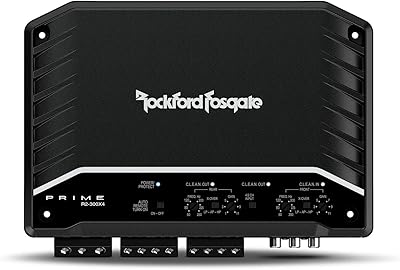
80%
86%
Sound Quality
78%
Power Output
88%
Installation Ease
83%
Build Quality
67%
Thermal Management
More
Rockford Fosgate R2-300X4 Prime 300-Watt 4-Channel Amplifier
86%
89%
Sound Quality
91%
Power Output
84%
Ease of Installation
87%
Bass Performance
82%
Build Quality
More
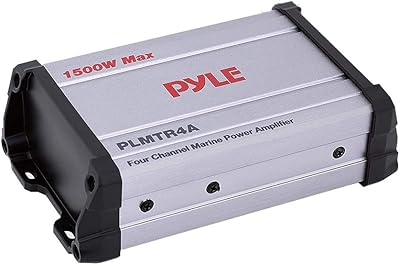
Pyle PLMTR4A 4-Channel Marine Amplifier
69%
78%
Value for Money
73%
Weatherproof Durability
41%
Power Accuracy
58%
Build Quality
86%
Installation Ease
More
Pyle PLMRMP4A 4-Channel Marine Amplifier
64%
61%
Value for Money
53%
Build Quality
67%
Waterproofing
58%
Power Output
79%
Ease of Installation
More

FAQ

Yes, that is actually one of the more practical features on this marine amplifier. The high-level auto turn-on detects the speaker-level signal coming from your factory head unit and powers the amp on and off automatically, so you do not need to run a separate remote turn-on wire back to the stereo. It simplifies the install considerably, especially on older boats where adding new wiring runs through the dash is a pain.

It is water-resistant, not waterproof — that distinction matters. The Element Ready protection handles spray, humidity, and condensation well, and it resists UV and corrosion over time. But it is not rated for submersion, and mounting it somewhere it will catch standing water or direct continuous spray is going to cause problems eventually. A sheltered location with good airflow is the right setup.

The TM400X4ad handles both 4-ohm and 2-ohm loads across all four channels, which gives you flexibility when mixing speaker types. In bridged mode, you will want to stay at 4-ohm minimum to keep the amp stable and within its thermal comfort zone. Running lower impedance loads in bridged mode is where heat and instability issues tend to show up.

Yes, this is a common and well-suited configuration. You would run two channels in stereo for your full-range speakers, then bridge the other two channels together to drive a single subwoofer with higher output. It is a clean single-amp solution for a small but complete marine system without needing a separate mono sub amp.

It runs warm during extended high-volume sessions, but thermal shutdowns are uncommon as long as the unit has reasonable airflow around it. Class-AD runs cooler than a traditional Class-A/B design, which helps. If you are mounting it in a sealed, unventilated compartment and running it loud for hours in summer heat, leave at least a couple of inches of clearance on all sides and you should be fine.

For most four-speaker marine setups, the on-board controls are enough. The built-in Butterworth crossover handles high-pass and low-pass filtering, and the Punch EQ adds bass reinforcement without any external hardware. If you are building a more elaborate system with precise multi-band tuning, you will eventually want a dedicated DSP, but for a straightforward upgrade from a factory marine setup, everything you need is already on the amp.

In practice, Class-AD tends to have a slightly warmer, more natural midrange compared to budget Class-D designs, which can sometimes sound a bit thin or clinical at higher volumes. The efficiency gap between the two technologies is narrower than it used to be, but this Rockford Fosgate unit still runs cooler than an equivalent Class-A/B design. The audible difference is most noticeable on vocals and acoustic instruments at moderate listening levels.

The factory corrosion resistance is a solid starting point, but saltwater is genuinely aggressive over multi-season exposure. Most experienced marine installers recommend applying dielectric grease to all terminals at installation and checking them annually. The amp body itself holds up well, but bare metal terminal connections in a salt-air environment will eventually show oxidation without that extra step.

It is impressively compact for its power rating, which is one of the reasons it sells well in the marine category. At roughly 13 inches long and just over six inches wide, it fits under most standard boat seats and in typical helm storage compartments without major modification. That said, measure your available space and factor in the cable routing clearance you will need at each end before committing to a mounting location.

The general consensus from owners is that the warranty process is straightforward and the brand stands behind its products. Most North American buyers report a reasonable turnaround and good communication from the service team. International buyers have occasionally flagged slower or more complicated service experiences, so if you are outside the US or Canada, it is worth confirming your regional warranty coverage before purchasing.

Where to Buy