Overview

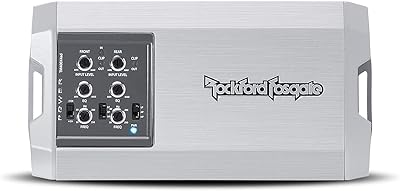
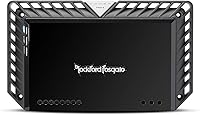
The Rockford Fosgate T400-4 4-Channel Car Amplifier sits comfortably in the mid-to-upper tier of the car audio market, backed by a brand that has been building serious audio hardware for decades. Yes, it has been discontinued — but that has done little to dampen demand on the used and new-old-stock market. What keeps buyers returning is the Class A/B topology, which delivers a warmer, more natural sound than the Class D amps dominating the budget segment. This is a full-range amplifier built for speakers, not subwoofers, and at roughly 13.66 x 8.14 x 2.14 inches running on a standard 12V system, it fits neatly into most trunk or under-seat installations.
Features & Benefits

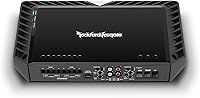
One of the most practical things about the T400-4 is how much flexibility it packs into a single chassis. You can run it as a true 4-channel amp powering all four doors, collapse it into a 2-channel setup, or bridge it to push 200 watts per side — useful if your build evolves over time. The variable Punch EQ handles bass and treble contouring on board, so you can skip the external equalizer in most installs. A 24dB/octave Butterworth crossover keeps unwanted frequencies away from your speakers, and the differential RCA inputs actively fight ground noise — a real concern in any vehicle. Power ratings are CEA-2006 compliant, which means the wattage figures on the label are honest, not inflated.

Best For

This 4-channel amplifier is best suited to builders who want clean, even power distributed across a full set of door speakers without splitting duties between multiple amps. If you are stepping up from a factory head unit and need something that handles the whole cabin, this Rockford Fosgate amp fits that role well. It also appeals strongly to installers who prioritize long-term thermal reliability — the unit holds up during extended listening without running hot. Anyone already running Rockford Fosgate components will appreciate the consistent sound character across the system. It is not the right tool if driving a subwoofer is your main goal; for that, a dedicated mono block alongside it makes far more sense.

User Feedback

Owner impressions of this Rockford Fosgate amp are broadly positive, though the Amazon rating pool is modest — around 66 reviews — so treat any patterns as directional rather than definitive. The most consistent praise centers on audio clarity and warmth, and on how cool the unit runs during long sessions, both of which align with what good Class A/B designs typically deliver. Installers frequently call out the clearly labeled gain and crossover controls as approachable for first-timers. On the downside, the discontinued status is a legitimate concern for anyone thinking years ahead, since sourcing parts later may prove difficult. A smaller segment of buyers also feel the price-per-watt is harder to justify against newer amplifiers offering comparable specs.

Pros

  • Class A/B circuitry produces noticeably warmer, more natural sound than typical budget Class D amps.
  • CEA-2006 compliant ratings mean the published wattage is real — no inflated numbers to second-guess.
  • Flexible channel configuration lets you run 4-channel, 2-channel, or bridged without buying additional hardware.
  • The built-in Punch EQ handles bass and treble shaping on board, reducing the need for a separate equalizer.
  • Differential RCA inputs actively fight ground noise, which matters a lot in real-world vehicle electrical environments.
  • Owners consistently report the unit runs cool even during extended listening sessions, suggesting solid thermal management.
  • Clearly labeled gain and crossover controls make setup approachable even for less experienced installers.
  • The 2-year parts and labor warranty is a meaningful commitment for a product in this category.
  • Rockford Fosgate’s brand reputation means support resources, forums, and installation guides are widely available.

Cons

  • The T400-4 is officially discontinued, making long-term parts availability a genuine concern for permanent builds.
  • Per-watt cost is harder to justify when compared to newer amplifiers offering similar output at lower price points.
  • At 10 pounds and over 13 inches long, fitting this amp into tight or unconventional spaces takes real planning.
  • Not designed to drive subwoofers, so bass-heavy builds will still require an additional dedicated mono amplifier.
  • The used and new-old-stock market introduces condition variability that new buyers need to vet carefully.
  • No remote turn-on level control is included, which some competing amps in the same tier do offer.
  • Four-channel configuration flexibility, while useful, adds a learning curve for buyers new to amplifier wiring.
  • With a relatively small Amazon review pool, first-hand feedback is limited compared to more current models.

Ratings

The scores below reflect our AI-driven analysis of verified global owner feedback for the Rockford Fosgate T400-4 4-Channel Car Amplifier, with spam, bot-generated, and incentivized reviews actively filtered out before scoring. Each category is rated independently to give you an honest picture of where this amp genuinely shines and where real buyers have run into friction. Both the strengths and the trade-offs are reflected transparently so you can make a well-informed decision.

Sound Quality
91%
Owners repeatedly describe the listening experience as warm and natural — qualities that become especially noticeable on long highway drives where listener fatigue with harsher Class D designs tends to creep in. The Class A/B topology handles vocal midrange and detailed high-frequency material with a composure that budget alternatives rarely match.
A small number of listeners feel the T400-4 lacks a bit of the raw transparency found in higher-end reference amplifiers at twice the price point. At moderate to low volume levels, some reviewers noted the soundstage felt slightly compressed compared to their expectations for a premium build.
Build Quality
88%
The chassis feels purposefully engineered — solid without being unnecessarily bulky, with clean PCB work and well-secured terminals that inspire confidence during a permanent install. Installers frequently cite the fit and finish as a step above what you typically encounter at this output level.
A few buyers noted that the external heatsink fins, while functional, are prone to collecting road dust and are awkward to clean once the amp is mounted in a tight enclosure. Some also flagged that the chassis corners are sharper than expected and can snag wiring during tight installation runs.
Thermal Performance
89%
Running cool is one of the most consistently praised attributes across owner feedback — even during summer road trips with the system pushed hard for hours. The thermal management holds up reliably in real vehicle environments where ambient temperatures under dashboards and in trunks routinely climb well above comfortable levels.
There is no active cooling fan, which means in extremely confined or poorly ventilated mounting locations the unit can warm up more than expected during peak power draws. A handful of owners in hotter climates noted occasional thermal protection activations when the amp was mounted inside sealed subwoofer enclosures.
Power Accuracy
93%
CEA-2006 compliance is the clearest signal that the published numbers are real, and owners who have measured output confirm the ratings hold up under actual load conditions. For buyers tired of chasing inflated peak-watt claims on cheaper amps, this is a genuine and meaningful point of differentiation.
The per-channel output at 4-Ohm — 60 watts RMS — is on the conservative side for listeners expecting wall-shaking volume from moderately efficient speakers. Buyers who compare raw wattage figures against newer Class D competitors at similar price points often feel shortchanged before understanding why honest ratings matter.
Installation Ease
84%
The labeled gain, crossover, and EQ controls remove a significant amount of guesswork during setup, and the terminal block layout is logically organized in a way that rewards even less experienced DIY installers. Multiple online guides and community threads specific to this amp make troubleshooting accessible.
At just over 13 inches in length and 10 pounds, fitting this 4-channel amplifier neatly into certain vehicles — particularly compact cars or trucks with limited under-seat depth — requires careful pre-measurement and sometimes custom mounting solutions. Wire routing to the differential RCA inputs can also be fussier than expected in congested firewall environments.
Noise & Interference Rejection
86%
The differential RCA inputs are a practical asset in the real-world chaos of a vehicle's electrical environment, actively working to cancel out ground loop noise that would otherwise produce an audible hum through the speakers. Owners who have battled alternator whine in previous builds specifically call out how quiet this amp sits in the signal chain.
The amp itself does not completely eliminate the need for careful grounding practice — a poor chassis ground connection will still produce noise regardless of the input design. A minority of users reported some residual hiss at high gain settings, which is more likely a gain-staging issue but is worth noting for those running low-output head units.
Configuration Flexibility
82%
18%
The ability to reconfigure between 4-channel, 2-channel, and bridged stereo modes without additional hardware gives this Rockford Fosgate amp genuine long-term adaptability as builds evolve — useful when upgrading speakers or reorganizing a system layout down the road.
Bridging drops the amp to two channels, which means you cannot run all four speakers and a bridged pair simultaneously from a single unit. Buyers who discover this limitation mid-build and need more channels often find themselves purchasing an additional amplifier they had not originally budgeted for.
On-Board EQ & Crossover
79%
21%
Having the Punch EQ and Butterworth crossover built in genuinely simplifies installs where adding an external processor would mean extra cost and wiring complexity. The bass boost range at 45Hz is well-suited to adding body to door speakers that roll off in the low-end without a dedicated subwoofer.
The EQ offers only two fixed frequency points rather than a parametric or multi-band adjustment, which limits fine-tuning for listeners with more demanding acoustic goals. Audiophiles who eventually add a dedicated DSP processor often find the on-board EQ redundant and leave it bypassed entirely.
Value for Money
67%
33%
For buyers who understand what they are paying for — genuine Class A/B circuitry, honest power ratings, and Rockford Fosgate’s build consistency — the price reflects real engineering value rather than marketing markup. The 2-year parts and labor warranty also adds tangible financial protection.
Against newer Class D competitors that offer comparable or higher raw wattage at significantly lower price points, the per-watt cost is difficult to rationalize for buyers who are not already sold on the sonic character of Class A/B. The discontinued status adds further hesitation when spending at this level.
Long-Term Reliability
81%
19%
Owners who have run the T400-4 for multiple years report consistent performance with no notable degradation in output or control response, which aligns with the build quality reputation Rockford Fosgate has maintained across its Power series products.
The discontinued status is a genuine long-term concern — sourcing replacement components or finding authorized repair service becomes increasingly difficult as the unit ages out of the supply chain. Buyers planning a permanent, multi-year build should factor in this parts availability risk before committing.
Warranty & Support
74%
26%
A 2-year parts and labor warranty is a meaningful commitment in the car audio amplifier category, where many competing products offer only limited or labor-excluded coverage. Rockford Fosgate’s support reputation is generally regarded as responsive for in-warranty claims.
Because the unit is discontinued, warranty claims may be subject to parts availability constraints that could affect turnaround times or result in unit replacements rather than direct repairs. Buyers purchasing from resale or new-old-stock channels should verify whether the original warranty window is still active.
Size & Fitment
76%
24%
At 2.14 inches tall, the low-profile design allows for under-seat or behind-panel mounting in most mid-size vehicles, and the dimensions are standard enough that off-the-shelf mounting brackets and racks fit without modification.
The 13.66-inch length is longer than many competing 4-channel amps in this power range, which creates real clearance problems in compact vehicles with shallow trunk floors or cramped under-seat profiles. The 10-pound weight is also noticeable when wall-mounting or securing the unit overhead in unconventional locations.
Brand Ecosystem Fit
87%
For anyone already running Rockford Fosgate speakers or signal processors, the T400-4 slots naturally into the chain with predictable tonal matching and straightforward gain-staging that the brand’s products are tuned around. The consistency across the Power series makes system-wide upgrades feel cohesive rather than piecemeal.
Outside the Rockford Fosgate ecosystem, the brand-specific tuning of the Punch EQ frequencies may not align perfectly with the voicing characteristics of third-party speaker brands. Buyers mixing component manufacturers sometimes need to compensate with external processing to achieve a balanced overall sound.

Suitable for:

The Rockford Fosgate T400-4 4-Channel Car Amplifier is the right call for enthusiasts who are serious about upgrading their vehicle's sound system and want a single, well-built amp to power all four door speakers cleanly. If you are stepping away from a factory head unit and want honest, reliable power without the guesswork of inflated wattage claims, the CEA-2006 compliant ratings here give you a trustworthy foundation to build around. It fits particularly well in builds where the installer wants configuration flexibility — running four channels today, then bridging to two if the system changes down the road. Audio purists who find Class D amps too clinical or fatiguing over long drives will appreciate the warmer character that Class A/B topology naturally produces. It also makes strong sense for anyone already running Rockford Fosgate speakers or processors who wants sonic consistency across their entire chain.
Not suitable for:

The Rockford Fosgate T400-4 4-Channel Car Amplifier is not the right fit for buyers whose primary goal is driving a subwoofer — this is a full-range amp, and pairing it with a sub means you will still need a separate mono block, which adds cost and complexity. Budget-conscious shoppers comparing raw watts-per-dollar against newer Class D alternatives will likely find the math frustrating, since the T400-4 prioritizes sound quality and build integrity over sheer output for the price. Anyone planning a long-term install and worried about the future should factor in that the unit has been officially discontinued, meaning replacement parts or warranty service through standard retail channels is increasingly uncertain. If your vehicle has very limited mounting space, the 10-pound, 13.66-inch chassis may also pose a real installation challenge. First-time buyers who want the simplest possible plug-and-play experience might find the configuration options — bridging, crossover tuning, EQ adjustment — more involved than expected without some research or professional help.

Specifications

  • Brand: Manufactured by Rockford Fosgate, a brand with decades of experience in car audio amplification.
  • Model Number: The unit carries the official model designation T400-4, part of the Rockford Fosgate Power series.
  • Circuit Class: Uses Class A/B topology, which balances power efficiency with the warmer, more natural sound character audiophiles prefer over Class D designs.
  • Total RMS Output: Delivers 400 watts total RMS output across all channels under CEA-2006 compliant testing conditions.
  • Channel Power: Rated at 60W x 4 at 4-Ohm, 100W x 4 at 2-Ohm, or 200W x 2 at 4-Ohm when bridged.
  • Channel Config: Supports 4-channel, 2-channel, and bridged stereo configurations, giving installers flexibility as builds evolve.
  • Crossover: Equipped with a 24dB/octave Butterworth crossover that filters unwanted frequencies before they reach connected speakers.
  • Punch EQ: Variable Punch EQ provides up to +18dB of boost at 45Hz for low-end body and up to +14dB at 12.5kHz for high-frequency presence.
  • RCA Inputs: Differential RCA inputs are designed to cancel out electrical noise and reduce ground loop interference common in vehicle environments.
  • Compliance: Power ratings are CEA-2006 certified, meaning published wattage figures reflect real, independently standardized measurements rather than peak or inflated values.
  • Dimensions: Measures 13.66″ x 8.14″ x 2.14″, making it compatible with most trunk, under-seat, or behind-panel mounting locations.
  • Weight: Weighs 10 pounds, which is typical for a full-range Class A/B 4-channel amplifier in this output class.
  • Voltage: Designed to operate on a standard 12V DC vehicle electrical system.
  • Supply Current: Draws 11.58 amps of supply current under rated operating conditions.
  • Warranty: Backed by a 2-year parts and labor warranty from Rockford Fosgate covering manufacturing defects.
  • Availability: The T400-4 has been officially discontinued by the manufacturer and is now available primarily through new-old-stock and used resale channels.
  • Mounting Type: Designed for car mounting and is compatible with standard automotive amplifier installation hardware and brackets.

Related Reviews

Rockford Fosgate R300X4 Prime 4-Channel Amplifier
87%
88%
Performance
91%
Ease of Installation
85%
Build Quality
87%
Thermal Management
84%
Sound Output
More
Rockford Fosgate PBR400X4D 4-Channel Car Amplifier
80%
96%
Size & Form Factor
81%
Power Output
78%
Installation Experience
83%
Sound Quality
89%
Heat Management
More
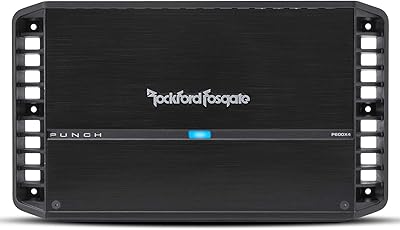
Rockford Fosgate Punch P600X4 4-Channel Amplifier
87%
93%
Sound Clarity
91%
Build Quality
88%
Power Output
89%
Installation Experience
71%
Value for Money
More
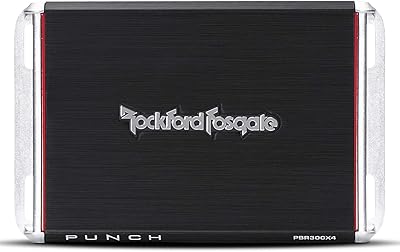
Rockford Fosgate PBR300X4 4-Channel Car Amplifier
79%
84%
Sound Quality
93%
Form Factor and Size
87%
Installation Ease
76%
Power Delivery
82%
Value for Money
More
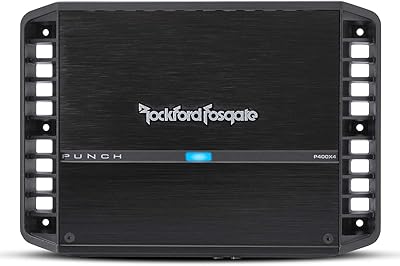
Rockford Fosgate P400X4 Punch 4-Channel Amplifier
83%
88%
Sound Quality
91%
Value for Money
83%
Ease of Installation
86%
Build Quality
67%
Thermal Management
More
Rockford Fosgate R2-300X4 4-Channel Amplifier
82%
86%
Sound Quality
83%
Build Quality
79%
Power Output
91%
Ease of Installation
62%
Thermal Management
More
Rockford Fosgate TM400X4ad Marine 4-Channel Amplifier
81%
91%
Build Quality
78%
Weather & Corrosion Resistance
88%
Sound Quality
86%
Power Output & Accuracy
72%
Heat Management
More
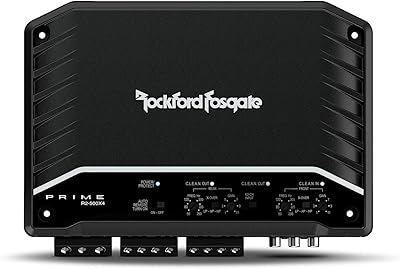
Rockford Fosgate R2-500X4 4-Channel Car Amplifier
80%
86%
Sound Quality
78%
Power Output
88%
Installation Ease
83%
Build Quality
67%
Thermal Management
More
Recoil DI800.4 4-Channel Car Amplifier
75%
88%
Value for Money
51%
Power Accuracy
63%
Build Quality
79%
Thermal Management
86%
Ease of Installation
More
Planet Audio AC2400.4 4-Channel Car Amplifier
84%
95%
Power Output
89%
Sound Clarity
87%
Bass Performance
82%
Ease of Installation
65%
Thermals/Heat Management
More

FAQ

Technically you can bridge two channels to push a subwoofer, but this amp was designed for full-range speaker duty — not dedicated bass work. If a subwoofer is a central part of your build, you will get much better results pairing this 4-channel amplifier with a separate mono block designed specifically for low-frequency loads.

That depends on what you value. The Rockford Fosgate T400-4 4-Channel Car Amplifier still holds up technically — the Class A/B design and honest power ratings are as relevant today as when it launched. The real risk is long-term: if something fails after the warranty window, sourcing parts or finding a repair facility familiar with the unit gets harder over time. For a permanent, high-investment build, that is worth factoring in. For someone who finds one at a fair price and wants proven performance now, it remains a solid choice.
It means the wattage numbers printed on the spec sheet were measured under a real, standardized test — not under ideal lab conditions designed to inflate the figure. A lot of budget amps advertise peak wattage that you will never actually hear in normal use. With CEA-2006 compliance, 60 watts per channel at 4-Ohm means 60 real, usable watts.

It is more approachable than many in its class. The gain and crossover controls are clearly labeled, which removes a lot of guesswork during setup. That said, wiring an amplifier into a vehicle still involves running power from the battery, grounding properly, and routing RCA cables — tasks worth researching or having a professional handle if you are doing it for the first time.

At 13.66″ long and 2.14″ tall, it can fit under many rear bench seats, but clearance varies significantly by vehicle. Measure your available space carefully before committing, and account for the wiring connections that will add a bit to the overall footprint once installed.

Most experienced listeners describe Class A/B as warmer and more natural, with better handling of the mid-range and a more relaxed high end. Class D is more efficient and runs cooler, which is why budget amps favor it — but efficiency often comes at the cost of some sonic character. For long drives and critical listening, many audiophiles find Class A/B noticeably more enjoyable.

The T400-4 runs at 60W per channel into 4-Ohm loads, so speakers rated to handle 50 to 100 watts RMS and with a 4-Ohm impedance are the sweet spot. Component or coaxial sets from brands like Focal, JL Audio, or Rockford Fosgate’s own speaker line pair naturally with this amplifier. Avoid speakers with very low sensitivity ratings, as they will demand more power than this amp is optimized to deliver.

It has the variable Punch EQ built right in, which gives you a meaningful bass boost at 45Hz and a high-frequency lift at 12.5kHz. For most everyday builds — especially if you are running a separate subwoofer for the deep bass — that on-board EQ is enough. If you want precise multi-band equalization across the whole spectrum, an external processor would still be an upgrade.

No — bridging combines pairs of channels, so a 4-channel amp in bridged mode becomes a 2-channel amp. You would use bridged mode when you want to drive two speakers with more power per channel, typically a component pair in the front stage. For four speakers, keep it in standard 4-channel mode.

That is almost certainly a ground loop, which is one of the most common issues in car audio installs. The differential RCA inputs on this Rockford Fosgate amp are designed to help reject that kind of interference, but the ground connection itself also has to be solid — short, direct, and attached to bare metal on the chassis. Check that your RCA cables are routed away from power wires, and make sure the amp ground is not sharing a bolt with other accessories.