Overview

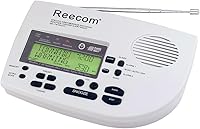
The Reecom R-1650D SAME Weather Radio has been on the market since 2010, and the fact that it's still actively sold — still pulling solid ratings — says something real about its staying power. This is a mid-range emergency alert device that doubles as an everyday AM/FM radio, aimed at homeowners, office workers, and anyone who lives somewhere severe weather isn't a rare event. Its 185-hour battery standby is the headline spec, and it's genuinely useful when the power goes out mid-storm. The design is functional rather than flashy — don't expect anything that looks current — but the hardware underneath is well-considered for what it's trying to do.
Features & Benefits

What sets this SAME-enabled radio apart from basic weather radios is how much control it actually gives you. The S.A.M.E. county filtering lets you program alerts for your specific area, so you're not getting jolted awake by sirens for storms happening three counties over. With 24 siren volume levels, you can dial in the loudness for a quiet bedroom or a busy office. The EOM detection is a smart practical touch — once an alert finishes, the unit returns automatically to whatever you were doing before. An on-screen countdown shows how long each active alert remains valid, and the 25-event memory lets you scroll back through recent alerts with timestamps attached.

Best For

This weather radio suits people who want emergency preparedness woven into daily life, not just a device sitting in a drawer. It's a natural fit for storm-prone households — tornado alley, hurricane coasts, anywhere with unpredictable severe weather seasons. Offices benefit from its ability to run quietly in the background, only triggering when something serious warrants attention. The battery backup matters most to anyone who has lived through a multi-day power outage; 185 hours of standby means coverage well beyond the first night. Those who want granular county-level control will appreciate the SAME programming, though be ready to spend some time with the manual before it clicks.

User Feedback

Across roughly 160 reviews, the Reecom unit holds a 4.2-star average — a score that reflects real-world satisfaction rather than a wave of first-week impressions. Owners consistently single out its alert reception sensitivity and siren reliability as genuine strengths, especially during actual weather events. Long-term users report the battery backup performs well when it matters most: during extended outages. On the downside, some buyers find the initial SAME county-code setup frustrating without prior experience, and a handful mention the display is harder to read at certain angles. Still, many who upgraded from simpler single-function radios describe the Reecom unit as a meaningful step up in dependability and overall feature depth.

Pros

  • County-level SAME filtering means you only get alerted for weather events that actually affect your area.
  • The 185-hour battery standby is one of the longest in its class and holds up during real extended outages.
  • 24 siren volume levels give genuinely fine-tuned control, from a gentle chime to a room-filling alarm.
  • EOM detection automatically returns the unit to its prior mode the moment an alert ends — no manual reset needed.
  • The 25-event memory with timestamps lets you review what alerts fired while you were away or asleep.
  • Reception sensitivity is consistently praised by long-term owners, even in areas with weaker NOAA signal coverage.
  • Doubles as a functional AM/FM radio with preset stations, sleep timer, and dual alarm clock for daily use.
  • The defeat siren function lets you selectively silence alerts for specific event types you find less relevant.
  • At its price point, the depth of alert customization is difficult to match with competing models.
  • Has remained in production and available for over a decade, which speaks to its reliability and manufacturer support.

Cons

  • Initial SAME setup is confusing for non-technical users and the manual does not make the process intuitive.
  • The display can be difficult to read at certain angles, particularly in bright ambient light conditions.
  • The button layout feels dated and takes time to learn, especially for users coming from more modern devices.
  • No smartphone integration or app connectivity of any kind — entirely standalone operation only.
  • The physical design looks and feels like a product from the late 2000s, because it essentially is one.
  • Siren volume at higher settings has been described by some owners as startling in smaller rooms at night.
  • Programming all 26 county code slots requires looking up specific FIPS codes, which adds friction during setup.
  • No USB charging port or modern power delivery options — relies solely on AC adapter or standard batteries.

Ratings

Our AI-generated scores for the Reecom R-1650D SAME Weather Radio are produced by systematically analyzing verified buyer reviews from around the world, with spam, bot submissions, and incentivized feedback actively filtered out before scoring. The ratings cover a wide range of owner profiles — from casual AM/FM listeners to households relying on this SAME-enabled radio as a primary storm alert system — so both genuine strengths and consistent pain points are reflected without bias. No score has been softened for optics; if a category underdelivers in real-world use, the number reflects that honestly.
Alert Reception Sensitivity
88%
Owners in rural and suburban areas consistently report pulling in NOAA signals with minimal static, even in basements and interior rooms where lesser radios struggle. The 7-channel digital PLL tuning locks on precisely, and several long-term users note it outperforms every older radio they replaced, especially during active storm-season monitoring.
In areas with genuinely weak NOAA signal infrastructure, a small number of users report occasional reception dropout. An external antenna input would help in those cases, but the unit does not offer one, leaving buyers in signal-challenged locations with limited options.
SAME Programming & Setup
61%
39%
Once configured correctly, the county-level SAME filtering works exactly as intended — silencing irrelevant regional advisories while reliably triggering for warnings that actually apply to your area. Users who committed time to the setup process consistently rate the resulting alert relevance as a meaningful improvement over non-SAME radios.
The setup process is where this radio frustrates buyers most. Entering FIPS county codes through a menu system that offers minimal on-screen guidance has generated repeated complaints, and a notable share of negative reviews traces back to setup confusion rather than any hardware defect.
Battery Backup Performance
84%
For buyers who have lived through multi-day outages, the battery backup stands out as a genuine strength. Multiple long-term owners confirm the unit kept alerting reliably through extended storms without noticeable degradation in reception quality or siren response when it mattered most.
The 185-hour standby figure applies specifically to passive monitoring mode, not active AM/FM playback. Users who run continuous music during outages see battery life drop substantially — a gap that surprises buyers who assume the headline rating covers all usage modes equally.
Siren Volume Control
83%
Having 24 distinct siren levels is more practical than it first sounds — it means a bedroom unit can be set low enough to avoid panic while an office unit can cut through ambient noise without startling everyone nearby. Households with light sleepers or young children particularly appreciate this granularity.
At the highest siren settings, a handful of reviewers describe the alert as genuinely jarring in small rooms, especially at night when the shift from silence to full alarm is most abrupt. There is no gradual volume ramp-up option, so every alert triggers at the pre-set level immediately.
Display Readability
58%
42%
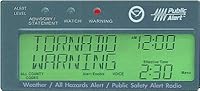
The display packs a useful amount of information — active alert type, remaining effective time, current clock, and event status — into a compact footprint. Users who position the unit at direct eye level on a desk or nightstand generally find the data legible enough for quick reference.
Viewing angle is a consistent complaint: the display washes out noticeably when viewed from below or the side, which matters when the radio sits on a low surface. Several reviewers also note the character size feels small for a device meant to convey urgent information at a glance.
EOM Detection
79%
21%
The end-of-message function works quietly and reliably in typical use — when the NOAA broadcast concludes, the radio reverts to its prior state without requiring user input. For overnight placements, this means you do not wake up to static or a frozen alert screen after a weather event passes.
A small number of edge-case reports describe the unit not returning correctly after back-to-back multi-message alert sequences. While this appears rare, it took some users several alert cycles to fully trust the function, leading them to check the radio manually longer than should be necessary.
Value for Money
76%
24%
For what is included — dedicated SAME alert filtering, extensive event memory, long battery standby, and a functional AM/FM alarm clock — the mid-range price point is reasonable. Buyers upgrading from basic single-purpose weather radios consistently describe this as a meaningful capability jump without a dramatic cost increase.
Compared against newer competitors at similar prices, the lack of modern conveniences — no Bluetooth, no app connectivity, an aging display — can make the value proposition feel dated. Buyers who mainly want casual AM/FM listening with occasional weather alerts may find simpler, cheaper options more appropriate.
Build Quality
72%
28%
The unit feels solidly assembled for its weight class — nothing rattles, buttons respond with consistent resistance, and the housing does not flex under normal handling. Long-term owners who have run the same unit for five or more years without hardware failure are well-represented in the review base.
The plastic casing has a utilitarian feel that does not inspire confidence on first impression, and the buttons lack the tactile precision of more recent consumer devices. The overall build communicates function over finish, which is accurate but may disappoint buyers expecting a more considered physical product.
AM/FM Performance
74%
26%
The AM/FM tuner performs solidly as a secondary capability — station coverage is reliable, the intro-scan function makes exploring new stations quick, and preset management is straightforward. A meaningful number of users report using this as their primary desktop radio for daily music and talk radio between alert events.
Audio output is adequate rather than impressive — the built-in speaker handles voice content reasonably well, but music listening reveals a flat, narrow sound profile. Users expecting rich audio from a bedside radio will be disappointed, as this is fundamentally a mono alert device rather than an audio-first product.
Event Memory & Logging
81%
19%
The 25-event memory with full date, time, and remaining effective time logging is genuinely useful for households that travel or work away from home. Being able to return after a weekend trip and see exactly which alerts fired, when, and for how long provides real peace of mind in storm-prone areas.
Navigating back through stored event records requires working through menu layers that some users — particularly older or less tech-savvy owners — find unintuitive. In high-frequency alert regions, the 25-event cap can also fill faster than expected, causing earlier records to drop off before some users have reviewed them.
Longevity & Reliability
86%
With a market presence stretching back to 2010, this SAME-enabled radio has accumulated a longer real-world track record than most current competitors. Owners reporting six to eight years of trouble-free use are genuinely common in the review base — a meaningful data point for a device you hope never to urgently need.
Some longer-tenured owners note that physical buttons and display labeling show wear over time, with fading text and slightly less responsive button feel after years of daily use. As the product ages further, sourcing accessories or replacement components may also become a more relevant concern for committed long-term buyers.
Alert Customization Depth
82%
18%
The ability to individually enable or disable the audible siren for up to 48 specific event message types gives this radio a level of alert control that most competitors simply do not match. Coastal users, for instance, can silence marine small craft advisories while keeping tornado and flash flood warnings fully active.
Configuring per-event siren behavior requires navigating several menu layers in a sequence that the manual does not explain particularly intuitively. Many users default to out-of-box settings rather than customizing event-by-event, which means the depth of this feature regularly goes untapped by the buyers who would most benefit from it.
Physical Design & Aesthetics
53%
47%
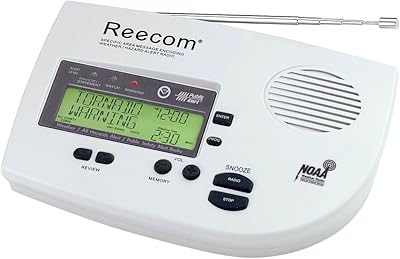
The low-profile horizontal form factor fits neatly on a nightstand or office shelf without demanding visual attention. The neutral grey housing blends into most room environments, and at just over 8 inches wide, it occupies a small enough footprint that placement is rarely a practical concern.
There is no softening this: the radio looks and feels like a 2010 product, because that is exactly what it is. The button styling, display font, and overall interface aesthetic all reflect design conventions from well over a decade ago — something buyers accustomed to modern consumer electronics will notice immediately upon unboxing.
Alarm Clock Usability
67%
33%
Having a dual alarm with snooze and AM/FM radio wake built into a weather radio eliminates the need for a separate bedside clock, which is a genuine day-to-day convenience. The sleep timer — adjustable up to just under two hours — makes winding down with music easy without leaving the radio running all night.
Setting or adjusting alarms requires navigating the same layered menu system that manages weather alert programming, which many users find cumbersome for what should be a simple daily task. The alarm interface has not kept pace with the ease expected of modern clock radios, and small adjustments can feel unnecessarily time-consuming.

Suitable for:

The Reecom R-1650D SAME Weather Radio is a strong match for households in storm-prone areas who want a dedicated, always-on NOAA alert device that doesn't require babysitting. If you live somewhere that sees regular tornado watches, severe thunderstorm warnings, or hurricane threats, having a unit that filters alerts down to your specific county — rather than blasting every regional advisory — is a genuine quality-of-life improvement. The 185-hour battery standby makes it especially valuable for people who have experienced multi-day power outages and know how quickly a plugged-in device becomes useless. It also works well in office settings where you need a background alert system that stays quiet unless something serious is actually happening nearby. Anyone who wants to consolidate a weather radio and a daily AM/FM alarm clock into a single countertop device will find the dual-purpose functionality genuinely useful rather than just a marketing bullet point.

Not suitable for:

The Reecom R-1650D SAME Weather Radio is not the right pick for buyers who want something they can unbox, plug in, and have fully configured in under five minutes. The SAME county-code programming, while powerful, involves navigating menus and entering specific FIPS codes — and without patience or a willingness to read the manual, it can feel unnecessarily complicated. If modern design matters to you, this unit will disappoint; it has the aesthetic of a late-2000s electronics product, because that's exactly what it is. People looking for smartphone integration, app connectivity, or digital display clarity comparable to newer devices will find this radio feels dated. It's also not ideal for buyers who only experience mild, infrequent weather events and don't need the depth of alert customization this radio is built around — a simpler, cheaper unit would serve them just as well.

Specifications

  • Brand: This weather radio is manufactured by Reecom Electronics, Inc., a company focused on NOAA-compliant emergency alert devices.
  • Model: The exact model designation is R-1650D, which indicates the SAME-enabled variant within Reecom's R-1650 product line.
  • Dimensions: The unit measures 8″ long by 5.4″ wide by 1.85″ high, making it compact enough for a nightstand or desk corner.
  • Weight: At approximately 1 pound, this radio is light enough to move between rooms without any real effort.
  • Power Source: It operates on either an included AC adapter for standard wall outlet use or battery backup for outage situations.
  • Battery Standby: In battery mode, the unit supports up to 185 hours of standby operation, covering several days of potential power disruption.
  • Radio Bands: Supported bands include AM, FM, and all 7 NOAA Weather Radio channels for comprehensive broadcast coverage.
  • Tuning Technology: Reception is handled via 7-channel digital PLL tuning, which provides stable, precise channel locking across weather frequencies.
  • SAME Memories: Up to 26 county code (SAME number) memories can be stored, allowing highly specific geographic alert filtering.
  • Siren Control: The alert siren offers 24 discrete volume levels, enabling precise loudness adjustment for different room sizes and times of day.
  • Event Memory: The radio stores up to 25 events — both active and expired — each logged with date, time, and remaining effective time data.
  • AM/FM Presets: Users can save up to 12 FM and 12 AM station presets for quick access during everyday listening.
  • Alert Types: The unit receives and distinguishes four NOAA alert categories: Warning, Watch, Advisory, and Statement.
  • Special Functions: Notable functions include EOM (End of Message) detection, an active alert countdown display, and per-event siren enable or disable control.
  • Sleep Timer: The sleep timer is adjustable in one-minute increments from 1 minute up to 1 hour and 59 minutes of continuous play.
  • Alarm Clock: A dual alarm clock with snooze function allows independent wake times, with the option to wake to a buzzer or live AM/FM radio.

Related Reviews
Reecom R-1630C Weather Alert Radio
79%
91%
SAME Filtering Accuracy
88%
Battery Backup Reliability
86%
Alert Volume & Siren
61%
Setup & Programming Experience
89%
Event Memory & Countdown Timer
More
LIJIANI SH01 Portable NOAA Weather Radio
75%
83%
Reception Quality
81%
NOAA Weather Alert Performance
91%
Portability & Size
67%
Battery Life
88%
Ease of Use
More
QAUYYW Emergency Weather Radio XSY330
86%
89%
Battery Life
85%
Ease of Use
92%
Portability
75%
Radio Reception
88%
Build Quality
More
FosPower A6 5200mAh Emergency Weather Radio
77%
91%
NOAA Reception
84%
Build Quality
67%
Power Bank Utility
53%
Hand Crank Efficiency
49%
Solar Charging
More
Sttfaishen F20 Emergency Hand Crank Weather Radio
72%
82%
NOAA Alert Reception
54%
Battery Capacity & Honesty
61%
Hand Crank Usability
57%
Solar Charging Performance
83%
USB-C Charging Speed
More
OnLyee CR1030 Emergency Weather Radio
76%
88%
Power Source Redundancy
83%
Hand Crank Durability
61%
Solar Charging Performance
79%
NOAA Reception Quality
67%
Battery Capacity & Phone Charging
More
RAOUOEN H27 30000mAh Emergency Weather Radio
68%
83%
Battery Capacity
81%
Value for Money
76%
Radio Reception
44%
Solar Charging
58%
Hand Crank Usability
More
TFTDOUP Emergency Weather Alert Radio
86%
88%
Overall Performance
85%
Battery Life
90%
Charging Options
80%
Ease of Use
87%
Build Quality
More
Raynic 1030 12000mAh NOAA Weather Radio
77%
88%
Battery Capacity
84%
NOAA Reception
71%
Solar Charging
66%
Hand Crank Charging
73%
Build Quality
More
Roxicosly CR1009Ultra 12000mAh Emergency Weather Radio
74%
88%
Battery Life
91%
Charging Versatility
86%
NOAA Alert Performance
58%
Hand Crank Durability
44%
Solar Charging Speed
More

FAQ

It takes some patience, but it is manageable. You will need to look up your county's FIPS code — a five-digit number you can find on the NOAA website — and then enter it through the menu system. The manual walks you through the steps, but the interface is not immediately intuitive, so set aside 20 to 30 minutes the first time.

The radio uses standard D-cell batteries for backup power. Reecom rates the standby life at up to 185 hours, which translates to over a week of passive monitoring. That figure assumes the unit is in standby mode rather than actively playing AM/FM radio, which will drain the batteries faster.

Yes, absolutely. The dual alarm clock with snooze function works independently of any weather alert activity, and you can set it to wake you with a buzzer or with live AM/FM radio. Many owners use this radio daily as their bedside alarm and treat the weather alert capability as a useful bonus.

That depends on how you program it. Out of the box without SAME coding, it will receive all alerts broadcast on the NOAA channel, which can cover a broad region. Once you program your specific county code, it filters alerts down to your area only, which significantly reduces unnecessary interruptions.

Yes, that is one of its key strengths. When AC power is lost, it automatically switches to battery backup and can stay in standby mode for up to 185 hours. This makes it particularly reliable during the kind of extended outages that often accompany severe storms.

The unit includes an auxiliary connectivity option, which allows you to connect it to external audio equipment. However, if you are looking for Bluetooth or wireless audio streaming, this radio does not support that — it is a wired-only connection.

Yes, and this is one of the more useful features. The defeat siren function lets you configure up to 48 individual event message types to either trigger the siren or stay silent. So if you want visual and display alerts for, say, a Marine Small Craft Advisory but no audible alarm, you can set that up.

The display does have backlighting, so it is visible in the dark. Some users find the viewing angle somewhat limited — it looks best when viewed straight on rather than from the side or below. For nightstand use, positioning matters more than it would with a higher-contrast modern display.

When a NOAA broadcast ends, it transmits an End of Message tone. This radio detects that tone and automatically returns to whatever state it was in before the alert — whether that was standby, AM/FM radio, or alarm mode. Without this feature, you would have to manually switch back after every alert, which gets old quickly.

The core NOAA alert system it is built around has not changed dramatically, so the fundamentals are still sound. It lacks modern conveniences like app connectivity or a sharp digital display, but for reliable county-level weather alerting with strong reception and solid battery backup, the Reecom unit holds up well against newer competitors in the same price range.