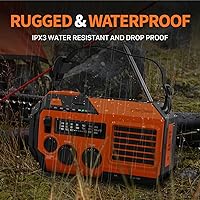
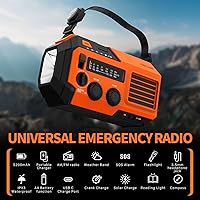
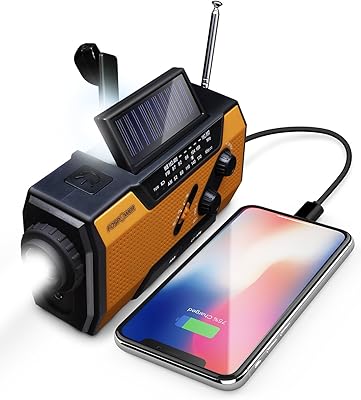
Overview

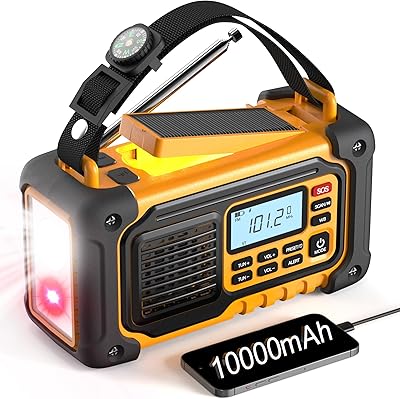
The FosPower A6 5200mAh Emergency Weather Radio is best understood as a compact emergency preparedness toolkit rather than a standalone radio. It sits in the middle of FosPower's lineup — more capable than the entry-level A1 and A3 models, but below the higher-capacity D-series units. What separates it from a basic weather radio is its four charging methods: USB-C, solar, hand crank, and AA batteries. At 1.06 pounds and roughly the size of a thick paperback, it tucks into a go-bag without much fuss. Just keep expectations grounded — this is a backup device, not an audiophile receiver or a primary power source for your everyday electronics.
Features & Benefits

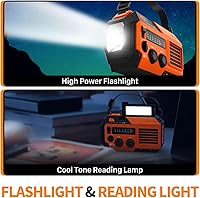
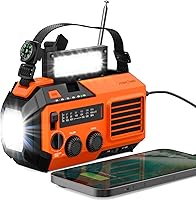
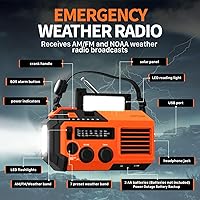
The 5200mAh power bank can push some charge to a smartphone during an outage, though realistically you're looking at one partial charge for a modern phone — treat it as supplemental power, not a full backup battery. The USB-C port recharges the unit fastest; the solar panel and hand crank are genuinely useful when nothing else is available, but don't expect speed from either. NOAA reception is reliable and covers all local weather alert channels, while AM/FM rounds out the dial for everyday use. Plug in headphones via the 3.5mm jack for clearer audio in noisy conditions. The SOS siren is loud enough to carry across a campsite, and the dual lights — a forward flashlight plus a downward reading lamp — cover most emergency lighting needs.

Best For

This emergency weather radio is a natural fit for anyone assembling a 72-hour emergency kit — the kind of household staple you hope you never actually need. If you live in a hurricane corridor, tornado belt, or wildfire-prone area, having a device that pulls NOAA alerts without relying on Wi-Fi or cell towers is genuinely reassuring. Campers and hikers will appreciate not packing a separate flashlight and charger alongside a radio. It also makes a thoughtful, practical gift for people who aren't the type to prep on their own but probably should be. One caveat: if you already own a dedicated emergency power station, this hand-crank radio fills a different role — focused on communication and alerting, not heavy power delivery.

User Feedback

With a 4.6-star rating drawn from over 40,000 reviews, the FosPower A6 has earned broad satisfaction, and the patterns in that feedback are worth unpacking. Buyers consistently highlight NOAA reception clarity and build quality as strong suits — the unit feels solid for its price point, not flimsy. Where opinions get more mixed is around charging: many users note the 5200mAh capacity is enough to top up a phone once in a pinch, but it primarily excels at keeping the radio itself running. Solar and crank charging draw the most complaints for being slower than expected, which is a fair criticism. AM/FM sensitivity gets occasional pushback for weak distant-station pickup. Still, for a device at this price, the overall value is hard to dispute.

Pros

  • Reliable NOAA weather alert reception is the core strength buyers consistently praise.
  • Four charging inputs mean you are rarely completely out of options in an extended emergency.
  • At just over a pound, this emergency weather radio fits easily into a go-bag or camping pack.
  • The SOS siren is genuinely loud and useful for signaling across open terrain or a dark campsite.
  • Dual lighting — a forward flashlight and a downward reading lamp — covers two distinct practical needs.
  • USB-C recharging is fast and convenient for keeping the unit topped up at home between emergencies.
  • The limited lifetime warranty backed by US-based support adds real long-term reassurance.
  • Over 40,000 ratings averaging 4.6 stars reflects consistent satisfaction across a wide range of buyers.
  • The AA battery slot provides a true last-resort power option that most people already have on hand.
  • Build quality is regularly called out as solid and durable relative to its mid-range price point.

Cons

  • Solar panel charging is very slow and largely ineffective in overcast or low-light conditions.
  • Hand-crank charging requires sustained effort for minimal power gain — not a practical primary input.
  • The 5200mAh capacity typically delivers one partial smartphone charge, not multiple full ones.
  • AM/FM sensitivity can be underwhelming for picking up weak or distant stations.
  • No built-in rechargeable battery indicator makes it hard to know exactly how much power remains.
  • The USB-A output port limits compatibility with newer devices that expect higher-wattage charging.
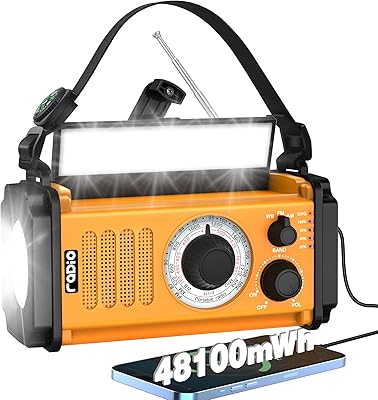
  • The bright orange color, while useful for visibility in emergencies, may feel bulky or obtrusive in a home setting.
  • No weather alert auto-scan or alert tone feature — you must manually tune to NOAA channels.
  • Sound quality through the built-in speaker is adequate but noticeably thin at higher volumes.

Ratings

The FosPower A6 5200mAh Emergency Weather Radio earned a 4.6-star average across more than 40,000 verified purchases — a dataset our AI rating system analyzed by filtering out incentivized, repeated, and bot-flagged submissions to surface genuine buyer sentiment. The scores below reflect both where this hand-crank radio genuinely delivers and where real users ran into frustration, giving you an honest picture before you buy.
NOAA Reception
91%
Pulling in clear NOAA weather alerts during an actual storm or power outage is where this radio earns its keep, and buyers across diverse regions consistently report strong, dependable signal on all seven standard weather channels. Many users specifically mention tuning in during hurricane and tornado watches with no dropouts.
A small but recurring group of buyers in fringe rural areas or near significant RF interference report occasional signal noise on certain NOAA frequencies. Extending the antenna fully and repositioning near a window resolves most of these complaints, but it is worth noting for users in low-signal zones.
Build Quality
84%
For a mid-range emergency radio, the physical construction feels noticeably more substantial than buyers expect at this price point — the casing has a solid, non-rattling feel and the buttons respond with satisfying clicks. The high-visibility orange housing holds up well through repeated handling in camp and go-bag scenarios.
The hand crank mechanism draws occasional criticism for feeling slightly loose or plasticky under heavy use, and a handful of long-term owners report the antenna connection showing wear after extended field use. It holds up fine under normal emergency-preparedness use, but it is not ruggedized for truly harsh outdoor abuse.
Power Bank Utility
67%
33%
In a genuine emergency where your phone is sitting at 15 percent and the grid is down, the 5200mAh internal battery provides a meaningful top-up — enough to make a few calls or send messages when it matters most. Buyers who frame it as supplemental emergency power rather than a primary charger report satisfaction.
Anyone expecting to charge a modern smartphone fully — let alone multiple times — will be let down; real-world output typically covers one partial charge for a current-generation phone. The USB-A output also limits charging speed, and buyers with USB-C only devices need an adapter that is not included.
Hand Crank Efficiency
53%
47%
When every other input is exhausted, the hand crank is genuinely better than nothing — sustained cranking for a few minutes will produce enough power to keep the radio broadcasting and the flashlight running, which in a real survival or shelter situation is meaningful. Buyers stuck in extended outages appreciate having this option at all.
This is the single most common source of disappointment across thousands of reviews — many buyers crank vigorously for ten minutes expecting a phone charge and get almost nothing measurable. The crank is best understood as a trickle-power input for the radio itself, not a charging tool, and FosPower could do more to set that expectation upfront.
Solar Charging
49%
51%
Under optimal conditions — strong direct sunlight, panel angled correctly outdoors — the solar input does provide a slow but real trickle of power that can extend radio runtime over a full day outside. Campers who leave the unit on a dashboard or picnic table in bright sun report noticeable charge contribution over several hours.
In any condition short of strong direct sunlight, the solar panel is nearly ineffective, and indoors it is functionally useless. Buyers who expected a robust solar charging experience — particularly in overcast climates — frequently cite this as a meaningful disappointment, and the panel size physically cannot deliver more than a trickle regardless of conditions.
AM/FM Performance
71%
29%
Local FM stations come in clearly and consistently, with audio quality through the built-in speaker being perfectly adequate for news and emergency broadcasts in a shelter-in-place scenario. Using the 3.5mm headphone jack noticeably improves audio clarity and is appreciated by users who want a more focused listening experience.
AM sensitivity is a recurring criticism, particularly for buyers in rural areas trying to reach distant stations — the tuner struggles with weak AM signals compared to dedicated portable radios. The analog tuning dial also makes precise station-finding a bit fiddly, especially in low-light conditions where you cannot clearly see the frequency markings.
SOS Alarm
88%
The siren output is loud enough to be heard clearly across a campsite or a multi-room building, and the simultaneous strobe significantly increases visibility in dark or smoky conditions. Buyers who tested the SOS function in open outdoor settings found the combination of audio and visual signaling genuinely reassuring as an emergency tool.
The siren tone, while loud, is a single fixed frequency rather than the attention-grabbing alternating pattern found on more specialized rescue devices. A small number of users also found the SOS activation button positioned in a way that made accidental triggering possible when the unit was stored loosely in a bag.
Flashlight & Lighting
82%
18%
Having both a forward flashlight and a downward reading lamp in one unit turns out to be more practically useful than it sounds — navigating a dark hallway and then reading a paper emergency plan or map are genuinely different lighting tasks. Buyers regularly mention using the reading lamp during extended outages for calm, close-range tasks.
The flashlight brightness, while serviceable, does not match a dedicated handheld LED torch — it illuminates a path but will not project far into deep darkness. Battery draw from running both lights simultaneously is noticeable, and users on longer camping trips suggest conserving power by using only one light mode at a time.
Portability
86%
At 1.06 pounds and slightly larger than a thick paperback, the FosPower A6 fits into a standard go-bag, camping pack, or car emergency kit without dominating the available space. Hikers and campers specifically appreciate consolidating a radio, flashlight, and emergency charger into one item they barely notice carrying.
Compared to bare-bones emergency radios without a power bank, the added bulk from the battery is noticeable — buyers prioritizing absolute minimal pack weight may prefer a lighter dedicated radio. The unit also lacks a carry loop or clip, so securing it inside a bag takes a bit more thought than it should.
USB-C Recharging
89%
Charging the unit from a wall adapter or laptop via USB-C is fast, straightforward, and the most reliable way to keep it topped up between emergencies. Buyers appreciate that this modern connector replaces the older Micro-USB found on previous FosPower models, making it compatible with the cables most households already own.
The USB-C port is input-only, so users cannot use it to charge other devices — a point of confusion for first-time owners who expect bidirectional USB-C functionality. No wall adapter is included in the box, which is a minor but slightly frustrating omission at this price point.
AA Battery Backup
78%
22%
The ability to drop in standard AA batteries as a power source is a genuinely practical failsafe — AAs are available nearly everywhere, making this a true last-resort option that does not depend on sunlight, muscle power, or a cable. Buyers assembling 72-hour emergency kits appreciate this redundancy.
The battery compartment does not accommodate rechargeable AA batteries as smoothly in all cases, with a few users reporting fitment variance depending on battery brand. Runtime on AAs alone is also limited, so this input is better treated as a short-term bridge than an extended power solution.
Value for Money
83%
Stacking up the feature list — four power inputs, NOAA plus AM/FM, dual lighting, SOS alarm, and a power bank — against the asking price makes a compelling case, and a 4.6-star average across a massive review base suggests most buyers feel they received fair value. The limited lifetime warranty adds long-term reassurance that cheap alternatives rarely offer.
Buyers who compare this strictly on power bank capacity or AM sensitivity against standalone devices in the same price range may feel the multi-function design involves trade-offs in each individual category. If you only need one of these functions done exceptionally well, a dedicated device will outperform this hand-crank radio on that single dimension.
Ease of Use
81%
19%
The control layout is intuitive enough that most users figure out the core functions — radio tuning, flashlight switching, and USB charging — without consulting the manual. Buyers who gifted this to elderly parents or less tech-comfortable family members report that those recipients navigated it without issue.
The analog tuning dial requires a steady hand for precise station selection, and some users find the small control labels difficult to read in low light without the reading lamp already active. A few buyers also note that the manual could be more detailed about the power priority order when multiple inputs are connected simultaneously.
Warranty & Support
79%
21%
A limited lifetime warranty backed by a US-based support team is a meaningful differentiator from generic emergency radios that ship with little to no post-sale coverage. Buyers who needed to contact FosPower support generally report responsive, resolution-oriented service.
The warranty is limited in scope rather than comprehensive, and a portion of buyers found the claims process less straightforward than expected for units that developed faults after extended storage. Reading the warranty terms carefully before assuming full coverage for all failure modes is advisable.

Suitable for:

The FosPower A6 5200mAh Emergency Weather Radio was built for people who want one reliable device covering multiple emergency bases without carrying a bag full of gear. It is an excellent fit for households in storm-prone regions — hurricane coasts, tornado corridors, wildfire zones — where losing power and cell service simultaneously is a real possibility, not a hypothetical. Apartment dwellers without a generator will find particular value here: when the grid goes down, this hand-crank radio keeps NOAA alerts coming in without depending on Wi-Fi or a charged phone. Outdoor enthusiasts who backpack or car-camp and want to consolidate their kit will also appreciate having a flashlight, reading lamp, radio, and emergency charger in a single 1.06-pound package. And for gift-givers, it is one of the most practical preparedness items you can hand to someone who keeps saying they will put together an emergency kit but never quite gets around to it.
Not suitable for:

The FosPower A6 5200mAh Emergency Weather Radio is not the right choice if your primary goal is serious power backup for multiple devices over multiple days — 5200mAh simply is not enough to carry that load. If you already own a dedicated high-capacity power station, this radio fills a narrower role than you might expect, so the overlap in your kit may not justify the cost. Audiophiles or anyone hoping for crisp AM reception at long range may be disappointed; the radio performs well for weather alerts and local stations, but it is not engineered for sensitive RF performance. People planning to rely heavily on solar or hand-crank charging as a primary recharge method will find the process genuinely slow and frustrating — these inputs are genuinely last-resort options, not daily drivers. If you want a device you can crank for ten minutes and walk away with a meaningfully charged phone, this is not it.

Specifications

  • Model Number: The unit is manufactured under model number FOSPWB-2418 by FosPower.
  • Dimensions: The device measures 6.76″ long by 3.52″ wide by 2.59″ tall.
  • Weight: The complete unit weighs 1.06 pounds, making it light enough for a go-bag or hiking pack.
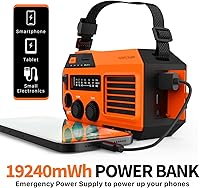
  • Battery Capacity: The internal power bank holds 5200mAh (rated as 19240mWh) of stored energy.
  • Charging Inputs: The radio accepts power via USB-C cable, built-in solar panel, hand crank lever, or standard AA batteries.
  • USB Output: A USB-A port on the unit allows external devices such as phones or small gadgets to draw charge from the internal battery.
  • Radio Bands: The tuner covers NOAA weather alert channels, standard AM broadcast bands, and standard FM broadcast bands.
  • Audio Output: A 3.5mm headphone jack provides private listening with improved sound clarity over the built-in speaker.
  • SOS Function: The SOS feature activates a loud audible siren combined with a strobe light for visual and audio signaling in emergencies.
  • Light Sources: Two independent LED lights are included: a forward-facing flashlight and a downward-facing reading lamp.
  • Battery Backup: The AA battery slot accepts standard AA batteries as an additional fallback power source when all other inputs are unavailable.
  • Color / Variant: This listing covers the Model A6 variant in Orange, designed for high visibility in emergency situations.
  • Warranty: FosPower covers this model with a limited lifetime warranty supported by a US-based customer service team.
  • Included Items: The package contains the radio unit and an owner’s manual; AA batteries are not included.
  • Brand: FosPower is the manufacturer, a consumer electronics brand known primarily for emergency preparedness and power accessory products.

Related Reviews

FosPower Emergency Weather Radio A1
76%
88%
NOAA Reception Quality
74%
AM/FM Reception
58%
Hand Crank Charging
53%
Solar Panel Effectiveness
62%
Power Bank Output
More
Sttfaishen F20 Emergency Hand Crank Weather Radio
72%
82%
NOAA Alert Reception
54%
Battery Capacity & Honesty
61%
Hand Crank Usability
57%
Solar Charging Performance
83%
USB-C Charging Speed
More
QAUYYW Emergency Weather Radio XSY330
86%
89%
Battery Life
85%
Ease of Use
92%
Portability
75%
Radio Reception
88%
Build Quality
More
Roxicosly CR1009Ultra 12000mAh Emergency Weather Radio
74%
88%
Battery Life
91%
Charging Versatility
86%
NOAA Alert Performance
58%
Hand Crank Durability
44%
Solar Charging Speed
More
RAOUOEN 30000mAh Emergency Weather Radio
85%
89%
Battery Life & Charging
91%
Performance in Emergencies
75%
Portability & Weight
84%
Sound Quality & Reception
87%
Ease of Use
More
OnLyee CR1030 Emergency Weather Radio
76%
88%
Power Source Redundancy
83%
Hand Crank Durability
61%
Solar Charging Performance
79%
NOAA Reception Quality
67%
Battery Capacity & Phone Charging
More
TFTDOUP Emergency Weather Alert Radio
86%
88%
Overall Performance
85%
Battery Life
90%
Charging Options
80%
Ease of Use
87%
Build Quality
More
Leaton Emergency NOAA Weather Alert Radio
85%
88%
Battery Life & Charging Options
85%
Weather Alerts & Reception
90%
Build Quality & Durability
93%
Portability & Size
87%
Ease of Use
More
PRUNUS J-369 Emergency Weather Radio
84%
88%
Value for Money
93%
Power Options Flexibility
85%
Ease of Use
90%
SOS Alarm Effectiveness
80%
Battery Life
More
AXYEBI AB-US-107Y Emergency Weather Radio
75%
91%
Value for Money
82%
NOAA Signal Reception
88%
Flashlight Performance
63%
Build Quality & Durability
67%
Hand Crank Usability
More

FAQ

Realistically, the 5200mAh internal battery will deliver roughly one partial charge to a modern smartphone — think topping up a low battery rather than fully charging a depleted phone multiple times. It is best approached as emergency supplemental power, not a replacement for a dedicated power bank. Keep your phone's power-hungry apps closed during an outage to stretch every bit of available charge.

It is genuinely useful, but you need to set realistic expectations. Cranking for several minutes will add a small amount of power — enough to keep the radio running for a while, but not enough to meaningfully charge a phone. Think of the crank as a last-resort input for keeping the radio and lights operational when every other power source is exhausted, not as a convenient everyday charging method.

Indoors, the solar panel is largely ineffective unless you are placing it directly against a bright, south-facing window in strong sunlight. On overcast days outdoors, performance is significantly reduced. The solar input is best used as a slow trickle-charge supplement over several hours of direct outdoor sun, not as a quick top-up method.

Yes, the FosPower A6 5200mAh Emergency Weather Radio covers all seven standard NOAA weather radio frequencies. Reception quality in most areas is solid and is consistently one of the most praised aspects in buyer feedback. For the best signal, extend the antenna fully and position yourself near a window if you are indoors.
Yes, standard rechargeable AA batteries will fit and work in the battery slot. Keep in mind that rechargeable AAs typically deliver slightly lower voltage than alkaline cells, which may result in marginally shorter runtime, but the difference in a real-world emergency scenario is minor.

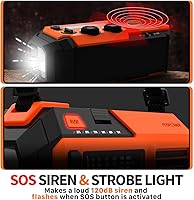
The siren is loud enough to carry clearly across a campsite or a multi-room building, and the simultaneous strobe adds a visual signal for low-visibility situations. It is not at the decibel level of a professional rescue beacon, but for alerting nearby searchers or signaling across an open field, it does the job without difficulty.

The flashlight projects forward, which makes it useful for navigating in the dark or lighting a path. The reading lamp faces downward, casting a softer, diffuse light that is easier on the eyes when you are sheltering in place, reading a map, or working at a table during a power outage. Having both in a single unit is genuinely practical.

The USB-C port is specifically for recharging the radio itself — it is the input port, and it is the fastest way to top up the internal battery before an emergency. The USB-A port on the unit is the output that you use to charge phones or other external devices. The two ports serve opposite functions, so it is worth noting which is which before you need to use either in a hurry.

For strong local FM stations, reception is clear and reliable. Where the hand-crank radio falls short is with weaker or more distant signals — AM sensitivity in particular can be hit or miss depending on your location and the surrounding interference. If you live in a rural area and depend on a specific AM station for emergency information, it is worth testing reception in your area before you actually need the radio.

FosPower backs this unit with a limited lifetime warranty and handles support through a US-based team. In practice, warranty terms vary by situation, so it is worth registering your purchase and keeping proof of purchase on hand. The warranty is a meaningful differentiator compared to generic emergency radios sold without any meaningful post-sale support.

Where to Buy