Overview

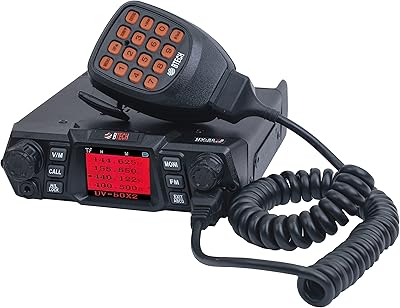
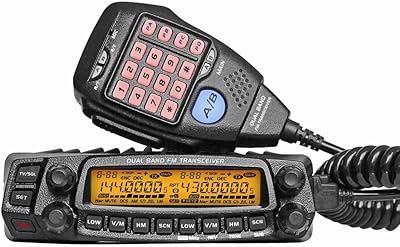
The QYT KT-980PLUS Dual Band Mobile Ham Radio enters a competitive mid-range market as a capable transceiver built for licensed ham operators who spend time on trails or behind the wheel. QYT has quietly built a following among budget-conscious radio enthusiasts, and this mobile ham radio reflects that value-first philosophy. One thing worth flagging upfront: no antenna is included in the box, which surprises more buyers than it should — budget for one separately before your first transmission. FCC-certified for both personal and business use, the KT-980PLUS carries legitimate credentials. Its quad-standby four-display layout genuinely sets it apart from similarly priced alternatives in the mobile transceiver space.
Features & Benefits

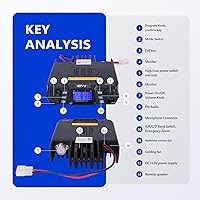
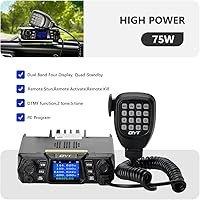
On paper, the KT-980PLUS punches above its weight in output power — up to 75W on VHF and 55W on UHF, though real-world measured output may fall short of those spec-sheet figures, so take them with a grain of salt. The four simultaneous display screens let you keep tabs on multiple channels without constantly switching views, which is genuinely useful during group runs or emergency monitoring. With 200 programmable channels and support for CTCSS, DCS, DTMF, and both 5-Tone and 2-Tone signaling, this dual band transceiver handles most coordination scenarios you would encounter. Repeater compatibility is a real asset for anyone operating in mountainous terrain where direct range falls short. The included kit — microphone, DC cable, bracket, and programming cable — gets you most of the way to a working installation.

Best For

This mobile ham radio is built for a specific kind of operator — one who holds a valid ham license and needs a dependable vehicle-mounted station for overlanding, trail coordination, or emergency preparedness. Off-road club members who rely on repeater networks to stay connected across long distances will find the range and signaling flexibility genuinely practical. It also makes sense as a cost-effective base station option for emergency prep enthusiasts who need wide VHF and UHF frequency coverage without spending premium prices. If you are monitoring multiple channels during a group event or coordinating across a large convoy, the quad-standby setup earns its keep. Just be clear: this radio is for licensed operators only and is not a plug-and-play solution for the general public.

User Feedback

With a 3.3-star average across 65 ratings, this dual band transceiver draws a genuinely divided response. Buyers who get it working well tend to praise audio clarity and how readable the displays are in varying light conditions. The friction starts with programming — the software is proprietary and incompatible with third-party tools, which frustrates experienced operators used to more open platforms. Build quality concerns appear often enough to be credible, and some users report that actual RF output does not match advertised wattage when tested with a wattmeter. Warranty and after-sale support experiences vary widely, adding real risk for buyers counting on backup if something fails. Customer service inconsistency is a recurring theme across forum discussions well beyond the product listing itself.

Pros

  • Dual band VHF and UHF coverage in a single compact unit keeps your dashboard uncluttered.
  • Quad-standby across four displays is a rare feature at this price point and genuinely useful for multi-channel monitoring.
  • Repeater compatibility significantly extends communication range in mountainous or remote terrain.
  • 200 programmable channels with CTCSS, DCS, and DTMF support covers most real-world coordination needs.
  • The included kit — microphone, mounting bracket, DC cable, and programming cable — makes initial installation straightforward.
  • FCC certification adds a layer of credibility and confirms legal compliance for personal and business use.
  • Audio clarity in favorable conditions draws consistent praise from buyers who get the unit properly installed.
  • LCD display with selectable backlight colors reads clearly across different lighting environments.
  • High advertised output wattage offers potential range advantage over lower-powered competitors in the same tier.
  • At its price, the feature-to-cost ratio is competitive for operators willing to invest time in setup.

Cons

  • No antenna is included, which adds an unexpected extra cost that many buyers discover too late.
  • Proprietary programming software blocks use of popular third-party tools, frustrating experienced operators.
  • Measured RF output frequently falls short of the advertised 75W VHF and 55W UHF figures.
  • Build quality concerns appear consistently enough across user reports to suggest durability risks over time.
  • Zero water resistance makes this a questionable choice for any exposed or outdoor vehicle mounting situation.
  • Warranty support and customer service responsiveness have been described as unreliable by multiple buyers.
  • Programming complexity creates a steep learning curve for operators new to Chinese-brand mobile radios.
  • A 3.3-star average rating across verified purchases signals a higher-than-average rate of buyer dissatisfaction.
  • No VOX functionality limits hands-free operation options for drivers who prefer voice-activated transmission.
  • Incompatibility with third-party software means future firmware or channel updates depend entirely on QYT support.

Ratings

Our AI-generated scores for the QYT KT-980PLUS Dual Band Mobile Ham Radio were produced by analyzing verified global buyer reviews, actively filtering out incentivized, bot-generated, and outlier feedback to surface what real operators actually experience day to day. The ratings below reflect both the genuine strengths that keep satisfied users coming back and the recurring pain points that have driven the radio's polarizing 3.3-star average. Nothing here is softened — if a category underperforms, the score shows it.
Value for Money
71%
29%
For operators on a tight budget, the KT-980PLUS offers a feature set — quad-standby, dual band, 200 channels, repeater access — that would cost significantly more from an established brand. Many buyers feel the out-of-box hardware justifies the spend when everything works as expected.
The value calculation gets murkier once you factor in the separately purchased antenna, potential software frustrations, and the risk of inconsistent output power. Buyers who hit problems early often feel the savings were not worth the trouble.
Output Power
58%
42%
On paper, the rated 75W VHF and 55W UHF figures are genuinely competitive for a mobile radio at this price tier, and operators in open terrain with a well-matched antenna do report noticeably better range than entry-level alternatives.
A recurring complaint across user communities is that actual measured output — verified with a wattmeter — consistently falls short of advertised specs. For operators depending on maximum range in emergency situations, that discrepancy is more than a minor inconvenience.
Programming Experience
39%
61%
The radio does ship with a programming cable and proprietary QYT software, so the pathway to getting channels loaded exists without additional purchases. Users who are already familiar with Chinese-brand radio software tend to get through setup without major issues.
Incompatibility with CHIRP and other third-party tools is a significant friction point for the majority of experienced ham operators. The proprietary software has been described as unintuitive, and the manual provides only basic guidance, leaving many users hunting for third-party tutorials just to complete a basic channel load.
Display Readability
83%
The large LCD with selectable backlight colors is one of the most consistently praised aspects of this radio. Operators using it during dawn trail runs or in dimly lit vehicles report that channel and frequency information stays clearly legible without straining.
A small number of buyers have noted that the backlight uniformity can be inconsistent across the four display zones, and a few long-term users have flagged early backlight dimming after extended daily use in hot vehicle environments.
Quad-Standby Functionality
78%
22%
Being able to monitor four channel slots simultaneously — across both VHF and UHF bands — is a genuine operational advantage during group off-road runs or emergency net monitoring. Users coordinating across multiple repeaters in real time find this feature genuinely practical rather than just a spec-sheet highlight.
A few operators note that the quad-standby interface takes time to configure intuitively and can feel cluttered on the display for users coming from simpler dual-watch radios. The benefit is real, but it comes with a learning investment.
Audio Clarity
76%
24%
Received audio quality on both VHF and UHF is regularly cited as a positive by buyers who got the unit properly installed with a good antenna. In vehicle environments, the speaker volume is adequate without distortion at moderate output levels.
A portion of users report that audio quality degrades noticeably on weaker signals and that the built-in speaker can sound thin compared to external speaker setups. Those operating in high-noise vehicle cabins often find an external speaker is effectively required.
Build Quality
47%
53%
The chassis dimensions and overall layout are practical for vehicle mounting, and the unit feels reasonably solid initially. Buyers who use it in stable, temperature-controlled vehicle installs tend to report fewer physical durability complaints.
Build quality is one of the most cited disappointment areas in user reviews. Complaints cover loose knobs, plastic components that feel brittle under regular handling, and concerns about long-term reliability in the vibration-heavy environments these radios are marketed toward.
Repeater Compatibility
81%
19%
The KT-980PLUS handles repeater offset and tone programming well once configured, and operators in areas served by strong local amateur repeater networks report reliable access that significantly extends their practical communication range beyond simplex limits.
Getting repeater tones and offsets programmed correctly is part of the broader software frustration — users who struggle with the programming interface may never fully leverage this feature. There is no simplified repeater auto-setup mode.
Antenna Omission Transparency
31%
69%
The product documentation does technically disclose that no antenna is included, so the information is not hidden. Buyers who read purchase details carefully arrive prepared and budget for a compatible dual band mobile antenna before installation.
In practice, a significant portion of buyers feel blindsided at unboxing, and the omission is frequently cited as a source of frustration in reviews. For a radio marketed to newer operators, the absence of even a basic whip antenna represents a real barrier to first use.
Scanning Performance
69%
31%
The built-in VHF and UHF scanning receiver gives this dual band transceiver a passive monitoring advantage over single-band alternatives. Off-road users who want to scan local channels while sitting on a primary frequency appreciate having that capability built in.
Scan speed and squelch sensitivity during scanning have drawn some criticism, with a handful of operators noting that the scanner misses brief transmissions or hangs on noise. It functions, but it is not the most refined scanning implementation at this price tier.
Included Accessories
72%
28%
The package includes a DTMF-equipped microphone, a DC power cable, a mounting bracket with hardware, and a programming cable — a reasonably complete installation kit that covers the core bases without requiring immediate additional purchases beyond the antenna.
The quality of the included accessories is average at best. The microphone cable and DC power cable have drawn comments about feeling thin and prone to wear, and some buyers have replaced both within the first few months of regular use.
Warranty & Support
36%
64%
A one-year limited warranty is offered, which is a standard assurance for a radio at this tier and does provide some recourse for buyers who experience defects within the coverage window.
Real-world warranty and support experiences are deeply inconsistent based on buyer accounts. Slow response times, difficulty reaching support, and unresolved claims are common enough themes across user feedback to make the warranty feel less reliable than its nominal coverage period suggests.
Ease of Installation
67%
33%
The included mounting bracket is compatible with most standard vehicle dash and console positions, and the compact form factor gives installers some flexibility in finding a workable mounting spot. Basic DC wiring is straightforward for anyone with vehicle electrical experience.
Users without prior experience wiring vehicle accessories have reported uncertainty around fusing, cable routing, and antenna coax connections. The manual's installation guidance is minimal, and without supplemental resources, the process can feel more involved than expected.
Frequency Coverage
79%
21%
Receive coverage spanning 136–174 MHz VHF and 400–480 MHz UHF is broad enough to pick up a wide variety of amateur, public service, and commercial signals passively, which adds genuine utility beyond the licensed transmit bands for monitoring purposes.
Transmit is locked to the standard amateur allocations — 144–148 MHz and 420–450 MHz — which is entirely correct and expected, but operators hoping for expanded or commercial transmit capability will find those doors closed by design and regulation.

Suitable for:

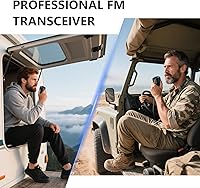
The QYT KT-980PLUS Dual Band Mobile Ham Radio is a practical fit for licensed amateur radio operators who want a capable, high-wattage mobile station without paying premium brand prices. Overlanders and off-road enthusiasts who run in groups will appreciate the repeater compatibility, which keeps communication alive across long distances and uneven terrain where direct radio-to-radio range falls short. The quad-standby design makes it especially useful for anyone who needs to monitor several frequencies at once — think trail leaders coordinating a convoy or emergency preparedness volunteers tracking multiple nets simultaneously. Off-road club members who already work within an established repeater network will find the signaling options thorough enough to cover most coordination scenarios. It also works reasonably well as a fixed base station for home emergency prep setups, provided you pair it with a quality external antenna and a stable 13.8V DC power supply.
Not suitable for:

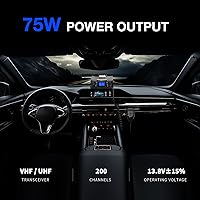
The QYT KT-980PLUS Dual Band Mobile Ham Radio is not a good fit for unlicensed buyers — transmitting on ham frequencies without an FCC-issued amateur license is illegal, and this radio offers no simplified workaround for general public use. Anyone expecting plug-and-play programming will likely run into frustration quickly, since the software is proprietary and incompatible with popular third-party tools like CHIRP, making channel setup a steeper learning curve than comparable radios. Operators who need verified, wattmeter-confirmed output power for contest or emergency communications should be cautious, as real-world RF output has been reported to fall below the advertised spec-sheet figures. Buyers working in wet or harsh outdoor environments should also look elsewhere — this unit carries no water resistance rating whatsoever, which is a real limitation for exposed vehicle mounting. Finally, anyone who values responsive manufacturer support or a reliable warranty process may find the inconsistent after-sale experience a dealbreaker, particularly if something fails outside a convenient return window.
Specifications

  • Brand: This mobile transceiver is manufactured by QYT, a Chinese brand known for producing budget-to-mid-range amateur radio equipment with a growing international user base.
  • Model: The specific model designation is KT-980PLUS, distinguishing it from other radios in the QYT lineup such as the KT-8900 and KT-9900.
  • Output Power: Rated transmit power is up to 75W on VHF and 55W on UHF, though real-world measured output may vary from these published figures.
  • Receive Range: The built-in scanning receiver covers 136–174 MHz on VHF and 400–480 MHz on UHF for passive monitoring across both bands.
  • Transmit Range: Licensed transmit frequencies are limited to 144–148 MHz on VHF and 420–450 MHz on UHF in compliance with FCC regulations.
  • Channels: The radio supports up to 200 programmable memory channels, allowing operators to store and quickly access frequently used frequencies.
  • Signaling: Supported signaling formats include CTCSS, DCS, DTMF, 5-Tone, and 2-Tone, covering the most common coordination and access tone systems in amateur and business radio use.
  • Display: A large LCD screen with selectable backlight colors provides channel and status readability across a wide range of ambient lighting conditions.
  • Standby Mode: Quad-standby operation across four simultaneous display readouts allows the operator to monitor multiple channel pairs without manually switching views.
  • Dimensions: The radio body measures 6.77″ deep by 5.51″ wide by 1.69″ tall, making it compact enough for most standard vehicle dash or console mounting positions.
  • Weight: The unit weighs approximately 3.83 pounds without an antenna, which is typical for a mobile transceiver of this output power class.
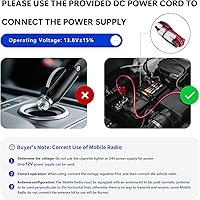
  • Voltage: The KT-980PLUS requires a stable 13.8V DC power supply, consistent with standard 12V vehicle electrical systems when the engine is running.
  • Water Resistance: This radio carries no water resistance or weatherproofing rating and should not be exposed to moisture, rain, or high-humidity environments.
  • In the Box: Each unit ships with one microphone with DTMF keypad, one DC power cable, one mobile mounting bracket with hardware, one programming cable, and one printed user manual.
  • FCC Certification: The KT-980PLUS holds FCC ID 2AV62KT-980PLUS, authorizing its use for both personal amateur radio operation and licensed business radio applications in the United States.
  • Warranty: QYT provides a one-year limited warranty on the KT-980PLUS, though buyer experiences with warranty claims and support responsiveness have been reported as inconsistent.
  • Antenna: No antenna is included with the radio; operators must purchase a compatible external VHF/UHF mobile antenna separately before the unit can be used for transmission.
  • Repeater Use: The radio supports repeater offset operation, enabling it to access local amateur repeater networks and significantly extend effective communication range in challenging terrain.

Related Reviews
QYT KT-8900 Dual Band Mobile Radio
74%
91%
Value for Money
83%
Audio Clarity
78%
Ease of Programming
63%
Build Quality
74%
RF Performance
More
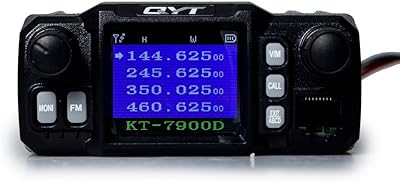
Retevis RT95 Dual Band Mobile Ham Radio
77%
88%
Audio Clarity
67%
Ease of Programming
91%
Display & Readability
86%
Value for Money
74%
Build Quality
More
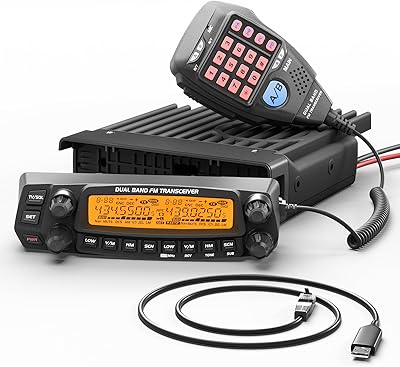
QYT KT-7900D Quad Band Ham Radio
72%
83%
Value for Money
91%
Band Coverage
58%
Ease of Programming
77%
Receive Audio Quality
61%
Transmit Audio Quality
More
AnyTone AT-778UV Dual Band Mobile Radio
79%
83%
Build Quality
88%
Audio Clarity
86%
Dual-Band Coverage
79%
Display & Interface
51%
Programming Software
More
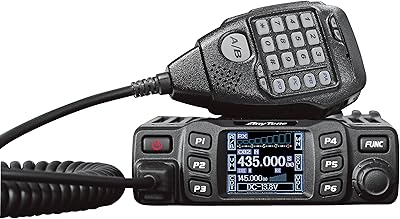
Radioddity DB50 Dual Band Mobile Radio Transceiver
79%
88%
Transmit Power & Range
91%
Receiver Coverage
86%
Audio Clarity
84%
Channel Management
89%
Chirp Compatibility
More
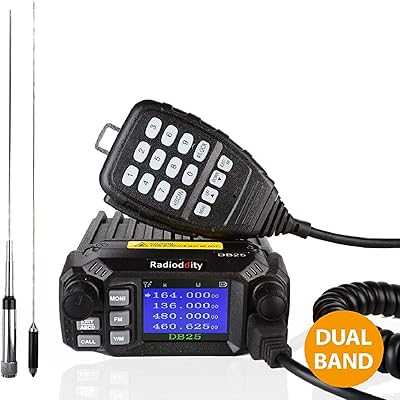
BTECH UV-50X2 Second Gen Mobile Radio
73%
88%
Transmission Performance
84%
Audio Clarity
79%
Build Quality
51%
Ease of Setup
47%
User Interface & Menu
More
Radioddity DB25 Pro Dual Band Mini Mobile Radio
88%
91%
Value for Money
87%
Signal Reception
89%
Ease of Use
92%
Display Quality
84%
Durability
More
Icom IC-2730A Dual Band VHF/UHF Mobile Radio
78%
93%
Transmit Power
91%
Dual-Band Receive
88%
Build Quality
89%
Audio Clarity
54%
Menu Navigation
More
AnyTone AT-779UV Mini Size Dual Band Transceiver Mobile Radio
85%
88%
Performance
85%
Build Quality
90%
Ease of Setup
65%
Software Compatibility
87%
Power Output
More
AnyTone AT-5888UV Dual Band Mobile Radio
69%
83%
RF Performance
78%
Build Quality
86%
Value for Money
81%
Cross-Band Repeat
74%
Display & Interface
More

FAQ

No, it does not. This is one of the most common surprises buyers run into, so it is worth being clear: you will need to purchase a compatible dual band VHF/UHF mobile antenna separately. Do not attempt to transmit without one connected, as doing so can damage the final amplifier stage.

Yes, a valid FCC-issued amateur radio license is required to transmit on the frequencies this radio covers. It is not a license-free device like a GMRS or FRS walkie-talkie. If you are not licensed, you can still listen on the receive frequencies, but transmitting without a license is illegal.

Unfortunately, no. The KT-980PLUS uses proprietary QYT programming software and is not compatible with CHIRP or other popular open-source tools. This is one of the more frustrating limitations for experienced operators who are used to the flexibility of CHIRP. You will need to use QYT's own software along with the included programming cable.

You will need a regulated 13.8V DC power supply rated for at least 15 amps on VHF to support the full rated output. A good quality switch-mode or linear power supply in that current range is recommended. The radio itself does not come with a power supply, so budget for one if you are not mounting it in a vehicle.

The four-display layout lets you keep two VHF and two UHF channels visible and active simultaneously, so you can monitor different frequencies without constantly scrolling through menus. It is particularly useful on group trail runs where you might need to watch a club channel, a repeater input, a local calling frequency, and an emergency channel all at once.

Not always, based on what buyers have reported. A number of operators who tested output with a wattmeter found that actual RF power fell noticeably short of the published 75W VHF and 55W UHF figures. For casual use this may not matter much, but if accurate output is critical for your setup — such as emergency communications — it is worth verifying with your own equipment after purchase.

Yes, repeater operation is one of its more practical strengths. You can program repeater offsets and CTCSS or DCS tones into memory channels, which lets you key into local club or emergency repeaters without manual adjustment every time. This is especially valuable for operators in hilly or mountainous areas where direct simplex range is limited.

No, there is no water resistance rating on this unit at all. If you drive with the top off or expose the radio to rain and trail dust, you risk damaging it. For open-air or seriously off-road builds, you would be better served by a radio with at least some degree of environmental protection, or by mounting it in a well-sealed enclosure.

It depends on your experience level. If you have programmed other ham radios before, the learning curve is manageable but not trivial given the proprietary software. Complete beginners may find it genuinely frustrating at first. The included manual helps to a point, but many users end up relying on online tutorials and community forums to get everything configured correctly.

QYT offers a one-year limited warranty, but buyer experiences with the support process have been mixed based on community feedback. Some operators report straightforward resolutions, while others describe difficulty getting timely responses. If reliable post-purchase support is important to you, that inconsistency is worth factoring into your decision alongside the purchase price.

Where to Buy